ICD-10 Code S82.242H: Displaced spiral tibial shaft fracture, delayed healing
ICD-10 Code S82.242H: Definition and code details ICD-10 Code S82.242H designate...

Last Updated: Oct 15, 2026
Billable Code Specific Code
S22.49XD is the billable ICD-10-CM code for multiple fractures of ribs, unspecified side, subsequent encounter for fracture with routine healing.
It applies once active treatment has finished and the patient returns for follow-up while the fracture heals.
Two details in the note decide whether the code fits: the phase of care, and what imaging says about healing.
Let Pabau's smart automation suggest the right codes, reduce claim denials, and keep your practice compliant—effortlessly.
Automate repetitive tasks and focus on what matters most—your patients.
Reduce coding errors and ensure compliance with the latest regulations.
Clean claims, fewer denials, and faster reimbursements.
Powerful insights and reporting to help your practice thrive.
HIPAA compliant SOC 2 certified GDPR-compliant Trusted by 4,000+ clinics worldwide

S22.49XD is a billable ICD-10-CM code for multiple fractures of ribs, unspecified side, subsequent encounter for fracture with routine healing.
The 7th character D means active treatment has finished and the patient is in routine follow-up care while the fracture heals.
S22.49 accepts six 7th characters, so read the imaging report before you choose between D, G, and K.
Use S22.49XD only when laterality is undocumented; if the record specifies right or left side, use S22.41XD or S22.42XD instead.
Pabau’s claims management software integrates with Claim.MD to streamline ICD-10 claim submission, eligibility verification, and ERA processing for US practices.
S22.49XD is a valid, billable ICD-10-CM code for the 2026 edition, effective October 1, 2025. The table below summarizes the key attributes coders need at a glance.
Billable status means the code is specific enough to be submitted on a claim. Payer coverage and reimbursement rates vary by plan, provider contract, and clinical documentation, so billable status alone does not guarantee payment.
Each segment of the code string carries distinct clinical meaning. Breaking the code apart prevents misassignment and explains why a different digit in any position produces a completely different code.
The “unspecified side” designation in ICD-10 Code S22.49XD is a documentation flag, not a preference. When the clinical note specifies a side, the coder should query the provider or use the more precise sibling code rather than defaulting to unspecified.
The 7th character extension is where most fracture coding errors occur. For S22.49, six 7th character options exist, and the diagram below shows how the note narrows them to one. Selecting the wrong one is a frequent cause of preventable billing denial codes on trauma claims.
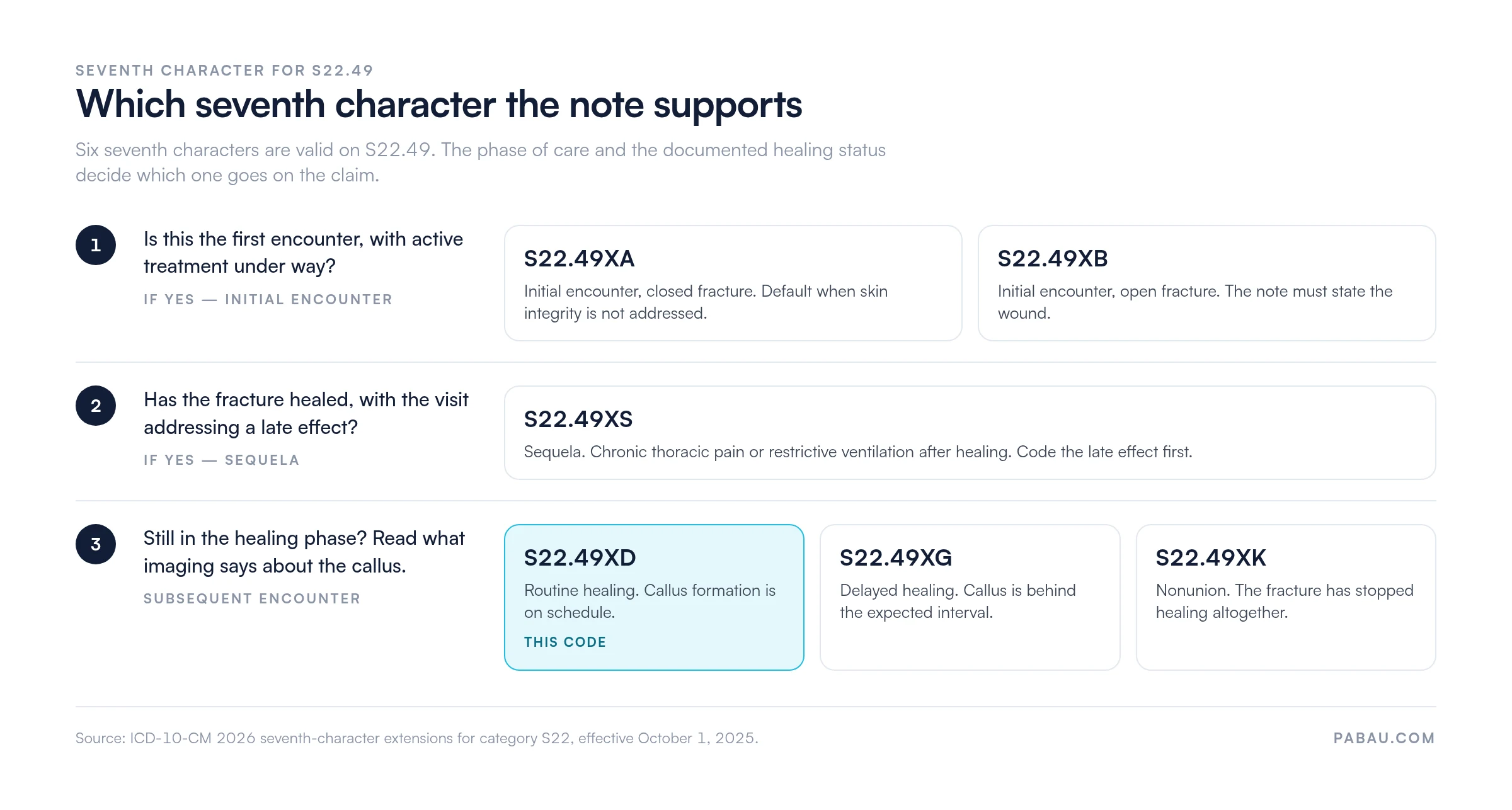
Each character maps to a phase of care and a healing status. The table sets them out with the full code string and the encounter that usually produces it.
The distinction between D, G, and K matters for more than accurate coding. When the provider documents delayed healing or nonunion, the clinical team should be prompted to reassess the treatment plan. Assigning D in either case masks a healing complication in the record.
Check the imaging report before you assign 7th character D to the claim. If the radiology note mentions fibrous union or inadequate callus at the expected healing interval, character D does not apply. Use G for delayed healing, or K where the report states nonunion, and flag the case for clinical review.
Understanding where ICD-10 Code S22.49XD sits in the classification tree helps coders navigate related codes and apply parent-code notes correctly. The full hierarchy runs as follows.
Parent code S22 carries instructional notes that apply to every code beneath it, including S22.49XD. The category note is a “code also” instruction. Report any associated intrathoracic organ injury, hemothorax, pneumothorax, or spinal cord injury from S24.- alongside the fracture code. Rib fracture codes carry no displaced or nondisplaced split, so that distinction never changes the character you select here.
S22.49XD is one member of a broader family of rib fracture codes. The table below covers the sibling codes most commonly encountered alongside it on trauma follow-up visits.
For bilateral rib fractures where both sides are fractured and documented, S22.43XD is the correct subsequent-encounter code. Do not use S22.49XD (unspecified side) when the record clearly states bilateral involvement.
Assigning the correct 7th character depends on two factors: the phase of care and the documented healing status. These are clinical determinations, not administrative ones, so the coder relies on what the provider writes in the note.
Subsequent encounter does not mean the patient is seen by a different provider. It refers to the phase of care. Consider a patient seen twice by the same emergency physician, once for initial treatment and once for a wound check. The second visit takes character D if healing is progressing normally.
The CMS ICD-10-CM Official Guidelines for Coding and Reporting govern how fracture codes are sequenced and assigned. For multiple rib fractures specifically, the following rules apply.
The aftercare-versus-subsequent-encounter rule is a consistent audit trigger. Practices that switch to Z-code aftercare early on fracture cases face payer pushback. The ICD-10-CM guidelines require the active fracture code throughout the healing phase.
Surgical stabilization during the initial phase is billed separately from the diagnosis. Check the earlier claim history for CPT code 21812 before you code the follow-up visit. A post-surgical course changes what the provider is likely to document.
Knowing the code definition is only half the job. The clinician’s note must carry specific elements before a coder can assign S22.49XD with confidence. Thin documentation on trauma follow-up visits is a leading cause of claim rework.
When laterality is missing from the note, the coder should query the provider before assigning S22.49XD rather than assume unspecified is correct. Query-and-correct is a standard step in compliant coding workflows, and it applies across all injury codes, not just rib fractures.
S22.49XD appears on claims for subsequent-phase rib fracture management across emergency medicine, orthopedics, pulmonology, and primary care. When submitting claims electronically, US practices use the 837P transaction format. Practice management software like Pabau integrates with the Claim.MD clearinghouse to route ICD-10-coded claims to thousands of US payers. The same workflow handles real-time eligibility verification and 835 electronic remittance advice.
S22.49XD claims come back with denial reasons tied to coverage limitations on fracture aftercare, or questions about medical necessity for a routine follow-up visit. Pairing the fracture code with the appropriate E/M level and a note documenting healing status addresses most medical-necessity denials on these claims.
Using streamlined claims management software that surfaces common denial patterns for fracture codes helps billing teams catch 7th character errors before submission rather than after. A built-in CPT and ICD-10 catalog validates the code-to-diagnosis pairing at submission. That is where a wrong 7th character is cheapest to fix.
When building a clean claim for a subsequent rib fracture encounter, include the treating provider’s notes on healing progress alongside the S22.49XD code. Payers audit subsequent-encounter fracture claims for clinical rationale. A one-line note reading ‘healing progressing as expected per X-ray dated [date]’ answers that question before it is asked.
The ICD-10-CM alphabetical index maps several clinical terms to S22.49XD. Coders who search by clinical terminology rather than code number should recognize these equivalent expressions, which are cross-referenced in AAPC’s ICD-10-CM code lookup.
None of these synonyms appear on the claim itself. They serve as index pathways into the code for coders using narrative-based lookups. The submitted code is always the alphanumeric string S22.49XD.
Practices that build condition-specific coding templates can add these synonyms to an internal reference sheet. That cuts lookup time on high-volume trauma follow-up days, when the same five phrasings arrive from five different providers.
The 7th character is usually chosen at the end of the day, from a note the coder reads without the provider in the room. If the healing status is vague or the side is missing, the claim still goes out. The denial arrives weeks later, and by then the visit is hard to reconstruct.
Pabau puts the coding step next to the record it depends on. Diagnosis codes are selected against the treatment note in the patient’s own file, so laterality and healing status are visible while the code is picked. The claim then goes to Claim.MD from the same screen, with eligibility checked in advance and ERAs posted back automatically.
For a billing team working trauma follow-ups, that changes where the error surfaces. A missing healing status becomes a question for the provider today, not a denial to appeal next month. Every subscription includes the full claims workflow.

Pabau’s claims management connects diagnosis coding, eligibility checks, and ERA posting through the Claim.MD clearinghouse. Your team codes against the treatment note, so fracture claims leave the practice complete.

S22.49XD fits a narrow set of circumstances. The encounter is a follow-up, the imaging supports routine healing, and the record never names a side. Change any one of those and the code changes with it.
The judgment worth carrying away is that unspecified laterality is a finding about the note, not about the patient. A query today costs a phone call. Coding around the silence costs a denial, an appeal, and a chart that no longer explains itself.
Book a demo to see how Pabau validates ICD-10 codes at submission and keeps rib fracture follow-ups off your denial list.

Coding a left-sided multiple rib fracture? ICD-10 code S22.42XG covers the follow-up visit where laterality is documented and healing is delayed.
Need the same logic for another fracture site? ICD-10 code S82.863D works through the seventh-character decision for a Maisonneuve fracture.
Want to reduce claim denials on musculoskeletal cases? Denial codes in medical billing explains the most common CARC codes affecting injury claims.
Exploring clearinghouse options for your US practice? Medical claims clearinghouse guide walks through how clearinghouses validate and route 837P claims.
ICD-10 Code S22.49XD is a billable diagnosis code for multiple fractures of ribs, unspecified side, subsequent encounter for fracture with routine healing. The 7th character D indicates the patient has completed active treatment and is receiving routine follow-up care during the healing phase. The unspecified side designation applies only when laterality is not documented in the clinical record.
Yes. S22.49XD is a billable, specific ICD-10-CM code for the 2026 edition, effective October 1, 2025. Billable status means it is specific enough to appear on a claim for reimbursement; actual payment depends on payer coverage policies and supporting documentation.
S22.49XA is the initial encounter code, used when the patient presents for the first active treatment of multiple rib fractures (unspecified side, closed). S22.49XD is the subsequent encounter code, used for follow-up visits once active treatment is complete and the fracture is healing normally. The clinical phase of care, not the visit count, determines which applies.
Use 7th character D (S22.49XD) when the clinical note and imaging confirm the fracture is healing as expected. Use G (S22.49XG) when the provider documents delayed healing or insufficient callus formation. Use K (S22.49XK) when the report states nonunion. The determination rests on documented clinical findings, not on how many visits have occurred.
When both sides are fractured and the documentation confirms bilateral involvement, use S22.43XD for the subsequent encounter with routine healing. Do not use S22.49XD (unspecified side) when bilateral is documented; S22.49XD is reserved for cases where laterality is genuinely not stated in the record.
Subsequent encounter (7th character D or G) is used while the fracture is still in the healing phase, whether healing normally or with complications. Sequela (7th character S) is used after the fracture has fully healed. It covers visits for a late effect of the injury, such as chronic intercostal pain or residual chest wall deformity. Sequela coding requires the code for the late effect to be sequenced first.