ICD-10 Code S53.013D: Anterior subluxation of unspecified radial head
ICD-10 Code S53.013D: Quick reference summary Use the table below as your first ...

Last Updated: Nov 6, 2026
Billable Code Specific Code
V95.42XA is the billable ICD-10-CM code for forced landing of spacecraft injuring occupant, initial encounter. It records how an injury happened when a spacecraft is forced to land and a person aboard is hurt, at a visit for active treatment.
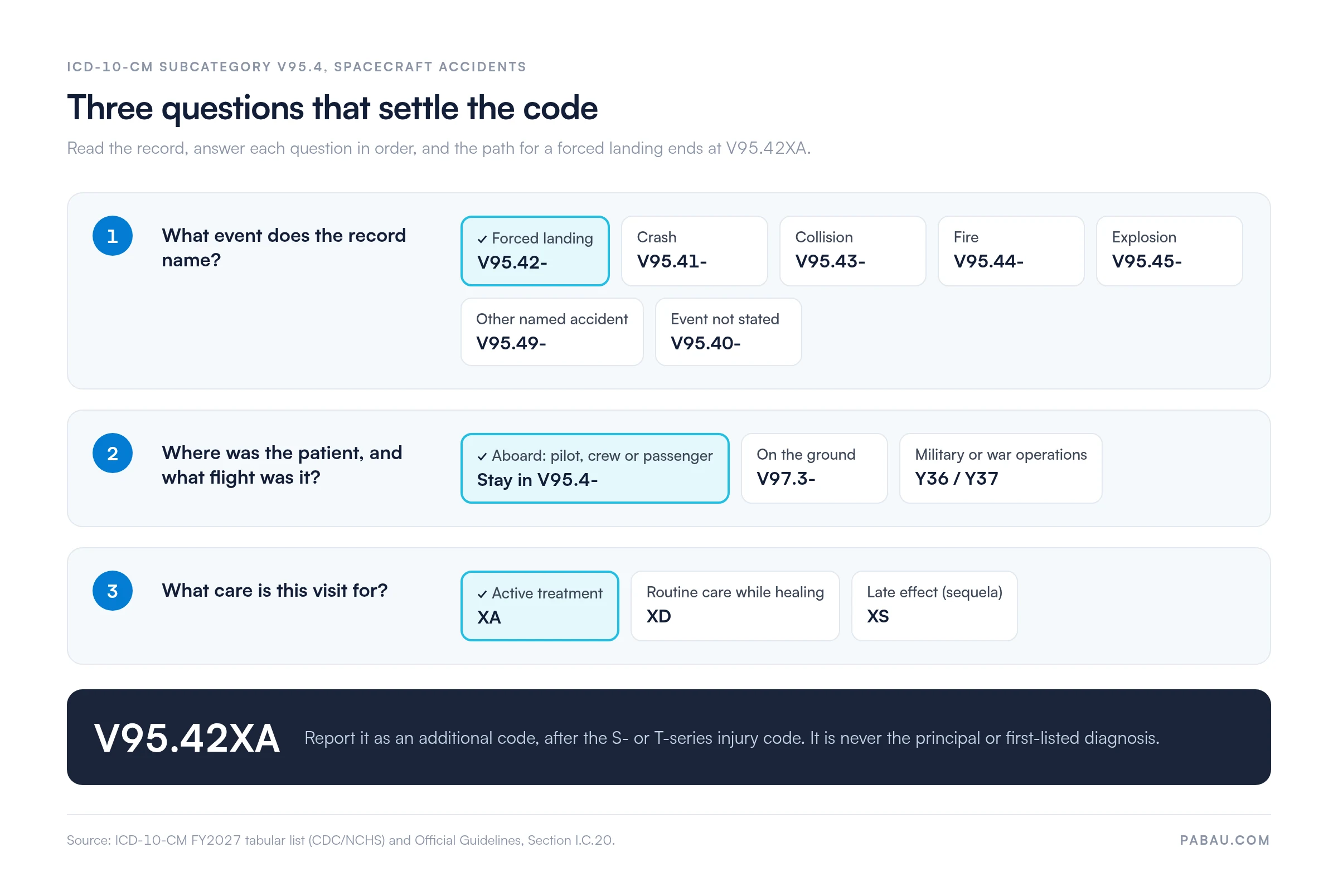
The code is always reported after the injury code, never as the principal diagnosis, and the X placeholder must stay in the sixth position. The fifth character names the event: a forced landing is V95.42, while a crash is V95.41 and a collision V95.43. A routine follow-up after active treatment takes V95.42XD instead.
Let Pabau's smart automation suggest the right codes, reduce claim denials, and keep your practice compliant—effortlessly.
Automate repetitive tasks and focus on what matters most—your patients.
Reduce coding errors and ensure compliance with the latest regulations.
Clean claims, fewer denials, and faster reimbursements.
Powerful insights and reporting to help your practice thrive.
HIPAA compliant SOC 2 certified GDPR-compliant Trusted by 4,000+ clinics worldwide

V95.42XA codes an injury to a spacecraft occupant caused by a forced landing, at the visit where active treatment begins.
A forced landing is not a crash: a spacecraft crash is V95.41XA, a collision V95.43XA and a fire V95.44XA.
It is an external cause code, so the injury code goes first and V95.42XA can never be the principal diagnosis.
The X in the sixth position is a required placeholder, and V95.42A without it is an invalid code that payers reject.
ICD-10 Code V95.42XA is the official ICD-10-CM code for “forced landing of spacecraft injuring occupant, initial encounter.”
It belongs to Chapter 20 (External causes of morbidity) of the ICD-10-CM classification, as published on the CMS ICD-10 codes page. The code captures how the injury happened, a spacecraft forced to land, rather than the injury itself.
“Occupant” covers the pilot, crew members, and any passengers aboard the spacecraft at the time of the landing. The fifth character, 2, is what separates a forced landing from its siblings in subcategory V95.4. A spacecraft crash is V95.41, a collision is V95.43, a fire is V95.44 and an explosion is V95.45. Nonpowered aircraft follow the same split in V96, where a balloon collision at the initial encounter is ICD-10 code V96.03XA.
Each character in V95.42XA carries a specific meaning. Knowing the structure helps coders spot errors before submission, and it explains why the X placeholder cannot be dropped.
The X in the sixth position is a placeholder. ICD-10-CM puts the encounter type in the seventh character, but subcategory V95.42 only has five characters. The X fills the sixth slot so the A lands in seventh place. Submitting “V95.42A” without it produces an invalid code that payers reject outright.
V95.42XA applies to one type of spacecraft accident. Knowing its boundaries prevents two common errors. One is reaching for a sibling code when the record says forced landing. The other is assigning V95.42XA when the record describes a different event. Three questions about the record settle which code applies, in this order.
The 7th character is the most commonly misapplied element of the V95.42 subcategory. The ICD-10-CM Official Guidelines for Coding and Reporting define each encounter type, and payers apply those definitions when auditing claims.
Each encounter takes the 7th character that matches the patient’s status at that visit. A patient seen in the emergency department on the day of the landing is coded XA. If they return six weeks later for a wound check, that visit is coded XD. The guidelines tie “active treatment” to the care being given, not to the days since the event.
V95.42XA is an external cause code. Under ICD-10-CM Official Guidelines Section I.C.20, external cause codes describe the event that caused the injury. They can never be the principal or first-listed diagnosis, so the injury code always comes first.
The correct claim sequencing follows three steps:
There is no national requirement to report external cause codes. Guideline I.C.20 makes them required only where a state-based reporting mandate or a particular payer calls for them. Everywhere else, it encourages voluntary reporting.
Many state injury databases and payers do want them on trauma claims, so check your payer’s policy before you leave them off. Our guide to the medical billing process follows a claim like this one from encounter to payment.
Run a sequencing check on every trauma claim before submission. Confirm that the first-listed code is an S- or T-series injury code, not V95.42XA. An external cause code in the first diagnosis position trips a code edit at Medicare and most commercial payers.
The medical record must give a coder what they need to confirm the code without inference. Vague phrases such as “aviation accident” or “transport injury” are not enough. The record should state:
The CDC/NCHS ICD-10-CM browser tool shows one exclusion note that reaches V95.42XA from the V95-V97 block. Military aircraft accidents in military or war operations go to Y36 and Y37 instead.
Name the event in the history of present illness. “Patient was aboard a spacecraft that made a forced landing” supports the code, while “transport accident” does not.
If the note only says the spacecraft “came down hard,” query the provider. The answer decides between a forced landing (V95.42) and a crash (V95.41), and coders should not choose between them on their own.
Every code in subcategory V95.4 describes a spacecraft accident injuring an occupant, so the descriptors look alike. The table lists the codes most often picked in error and a decision rule for each.
The AAPC Codify ICD-10-CM lookup shows the full V95 hierarchy, which helps when checking which subcategory fits the documented event.
The denial patterns for V95.42XA follow the same structure seen across Chapter 20 external cause codes. Each one has a specific corrective action.
Systematic denial management workflows for trauma claims should include a pre-submission check. It confirms that external cause codes sit in an additional diagnosis position and that the placeholder is intact.
V95.42XA never stands alone on a claim. A complete trauma claim carries the injury codes first, then the external cause codes that explain them. The injury codes that lead the claim come from the S- and T-series of the ICD-10-CM codes library.
Check code values against the ICD List lookup tool, which mirrors the official CMS and NCHS data. Getting the sequencing, the placeholder, and the payer’s external cause rules right is what turns this claim into a clean claim on first submission.
Section I.C.20 of the ICD-10-CM Official Guidelines for Coding and Reporting governs every Chapter 20 code, including V95.42XA. Beyond the sequencing rule above, these are the points coders should have at hand:
The CMS ICD-10-CM annual update files publish these guidelines each fiscal year. Always reference the current release, because guideline language can change.
When a forced landing causes several injuries, code each one separately before adding V95.42XA. Do not fold them into a single unspecified trauma code to simplify the claim. Each specific injury code supports medical necessity for its own line of service.
Rare codes like V95.42XA are where coding errors hide. A coder who sees one once a year has to look up the subcategory, count the characters, and remember the sequencing rule. When any of those slips, the error only shows up weeks later as a denial.
Pabau, the practice management platform we build, keeps the clinical note, the diagnosis codes, and the claim in one patient record. Its claims management software lets your team enter ICD-10-CM injury and external cause codes against the encounter. Claims then go out through a clearinghouse, which checks them against payer edits before submission.
So fewer claims come back for avoidable reasons, and your billing team spends less time reworking them.

Pabau keeps encounters, diagnosis codes, and claims in one place, and sends claims through a clearinghouse that checks them before they reach the payer. See how practices use Pabau to cut avoidable denials.

V95.42XA is one of the more precise codes in Chapter 20. It has a single X placeholder, a specific accident type, and an encounter type that must match the treatment phase. The descriptor is where errors start, because a forced landing and a crash sit one character apart.
Read the record for the words that name the event, and let those words choose the fifth character. When the note is vague, a provider query costs far less than a denied claim. To see how Pabau keeps coding and claims together for your practice, book a demo.

Need to understand how claims move from code to payment? What is revenue cycle management covers the end-to-end process from charge capture through reimbursement.
Working through a denial on a trauma claim? Denial codes in medical billing explains the most common CARC and RARC combinations and how to respond to each.
Choosing how your claims reach payers? Claim.MD clearinghouse overview explains how Pabau’s clearinghouse partner processes ICD-10-coded claims and ERA responses.
V95.42XA is the ICD-10-CM external cause code for forced landing of spacecraft injuring occupant, initial encounter. It is used at active-treatment visits when a spacecraft forced landing injures a person aboard. It belongs to Chapter 20 (External causes of morbidity) and cannot be reported as a principal diagnosis.
Both codes cover a spacecraft accident that injures an occupant, at the initial encounter. V95.41XA is a spacecraft crash, while V95.42XA is a forced landing of a spacecraft. Code the event the record names, and query the provider if the note does not make the difference clear.
No. V95.42XA is an external cause code and can never be the principal or first-listed diagnosis on a claim. Sequence the injury code first, such as a fracture, head injury, or burn code, then report V95.42XA as an additional code.
All three describe the same forced landing at different points in care. V95.42XA applies while the patient receives active treatment. V95.42XD applies to routine follow-up visits after active treatment ends. V95.42XS applies when treating late effects of the original injuries, such as chronic pain or scar revision.
There is no national requirement to report external cause codes. Guideline I.C.20 makes them required only under a state-based reporting mandate or a payer policy, and it encourages voluntary reporting otherwise. Check the payer’s companion guide and your state’s rules before you decide.
The record must state that the event was a forced landing of a spacecraft and that the patient was aboard. It must also show that this visit is for active treatment and list the specific injuries. Vague terms such as aviation incident or transport injury are not enough to defend the code at audit.