ICD-10 Code S42.444P: Medial epicondyle fracture, right humerus
ICD-10 Code S42.444P: full descriptor and code validity ICD-10 Code S42.444P car...

Last Updated: Oct 13, 2026
Billable Code Specific Code
V95.21XA is the billable ICD-10-CM code for other private fixed-wing aircraft crash injuring occupant, initial encounter.
Coders reach for it after treating pilots or passengers of non-commercial, non-helicopter fixed-wing aircraft such as Cessnas, Pipers and Beechcrafts. Three errors drive most denials on these claims. They are the wrong 7th character, a missing accompanying injury code, and confusion with the helicopter family (V95.01XA).
Let Pabau's smart automation suggest the right codes, reduce claim denials, and keep your practice compliant—effortlessly.
Automate repetitive tasks and focus on what matters most—your patients.
Reduce coding errors and ensure compliance with the latest regulations.
Clean claims, fewer denials, and faster reimbursements.
Powerful insights and reporting to help your practice thrive.
HIPAA compliant SOC 2 certified GDPR-compliant Trusted by 4,000+ clinics worldwide

ICD-10 code V95.21XA covers occupants of other private fixed-wing aircraft (not helicopters, not ultralights) injured in a crash on the first active treatment visit.
It is an external cause of morbidity code, so it must always be paired with a primary injury diagnosis code. It cannot stand alone.
The 7th character determines encounter type: A = initial, D = subsequent, S = sequela. Selecting D when A applies is a top denial trigger.
Pabau’s claims management software supports ICD-10-CM code entry and claim submission workflows to reduce coding errors at the point of documentation.
ICD-10 code V95.21XA reports an occupant of another private fixed-wing aircraft injured in a crash, at the first encounter for active treatment. It is billable for FY2026, but only as a supplement to the injury code that leads the claim.
The table below carries the descriptor, code type, and 7th-character rules you need to confirm the code at a glance. For the authoritative descriptor and annual validity status, cross-reference against the CDC/NCHS ICD-10-CM web tool.
“Other private fixed-wing aircraft” in ICD-10-CM refers to fixed-wing powered aircraft that are privately owned or operated. The term covers those not classified elsewhere in the V95 family. Knowing what falls in and out of scope prevents selecting the wrong subcategory.
Because V95.21XA belongs to Chapter XX (External causes of morbidity), it documents how the injury happened, not what the injury is. A traumatic brain injury coded alongside it uses the appropriate S-code, and a rib fracture uses its own S-code. The external cause code is always secondary.
V95.21XA uses A as its 7th character, which designates the initial encounter. That means the first visit at which the patient receives active treatment for the crash injuries. The 7th character is the most frequently miscoded part of this code family. Selecting D when A applies is consistently cited on remittance advices as a reason for denial.
A practical rule: If the patient walks into the emergency department directly from the crash scene, it is XA. If they return six weeks later for a follow-up x-ray, it is XD. If they present two years later with crash-related PTSD or a malunited fracture, it is XS.
Knowing the parent code tree shows coders why specificity matters, and where external cause codes behave differently from clinical diagnosis codes. You can browse the neighboring entries in our ICD-10-CM code library when the descriptor alone does not settle the choice. The CMS ICD-10 codes page publishes the annual tabular list update files where these hierarchies can be verified.
The “X” placeholder in the 6th position is structural. ICD-10-CM uses it when a code has fewer than 6 characters but requires a 7th-character extension. It carries no clinical meaning and must always be present.
The V95 family is where most aviation coding errors originate, because each subcategory maps to one aircraft type. Selecting V95.01XA when the patient was in a Cessna is a correctable error that still costs denial management time. Use the comparison table below to confirm the aircraft type before coding.
The key disambiguator between V95.01XA and V95.21XA is rotor versus fixed wing. A helicopter has rotating blades. A Cessna has wings. Any note that documents the aircraft type clearly will resolve the choice. When the documentation says only “small plane”, without the model or type, query the physician before coding.
V95.21XA is an external cause code with defined boundaries. Coding it outside those boundaries produces a clean-looking claim that a payer’s edit logic will still reject. Review the WHO ICD-10 browser for the parent-category excludes notes.
Check the ICD-10-CM Tabular List for any Excludes1 and Excludes2 notes under V95.2 before finalizing the code. Excludes1 notes mean the listed code can never be used with V95.21XA in the same encounter. Excludes2 notes mean the listed code may be used together when both conditions are documented.
Correct use of V95.21XA follows a five-step sequence. Skipping any step is the underlying cause of most aviation-related claim rejections.
The finished claim carries those codes in a fixed order. The diagram below shows which one leads, where V95.21XA falls, and which supporting codes are added only when the record documents them.
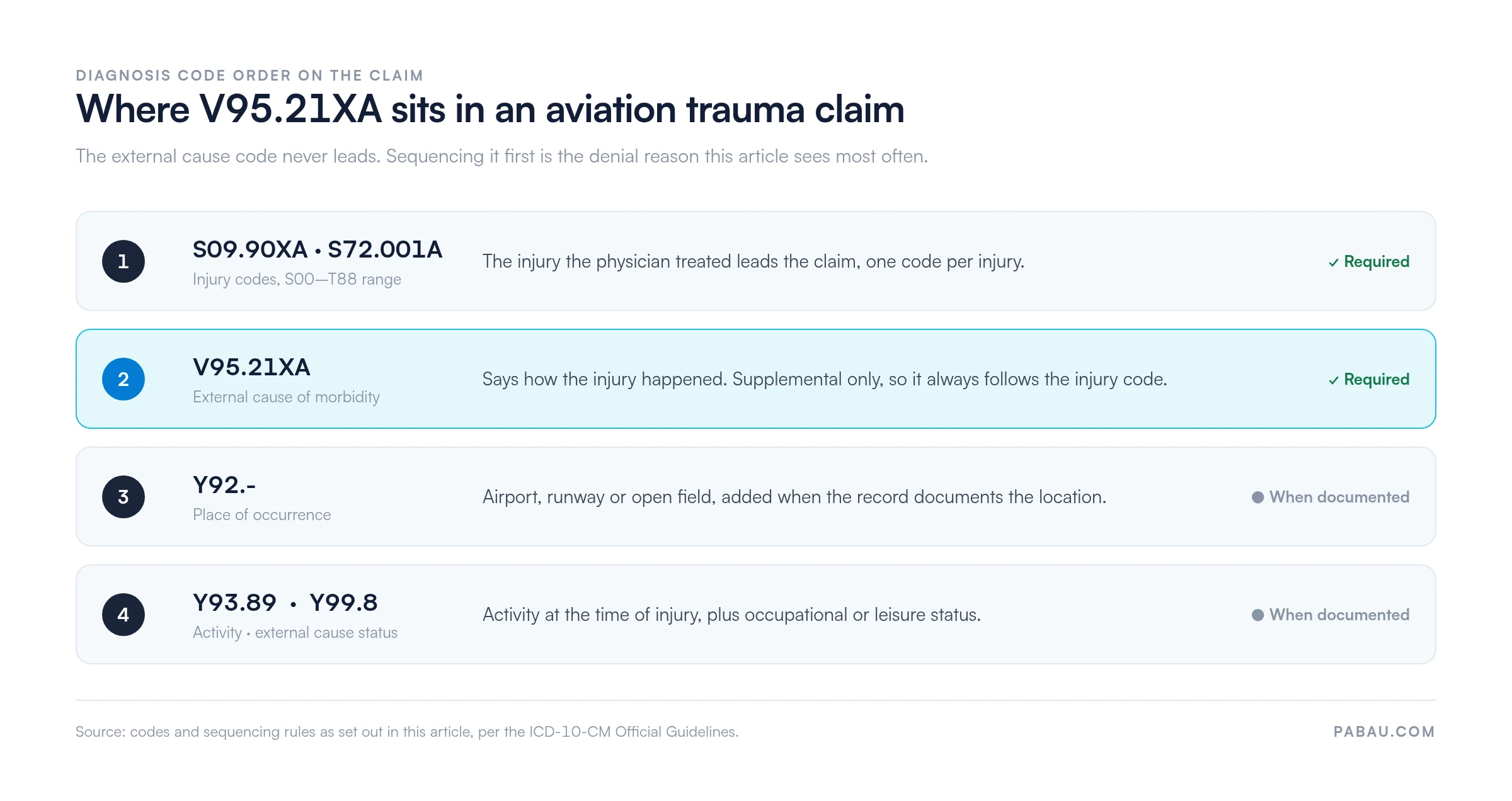
Submitting a clean claim with aviation external cause codes depends on having all five elements in place before the claim leaves the practice. Practice management software like Pabau flags missing required code fields during claim preparation, which reduces rework after a denial.
Payers treat V95.21XA as a supplemental code, and their processing rules reflect that. Submitting without understanding those rules is where aviation claims run into preventable delays. Running submissions through claims software for coders catches a missing injury code or an invalid 7th character before the payer sees it.

Prior authorization for trauma surgery after an aviation crash is typically handled by the treating facility under emergent care exemptions. For non-emergency follow-up care, standard prior authorization rules apply by payer.
Aviation trauma claims denied on the external cause code are almost always correctable. The denial patterns are predictable, and catching them at the point of coding prevents the rework. A wider denial management routine gives you the process for working the ones that still slip through.
Reviewing the electronic remittance advice on a denied aviation claim shows which problem caused it. The candidates are a sequencing error, a 7th-character error, or insufficient documentation. Each denial type carries a distinct CARC code that points to the specific fix.
Coding an aviation trauma case often requires multiple codes working together, and V95.21XA is only one part of the claim. The table below maps the codes most commonly needed when documenting a private fixed-wing aircraft crash. Consult the AAPC Codify ICD-10-CM lookup to verify current descriptors and any active Excludes notes before finalizing the claim.
The chart note from the initial encounter should be referenced in every subsequent note. That reference is what supports the 7th character a coder assigns on the later visits.
Most coding teams find a sequencing error only when the remittance advice arrives. By then the claim has been rejected, someone has to reopen the chart, and the correction goes back out weeks after the encounter.
Pabau is practice management software that keeps coding in the same record as the appointment and the treatment note. Coders build the diagnosis line-up on the claim itself, so the injury code and V95.21XA stay in the order the payer expects. Claim preparation flags a missing required code field before the claim leaves the practice.
Denials are then reported back against the codes that produced them. A billing lead can see whether V95.21 claims keep failing on the 7th character or on thin documentation. The fix then lands in the coding workflow rather than in a spreadsheet nobody else reads.

Pabau’s claims management workflows help coding teams pair external cause codes correctly, flag missing injury codes before submission, and track denial patterns across your practice.

Aviation trauma claims fail at the external cause code more often than at the injury level, and those failures are avoidable at the desk. The 7th character carries the most weight, because a payer can test it against the date of service without reading a single note.
So treat V95.21XA as the second line on the claim, and query the physician whenever the record says only “aircraft crash”. A query costs a few minutes. A denial costs the encounter, the appeal, and every day in between.
Pabau’s claims management software builds the code sequence at the point of documentation. It also reports denial patterns back to the coders who can act on them. Book a demo to see how it handles multi-code trauma claims from the first encounter through to payment.

Need to understand how clearinghouses validate ICD-10 codes before submission? Claim.MD clearinghouse overview explains how real-time eligibility and code validation reduce denials on external cause code claims.
Working through a denied aviation claim? Denial codes in medical billing maps common CARC codes to the specific coding or documentation fix each denial requires.
Want to understand the 837 transaction that carries your ICD-10 codes to the payer? 837 file guide explains how the electronic claim file is structured and where external cause codes appear in the transaction.
ICD-10 code V95.21XA is the billable external cause of morbidity code for an occupant of other private fixed-wing aircraft injured in a crash. It applies at the initial encounter, meaning the first active treatment visit. It is a supplemental code used alongside a primary injury diagnosis code to document how the injury occurred.
Yes, V95.21XA is a valid, billable ICD-10-CM code for FY2026. It is billable as a supplemental external cause code and must be paired with a primary injury diagnosis code. It cannot be submitted as a standalone or principal diagnosis code on any claim.
The 7th character “A” designates an initial encounter, meaning the patient is receiving active treatment for the crash-related injury for the first time. Once active treatment is complete and the patient returns for routine follow-up, the correct code is V95.21XD (subsequent encounter). Late effects of the crash are coded with V95.21XS (sequela).
V95.01XA covers helicopter crashes; V95.21XA covers other private fixed-wing aircraft crashes. The key distinction is aircraft type: Helicopters use rotating blades and fall under V95.0X, while fixed-wing aircraft (Cessna, Piper, Beechcraft) fall under V95.2X. Using V95.01XA when the patient was in a fixed-wing plane is a correctable coding error. Confirming the aircraft type in the physician note catches it before submission.
A primary injury code (S00-T88 range, such as a fracture or head trauma code) must lead the claim. V95.21XA follows as the external cause supplement. A place of occurrence code (Y92 series) should be added when the incident location is documented. Each injury from the crash that the physician actively treated should be separately coded with its own injury code.
The most common denial reason is submitting V95.21XA as the primary diagnosis instead of as a supplemental code. Other frequent causes include selecting the wrong 7th character, such as D instead of A on an initial visit. Omitting the required primary injury code is another. So is documentation that does not specify the aircraft as a private fixed-wing plane rather than a helicopter or commercial aircraft.