

ICD-10 Code R63.4: Abnormal weight loss
ICD-10 code R63.4: Definition, billability and code structure ICD-10 code R63.4 ...

Last Updated: Nov 13, 2026
Billable Code Specific Code
M47.816 is the billable ICD-10-CM code for spondylosis without myelopathy or radiculopathy, lumbar region. It covers degenerative change at L1-L5 with no cord or nerve root involvement.
The code sits under category M47 (Spondylosis) and is valid from FY2025 through FY2027. Correct assignment turns on three checks. Confirm there is no myelopathy or radiculopathy, separate lumbar from lumbosacral (M47.817), and decide whether a disc degeneration code belongs alongside it.
Let Pabau's smart automation suggest the right codes, reduce claim denials, and keep your practice compliant—effortlessly.
Automate repetitive tasks and focus on what matters most—your patients.
Reduce coding errors and ensure compliance with the latest regulations.
Clean claims, fewer denials, and faster reimbursements.
Powerful insights and reporting to help your practice thrive.
HIPAA compliant SOC 2 certified GDPR-compliant Trusted by 4,000+ clinics worldwide

M47.816 covers spondylosis without myelopathy or radiculopathy in the lumbar region only, not the lumbosacral (M47.817) or thoracolumbar (M47.815) region.
The code is billable and valid from FY2025 through FY2027. It must not be assigned when myelopathy or radiculopathy is documented.
Documentation must name the lumbar site and confirm there is no neurological involvement. A note missing either element is a common denial trigger.
Pabau, the practice management platform we build, submits claims and checks patient eligibility through Claim.MD, so coverage problems surface before the visit.
ICD-10 code M47.816 is the billable ICD-10-CM code for spondylosis without myelopathy or radiculopathy, lumbar region. It is listed as billable in CMS’s 2027 ICD-10-CM files, which apply from October 1, 2026. Clinically, it describes degenerative change in the L1-L5 segment with no neurological compromise.
The typical patient has facet joint arthrosis, osteophytes, or disc space narrowing. The record shows no cord dysfunction and no nerve root compression.
The CDC/NCHS ICD-10-CM web tool and the CMS ICD-10 codes page both list the code as billable. CMS publishes the annual update each October 1, so check both at the start of every fiscal year.
M47.816 applies when the clinical documentation describes degenerative spinal changes confined to the lumbar segment with no neurological involvement. The conditions below map correctly to this code.
Two conditions decide it. The physician note must confirm the lumbar site, and it must not document radiculopathy, myelopathy, or spinal cord compression at any level. If imaging shows osteophytes but the note describes radiating leg pain consistent with radiculopathy, M47.816 is the wrong code.
Several adjacent conditions are explicitly outside M47.816’s scope. Assigning this code when these conditions are documented is a common denial trigger.
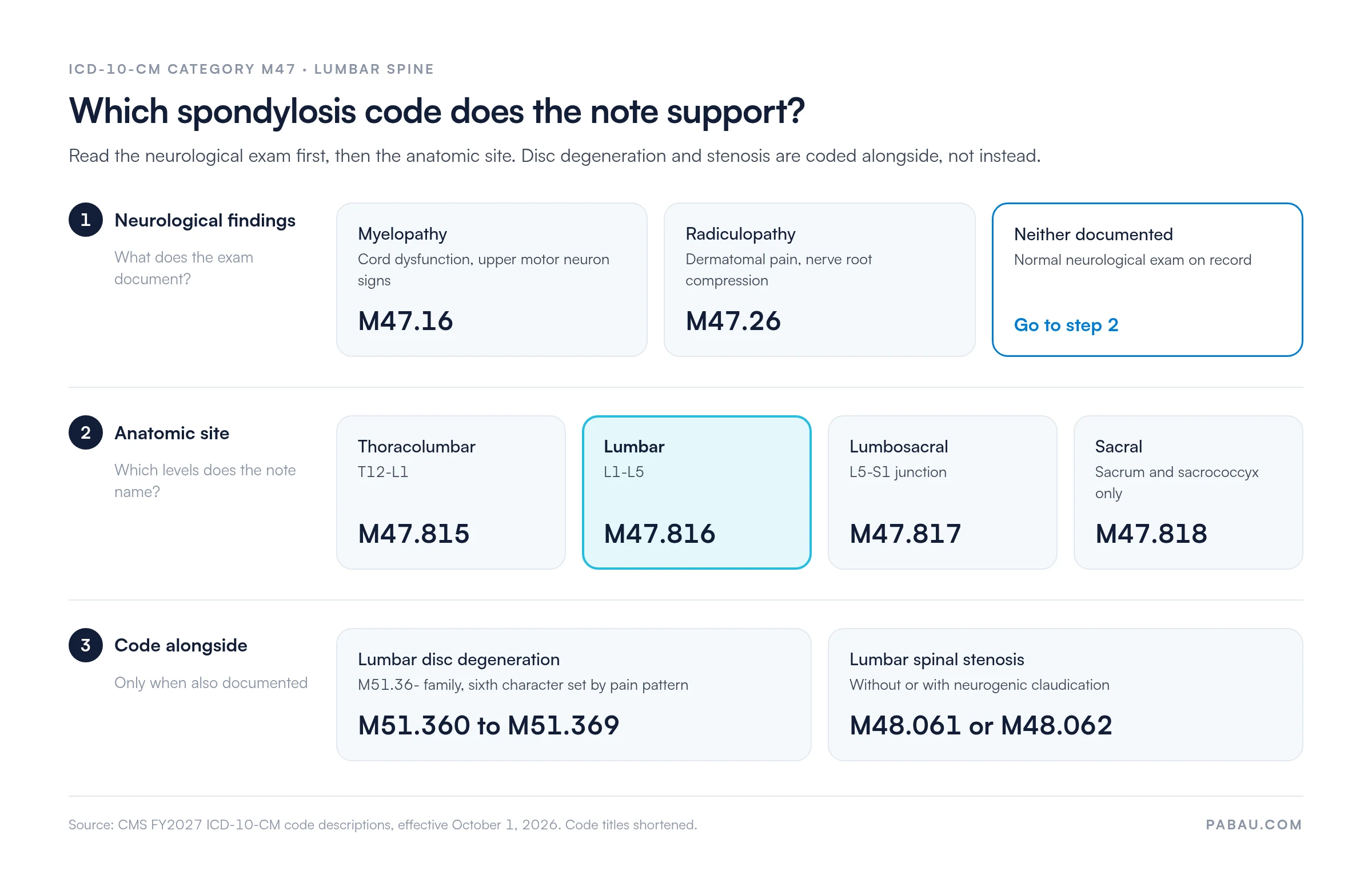
When a physician documents both lumbar spondylosis and degenerative disc disease, report M47.816 with the matching M51.36- code. The two are not mutually exclusive. Lumbar spinal stenosis (M48.061 or M48.062) may also be coded alongside it when documented. Myelopathy and radiculopathy work differently, because they move the claim to M47.16 or M47.26 instead of M47.816. When the note mentions no back or leg pain, report code M51.369 for the disc.
The M47 category contains several site-specific spondylosis codes that look nearly identical. The AAPC Codify ICD-10-CM lookup displays the full M47 subcategory structure, which helps when navigating between adjacent codes.
Lumbar vs lumbosacral: This is the most common site-specificity error. The lumbar region (M47.816) covers L1-L5. The lumbosacral region (M47.817) covers the L5-S1 junction only, and spondylosis confined to the sacrum is M47.818 (sacral and sacrococcygeal region). When the note says “lumbosacral” or names L5-S1, M47.817 is the correct code, not M47.816.
The diagram below puts the decision in order. Check the neurological findings first, then the anatomic site, then any companion codes the note supports.
Run a quick chart audit. Pull every M47.816 claim from the past 90 days and search the physician notes for ‘L5-S1’, ‘lumbosacral’, or ‘radiating pain’. Those encounters likely needed M47.817 or M47.26 instead. Catching the pattern saves denial appeals before they stack up.
Payer audits on lumbar spondylosis claims focus on two things: Anatomic specificity and the absence of neurological involvement. A note that says “lumbar spondylosis” without further detail often passes. A note that says “lower back pain with leg radiation” but then uses M47.816 often fails.
Medical billing software can only submit what the chart supports, so medical billing compliance starts with the note itself. To support M47.816 without a medical necessity review, the physician note needs all five elements below.
AHIMA and CMS coding guidelines agree that the diagnosis code must reflect the documented condition, not the working diagnosis or the imaging report alone. When imaging shows osteophytes but the note documents radiculopathy, the clinical note governs code selection.

Medicare covers a range of services when M47.816 is the supporting diagnosis, but coverage varies by Medicare Administrative Contractor (MAC) jurisdiction and by service type. No single national LCD governs every M47.816 claim. Coders should check their MAC’s Local Coverage Determinations for each service category.
Run the eligibility check before the appointment rather than after a denial. It confirms active coverage for the service billed under M47.816 while there is still time to fix a problem.
M47.816 denials cluster around three issues: Wrong anatomic specificity, neurological involvement missed at code selection, and thin medical necessity documentation. The adjustment reason on the remittance tells you which one you face, and our guide to common CARC denial codes explains each one. Systematic denial management workflows catch most of these before they reach the payer.
The same diagnosis code supports very different claim structures depending on the specialty. What matters is knowing which companion CPT codes each specialty pairs with M47.816 and what documentation the respective payer LCDs require.
M47.816 is the primary diagnosis when lumbar spondylosis is the reason for the PT episode of care. Therapeutic exercise, billed under CPT 97110, is a common companion service. Manual therapy (97140) and mechanical traction (97012) often appear on the same claim. The PT note needs objective measures, such as a pain scale and the Oswestry Disability Index, plus a plan of care with measurable goals. Recording those scores in structured fields rather than free text makes the audit trail easier to produce.
M47.816 supports chiropractic manipulation claims, from CPT 98940 through 98942, as a secondary diagnosis. Medicare chiropractic coverage requires the subluxation to be the primary documented condition. M47.816 adds the degenerative context. The chiropractic note must separately document the subluxation level and the manipulation technique. Note templates that prompt for both cut the documentation misses behind most LCD-based denials.
Pain management physicians use M47.816 as a primary or secondary diagnosis for epidural steroid injections (CPT 62321, 62323), facet joint injections, and medial branch blocks. A single-level lumbar facet injection is billed as CPT 64493, with 64494 and 64495 for added levels. Prior authorization is common for injection procedures. The request should include imaging that confirms spondylosis and documentation of failed conservative treatment. When disc degeneration or stenosis is also documented and treated, M47.816 may be reported with an M51.36- code or with M48.061 or M48.062.
Orthopedic surgeons and neurologists use M47.816 for evaluation and management visits (CPT 99213-99215) and pre-operative assessments when conservative management has failed. If surgery is planned, check whether intraoperative findings of myelopathy or radiculopathy will move the code to M47.16 or M47.26. The pre-operative code should reflect the documented pre-operative diagnosis, not the anticipated intraoperative finding.
The ICD-9-CM predecessor code for M47.816 is 721.3, and the crosswalk is approximate rather than exact. Tools such as CrossCoder run bidirectional crosswalk searches using General Equivalence Mapping (GEM) file data for legacy payer systems.
Legacy claims using 721.3 must be reviewed before they are crosswalked to ICD-10-CM. A claim that used 721.3 for a lumbosacral encounter should map to M47.817, not M47.816. Blanket conversion without a site review is a common error when practices migrate legacy EHR data or manage older payer contracts. A clean claim after the crosswalk depends on the anatomic site in the original chart note, not just the ICD-9 code.
Before migrating a legacy claim database from ICD-9 to ICD-10, filter every 721.3 code and query the original notes for ‘lumbosacral’, ‘L5-S1’, or ‘sacral’ language. Recode the lumbosacral ones to M47.817 and the sacral-only ones to M47.818. The remaining 721.3 claims map to M47.816. A 30-minute audit prevents months of rebilling.
In most practices, the M47.816 decision happens twice. The clinician writes the exam findings into the note, and a coder later reads that note and picks the code. When the note and the claim live in separate systems, a missed “radiating” or “L5-S1” only shows up as a denial weeks later.
Pabau keeps the treatment note, intake forms, and the claim in one patient record. Your coder checks the neurological exam in the same system that sends the claim. US claims go out as CMS-1500 or 837P through Claim.MD, with eligibility checked before the visit and ERA remittances returned to Pabau.
For pain management, the prior authorization code for an injection is tracked on the patient’s case, with a warning when one is missing. The outcome is fewer site and neurology mismatches reaching the payer, and a shorter path from visit to payment.

Pabau keeps treatment notes, forms and claims in one patient record, then submits US claims and checks eligibility through Claim.MD. Your coder works from the chart the clinician wrote.

M47.816 holds up only when the note documents two absences and one location. There is no myelopathy, no radiculopathy, and the changes sit between L1 and L5.
Start with your own claims. Pull the last quarter of M47.816 claims and search each note for “radiating”, “dermatomal”, or “L5-S1”. Each hit probably needed M47.26 or M47.817, and it points to a note template that needs a neurological exam field.
The trade-off is a few extra lines in every lumbar note. In return, your claims survive an audit and your coder stops guessing. Book a demo to see how Pabau keeps spine notes and insurance claims in one record for PT, chiropractic, and pain management practices.

Need to understand the broader denial landscape? Denial management in healthcare covers systematic approaches to tracking, categorizing, and resolving claim denials across all diagnosis codes.
Coding the same pattern higher up the spine? ICD-10 code M47.812 covers cervical spondylosis without myelopathy or radiculopathy, with the same neurological checks.
Looking for the full clearinghouse integration picture? Medical claims clearinghouse explains how clearinghouse validation works between practice billing systems and payers.
ICD-10 code M47.816 is the billable diagnosis code for spondylosis without myelopathy or radiculopathy, lumbar region. It covers degenerative spinal changes at L1-L5 without neurological involvement. It belongs to category M47 (Spondylosis) in the ICD-10-CM tabular list and is valid from FY2025 through FY2027.
Yes, M47.816 is a billable, specific ICD-10-CM code that the CDC/NCHS lists as valid from FY2025 through FY2027. It can be submitted on a CMS-1500 or 837P claim as a primary or secondary diagnosis code, provided the physician documentation supports it.
M47.816 covers the lumbar region (L1-L5). M47.817 covers the lumbosacral region, meaning the L5-S1 junction only, and sacral-only spondylosis is M47.818. Use M47.817 when the physician note or imaging report references “lumbosacral” or “L5-S1”. Using M47.816 for a lumbosacral encounter is a common site-specificity denial trigger.
M47.816 maps approximately to ICD-9-CM code 721.3 (lumbosacral spondylosis without myelopathy). The crosswalk is approximate because 721.3 covered both lumbar and lumbosacral sites, which ICD-10-CM splits into M47.816 and M47.817. Always verify the original chart’s anatomic site before converting legacy 721.3 claims.
Yes, M47.816 is an appropriate supporting diagnosis for chiropractic manipulation claims. Medicare chiropractic coverage still requires a separately documented subluxation as the primary condition. Coverage rules vary by Medicare Administrative Contractor, so verify the applicable LCD for your jurisdiction before billing.
No, they are distinct for coding purposes. Lumbar spondylosis without myelopathy codes to M47.816, while lumbar intervertebral disc degeneration (DDD) codes to the M51.36- family: M51.360, M51.361, M51.362, or M51.369. When both are documented in the same encounter, both codes may be reported together. They are not mutually exclusive under ICD-10-CM guidelines.



