

ICD-10 Code R63.4: Abnormal weight loss
ICD-10 code R63.4: Definition, billability and code structure ICD-10 code R63.4 ...

Last Updated: Nov 13, 2026
Billable Code Specific Code
E29.1 is the billable ICD-10-CM code for testicular hypofunction, meaning reduced hormone output that starts in the testes. It covers testicular hypogonadism NOS, defective testicular androgen biosynthesis, and 5-alpha-reductase deficiency.
The code sits in category E29, Testicular dysfunction, in the endocrine chapter. Hypofunction after surgery or radiation codes to E89.5 instead. Pituitary-driven hypogonadism codes to E23.0, and Klinefelter syndrome to Q98.0.
Let Pabau's smart automation suggest the right codes, reduce claim denials, and keep your practice compliant—effortlessly.
Automate repetitive tasks and focus on what matters most—your patients.
Reduce coding errors and ensure compliance with the latest regulations.
Clean claims, fewer denials, and faster reimbursements.
Powerful insights and reporting to help your practice thrive.
HIPAA compliant SOC 2 certified GDPR-compliant Trusted by 4,000+ clinics worldwide

E29.1 is the billable ICD-10-CM code for testicular hypofunction in FY 2027, and it applies to male patients only.
Payers expect documented serum testosterone plus FSH and LH values that show where the hypofunction starts.
Klinefelter syndrome (Q98.0) and isolated gonadotropin deficiency (E23.0) are Excludes1 conditions, so they replace E29.1 rather than join it.
Common denials stem from borderline lab values, missing prior authorization for TRT, and Excludes1 conflicts.
Pabau, the practice management platform we build, links E29.1 to procedure codes at the point of care, so coding errors surface before submission.
ICD-10 code E29.1 is a billable ICD-10-CM code with the official descriptor “Testicular hypofunction,” valid for FY 2027 claims (October 1, 2026, onward). It sits within Chapter 4 (Endocrine, Nutritional and Metabolic Diseases) under category E29 (Testicular dysfunction). The CDC/NCHS ICD-10-CM web tool lists E29.1 as billable with no additional characters required.
E29.1 shows up in medical billing workflows across endocrinology, urology, and primary care. It still needs supporting lab evidence in the medical record before the claim is submitted.
E29.1 covers reduced hormone output that starts in the testes. The AAPC ICD-10-CM code lookup and the official CMS Tabular List both list these inclusion terms under E29.1:
Clinical notes often describe the same picture as low testosterone, androgen deficiency, or male hypogonadism. Those are clinical synonyms, not official inclusion terms, so the documented cause still decides the code.
E29.1 applies to testicular (primary) hypogonadism. Hypogonadotropic hypogonadism from isolated gonadotropin deficiency codes to E23.0, which the E29 category excludes. When Klinefelter syndrome drives the hypofunction, Q98.0 is coded instead of E29.1, because Klinefelter syndrome is also an Excludes1 condition for E29.
The official Tabular List excludes certain conditions from E29.1 that coders might initially reach for this code to describe. Reporting E29.1 when an excluded code is required creates an Excludes1 violation, which claim scrubbers and payers reject. Per CMS ICD-10-CM guidance, Excludes1 means the two codes can never be reported together on the same claim.
An Excludes2 note, by contrast, signals the excluded condition is not included under E29.1 but may be coded together when both are present. Always verify the note type against the current Tabular List before combining codes on a claim.
Primary hypogonadism originates in the testes themselves. Secondary hypogonadism originates in the hypothalamus or pituitary. The distinction decides whether E29.1 is the right code at all, and payers may check the lab pattern when they review TRT prior authorizations.
Per the Endocrine Society Clinical Practice Guideline, FSH and LH levels are the clinical standard for distinguishing the two subtypes. Document both values in the medical record. Without them, payers have grounds to question which code applies.
Put together, the documented cause sends the claim to one of five codes, and only one of them is E29.1.
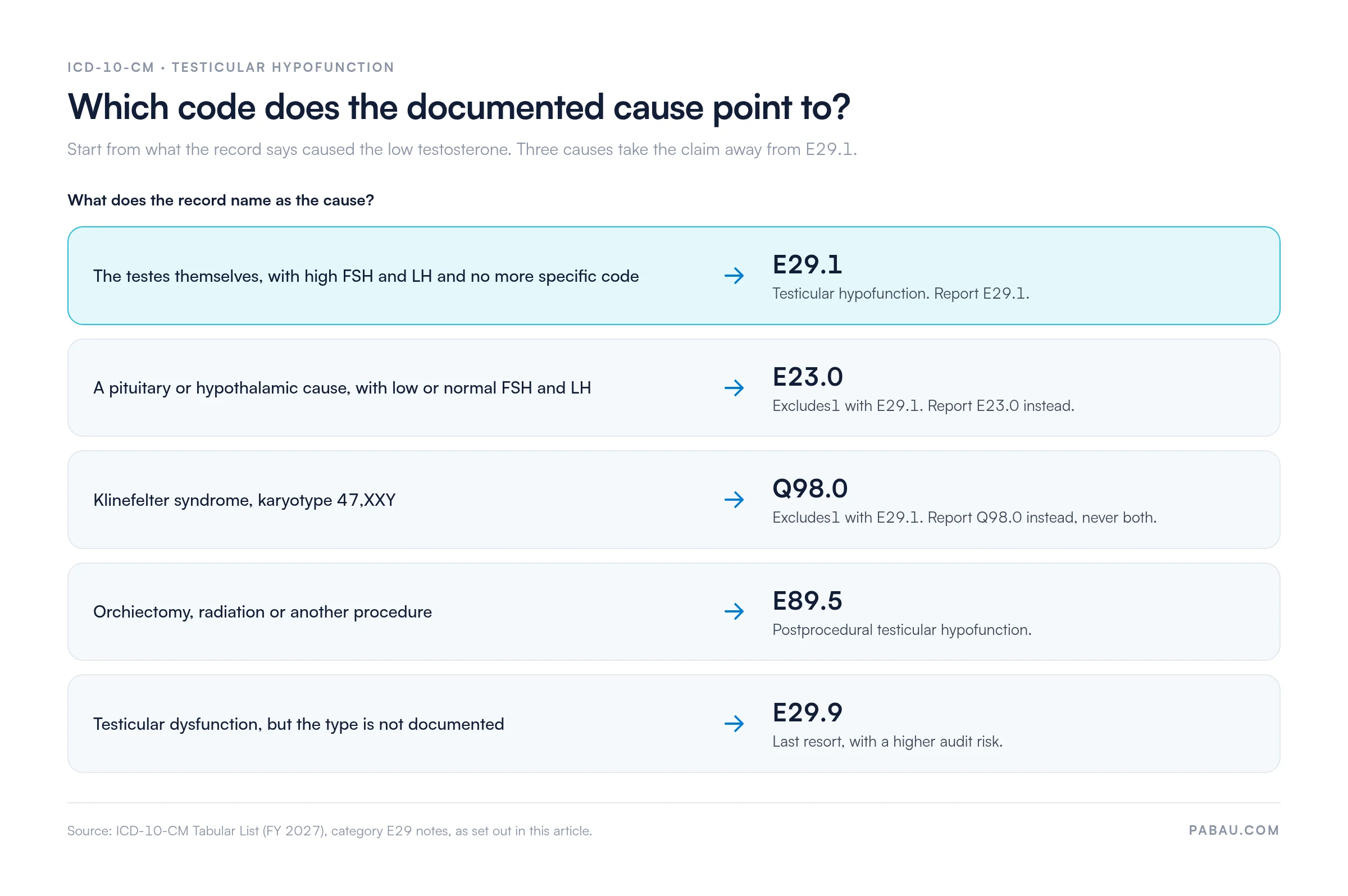
A correctly assigned code without supporting documentation is still a denied claim. The following elements must appear in the clinical record before E29.1 goes out on a TRT or hypogonadism claim. Medical billing compliance audits check for each one.
Running insurance eligibility verification before the encounter identifies the LCD that governs the patient’s plan. The documentation checklist can then be matched to that payer before the visit ends. The serum total testosterone test behind the first item is billed separately, with CPT code 84403.
E29.1 is the primary supporting diagnosis for TRT claims across Medicare and commercial payers. Without it, or with thin documentation behind it, the claim is likely to be denied or returned for more information. Most payers require prior authorization for TRT, and the request must reference E29.1 along with the lab values and clinical criteria above.
TRT administration is billed with CPT procedure codes for the delivery method (injection, implant, or transdermal), with E29.1 as the linked diagnosis. For testosterone cypionate, the drug itself is reported with HCPCS J1071. Submit E29.1 as the principal diagnosis when the encounter is about managing the testosterone deficiency. Add Z79.890 (hormone replacement therapy) when the patient is on established TRT.
Practices using claims management software can link E29.1 to the relevant CPT codes at the point of care. Missing documentation is flagged before the claim leaves the practice. Pabau sends US claims electronically through its Claim.MD clearinghouse integration, which checks claim data against thousands of US payers. It also returns real-time eligibility checks and ERA remittances.
Denials for E29.1 cluster around a small set of avoidable errors. The table below identifies each denial pattern, the CARC code most commonly returned, and the correction that resolves it. Denial management workflows that track these patterns by payer reduce rework significantly.
Reviewing CARC denial codes alongside each payer’s ERA remittances shows systemic patterns, so the team fixes causes instead of one denial at a time.
Run a quarterly audit of all E29.1 denials grouped by CARC code and payer. If CARC 50 dominates, the issue is documentation. If CARC 197 dominates, the issue is prior auth workflows. Fixing the process root cause eliminates more denials than appealing each claim individually.
The E29 category contains four subcodes. Using E29.9 (unspecified) when E29.1 is documented is a specificity error that can trigger a payer audit flag. Use the most specific code the documentation supports, as the WHO ICD classification system and CMS coding guidelines both require.
Several codes come up in the same episode of care as E29.1. Some replace it, some sit beside it as comorbidities, and one is a status code for ongoing hormone therapy. The ResDAC ICD coding resources provide additional context on how these codes appear in Medicare claims data.
Accurate coding starts at the point of care, well before the claim reaches the billing queue. These steps apply whether the practice uses a standalone EHR or a platform that also handles billing.
In many practices, the lab results sit in one system and the claim gets built in another. A biller then rekeys E29.1, the CPT codes, and the prior authorization number by hand. Each rekey is a chance to drop the FSH and LH values or pick the wrong code.
Pabau surfaces E29.1 in the clinical record search and links it to the relevant CPT codes at checkout. Completed claims then go through Claim.MD, which validates them before they reach the payer.
That means fewer returned claims and less manual rework. Your billing team spends its week on new claims instead of rebuilding a CARC 50 appeal for a TRT patient.

Pabau links diagnosis codes to procedures at the point of care and routes claims through Claim.MD for real-time validation across thousands of US payers. Book a demo to see the workflow.

ICD-10 code E29.1 is the right code only when the record shows the hypofunction starts in the testes. Klinefelter syndrome, a pituitary cause, or a past procedure each sends the claim to a different code instead, never alongside it.
So settle the cause before the claim is built. Record two morning testosterone draws, FSH and LH values, and the symptom history in the note, and get prior authorization before the first TRT dose. With those in place, the denials in the table above have little to catch.
Pabau’s claims management links E29.1 to procedure codes at the encounter and routes claims through Claim.MD for validation against payer rules. Book a demo to see how Pabau handles E29.1 and TRT billing end to end.

Need a denial management framework for endocrine claims? Denial management in healthcare covers how to track, categorize, and resolve recurring claim rejections by CARC code and payer.
Looking to understand how clearinghouse submissions work? Claim.MD clearinghouse guide explains the EDI 837 workflow, real-time eligibility checks, and ERA remittance handling for US practices.
Want to reduce billing errors across all diagnosis codes? Revenue cycle management guide outlines the end-to-end workflow from eligibility verification to payment posting.
ICD-10 code E29.1 is the billable ICD-10-CM diagnosis code for testicular hypofunction. It covers testicular hypogonadism NOS and defective testicular androgen biosynthesis. It is valid for FY 2027 and applies to male patients only. The code sits under category E29 (Testicular dysfunction) in Chapter 4 of ICD-10-CM.
Yes, E29.1 is a billable ICD-10-CM code requiring no additional characters for FY 2027. It can be reported directly on a claim as a principal or additional diagnosis, provided the supporting clinical documentation meets payer medical necessity criteria.
E29.1 specifies testicular hypofunction, meaning confirmed reduced testosterone or androgen output from the testes. E29.9 is the unspecified testicular dysfunction code, used only when documentation cannot support a more specific code. CMS coding guidelines require the most specific code available, so E29.1 is used when testicular hypofunction is documented. E29.9 carries a higher audit risk.
Yes, E29.1 can serve as the principal diagnosis when the encounter is about managing documented testicular hypofunction or starting TRT. At a follow-up for established TRT, E29.1 remains the supporting diagnosis, with Z79.890 (hormone replacement therapy) reported additionally. Check the payer’s LCD for any ordering-sequence requirements.
No. Hypogonadotropic hypogonadism starts in the pituitary or hypothalamus, not the testes, so it does not code to E29.1. Isolated gonadotropin deficiency codes to E23.0, which is an Excludes1 for the E29 category. The two are never reported together, and the FSH and LH pattern in the record shows which applies.
No. E29.1 is classified under testicular dysfunction and applies to male patients only. Female androgen deficiency requires different ICD-10-CM coding. Reporting E29.1 for a female patient will trigger a sex edit rejection from the payer.



