

ICD-10 Code R63.4: Abnormal weight loss
ICD-10 code R63.4: Definition, billability and code structure ICD-10 code R63.4 ...

Last Updated: Nov 13, 2026
Billable Code Specific Code
I42.9 is the billable ICD-10-CM code for cardiomyopathy, unspecified. It covers heart muscle disease when the record names cardiomyopathy but not its type or cause.
The code is the residual option in category I42, used when no sibling code (dilated, hypertrophic, restrictive, alcoholic, drug-induced) fits the documented presentation. Once the chart supports a more specific choice, such as I42.0, or I25.5 when the chart documents an ischemic cause, that code replaces I42.9. In FY2027, dilated cardiomyopathy is reported with I42.00, I42.01 or I42.09.
Let Pabau's smart automation suggest the right codes, reduce claim denials, and keep your practice compliant—effortlessly.
Automate repetitive tasks and focus on what matters most—your patients.
Reduce coding errors and ensure compliance with the latest regulations.
Clean claims, fewer denials, and faster reimbursements.
Powerful insights and reporting to help your practice thrive.
HIPAA compliant SOC 2 certified GDPR-compliant Trusted by 4,000+ clinics worldwide

I42.9 is a billable ICD-10-CM code for FY2027, used only when the record names cardiomyopathy without its type or cause.
Ischemic cardiomyopathy (I25.5) sits in an Excludes2 note at I42, so a documented ischemic cause is coded I25.5 rather than I42.9.
I42.9 and a heart failure code from I50 can be reported together when the physician documents both conditions.
In FY2027, dilated cardiomyopathy is coded I42.00, I42.01 or I42.09, because I42.0 itself is no longer billable.
Pabau, the practice management platform we build, submits US claims through Claim.MD with eligibility checks and ERA remittances.
ICD-10 code I42.9 is the billable ICD-10-CM code for cardiomyopathy, unspecified, valid for claims under the FY2027 code set. It appears in CMS’s FY2027 ICD-10-CM files, which apply to encounters from October 1, 2026 to September 30, 2027. The code belongs to category I42 (Cardiomyopathy) in Chapter 9, Diseases of the circulatory system (I00-I99). You can look it up in the CDC/NCHS ICD-10-CM browser.
Cardiomyopathy, unspecified describes a disease of the heart muscle whose type or cause has not been established or documented at the time of coding. The myocardium is abnormal in structure or function. The record does not say whether it is dilated, hypertrophic or restrictive, or caused by a known agent such as alcohol.
Several clinical scenarios legitimately support I42.9. The patient may be at an initial workup visit before echocardiography results are available. The cardiologist may write “cardiomyopathy” without further qualification, or biopsy results may still be pending. In each case the code records diagnostic uncertainty at a specific point in time, and it should change once the workup names a type.
Per ICD-10-CM Official Guidelines Section I.B.2 (Level of Detail in Coding), codes are reported to the highest level of specificity documented in the medical record. When the record supports a more specific I42 code, assigning I42.9 instead goes against that guideline.
The I42 category contains ten subcategories, I42.0 through I42.9. In the FY2027 code set, I42.0 and I42.8 are headers that split into billable codes, so a claim never carries either one on its own. The table below maps each code to the documentation that takes a claim off I42.9.
Read the same family the other way round and it becomes a checklist. The panel below starts from what the chart documents and ends on the code each finding supports.
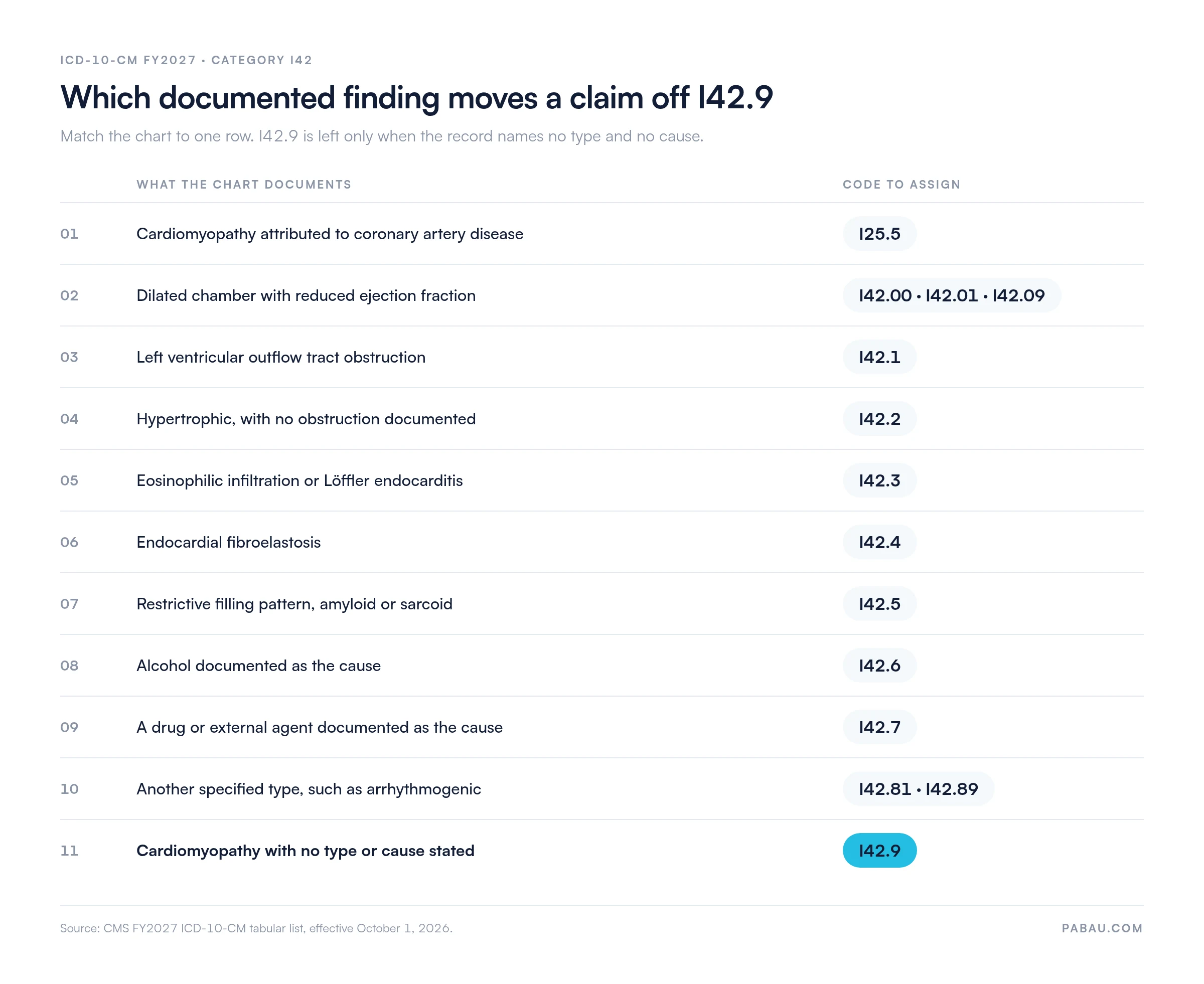
The I42 category carries an Excludes2 note listing ischemic cardiomyopathy (I25.5), peripartum cardiomyopathy (O90.3) and ventricular hypertrophy (I51.7). Under the FY2027 ICD-10-CM Official Guidelines, an Excludes2 note means “not included here.” The excluded condition is not part of I42, but a patient may have both at the same time, and both codes may then be reported.
If the record documents ischemic cardiomyopathy, the coder assigns I25.5. I42.9 joins it only when the physician separately documents a cardiomyopathy that is not ischemic.
Several conditions are commonly confused with I42.9 but belong to different codes entirely.
Ischemic cardiomyopathy, coded I25.5, is the most consequential distinction for coders working with the I42 category. I42.9 covers heart muscle disease of unknown or undocumented origin, while I25.5 covers cardiomyopathy caused by coronary artery disease. Because I25.5 sits in an Excludes2 note at I42, the two may share a claim, but only when the record supports both.
When a patient has both known CAD and cardiomyopathy, the coder must query the physician to confirm whether the cardiomyopathy is ischemic before assigning I25.5. Assuming an ischemic origin without explicit physician documentation is a coding error under ICD-10-CM guidelines.
Yes, cardiomyopathy (I42.9) and heart failure (I50.-) may be coded together when the treating physician documents both conditions. Per AHA Coding Clinic guidance, they are distinct diagnoses. One describes structural disease of the myocardium, and the other describes the functional consequence of that disease. A structural cause does not make heart failure implicit, so the physician must document heart failure separately for it to be coded.
The I50 code depends on the type documented. I50.20 through I50.23 cover systolic heart failure, and I50.30 through I50.33 cover diastolic heart failure. Left ventricular ejection fraction (LVEF) from the echo report supports the distinction. Sequence I42.9 as the principal or a secondary code depending on the reason for the encounter, then add the applicable I50 code.
Dilated cardiomyopathy is the most common reason a coder reaches for I42.9 and then has to reclassify. If an echo or the physician’s note describes a dilated left ventricle with reduced ejection fraction and attributes it to cardiomyopathy, a dilated code applies. In FY2027 that means I42.00 (unspecified), I42.01 (familial-genetic) or I42.09 (other), because I42.0 is now a header.
I42.9 fits only the visit before the echo is completed, or a note that documents “cardiomyopathy” without a type. Once the chart contains morphological detail that maps to a specific I42 code, that code replaces I42.9.
A clean claim submission for I42.9 rests on documentation that justifies the unspecified designation. These are the minimum elements a coder should verify before assigning the code.
When documentation is ambiguous, such as a note reading “cardiomyopathy, likely non-ischemic,” the coder should send a physician query before assigning I42.9. The AHA Coding Clinic and AHIMA both advise against coding qualified diagnoses without clarification.
Query the cardiologist before assigning I42.9 when the chart mentions coronary artery disease or echocardiogram findings. Do the same when a phrase links the cardiomyopathy to a known cause. One clarifying note from the cardiologist can move the code from I42.9 to a specific sibling, and it may change the HCC mapping.
Cardiology practices using I42.9 on claims typically pair it with one or more of the procedure codes below. Medical necessity for each depends on the payer’s local coverage determination (LCD) and the clinical context. In the US, Pabau sends these claims through Claim.MD as CMS-1500 (837P) submissions, with eligibility checks before the claim goes out.
I42.9 maps to a Hierarchical Condition Category (HCC) under the CMS risk-adjustment model, which feeds Risk Adjustment Factor (RAF) scores for Medicare Advantage plans. The HCC assignment and its weight depend on the model version in use (V24 or V28). Check the current year’s CMS model software and ICD-10 mappings before projecting revenue from I42.9.
Leaving I42.9 off an encounter where it is the documented diagnosis can lower RAF scores for Medicare Advantage patients and reduce risk-adjusted revenue. Consistent HCC capture at every eligible encounter is part of medical billing compliance for cardiology practices.
The diagnosis must be documented and coded at least once per plan year for its RAF contribution to carry forward. A cardiomyopathy captured last year adds nothing to this year’s score unless the physician addresses it again.
Cardiology billing teams see a predictable set of denial patterns with ICD-10 code I42.9. Effective denial management workflows for cardiomyopathy claims focus on three failure points: Code selection, missing documentation, and coding errors around I25.5. Reading the denial reason codes on each remittance shows which of the three caused the denial.
Medicare coverage for cardiomyopathy-related services rests on Local Coverage Determinations (LCDs) published by the Medicare Administrative Contractor (MAC) for the practice’s jurisdiction. LCDs for echocardiography and cardiac MRI typically require the diagnosis code to support a specific clinical indication. I42.9 generally satisfies medical necessity for initial echocardiography. Cardiac MRI or biopsy guidance may require documentation that simpler tests were inconclusive.
Commercial payers vary widely in their prior authorization rules when I42.9 is the primary diagnosis. Some plans require authorization for cardiac MRI whenever an unspecified cardiomyopathy code is submitted, on the reasoning that the workup is incomplete. Sending a letter of medical necessity and the echo report with the request reduces denials on those claims.
Practices with Medicare Advantage patients should also plan for annual HCC recapture, since I42.9 counts toward risk scores only when documented each plan year. Repeated unspecified codes for the same patient, with no record of the workup moving forward, also draw audit attention.
The CMS ICD-10-CM Official Guidelines and AHIMA practice briefs agree on this point. Unspecified codes are acceptable when the documentation lacks specificity. They are never a shortcut when the chart already holds the detail for a more specific code.
When documentation is ambiguous, AHIMA guidance prefers a physician query over an assumption. A query asking the cardiologist whether the cardiomyopathy is ischemic, dilated or of undetermined cause protects both the coder and the practice. Querying at the first encounter also saves a recode at the follow-up visit. To compare coding patterns across providers, AAPC’s ICD-10-CM code reference helps confirm which specific codes your I42.9 claims could have used.
Check your practice’s I42.9 usage rate by provider every quarter. Picture a coder assigning I42.9 to 90% of cardiomyopathy encounters while the same cardiologist’s echo reports describe dilated morphology. An auditor will find that mismatch, and a physician education session fixes it faster than a retrospective recode.
In many cardiology practices the diagnosis reaches billing by hand. The cardiologist writes “cardiomyopathy” in the note, the echo report arrives days later, and a biller codes from whatever is on file. That is how I42.9 lands on a claim after the chart already supports I42.00 or I25.5.
Pabau builds the claim from the patient’s visit record, so the note, the echo result and the diagnosis code sit side by side. Its streamlined claims management sends US claims through Claim.MD as CMS-1500 (837P) submissions, with eligibility checks and ERA remittances in the same workflow.
Prior authorizations for cardiac MRI are tracked on the patient’s case, with a warning when an authorization code is missing. Your billing team codes from the full chart, and a denied claim is reworked in the record it came from.

Pabau sends US claims through Claim.MD with eligibility checks and ERA remittances, so your billing team codes I42.9 from the same record the cardiologist wrote.

I42.9 is a temporary code by nature. It belongs on the claim while the workup is open. As soon as the chart supports I42.00, I25.5 or another specific code, that code takes over. Treat every I42.9 on a follow-up visit as a prompt to check the echo report and query the cardiologist.
The practices that code it well are the ones whose billers can see the note and the test results together. If yours still codes from a summary sheet, compare dedicated medical billing software on that point first. Book a demo to see how Pabau keeps cardiology claims tied to the record they came from.

Need to understand how clearinghouse claim validation works? Claim.MD clearinghouse overview explains how electronic claims are scrubbed, submitted, and tracked before they reach the payer.
Coding cardiomyopathy caused by coronary artery disease? ICD-10 code I25.5 covers ischemic cardiomyopathy, the code that replaces I42.9 when the chart documents an ischemic cause.
Want to reduce the volume of denied cardiology claims? Clean claim requirements in medical billing covers the submission criteria payers check before adjudicating any diagnostic code claim.
Looking to understand denial reason codes on I42.9 claims? Denial codes in medical billing explains CARC codes, remittance advice reading, and how to use denial data to fix upstream coding errors.
ICD-10 code I42.9 is the billable diagnosis code for cardiomyopathy, unspecified. It covers heart muscle disease when the medical record does not document the type or cause. It is valid for FY2027 claim submission.
Use I42.9 only when the physician’s documentation does not specify the type or cause of the cardiomyopathy. A typical case is an initial workup visit before echo results are available. If the chart specifies dilated, hypertrophic, restrictive, alcoholic or drug-induced cardiomyopathy, the matching specific I42 code is required.
I25.5 covers cardiomyopathy caused by coronary artery disease, while I42.9 covers cardiomyopathy of unknown or undocumented cause. I25.5 sits in an Excludes2 note at I42, so a documented ischemic cause is coded I25.5. Both codes appear on one claim only when the physician documents a separate non-ischemic cardiomyopathy as well.
Yes. Cardiomyopathy and heart failure are distinct diagnoses, and dual coding is appropriate when the treating physician documents both. The I50 code depends on whether systolic or diastolic heart failure is documented.
I42.9 maps to an HCC category under the CMS risk-adjustment model, contributing to RAF scores for Medicare Advantage patients. The exact HCC mapping and weight vary by CMS model version. Verify the current year’s mapping against the CMS model software before projecting risk-adjusted revenue.
The most common trigger is coding I42.9 when the chart documents an ischemic cause that calls for I25.5. Another is using I42.9 when documentation supports a specific code such as I42.00. The third is missing medical necessity documentation for cardiac MRI paired with an unspecified diagnosis.



