

ICD-10 Code R63.4: Abnormal weight loss
ICD-10 Code R63.4: Definition, billability, and code structure ICD-10 code R63.4...

Last Updated: Nov 13, 2026
Billable Code Specific Code
K85.90 is the billable ICD-10-CM code for acute pancreatitis without necrosis or infection, unspecified. It applies when the chart confirms acute pancreatitis but names no cause, and imaging shows no necrosis or infection.
Most K85.90 denials trace to one of two documentation problems. Either the chart records a cause that calls for a code from K85.0x to K85.8x, or the physician never rules out necrosis.
Let Pabau's smart automation suggest the right codes, reduce claim denials, and keep your practice compliant—effortlessly.
Automate repetitive tasks and focus on what matters most—your patients.
Reduce coding errors and ensure compliance with the latest regulations.
Clean claims, fewer denials, and faster reimbursements.
Powerful insights and reporting to help your practice thrive.
HIPAA compliant SOC 2 certified GDPR-compliant Trusted by 4,000+ clinics worldwide

K85.90 is a valid, billable ICD-10-CM code for acute pancreatitis with no documented cause, necrosis or infection.
Use K85.90 only when the chart names no cause. A documented etiology, idiopathic included, calls for a code from K85.0x to K85.8x instead.
K85.91 (uninfected necrosis) and K85.92 (infected necrosis) are the adjacent codes when imaging shows necrosis. Selecting K85.90 without ruling out necrosis is a leading denial trigger.
Pabau, the practice management platform we build, sends US claims through Claim.MD, which validates ICD-10 codes against payer rules before submission.
ICD-10 code K85.90 is the billable ICD-10-CM code for acute pancreatitis without necrosis or infection, unspecified. It belongs to category K85 (acute pancreatitis) in the ICD-10-CM tabular list. The code set is maintained by the CDC’s National Center for Health Statistics (NCHS), with annual code files hosted by CMS. The “90” subcode specifies two things at once. The “9” marks an unspecified etiology, and the final “0” means no necrosis or infection.
The code took effect for discharges and encounters on October 1, 2016, when the K85 codes gained their necrosis and infection digits. It remains valid in the FY 2027 ICD-10-CM release with no descriptor change. Within MS-DRG it groups with the disorders of the pancreas, though comorbidities, secondary diagnoses and procedure codes decide the final DRG.
K85.90 is a residual code. It captures acute pancreatic inflammation when the clinical record is silent on the cause and on any necrosis or infectious complication.
K85.90 applies when all of the following are true:
K85.90 does not apply when:
The CDC/NCHS ICD-10-CM web tool shows K85.90 with no Excludes1 or Excludes2 note at code level. The sibling K85 subcodes cover the specified causes (idiopathic K85.0x, biliary K85.1x, alcohol-induced K85.2x, drug-induced K85.3x, other K85.8x). That is why the etiology check comes first.
The K85 category works as a grid of 18 codes. The first decimal digit records the etiology, and the final digit records necrosis and infection status (0 to 2). K85.90 sits where an unspecified etiology meets no necrosis or infection, as the grid below shows.
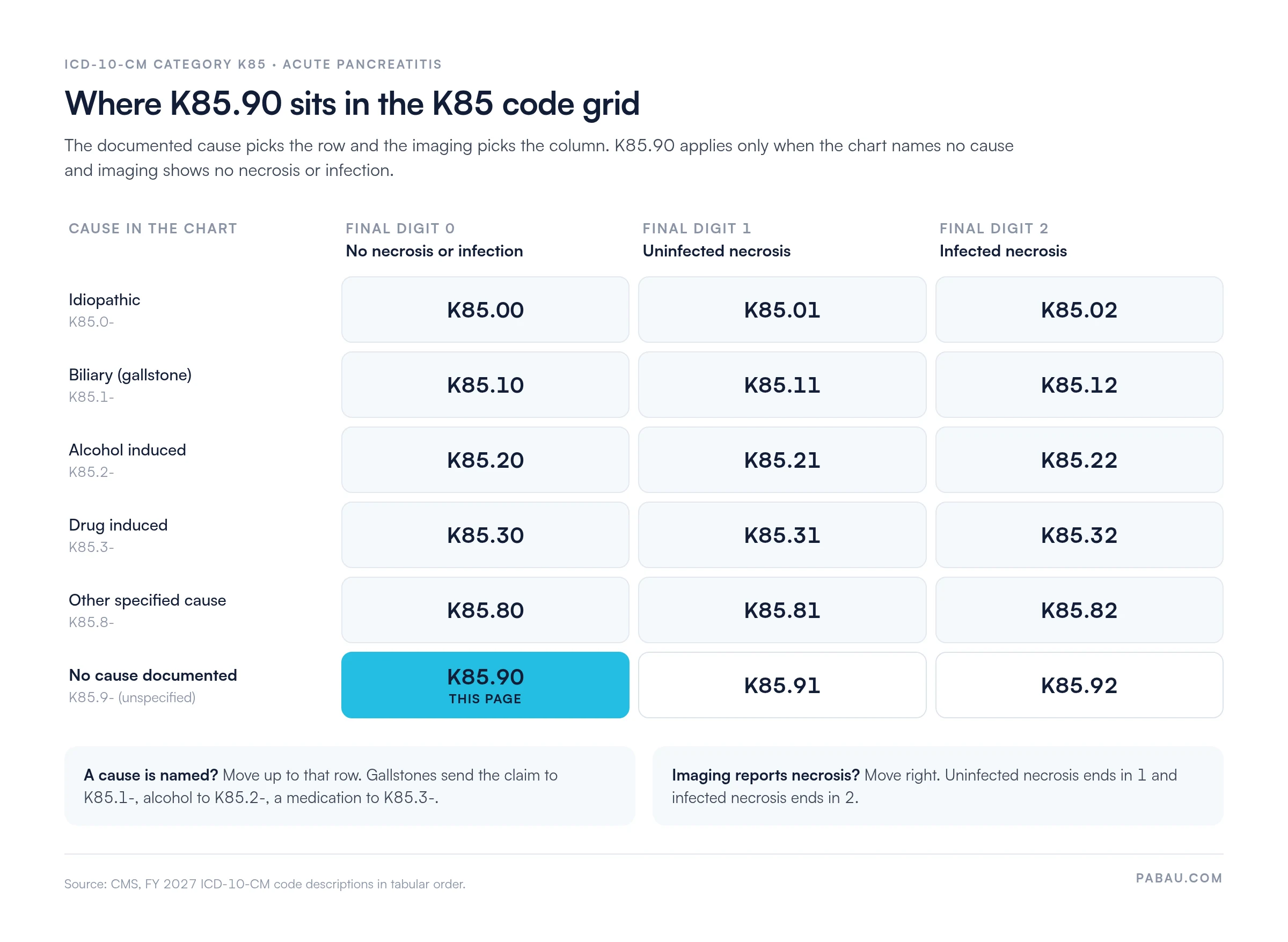
The table maps every K85.9x code and the etiology-specific codes coders most often confuse with K85.90.
The K85.90 vs K85.91 boundary is the highest-audit pairing. When a CT report mentions “peripancreatic stranding” without calling it necrosis, the physician’s attestation governs. Without a clear note ruling out necrosis, a payer can argue the coder should have queried the physician before defaulting to K85.90.
Run a two-question check before finalizing K85.90. First, does the CT or MRI report use the word ‘necrosis’ or ‘infected’? Second, does the history and physical or discharge summary name a specific cause, such as gallstones, alcohol or a medication? If either answer is yes, K85.90 is wrong. Query the physician or escalate to the coder of record before submitting.
Acute-on-chronic pancreatitis is not coded with K85.90. When a patient with known chronic pancreatitis presents with an acute exacerbation, the principal code comes from the K86.x category. That follows ICD-10-CM coding conventions and AHA Coding Clinic guidance.
The distinction matters because chronic pancreatitis (K86.0 alcohol-induced, K86.1 other chronic pancreatitis) has its own DRG pathways and payer medical necessity criteria. Using K85.90 for an acute-on-chronic case raises claim risk. The clinical record will reference prior chronic disease, and the imaging will often show chronic changes. A payer reviewer reading those notes will flag the mismatch.
The documentation burden for K85.90 is higher than it looks, because “unspecified” does not mean “undocumented.” Payers expect evidence that a provider evaluated for and ruled out both a specific etiology and necrosis. A note that simply never mentions them falls short.
Supporting medical billing compliance for a K85.90 claim requires these elements in the chart:
When the record meets all six criteria, K85.90 carries low pre-payment audit exposure and has the makings of a clean claim. When one or more elements are missing, the claim becomes an easy target for post-payment review. The lipase test behind the lab criterion is billed on its own line as CPT code 83690.
Medicare and most commercial payers group acute pancreatitis admissions under Disorders of pancreas except malignancy. That is MS-DRG 438 (with MCC), 439 (with CC) or 440 (without CC/MCC). K85.90 alone does not determine the DRG, because secondary diagnoses and procedure codes drive the final grouping.
Payers expect the principal diagnosis to be supported by the documentation requirements above. They apply medical necessity criteria through Local Coverage Determinations (LCDs) that vary by Medicare Administrative Contractor (MAC).
Practices using claims management software can run eligibility checks before a K85.90 claim goes out. Pabau sends US claims through the Claim.MD clearinghouse, which validates ICD-10 codes against payer rules across Claim.MD’s US payer list. It also generates 837P claim files and routes electronic remittance advice back through the same workflow.
Key payer-specific considerations for K85.90 include:
K85.90 denials cluster around four root causes. Understanding each one reduces rework and supports stronger denial management workflows.
Reviewing medical billing denial codes alongside K85.90 denial patterns helps coding teams spot systemic issues instead of treating each denial in isolation.
Acute pancreatitis rarely presents without comorbid conditions, and K85.90 as the sole diagnosis on an inpatient claim is an outlier that invites review. These secondary codes appear frequently with K85.90 and are clinically appropriate when documented:
Symptoms integral to acute pancreatitis (nausea, vomiting, abdominal pain) are generally not coded separately per the ICD-10-CM Official Coding Guidelines. That keeps R10.9 off most pancreatitis claims. Code a symptom secondarily only when it is independently evaluated and treated. The other exception is a symptom the physician documents as a distinct condition with its own management.
Assigning K85.90 as the principal diagnosis follows a five-step verification process. Skipping a step leaves the claim open to a preventable denial.
Check the official ICD-10-CM tabular list in the CDC/NCHS tool before each new fiscal year starts on October 1. The K85.9x descriptors and guidance notes change only in the official release, and your coding team gets no automatic notice when they do.
A K85.90 claim is usually coded days after discharge. A coder reads the CT impression, the lipase result and the discharge summary, then decides whether the chart names a cause. If one of those documents is missing at that point, the unspecified code goes out by default, and the denial arrives weeks later.
Pabau keeps those documents in one patient record. Practices that switch on Labs can order the lipase test from Quest, and the result imports into the chart automatically. The claim then goes to the payer through Claim.MD as an 837P file, with an eligibility check before submission.
Remittances come back to the same record as ERA files, so a denied K85.90 claim sits next to the note that should have supported it. Your team can correct the code or query the physician without rebuilding the case from separate systems.

Pabau keeps lab results, imaging notes and claims in one patient record. US claims go out through Claim.MD with eligibility checks, and remittances return to the same record.

Treat K85.90 as the code you reach only after two checks come back empty. The chart names no cause, and imaging documents no necrosis or infection. The code is valid and billable, so denials come from assigning it before those checks are done.
When either check is unclear, query the physician before the claim goes out. A query delays the claim by a day or two. A denied inpatient claim costs a resubmission, and often an appeal as well.
Pabau sends US claims through Claim.MD with eligibility checks and returns remittance data to the patient record. Book a demo to see how your team can catch K85.90 coding errors before the claim reaches a payer.

Need a full picture of how claim denials are categorized? Denial codes in medical billing explains the most common reason codes and how to map each one to a corrective action.
Looking to understand the broader clearinghouse workflow? How the Claim.MD clearinghouse works covers 837P submission, ERA routing and eligibility verification in one end-to-end guide.
Want to improve your team’s overall claim accuracy? Medical billing compliance outlines the documentation standards that keep ICD-10 claims clean from the first submission.
Coding gallstones found during the workup? ICD-10 code K80.20 covers calculus of the gallbladder without cholecystitis or obstruction.
ICD-10 code K85.90 is the billable diagnosis code for acute pancreatitis without necrosis or infection, unspecified type. “Unspecified” means the clinical record documents no specific cause, such as biliary, alcohol-induced or drug-induced pancreatitis. “Without necrosis or infection” means imaging or clinical evaluation has found no necrotic or infected pancreatic tissue.
K85.90 describes acute pancreatitis with no documented necrosis or infection, while K85.91 describes acute pancreatitis with uninfected necrosis. The difference is imaging-driven. If CT or MRI shows necrotic pancreatic or peripancreatic tissue that has not become infected, K85.91 is correct. Using K85.90 when the imaging report mentions necrosis is a leading cause of post-payment audit findings.
Use K85.90 only when three conditions are all true. The etiology is unspecified in the physician’s documentation, imaging confirms no necrosis, and no infection is present. If a cause is documented, use K85.0x through K85.8x. If necrosis is present without infection, use K85.91. If infected necrosis is present, use K85.92.
Yes. K85.90 is a valid, billable ICD-10-CM code. It can be sequenced as the principal diagnosis on inpatient and outpatient claims when the clinical documentation supports it. The NCHS ICD-10-CM tabular list marks it as billable without restriction.
Four triggers cause most K85.90 denials. A specific etiology was documented but the coder defaulted to the unspecified code, or CT imaging showed necrosis that required K85.91 or K85.92. The lab values or imaging report may have been missing at submission. The code may also have been sequenced after a symptom code instead of as the principal diagnosis. A pre-submission documentation checklist prevents each of these.
No. Acute-on-chronic pancreatitis is coded from the K86.x category per ICD-10-CM conventions and AHA Coding Clinic guidance. Using K85.90 for a patient with established chronic pancreatitis who presents with an acute flare creates a documentation mismatch. Payer reviewers can spot it from the clinical record alone.



