ICD-10 Code S52.101P: Right radius fracture with malunion
ICD-10 Code S52.101P: definition and code details ICD-10 Code S52.101P is a bill...

Last Updated: Oct 19, 2026
Billable Code Specific Code
S79.141A is the billable ICD-10-CM code for salter-Harris Type IV physeal fracture of lower end of right femur, initial encounter for closed fracture.
Let Pabau's smart automation suggest the right codes, reduce claim denials, and keep your practice compliant—effortlessly.
Automate repetitive tasks and focus on what matters most—your patients.
Reduce coding errors and ensure compliance with the latest regulations.
Clean claims, fewer denials, and faster reimbursements.
Powerful insights and reporting to help your practice thrive.
HIPAA compliant SOC 2 certified GDPR-compliant Trusted by 4,000+ clinics worldwide

ICD-10 Code S79.141A describes a Salter-Harris Type IV physeal fracture of the lower end of the right femur, at the initial encounter. It is billable.
The 7th character ‘A’ designates active treatment at an initial encounter. Six valid extensions exist (A, D, G, K, P, S), covering healing stages and sequelae.
Salter-Harris Type IV fractures cross the epiphysis, physis, and metaphysis at once. That makes laterality and fracture type documentation decisive for claim approval.
Practice management software like Pabau keeps fracture coding, treatment notes, and electronic claims in one system, so nothing is missing at submission.
ICD-10 Code S79.141A identifies a Salter-Harris Type IV physeal fracture at the lower end of the right femur, coded for an initial encounter. Three descriptors make this code precise.
They are the fracture type (Salter-Harris IV), the anatomical site (lower end of the right femur), and the encounter qualifier. Initial means the patient is actively receiving treatment for the injury. All three must be confirmed in the medical record before this code can be assigned.
The distal femoral physis is one of the most commonly injured growth plates in children and adolescents. According to the CDC/NCHS ICD-10-CM official tabular list, S79.141A sits within Chapter 19, which covers injury, poisoning and certain other consequences of external causes.
The fracture coding guidelines in ICD-10-CM Section I.C.19.a govern its use. These guidelines dictate when each 7th character is appropriate and how to sequence fracture codes alongside external cause codes.
The Salter-Harris classification system grades physeal fractures in skeletally immature patients from Type I (least severe) through Type V (most severe). The grade reflects the anatomical planes the fracture crosses. Type IV is one of the more complex patterns.
The fracture line passes through the epiphysis, across the physis (growth plate), and into the metaphysis. That triplanar path is what separates Type IV from Types I through III. The fracture crosses the articular surface and the growth plate at once. Growth disturbance and joint incongruity are both possible if it is managed as a simpler pattern.
For the distal femur specifically, this matters most in patients between 2 and 17 years of age. The physis is still open at that stage, so growth arrest carries clinically significant consequences.
Orthopedic and pediatric providers code these encounters in physical therapy EMR software or orthopedic EHR platforms. Before assigning any S79 physeal fracture code, confirm that growth plate status is documented in the chart.
The 7th character tells payers and auditors where the patient sits in the treatment timeline. It is required on every fracture code, not an optional suffix.
Using the wrong extension is one of the most common fracture coding errors caught on medical records audits, per ICD-10-CM Official Guidelines Section I.C.19.a. In orthopedic medical billing, that qualifier decides which reimbursement pathway the claim follows.
A patient can be coded with “A” (initial encounter) across multiple visits, as long as active treatment continues. That includes each surgical procedure and each cast change. The transition from “A” to “D” does not occur at the second visit. It happens when the treating provider determines the acute treatment phase has concluded.
Coding accuracy requires knowing when to shift from S79.141A to a sibling or adjacent code. The most common confusion involves laterality (left vs. right vs. unspecified) and encounter type.
The AAPC ICD-10-CM code lookup and WHO’s ICD-10 browser both provide quick cross-reference tools for practitioners navigating these distinctions. The full S79 category also covers adjacent thigh injuries such as S76.909A.
Two digits do the work inside this subcategory, and mixing them up is the root of most sibling-code errors. The 6th character carries laterality: 1 for the right femur, 2 for the left, and 9 for an unspecified side. The 5th character carries the Salter-Harris type, so S79.13x codes are Type III and S79.14x codes are Type IV.
Non-physeal fractures at the same site sit outside this subcategory, in the S72.4 series. One example is S72.414P.
Check whether the fracture is open or closed before assigning S79.141A. The full code description specifies ‘closed fracture.’ Open fractures require different sequencing and may involve additional codes for the wound. Confirm open vs. closed status in the operative or emergency note before finalizing the encounter.
A correctly assigned S79.141A diagnosis code is only as defensible as the documentation behind it. Payers applying medical necessity edits and post-payment audit contractors look for five specific elements in the medical record. Missing any one of them creates exposure for a take-back or denial.
Practices submitting through the Claim.MD integration can validate code-level data before transmission. That cuts front-end rejections on physeal fracture claims.
Those five elements are not independent of the code. Each one defends a specific character of S79.141A.
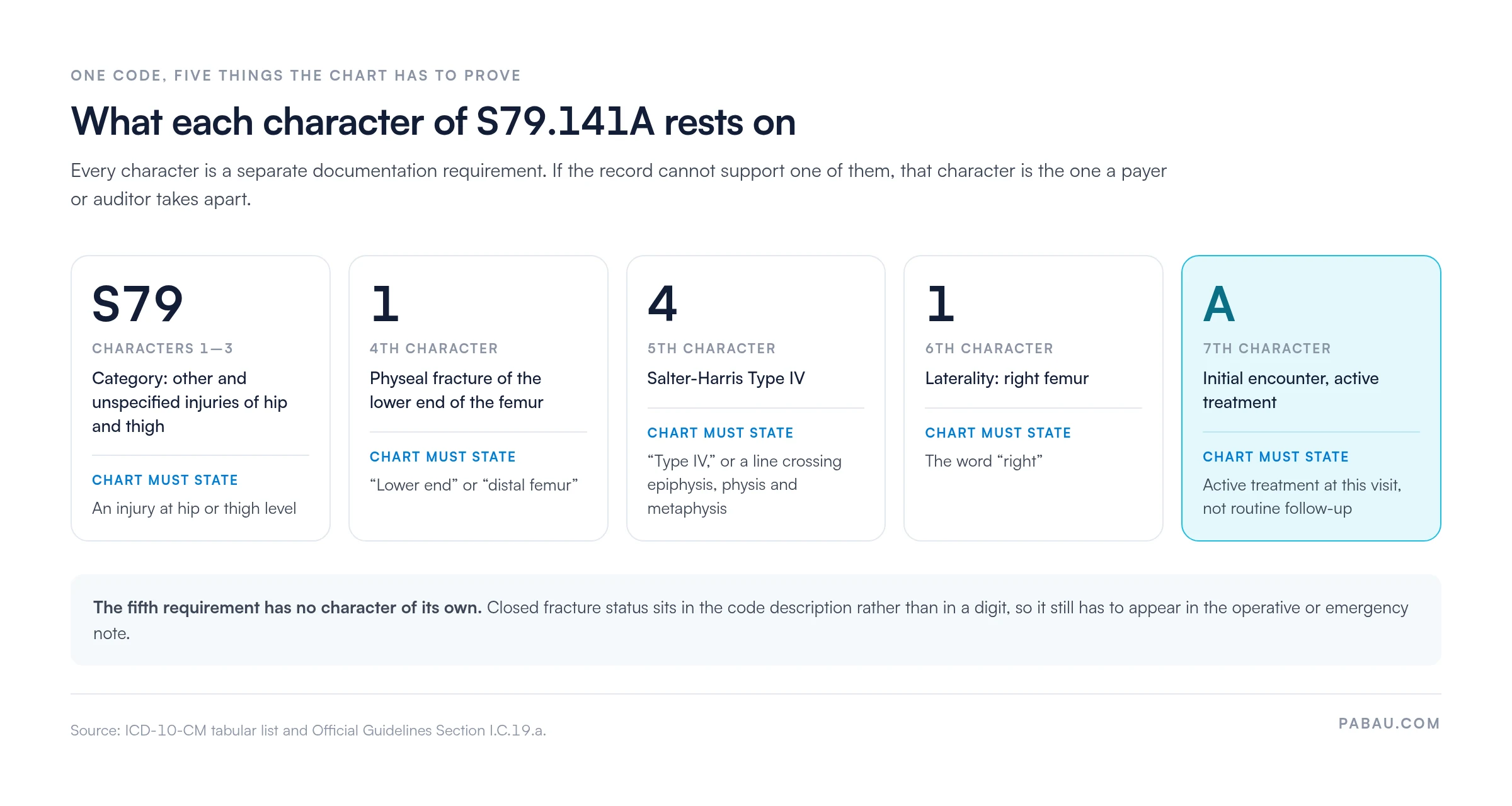
Orthopedic practices coding pediatric distal femur injuries do better with documentation templates that prompt for all five elements at the point of care. Building those prompts into the EHR template is more reliable than a post-visit chart review.
When submitting a clean claim for a pediatric fracture encounter, check every field the payer uses to test medical necessity. Populate all of them before the claim leaves the practice.
Most coding errors on S79.141A fall into four patterns. Each one is preventable with a pre-submission checklist built into the practice’s workflow. Practices running orthopedic or sports medicine software should flag all four in claim scrubbing.
Submitting S79.141 without the 7th character extension is a claim rejection waiting to happen. ICD-10-CM requires the full 7-character code for all fracture codes in Chapter 19. Similarly, using “D” on what is still an active treatment visit (such as a cast change three days post-injury) is an audit finding. The 7th character must reflect the clinical reality of the visit, not a default entry. The fee schedule sets the allowed amount, and the practice writes off the difference from its own charge. Front-desk data entry and back-office coding both feed cash collection, so errors compound downstream.
When laterality is documented in the medical record, coders must assign the laterality-specific code. Using S79.149A (unspecified femur) when the record clearly states “right” is considered a coding deficiency and may be flagged during a payer audit. This error reduces specificity and can trigger medical necessity reviews.
Each Salter-Harris type maps to a different subcategory within S79. A Type II fracture documented in the record but coded as Type IV is both a clinical error and a billing error. The same is true in reverse. Coders should never assign the Salter-Harris type from imaging impressions alone. The treating clinician’s documented diagnosis takes precedence for coding purposes.
Sequela codes (7th character S) apply after active treatment of the injury has concluded. The patient is presenting with a late effect, such as a growth plate arrest or an angular deformity. Using “S” during the active treatment phase is a coding error with reimbursement consequences. So is using “D” when a late effect is the primary reason for the visit.
The denial codes tied to these sequencing errors most often arrive as medical necessity denials (CO-50) or missing/incomplete information denials (CO-16). Practices with proactive denial management workflows catch these before they reach secondary review.
Build a fracture coding cheat sheet for your front-end coders. Map each Salter-Harris type to its correct S79 subcategory, add a laterality column (left/right/unspecified), and include a 7th character decision tree. Attach it to your EHR template for distal femur fracture encounters. Catching the right code at charge capture is faster than reworking a denial.
In most practices, S79.141A gets assembled from three places. The imaging report carries the Salter-Harris type, the operative note carries open or closed status, and the encounter note carries the treatment stage. Anything missing tends to surface weeks later, in a remittance.
Pabau keeps those records in one client file. Treatment notes, images, and consent forms sit against the appointment itself. The encounter template can prompt for laterality and fracture type while the patient is still in the room. Claims then go out electronically through Claim.MD, so a clearinghouse check runs before the payer ever sees the file.
The outcome is fewer physeal fracture claims coming back for rework. You also spend less time reconstructing what the chart should have said. Pabau’s claims management tools follow each claim from charge capture through to remittance, so you can see which codes are getting paid.

Pabau keeps client records, treatment notes, and electronic claims in one system. Orthopedic and sports medicine practices can check a fracture code before the claim leaves the front desk.

Fixing S79.141A at charge capture takes seconds. Fixing it after a denial takes a rework cycle and a delayed payment. That difference is the whole argument for prompting all five documentation elements inside the encounter template.
There is a clinical reason to get it right as well. A Type IV pattern at the distal femur can end in growth arrest. The record that supports the code is also the record the next provider reads. Coding it precisely and documenting it fully are the same job.
If your practice reworks physeal fracture claims more than once a quarter, start with the encounter template. Book a demo to see how Pabau handles fracture coding and electronic claim submission.

Need the nonunion equivalent? S72.435M walks through documenting a condyle fracture that never united.
Billing a vulvar biopsy? Vulvar biopsy billing guide covers biopsy of the vulva or perineum for a single lesion and why these claims get denied.
Billing an image-guided injection alongside fracture care? CPT code 20611 explains the ultrasound documentation payers expect.
Billing a total hysterectomy? Total hysterectomy billing guide covers the open total abdominal hysterectomy code, its 90-day global period, and which codes bundle in.
ICD-10 Code S79.141A is a billable ICD-10-CM diagnosis code for a Salter-Harris Type IV physeal fracture of the lower end of the right femur. It covers the initial encounter for a closed fracture. It is used in orthopedic, pediatric, and emergency settings when this specific fracture pattern is documented and the patient is actively receiving treatment.
Yes, S79.141A is a valid and billable ICD-10-CM diagnosis code for the current fiscal year. It can be submitted on claims when the documentation confirms right laterality and Salter-Harris Type IV fracture type. The record must also show closed fracture status and an initial encounter stage, per ICD-10-CM Official Guidelines Section I.C.19.a.
The 7th character ‘A’ is used when the patient is receiving active treatment for the fracture. That covers the initial emergency visit, surgical repair, casting, and any further active interventions in the same treatment phase. It transitions to ‘D’ (routine healing) only after the provider determines active treatment has ended.
Six extensions are valid for S79.141. They are A (initial encounter), D (subsequent, routine healing), G (subsequent, delayed healing), K (subsequent, nonunion), P (subsequent, malunion), and S (sequela). Each reflects a distinct clinical stage and must match the encounter documentation. Using the wrong extension is an audit finding.
The equivalent code for the left femur is S79.142A (Salter-Harris Type IV physeal fracture of the lower end of the left femur, initial encounter). Use S79.149A only when laterality is genuinely not documented in the record. Never use it as a substitute when the side is clearly stated.
S79.141A codes the diagnosis. The mechanism of injury is captured separately with an external cause code from the W-series. Examples include W18.x for falls on the same level and W17.x for falls from one level to another. ICD-10-CM guidelines require an external cause code alongside the injury code when the mechanism is documented. Sequence S79.141A as the principal diagnosis, followed by the fall ICD-10 code.