ICD-10 Code Z86.73: Personal history of TIA
ICD-10 Code Z86.73: Definition, descriptor, and code hierarchy ICD-10 Code Z86.7...

Last Updated: Nov 20, 2026
Billable Code Specific Code
E83.52 is the billable ICD-10-CM code for hypercalcemia, a blood calcium level that a provider documents as abnormally high. It also covers familial hypocalciuric hypercalcemia and milk-alkali syndrome.
The code sits in subcategory E83.5, Disorders of calcium metabolism. Hypercalcemia caused by hyperparathyroidism is an Excludes1 there, so it is coded to E21.0-E21.3 instead of E83.52.
Let Pabau's smart automation suggest the right codes, reduce claim denials, and keep your practice compliant—effortlessly.
Automate repetitive tasks and focus on what matters most—your patients.
Reduce coding errors and ensure compliance with the latest regulations.
Clean claims, fewer denials, and faster reimbursements.
Powerful insights and reporting to help your practice thrive.
HIPAA compliant SOC 2 certified GDPR-compliant Trusted by 4,000+ clinics worldwide

E83.52 is the billable ICD-10-CM code for hypercalcemia, and it also covers familial hypocalciuric hypercalcemia and milk-alkali syndrome.
Hyperparathyroidism is an Excludes1 at E83.5, so hypercalcemia from that cause is coded to E21.0-E21.3 alone, never with E83.52.
With malignancy, sarcoidosis or hypervitaminosis D, report the cause and E83.52, and let the focus of the encounter decide which comes first.
Assign E83.52 only from a provider’s diagnosis, because a high calcium result on its own is a lab finding.
Pabau pre-fills claims from the patient record, checks required claim fields and sends US claims through Claim.MD.
ICD-10 code E83.52 is the billable ICD-10-CM diagnosis code for hypercalcemia, an abnormally high calcium level that a provider documents as a diagnosis. CMS’s FY 2027 ICD-10-CM code files list it with the descriptor “Hypercalcemia” and one inclusion term, familial hypocalciuric hypercalcemia.
The code is complete at five characters (six with the decimal point), with no seventh character. It is valid for HIPAA-covered claims in the FY 2027 code set, which took effect on October 1, 2026.
E83.52 belongs to the US clinical modification only. The WHO’s ICD-10 browser stops at E83.5, so payers outside the US may expect a different code. Before billing, confirm the code against the current release in the CDC/NCHS ICD-10-CM web tool.
E83.52 applies whenever the provider diagnoses hypercalcemia, whatever the mechanism. That includes symptomatic cases (fatigue, polyuria, kidney stones, confusion) and elevations found on a routine metabolic panel.
The code covers:
A note on lab values: The diagnosis comes from the provider, not from the number. Section III.B of the FY 2027 Official Guidelines says abnormal findings are not coded unless the provider indicates their clinical significance. So a coder never assigns E83.52 from a calcium value alone.
Cutoffs also vary by laboratory. The record should show calcium above that laboratory’s reference range, plus a provider statement that it is hypercalcemia.
Excludes1 means two conditions are never reported together. For E83.52, those notes sit at two levels, subcategory E83.5 and category E83.
Exclusion notes can change at the October update. Recheck them each year in the AAPC Codify ICD-10-CM lookup or the CDC tool.
The four codes in subcategory E83.5 look alike but describe different calcium states. Swapping E83.51 for E83.52 is an easy keying slip, and it sends the wrong diagnosis to the payer.
Memory rule: E83.51 = Low (hypocalcemia). E83.52 = High (hypercalcemia). The numbers follow the alphabet, hypo before hyper. When the note points to a different metabolic disorder, our diagnostic code library covers the neighboring codes. Hypomagnesemia, for instance, belongs to subcategory E83.4 as code E83.42.
E83.52 carries no “code first” note, so it is not a manifestation-only code. It can be the principal or first-listed diagnosis when hypercalcemia is the reason for the encounter. Where a cause is documented, the cause decides whether E83.52 appears at all.
The decision guide below sorts the five situations coders meet most often.
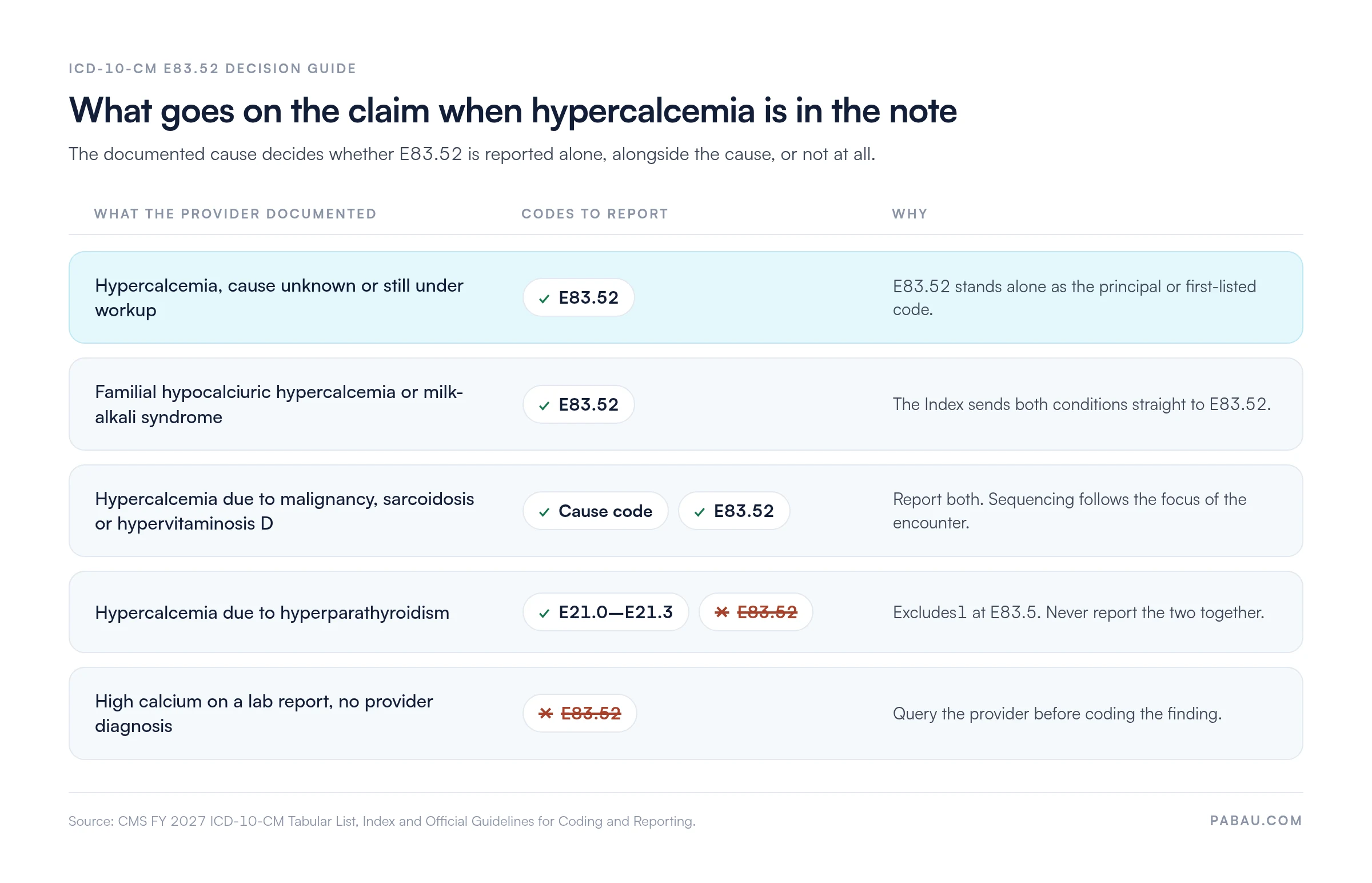
Malignancy needs the most care. Section I.C.2.c of the ICD-10-CM Official Guidelines sets sequencing rules for complications of cancer, but it does not name hypercalcemia. When only the dehydration from a cancer is treated, for example, dehydration is sequenced first.
So for hypercalcemia of malignancy, look at what the encounter was for. A visit to treat only the high calcium can list E83.52 first, followed by the neoplasm. A visit for the cancer itself lists the neoplasm first. When the note does not make the focus clear, query the provider.
Before you code a hypercalcemia encounter, check two things in the note. Does the provider name a cause, and is that cause hyperparathyroidism? If it is, code E21.x and drop E83.52. If the note says cause under investigation, E83.52 alone is correct for that visit. Never code a suspected cause.
A payer reviewing an E83.52 claim looks for a provider diagnosis, not an abnormal lab flag. These elements keep the code defensible and support sound medical billing compliance:
Here is the path an outpatient E83.52 claim takes in a typical practice, and where each step can go wrong.
A clean claim gets through steps four to six on the first pass. Most rework on these claims traces back to step one or two.
These services often appear on claims with E83.52 during workup and treatment. Each pairing still has to meet the payer’s medical necessity rules.
Our guides to CPT 82310 and CPT 83970 cover the billing rules for the two most common workup tests. For unexplained hypercalcemia, Noridian’s billing article A57718 also accepts E83.52 for CPT 82652.
For outpatient IV bisphosphonate infusions (zoledronic acid, pamidronate), 96365 (and 96366 for each additional hour) is typically paired with E83.52. Inpatient facility billing differs. Prior authorization rules vary by payer and plan, so confirm them before the infusion.
Denials on E83.52 claims fall into a few repeat patterns. Good denial management starts with knowing them before the claim goes out.
E83.52 is valid in both settings, but the rules for which diagnosis goes first differ. Apply the right set from the start.
If you run reports on Medicare claims data, search for E8352. The ResDAC guide to ICD codes in Medicare files explains that diagnosis codes are stored with the decimal point removed.
Most hypercalcemia claims stall for small reasons. A diagnosis is keyed from memory, a required field is blank, or a denial sits unread in a payer portal.
Pabau, the practice management platform we build, keeps those steps in one place. Coders search ICD-10-CM and CPT code libraries inside the claim, and claim details pre-fill from the patient record. Our claims management software checks that required claim fields are complete before you submit.
US practices send claims through Claim.MD as 837P files. Eligibility checks run before the visit, and ERA remittances come back into Pabau, so denials are visible next to the claim. Coding judgment, like the E21.x exclusion, stays with your coder.

Pabau pre-fills claims from the patient record, checks required fields and sends US claims through Claim.MD. Eligibility checks and ERA remittances sit beside each claim.

E83.52 is easy to find and easy to misuse. The code itself rarely causes trouble. The cause written next to it does.
Make one habit standard. Before an E83.52 claim leaves the practice, read the note for a cause and check it against the E83.5 Excludes1 list. That single check catches the hyperparathyroidism pairing, the missing neoplasm code and the lab-only diagnosis.
Book a demo to see how Pabau gets complete, correctly filled claims to the payer and brings the remittance back to your team.

Working a denial on a metabolic claim? Denial codes in medical billing explains the CARC and RARC codes payers return and how to respond.
Billing the vitamin D workup? CPT code 82306 covers coverage rules for the 25-hydroxy vitamin D test.
Treating hypercalcemia with zoledronic acid? HCPCS code J3489 covers units and billing for the drug itself.
Using pamidronate instead? HCPCS code J2430 walks through pamidronate billing and documentation.
New to the full billing cycle? What is medical billing follows a claim from encounter documentation to remittance posting.
No. ICD-10-CM has no combination code for it. Report the neoplasm code and E83.52, sequenced by the focus of the encounter.
Hypercalciuria, high calcium in the urine, is coded to R82.994. That includes idiopathic hypercalciuria. E83.52 is reserved for high calcium in the blood.
Yes. E83.52 is not on the CMS FY 2027 list of POA exempt codes, so inpatient claims report Y, N, U or W for it.
Without the decimal point, as E8352. Billing software usually strips the decimal for you, but manual entries and claim scrubber reports show the shorter form.
E83.52 belongs to ICD-10-CM, the US version. WHO’s ICD-10 ends at E83.5, and countries such as Canada and Australia use their own modifications.