CPT code 93567: Supravalvular aortography billing guide
CPT code 93567 covers aortography above the aortic valve CPT code 93567 reports ...

Last Updated: Nov 20, 2026
82652 is the CPT code for vitamin D; 1, 25 dihydroxy, includes fraction(s), if performed. It measures calcitriol, the active hormone form of vitamin D, rather than the 25-hydroxy storage form billed with CPT 82306.
Payers limit 82652 to specific indications. In Noridian's jurisdictions JE and JF, billing article A57718 (associated LCD L36692) lists unexplained hypercalcemia or hypercalciuria, kidney stones, osteomalacia and rickets. Other MACs publish their own vitamin D policies.
Let Pabau's smart automation suggest the right codes, reduce claim denials, and keep your practice compliant—effortlessly.
Automate repetitive tasks and focus on what matters most—your patients.
Reduce coding errors and ensure compliance with the latest regulations.
Clean claims, fewer denials, and faster reimbursements.
Powerful insights and reporting to help your practice thrive.
HIPAA compliant SOC 2 certified GDPR-compliant Trusted by 4,000+ clinics worldwide

CPT code 82652 covers vitamin D 1,25-dihydroxy (calcitriol) testing, the active hormone, not the storage form that CPT 82306 measures.
Noridian’s billing article A57718 lists 17 diagnosis codes for 82652, including active rickets, unexplained hypercalcemia or hypercalciuria, osteomalacia and kidney stones.
Under A57718, chronic kidney disease and parathyroid disorders support 82306, so check your own payer’s policy before billing 82652 for them.
Routine screening supports neither vitamin D code under Medicare, and a vitamin D status check belongs on 82306.
Pabau’s claims management software sends 82652 claims through Claim.MD, with eligibility checks and ERA remittances in the same workflow.
CPT code 82652 is defined by the American Medical Association as: “Vitamin D; 1, 25 dihydroxy, includes fraction(s), if performed.” The analyte is 1,25-dihydroxyvitamin D, or calcitriol, which Noridian’s vitamin D LCD describes as the kidney’s active vitamin D hormone. Calcitriol regulates calcium absorption, bone metabolism and immune function at the cellular level.
Medicare contractors limit 82652 to specific indications, such as unexplained hypercalcemia, kidney stones and suspected tumor-induced osteomalacia. A request to check a patient’s vitamin D status belongs on CPT 82306 instead.
The phrase “includes fraction(s), if performed” means the lab bills no extra charge when it measures individual dihydroxy fractions in the same assay. The whole assay goes on the claim as one unit of 82652.
82652 measures the 1,25-dihydroxy form and 82306 measures the 25-hydroxy form, two chemically different molecules at different points in the vitamin D pathway. Ordering the wrong one is a primary source of avoidable denials, because payers apply different medical necessity rules to each.
A frequent coding error is ordering 82652 for a patient whose vitamin D status is the only question. That is an 82306 indication. Routine screening is not covered for either code under 42 CFR 410.32(a) and SSA §1862(a)(7). If the clinical notes say “rule out deficiency” or “vitamin D levels,” 82306 is the correct code.
Before ordering 82652, ask one question: does the patient have unexplained hypercalcemia or hypercalciuria, kidney stones, osteomalacia or rickets? If yes, 82652 may be appropriate. If the goal is checking vitamin D nutritional status, order 82306 instead. Getting this right at the order stage prevents the denial before it starts.
In Noridian’s Jurisdictions JE and JF, billing article A57718 (associated LCD L36692) lists the diagnoses that support 82652. Other MACs, such as Palmetto GBA, CGS and Novitas, publish their own vitamin D LCDs and articles. A57718’s list covers disorders where measuring the active hormone, rather than the storage form, changes the workup.
Three indications that clinicians often associate with 82652 are commonly supported by other payers or clinical policies, but A57718 does not list them for 82652:
Routine screening is not covered under 42 CFR 410.32(a) and SSA §1862(a)(7), both cited in A57718. A clinical diagnostic test must be ordered by the treating physician for a specific medical problem and used to manage it.
Noridian’s Billing and Coding article A57718 covers vitamin D assay testing in Jurisdictions JE and JF. Its associated LCD is L36692. Noridian issues it, and other MACs publish their own LCDs and articles. Running an insurance eligibility verification before ordering the test is the first line of defense against denials.
Key coverage rules under A57718 for CPT code 82652:
Prior authorization: Requirements vary significantly by payer. Medicare does not require prior authorization for most laboratory tests including 82652, but many commercial payers do. Never assume Medicare rules apply to commercial plans. Check the payer’s current policy for each patient encounter.
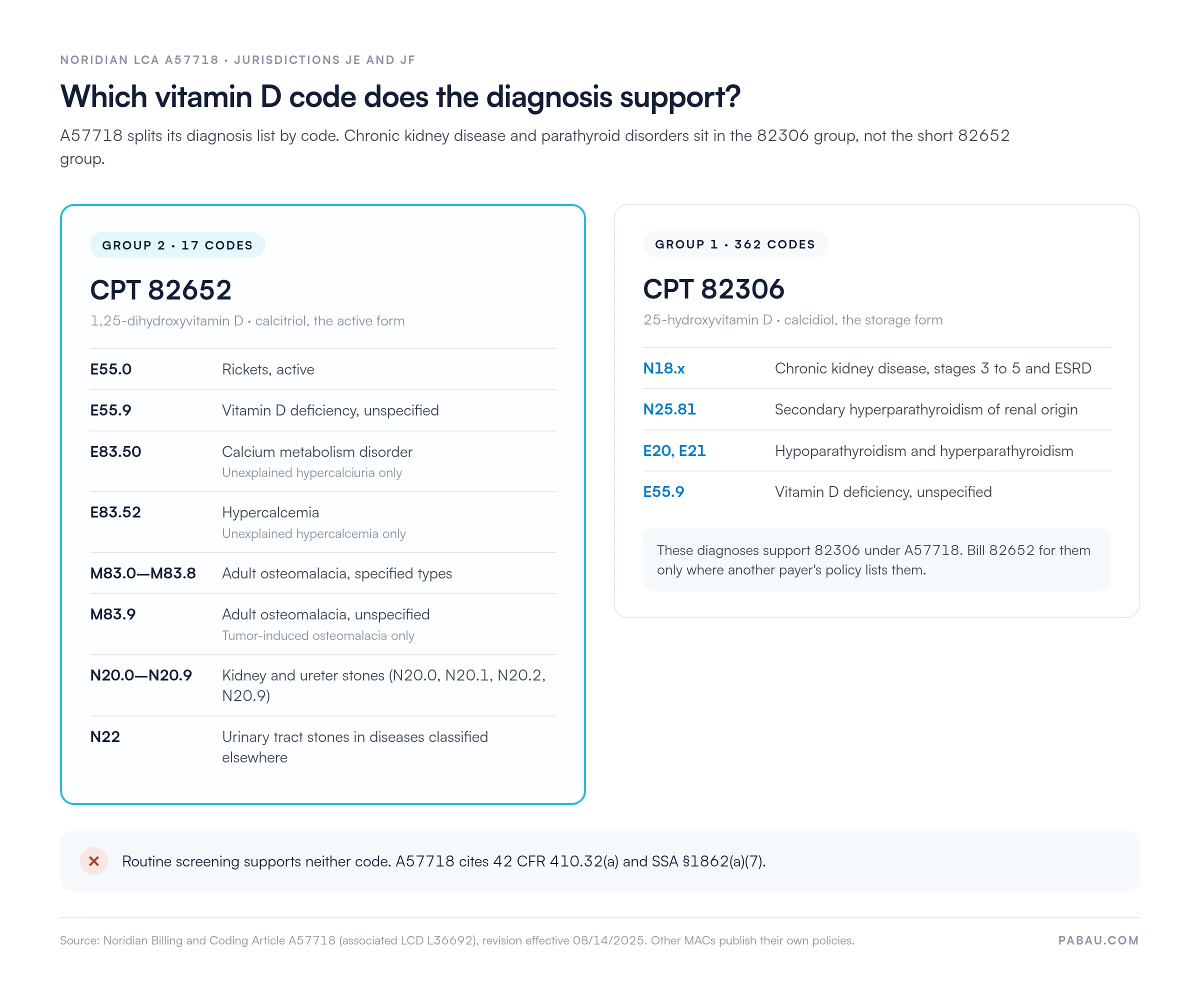
Every 82652 claim needs a supporting diagnosis code that maps to a covered indication. For unexplained hypercalcemia, A57718 pairs 82652 with E83.52 and limits that code to cases with no known cause. Key that code carefully, because E83.42, one digit away, codes hypomagnesemia. The table below shows the codes A57718 lists for 82652, then the codes other payers commonly accept.
Caution on E55.9: A57718 lists E55.9 for 82652, but many other payers read it as a status check that points to 82306. Pair it with a secondary diagnosis for the specific metabolic condition when both are clinically documented.
The split between the two vitamin D codes is easy to misread. Under A57718, 17 diagnosis codes support 82652, while 362 support 82306, including CKD stages 3 to 5 and parathyroid disorders.
82652 is paid under the Clinical Laboratory Fee Schedule (CLFS), not the Physician Fee Schedule (PFS). CMS sets the rates nationally and updates them each year. The CMS Physician Fee Schedule search tool verifies rates by locality. For lab codes, the CMS Clinical Laboratory Fee Schedule files are the definitive source.
Key reimbursement facts for CPT code 82652:
Because CLFS dollar amounts change annually and vary by locality, specific figures are not reproduced here. Pull the current year’s CLFS file from CMS or use a code lookup tool to retrieve the precise national limitation amount for 82652 before billing.
A clean 82652 claim requires four specific documentation elements before it reaches the clearinghouse. Missing any one is enough for a payer to deny or suspend the claim. Building a clean claim for laboratory codes starts at the point of care, not at the billing desk.
Submitting the claim electronically through a clearinghouse such as Claim.MD brings back an electronic remittance advice (ERA) with the payer’s adjustment reason codes. Those codes tell your billing team exactly why an 82652 line was reduced or denied.
82652 has a higher denial rate than most routine lab codes because its medical necessity bar is narrow. Understanding denial codes in medical billing and tracking them systematically is the first step to reducing write-offs on this code.
A structured denial management workflow tracks 82652 rejections by reason code, such as CO-50 and CO-96. It shows whether a problem is systemic, such as providers who were never trained on indication language, or an isolated coding error. Denial data grouped by code is more actionable than chasing individual claims.
Most modifier questions around 82652 come up in three scenarios, each covered below.
Before submitting a claim with both codes, check current bundling edits and LCD policy articles in the AAPC Codify CPT lookup. The CrossCoder procedure-to-diagnosis crosswalk tool helps with the same check.
Run a quarterly audit of 82652 claims against the CLFS allowable and your contracted commercial rates. Lab codes with narrow coverage criteria like this one tend to accumulate denials quietly. A single-payer denial pattern that takes two months to surface costs more in write-offs and rework than a 30-minute audit report would have flagged upfront.
Pabau, the practice management platform we build, sends US insurance claims through Claim.MD as CMS-1500 or 837P files. Eligibility checks run before the visit, so a lapsed plan shows up before the lab draws blood. ERA remittances come back into the same workflow, so an 82652 denial and its reason code sit next to the original claim.
Once the primary payer has paid, a secondary claim goes out from the same record. The medical claims clearinghouse guide walks through that workflow step by step. For practices handling both 82652 and high-volume 82306 orders, Pabau’s claims management software keeps each claim’s status and remittance in one place. A repeat 82652 documentation problem is then easy to spot.

Pabau connects with Claim.MD to handle CPT code submissions, eligibility checks, and ERA posting in one place. See how practices reduce claim denials for laboratory codes like 82652.

Justify 82652 before the blood draw, because a denial on a narrow lab code is far harder to fix afterward. In Noridian’s states the code supports a short list: unexplained hypercalcemia or hypercalciuria, kidney stones, osteomalacia and rickets. CKD and parathyroid disease route to 82306 there, so read your own MAC’s policy before you assume otherwise.
Write the indication into the order in the payer’s own words, and a vitamin D status check will land on 82306 where it belongs. Book a demo to see how Pabau keeps lab claims, eligibility checks and remittances in one billing workflow.

Choosing a clearinghouse for lab claims? Claim.MD vs Office Ally compares Pabau’s integrated clearinghouse against the alternative most independent labs consider.
Unfamiliar with ERA posting and 835 remittance files? Electronic remittance advice explains how ERA files carry denial reason codes back to your billing system automatically.
Building a denial prevention program? Medical billing compliance covers the documentation and audit practices that keep laboratory claims clean across payers.
Coding the deficiency itself? ICD-10 code E55.9 covers unspecified vitamin D deficiency and the documentation that supports it.
CPT code 82652 tests for vitamin D 1,25-dihydroxy (calcitriol), the biologically active hormonal form of vitamin D produced by the kidneys. This is chemically distinct from the storage form measured by CPT 82306. The 1,25-dihydroxy assay is ordered for specific metabolic disorders where active hormone production is directly relevant, not for general vitamin D status checks.
CPT 82306 measures 25-hydroxyvitamin D, the storage form; 82652 measures 1,25-dihydroxyvitamin D (calcitriol), the active form. 82306 is the code for assessing vitamin D status, including suspected deficiency. 82652 is ordered when a disorder of calcitriol production is suspected, such as unexplained hypercalcemia, kidney stones or tumor-induced osteomalacia. Medicare covers 82306 more broadly than 82652.
Yes, Medicare covers CPT code 82652 when the diagnosis meets the medical necessity rules in your MAC’s policy. In Noridian’s Jurisdictions JE and JF, billing article A57718 (associated LCD L36692) lists active rickets, unexplained hypercalcemia or hypercalciuria, osteomalacia and kidney stones. Other MACs publish their own vitamin D LCDs. Routine screening is not covered under 42 CFR 410.32(a) and SSA §1862(a)(7).
Under Noridian’s A57718, the listed codes include E55.0, E55.9, E83.50 and E83.52. E83.50 is for unexplained hypercalciuria only, and E83.52 for unexplained hypercalcemia only. The list also includes M83.0-M83.8, M83.9 for tumor-induced osteomalacia only, N20.0, N20.1, N20.2, N20.9 and N22. Other payers or clinical policies commonly support CKD (N18), parathyroid disorders (E20, E21) and sarcoidosis (D86). A57718 does not list them for 82652.
Prior authorization requirements depend entirely on the payer. Medicare Part B does not require prior authorization for most lab tests including 82652. Many commercial payers do require it, particularly for specialty metabolic panels. Always verify with the specific payer before ordering the test for a commercially insured patient to avoid a denial that could not have been appealed.
A clean 82652 claim starts with a physician order that states the specific clinical indication by name (not just “vitamin D level”). It also needs the most specific covered ICD-10 code, the lab report with the CLIA number, and a signed ABN if Medicare coverage is uncertain. The clinical notes must connect the order to a diagnosis on your MAC’s covered list before the test date. In Noridian’s JE and JF, that list is A57718.