ICD-10 Code I27.20: Secondary pulmonary hypertension, unspecified
ICD-10 code I27.20: Quick reference Use this table to verify billable status, ef...

Last Updated: Nov 18, 2026
Billable Code Specific Code
E83.42 is the billable ICD-10-CM code for hypomagnesemia, a serum magnesium level below the reference range. It sits under E83.4, disorders of magnesium metabolism, in the endocrine, nutritional and metabolic diseases chapter.
Assignment turns on the cause the provider documents. Dietary magnesium deficiency goes to E61.2, which an Excludes1 note keeps off the same claim. A newborn with low magnesium takes P71.2, and coexisting hypokalemia adds E87.6.
Let Pabau's smart automation suggest the right codes, reduce claim denials, and keep your practice compliant—effortlessly.
Automate repetitive tasks and focus on what matters most—your patients.
Reduce coding errors and ensure compliance with the latest regulations.
Clean claims, fewer denials, and faster reimbursements.
Powerful insights and reporting to help your practice thrive.
HIPAA compliant SOC 2 certified GDPR-compliant Trusted by 4,000+ clinics worldwide

E83.42 is the billable, specific ICD-10-CM code for hypomagnesemia, while the parent E83.4 is a non-billable header.
Dietary magnesium deficiency codes to E61.2, and an Excludes1 note at E83 keeps it off the same claim as E83.42.
Hypomagnesemia in a newborn codes to P71.2 from the perinatal chapter, not to E83.42.
The record needs a dated serum magnesium value with its reference range and a physician statement of the diagnosis.
Code a documented cause, such as a diuretic adverse effect or alcohol use disorder, alongside E83.42.
ICD-10 code E83.42 is the billable, specific ICD-10-CM code for hypomagnesemia, a serum magnesium level below the reference range. The tabular list in CMS’s FY 2027 ICD-10-CM files places it under E83.4, disorders of magnesium metabolism. Those files cover encounters from October 1, 2026, to September 30, 2027.
The table below collects the reference data coders check before billing E83.42. Confirm each field against the current code set in your EHR for the fiscal year of service.
Hypomagnesemia is a serum magnesium level below approximately 1.7 mg/dL (0.70 mmol/L), reflecting a deficit in total body magnesium stores. It matters clinically because magnesium drives neuromuscular transmission, cardiac rhythm regulation, and hundreds of enzymatic reactions.
Coders do not diagnose hypomagnesemia. They do need to know the clinical picture well enough to see when documentation supports the code.
Clinicians commonly document these causes, and each may need an etiology code alongside E83.42:
The record usually shows some of these findings:
Symptoms consistent with low magnesium plus a confirmatory lab value support E83.42 as a principal or secondary diagnosis. The one exception is a newborn, whose hypomagnesemia codes to P71.2 in the perinatal chapter.
Reading the tabular hierarchy keeps the non-billable parent E83.4 off the claim. In the FY 2027 files on the CMS ICD-10 codes page, E83.42 is the fifth level of a chain from Chapter 4.
E83.4 holds four billable codes: E83.40 (unspecified), E83.41 (hypermagnesemia), E83.42 (hypomagnesemia) and E83.49 (other disorders). Only E83.42 reports low magnesium. A claim that carries the parent E83.4 is rejected as a non-billable code.
To compare descriptors across neighboring categories, browse the ICD-10-CM code library before you finalize the claim.
The ICD-10-CM tabular list carries instructional notes at the category level that apply to E83.42 by inheritance. Check them before you finalize any claim that includes this code.
E83 carries an Excludes1 note for three groups of conditions coded elsewhere:
An Excludes1 note means the two conditions are never coded together. For E83.42, the entry that matters is E61.2, magnesium deficiency, which sits inside the excluded E58-E61 range. Claim scrubbers flag E83.42 and E61.2 on the same claim as an invalid combination.
Neither E83.4 nor E83.42 carries instructional notes of its own in the FY 2027 tabular list. The only restrictions are the ones inherited from E83. Notes can change in the annual update. Confirm the current year in the CDC/NCHS ICD-10-CM web tool.
Always look up instructional notes at every level of the hierarchy, not just the code itself. Notes at E83 apply to E83.42 even though they are not reprinted at the E83.42 entry. Coding software may display only the code-level notes by default.
The codes most often confused with E83.42 fall into three groups. These are the sibling magnesium codes in E83.4, the nutritional and newborn codes elsewhere in the classification, and the electrolyte codes in E87.
The wording in the note decides between E61.2 and E83.42. “Dietary magnesium deficiency” or “nutritional magnesium deficiency” goes to E61.2 alone. Low magnesium from renal wasting, GI loss or a medication goes to E83.42.
The Alphabetic Index also sends a bare “magnesium deficiency” to E61.2. When a note uses that phrase for a renal or GI loss, query the provider before you pick a code. The decision list below puts the five outcomes in the order a coder checks them.
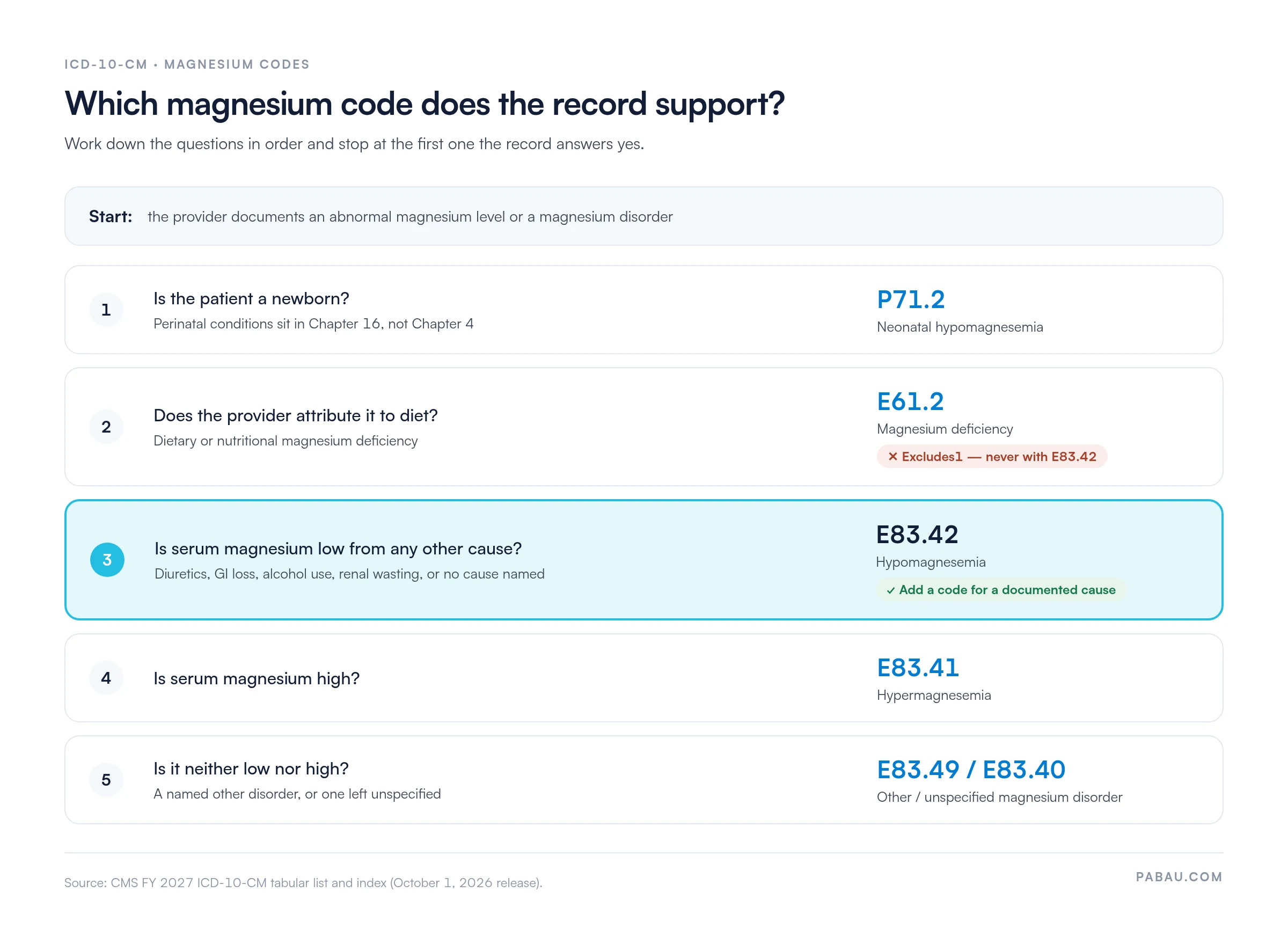
E83.42 works as either a principal diagnosis or a secondary code, depending on the clinical context. The sequencing decision turns on what the encounter was for and whether the provider identified an underlying cause.
Use E83.42 as the principal code when the hypomagnesemia itself is the reason for the encounter. The clinician documents and treats it as the primary condition, and no underlying cause is identified or confirmed in that encounter.
When the provider documents an underlying cause, the official ICD-10-CM guidelines call for the etiology to be coded alongside E83.42. Common combinations include:
The key principle from the ICD-10-CM guidelines: Code the underlying disease first when a “code also” or instructional note directs you to do so. When no such instruction exists but an etiology is documented, sequence by the principal condition treated.
Payers, including Medicare, expect the medical record to show specific elements before an E83.42 claim passes medical necessity review. A clean claim submission for E83.42 starts with these documentation essentials.
A lab value alone, without a physician diagnosis statement, is insufficient. An audit denies the claim when the only record entry is a flagged lab result. The physician must acknowledge it in a progress note or problem list.
Coverage for services billed with E83.42 is governed by Local Coverage Determinations (LCDs) from Medicare Administrative Contractors (MACs), not a single national policy. The most directly relevant LCD for most E83.42 encounters covers the serum magnesium test, CPT 83735. Each MAC jurisdiction, such as Novitas Solutions, CGS Administrators and Palmetto GBA, publishes its own LCD listing the indications that justify magnesium testing.
Key coverage considerations for E83.42 encounters:
Run insurance eligibility verification before the visit to confirm the patient’s active plan. Otherwise a lapsed or changed plan only surfaces once the claim is denied.
Denials on E83.42 claims follow predictable patterns, and each one maps to a specific documentation or coding correction. Sorting them by root cause is the first step in denial management workflows for electrolyte codes.
Hypomagnesemia often presents alongside hypokalemia (E87.6) and hyponatremia (E87.1), because magnesium plays a role in potassium and sodium transport at the cellular level. On these encounters, expect to report more than one electrolyte code.
Both E83.42 and E87.6 may be coded on the same claim when the physician documents both conditions as clinically addressed. Neither code carries an Excludes1 note against the other. Sequence by the principal condition treated or the reason for the encounter, per the official ICD-10-CM guidelines.
When a patient presents with refractory hypokalemia that is not responding to potassium replacement, the treating physician should document any coexisting hypomagnesemia. Magnesium deficiency prevents cellular potassium uptake. Coding both E83.42 and E87.6 accurately reflects the clinical complexity and supports higher-acuity DRG grouping in inpatient settings.
ICD-11, the current international standard maintained by the WHO, classifies hypomagnesemia under a different code structure. The WHO ICD-11 browser places low magnesium within its metabolic disorders chapter, under an identifier unlike E83.42.
For US coders, current practice does not change. CMS has not finalized a transition date from ICD-10-CM to ICD-11 for HIPAA-covered entities. US claims still require ICD-10-CM codes under 45 CFR Part 162, and E83.42 remains valid and billable for fiscal year 2026 and 2027 encounters.
An E83.42 claim depends on three records agreeing: the dated lab value, the physician’s diagnosis statement, and the claim itself. When those live in separate systems, every handoff risks losing the lab date or the diagnosis statement. The payer then reviews an incomplete record.
Pabau, the practice management platform we build, keeps them on one patient record. Practices that switch on US labs order Quest tests from the patient record, and Quest and Labcorp results sync back automatically. The lab trends chart then shows the magnesium values over time beside the treatment notes.
US claims go out as CMS-1500/837P files through our Claim.MD integration, with eligibility checks before the visit and ERA remittances posted back. Our claims software for practices builds each E83.42 claim from the record that already holds the lab value and the diagnosis statement.

Pabau keeps magnesium lab results, diagnosis notes and Claim.MD claims on one patient record, so each E83.42 claim carries the documentation payers review.

Before you submit E83.42, read the record the way an auditor will. A physician statement of hypomagnesemia, a dated serum magnesium value, and any documented cause decide whether the claim pays.
Two checks change the code itself. If the provider names diet as the cause, switch to E61.2 and drop E83.42, because the Excludes1 note does not allow both. If the patient is a newborn, P71.2 applies instead.
The trade-off is effort at the front of the cycle. Confirming the lab date and the diagnosis statement before submission costs less than reworking a denied claim. Book a demo to see how Pabau keeps lab results, diagnosis notes and claims on one patient record.

Need a clearinghouse that validates ICD-10 codes before submission? Pabau’s Claim.MD clearinghouse integration routes claims through real-time edits that catch E83.42 mismatches before they reach the payer.
Confused about how claim denials get resolved? Medical billing denial codes breaks down the most common CARC denial reason codes and what each one means for your follow-up workflow.
Want to understand the 837P claim format for diagnosis codes? Electronic claim file (837) explains how ICD-10-CM codes are transmitted in the HIPAA 837P transaction set.
ICD-10 code E83.42 is the billable ICD-10-CM diagnosis code for hypomagnesemia. It applies when serum magnesium is below the reference range and the provider documents and manages the condition. It sits under subcategory E83.4, disorders of magnesium metabolism, in Chapter 4. The parent E83.4 is a non-billable header.
E83.41 is hypermagnesemia, an elevated serum magnesium, and E83.42 is hypomagnesemia, a low one. They are sibling codes under E83.4 and describe opposite clinical states. The direction of the lab value decides which code applies.
Code it as E61.2, magnesium deficiency. Category E83 carries an Excludes1 note for dietary mineral deficiency (E58-E61), so E61.2 and E83.42 never appear on the same claim. Use E83.42 when the low magnesium comes from renal wasting, GI loss, a medication, or an unstated cause.
Yes, when the provider documents a cause. Code the etiology alongside E83.42, such as a diuretic adverse effect, alcohol use disorder or a malabsorption syndrome. When no cause is established, E83.42 may stand alone as the principal or a secondary diagnosis.
The usual causes are a lab result with no physician diagnosis statement and the non-billable parent E83.4 submitted in place of E83.42. Incorrect sequencing when an etiology should come first also triggers denials. So does billing the serum magnesium test (CPT 83735) more often than the MAC allows without a documented reason for each test.
Yes. E83.42 and E87.6 may be coded together when the provider documents both conditions and addresses them during the encounter. Neither code carries an Excludes1 note against the other. Sequence by the primary reason for the encounter, per the official ICD-10-CM guidelines.
Coverage depends on the Local Coverage Determination your Medicare Administrative Contractor applies to the service billed with E83.42. For CPT 83735, the serum magnesium test, most MAC LCDs list confirmed hypomagnesemia as a covered indication. Infusion-based magnesium replacement may vary by payer and setting, so check the current LCD before billing repeat tests.