HCPCS Code G0163: Skilled nursing observation and assessment
What is HCPCS Code G0163? HCPCS Code G0163 is a deleted Level II code for skille...

Last Updated: Oct 15, 2026
83970 is the CPT code for parathormone (parathyroid hormone).
Most denial activity on this code traces to two problems: a non-covered ICD-10 diagnosis paired to the order, or a frequency limit exceeded under Medicare's LCD L34018. Getting either wrong means the lab eats the cost. This reference covers the official descriptor, covered diagnosis codes, the 2026 Medicare Clinical Laboratory Fee Schedule rate, co-billed companion codes, and the documentation checklist that keeps 83970 claims clean on first submission.
Let Pabau's smart automation suggest the right codes, reduce claim denials, and keep your practice compliant—effortlessly.
Automate repetitive tasks and focus on what matters most—your patients.
Reduce coding errors and ensure compliance with the latest regulations.
Clean claims, fewer denials, and faster reimbursements.
Powerful insights and reporting to help your practice thrive.
HIPAA compliant SOC 2 certified GDPR-compliant Trusted by 4,000+ clinics worldwide

CPT Code 83970 reports quantitative intact PTH (parathormone) testing on serum or plasma – not intraoperative PTH monitoring, which uses a different code.
Coverage under Medicare LCD L34018 requires a supporting ICD-10-CM diagnosis; a non-covered or missing code is the leading denial trigger for this code.
The 2026 Medicare Clinical Laboratory Fee Schedule sets the national payment rate; commercial payer rates vary and contracted rates can differ a lot.
Practice management software like Pabau supports correct code and diagnosis pairing, reducing 83970 denials at the point of order entry.
CPT Code 83970 carries the official AMA descriptor “Parathormone (parathyroid hormone).” It sits within the Chemistry Procedures section of the CPT code set, spanning codes 82000 through 84999. According to the American Medical Association’s CPT code set, this section covers quantitative chemical analyses performed on body specimens. For 83970 specifically, that means a quantitative immunoassay measurement of intact PTH (iPTH, also called PTH 1-84) on a serum or plasma specimen.
Other hormone assays in that range are also paid under the Medicare Clinical Laboratory Fee Schedule. CPT code 83002 for luteinizing hormone is one example.
Two distinctions matter for correct code selection. First, 83970 covers standard outpatient or inpatient PTH measurement – not intraoperative PTH monitoring performed during parathyroid surgery, which uses a separate code. Second, it covers parathyroid hormone itself, not parathyroid hormone-related protein (PTHrP), which is a distinct analyte billed separately. Coders who blur these lines generate avoidable denials or, worse, overpayments subject to audit recovery.
Understanding the full scope of medical billing workflows for laboratory codes helps billing staff apply these distinctions consistently across the revenue cycle.
PTH testing is medically necessary when a clinician needs to identify the cause of abnormal calcium levels. Clinicians also use it to monitor a known parathyroid disorder, or track mineral metabolism in kidney disease. Medicare’s LCD L34018 and most commercial payer policies recognize a defined set of clinical scenarios. The ordering provider’s documentation must reflect each indication – a lab order alone does not establish medical necessity.
Once those results confirm primary hyperparathyroidism and surgery is planned, the workup moves to preoperative localization. The parathyroid planar imaging that pinpoints the overactive gland is billed under 78070, with its own documented indication.
A non-covered or absent ICD-10-CM diagnosis code is the single most common denial trigger for 83970 claims. The table below lists the primary covered codes under Medicare LCD L34018 and major commercial payer policies. Note that covered code lists can vary by MAC jurisdiction and payer; always verify against the specific payer’s LCD or coverage bulletin before billing.
Cross-checking a proposed diagnosis against the covered code list at the point of order entry is a reliable check. It confirms the payer recognizes the diagnosis before you submit the claim.
LCD L34018 (titled “Parathormone”) is the CMS Local Coverage Determination that governs Medicare payment for 83970. CMS Article A57122 is the companion billing and coding article that provides documentation and submission instructions specific to this code. Together they define what coverage includes and excludes. They also set how often you can bill the test per benefit period, and what records must support each claim.
Key provisions billing staff need to track:
The Medicare Clinical Laboratory Fee Schedule (CLFS) prices CPT Code 83970, and the Protecting Access to Medicare Act (PAMA) governs that schedule. PAMA pricing uses weighted median private payer rates that laboratories report, and CMS resets the rates on a three-year cycle. Verify the 2026 national payment rate for 83970 directly against the published CMS fee schedule lookup tool. Rates adjust annually and vary by clinical setting.
Two practical points for billing managers. First, commercial payer contracted rates for 83970 often differ a lot from the Medicare rate – sometimes higher, sometimes lower depending on the payer contract. Second, bill CLFS codes on a CMS-1500 or 837P claim with a date-of-service equal to the collection date, not the reporting date. Pabau’s integration with Claim.MD supports electronic claims via Claim.MD to over 4,000 US payers, with built-in CPT catalogues that flag code-level edits before submission. Understanding how electronic remittance advice works helps practices reconcile CLFS payments against expected rates quickly when discrepancies arise.

Pabau’s claims management module connects coding, documentation, and clearinghouse submission in one workflow. Pair the right diagnosis code to every lab order and catch edits before claims leave your practice.

Billers routinely confuse several codes with 83970 or bill them alongside it on the same date of service. The distinction between 83970 and intraoperative PTH monitoring matters most. Using the wrong code in a surgical context is a material billing error that attracts audit attention.
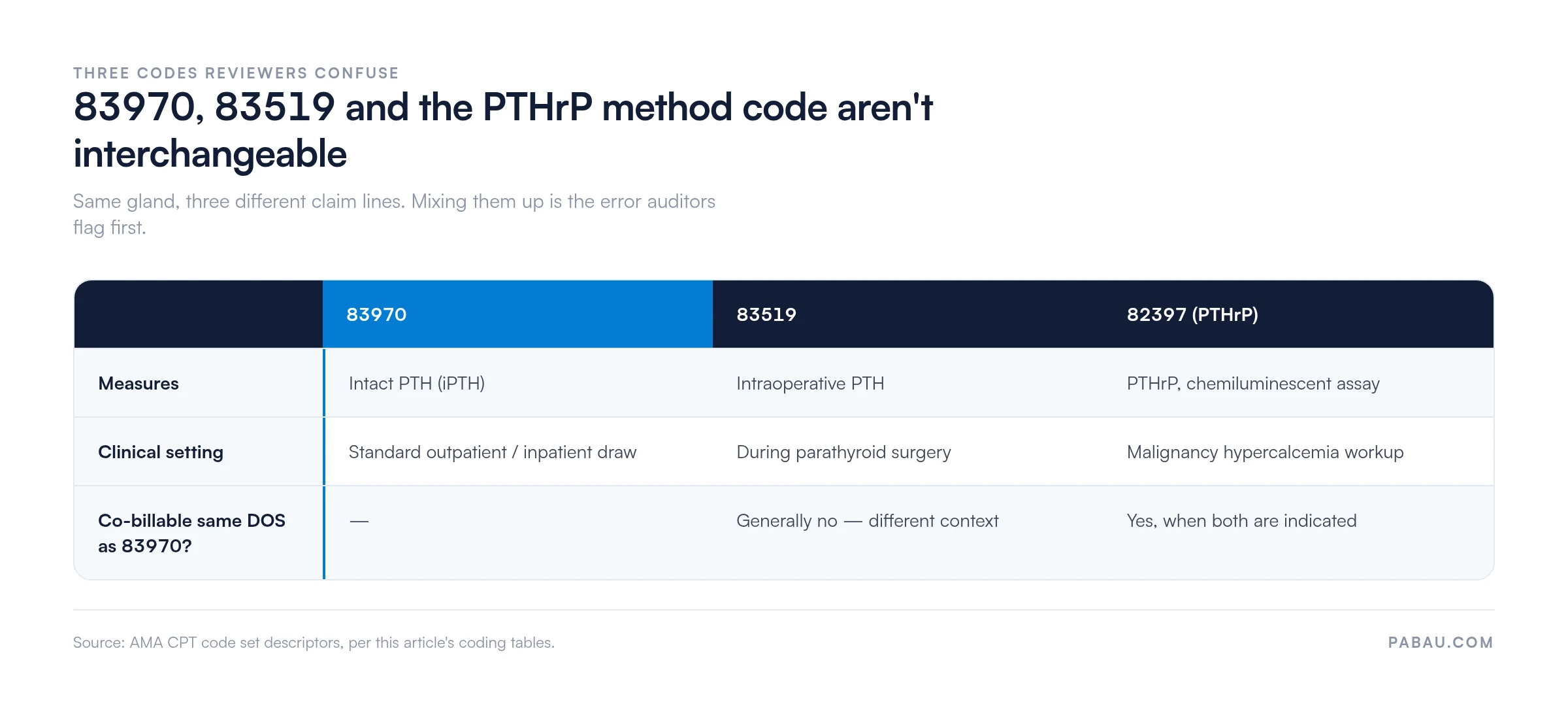
Most 83970 denials fall into a short list of recurring patterns. Addressing them at the front end of the revenue cycle costs far less than working remittances after the fact. Effective denial management starts with identifying which pattern is generating the most volume in your practice.
Understanding common denial codes in medical billing helps coding teams map remittance adjustment reason codes (CARCs) back to these root causes. Practices using Pabau’s claims management software can configure code-level editing rules that surface these denial triggers before a claim leaves the practice.
Run a quarterly denial analysis on 83970 claims sorted by CARC code. The top three CARCs will almost always map to ICD-10 mismatches, frequency overruns, or missing documentation. Fixing one systemic root cause saves more money than working individual claim appeals.
Thorough documentation is the single most reliable defense against 83970 audit exposure. The ordering provider’s note must give a reviewer enough information to confirm medical necessity without extra explanation. That’s why medical billing compliance practices emphasize documenting in real time over adding notes later.
What the medical record must contain for each 83970 order:
Practices that integrate lab ordering directly into their superbill documentation workflow reduce the risk of indication gaps. Staff capture the diagnosis code and the clinical note in the same encounter, instead of reconciling them later.
Medicare generally does not require prior authorization for outpatient laboratory tests billed under the Clinical Laboratory Fee Schedule, including CPT Code 83970. The coverage gate for Medicare is medical necessity under LCD L34018, not a pre-authorization step. However, that does not mean you never need authorization.
Three scenarios where you need extra steps:
The foundations of medical billing consistently emphasize one principle here: a denied claim that needed prior authorization always costs more than the check would have. A two-minute eligibility check at the time of order always catches the requirement first.
Most 83970 denials come down to one of two problems. Staff never checked a diagnosis code against the LCD L34018 covered list, or a frequency limit went untracked. Practice management software like Pabau closes that gap at the point of order, not after the remittance arrives.
Pabau’s claims management software flags a non-covered ICD-10 pairing before you finalize the lab order. Its digital forms then hold the clinical indication and the ABN on the same patient record the biller sees at claim time. When a claim does deny, the remittance detail stays attached to the original order, so the root cause is visible without pulling three systems together.
Pabau pairs the diagnosis code to the lab order, flags frequency and ABN issues at entry, and keeps the documentation trail on one patient record.
CPT Code 83970 denials are almost entirely preventable. The two dominant failure modes are a non-covered ICD-10 code and an exceeded frequency limit. You can address both at the front end of the workflow, before you submit the claim. Getting the diagnosis pairing right and documenting the clinical indication in the ordering note closes most of the denial gap. Verifying authorization requirements for non-Medicare patients closes the rest.
Pabau’s claims management workflow connects lab code entry, diagnosis validation, and clearinghouse submission in a single pipeline. This way, you fix a recurring 83970 denial at its source, instead of reworking it claim by claim. Book a demo to see how Pabau keeps 83970 claims accurate from order entry through remittance.

Need a structured approach to lab billing compliance? Medical billing compliance practices covers the documentation and audit-readiness steps that protect practices across all lab code types.
Want to understand how clearinghouse submission works? How Claim.MD clearinghouse works explains the electronic claims pathway from practice to payer, including edit logic and ERA reconciliation.
Looking for the broader denial prevention framework? Denial management in healthcare walks through the root-cause analysis process that reduces denial volume across an entire revenue cycle.
CPT Code 83970 covers quantitative measurement of parathyroid hormone (parathormone) on a serum or plasma specimen using an immunoassay method. It applies to standard outpatient and inpatient PTH testing, not intraoperative PTH monitoring during parathyroid surgery.
Key covered ICD-10-CM codes include E21.0 (primary hyperparathyroidism), E20.0 (idiopathic hypoparathyroidism), E83.52 (hypercalcemia), and E83.51 (hypocalcemia). Others are N18.1-N18.6 (CKD stages), E55.9 (vitamin D deficiency), and M81.0 (age-related osteoporosis). Covered code lists are MAC-specific; always verify against the current LCD L34018 for your jurisdiction.
Yes, you can generally bill 83970 on the same date as CPT 82310 (calcium, total), 82306 (vitamin D, 25-OH), 84100 (phosphorus), and 83735 (magnesium). Each test needs its own clinical indication and a separate order. Verify that billing a basic metabolic panel (80048) on the same date does not create component unbundling issues. Check for any chemistry already included in the panel.
Not for Medicare – laboratory tests under the Clinical Laboratory Fee Schedule do not require prior authorization from Medicare. However, many commercial insurers and managed Medicaid plans do require it. Check the specific plan’s requirements at the time of the order, not after you collect the specimen.