



CCSD code G5100: Bypass of duodenum billing guide
CCSD code G5100 bills a bypass that leaves the duodenum in place CCSD code G5100...

Last Updated: Oct 16, 2026

CPT code 82306 describes Vitamin D; 25 hydroxy testing, the 25-hydroxyvitamin D assay used to assess a patient’s vitamin D status.
Medicare covers CPT 82306 only when it is medically necessary under Billing and Coding Article A57718. Routine screening in healthy patients is not covered.
The 2026 Medicare national average reimbursement for CPT 82306 is roughly $17-19, and rates vary by MAC jurisdiction and place of service.
Practice management software like Pabau automates 82306 claim submission, eligibility checks, and ERA processing through the Claim.MD clearinghouse.
CPT code 82306 is the AMA-maintained code for measuring 25-hydroxyvitamin D, the primary circulating form of the vitamin. Labs report it to assess a patient’s vitamin D status. The official descriptor reads: Vitamin D; 25 hydroxy, includes fraction(s), if performed.
The “includes fraction(s), if performed” language means the code covers total 25-hydroxyvitamin D measurement. Any sub-fractionation, meaning D2 and D3 reported separately, is bundled into the single code. Billing a separate code for each fraction is incorrect and may trigger a claim edit.
That bundling rule belongs to 82306 alone. A descriptor that reads “each” works the opposite way, so 82172 for apolipoprotein testing bills one unit per analyte.
Confusing these two codes is one of the most common upcoding errors in lab billing. CPT 82306 measures the storage form of vitamin D. CPT 82652 measures the active hormone form. They answer different clinical questions and carry different coverage rules.
Billing 82652 when 82306 was clinically appropriate is an upcoding risk. Payers may apply a National Correct Coding Initiative (NCCI) edit if both tests are ordered on the same date. They then bundle the pair and pay for one.
Every CPT 82306 claim needs a supporting ICD-10-CM diagnosis code that establishes medical necessity. Billing and Coding Article A57718 and most commercial payer policies recognize the same core set of conditions. Missing or unsupported diagnosis codes are the leading cause of 82306 denials. Our ICD-10-CM code library carries the full descriptors, and the ICD List lookup confirms billable status before you submit.
Always document the specific diagnosis in the medical record before ordering the test. A code that maps to screening or examination rather than an active condition typically fails medical necessity review. Capture the patient’s active conditions during eligibility verification, before the requisition leaves the practice.
Screening is not an automatic denial on every lab code. Guaiac fecal occult blood testing bills under 82270, which Medicare covers once every 12 months for average-risk screening.
Medicare coverage for CPT 82306 is set out in Billing and Coding Article A57718, which CMS maintains alongside LCD L36692. The article establishes that vitamin D 25-hydroxy testing is covered only when it is medically necessary for diagnosing or treating a specific condition.
Medicare and most commercial payers cover CPT 82306 when the patient carries one of the qualifying conditions below. Each ordering event has to map to a documented active diagnosis, not to a risk factor.
Routine population screening is the most common reason for denial. Medicare does not cover CPT 82306 ordered as a preventive wellness test in an otherwise healthy patient without a qualifying diagnosis. Common denied scenarios include the following.
Denials like these cost more to rework than the test pays. A steady denial management routine helps billing teams catch the pattern before it repeats. Five checkpoints decide whether an 82306 claim clears, and any one of them can sink it.
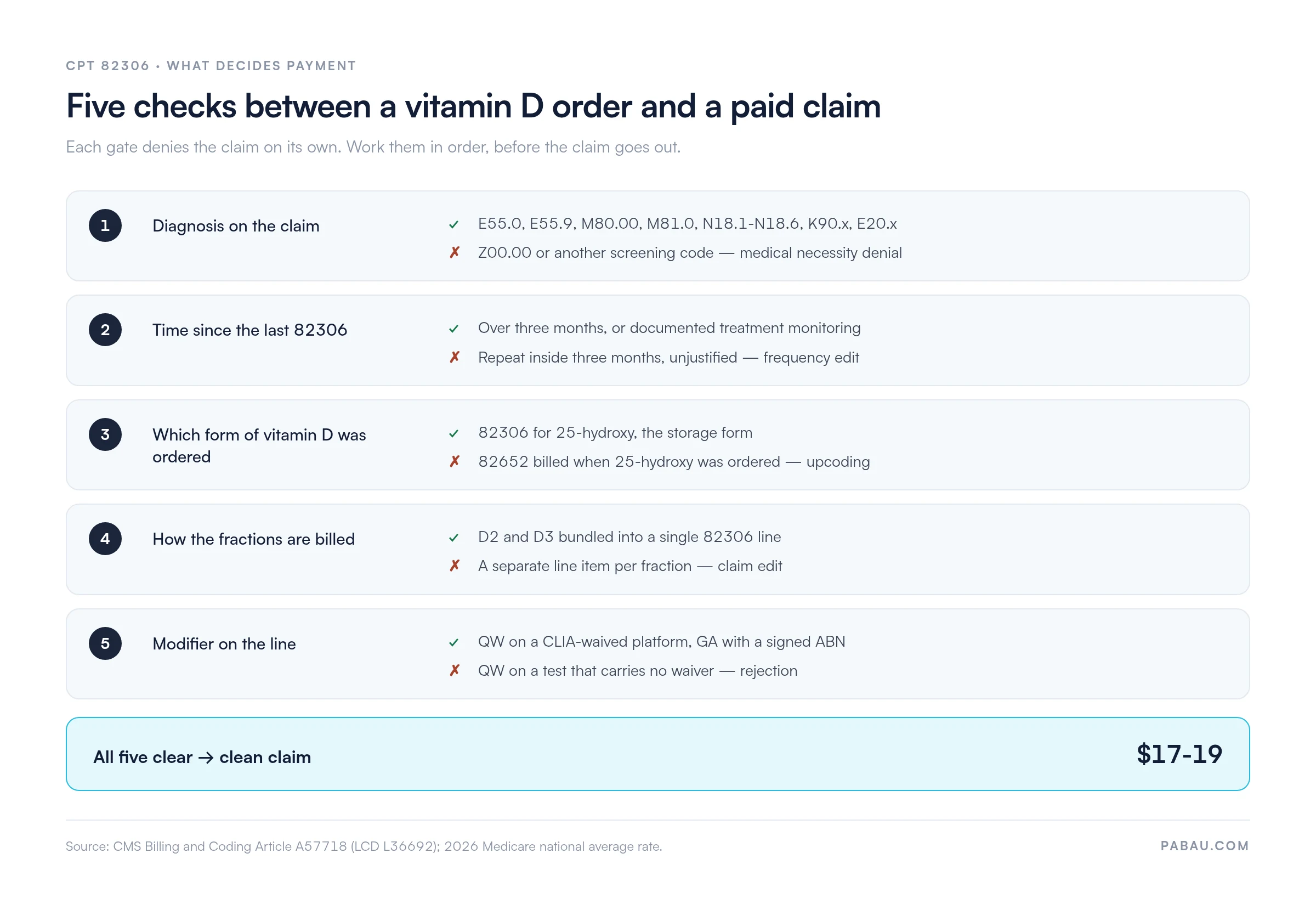
Before submitting any CPT 82306 claim, confirm the ordering provider has documented the qualifying ICD-10 diagnosis in the patient’s record. A code on the lab requisition alone will not hold up. Payers audit vitamin D claims often and request medical record support. A claim that passes initial review can still be recovered under post-payment audit if the documentation does not support the stated diagnosis.
Commercial payers broadly follow the Medicare coverage framework but apply their own medical policy language. Their criteria are similar without being identical. Always check the individual plan’s policy before ordering.
Checking eligibility and benefit details before ordering is the most effective way to prevent a denied claim. Many commercial plans now require prior authorization for repeat vitamin D testing within six months, so verify each patient’s plan requirements individually.
CPT 82306 is reimbursed under the Medicare Physician Fee Schedule (MPFS) and the Clinical Laboratory Fee Schedule (CLFS). The rate depends on where the test is performed and which MAC jurisdiction the provider falls under. Use the CMS Physician Fee Schedule lookup tool to retrieve the exact 2026 rate for your locality.
Place of service affects reimbursement. A test billed from an independent laboratory reimburses differently than one billed from a hospital outpatient department. For CPT 82306, the 2026 Medicare national average sits at roughly $17-19 under the clinical laboratory fee schedule. Individual MAC jurisdictions vary around that figure.
At $17-19 a claim, the reconciliation work costs more than the underpayment it finds, so few teams do it by hand. Practice management software like Pabau captures the ERA and matches each payment against the submitted claim automatically. Small underpayments then surface on their own, which matters on a code a busy lab bills hundreds of times a month.
Vitamin D testing has straightforward coding rules, and coders still trip on the same handful of errors. The modifiers below are the ones that apply, and the mistakes after them are the ones that cost the most to unwind.
Modifiers for CPT 82306 are limited but important to apply correctly.
These are the errors that most frequently cause CPT 82306 claims to reject or deny on first submission. Resolving them at the front end costs far less than working denials afterward.
Building clean claims from the start reduces denial rates. Before submitting, confirm each CPT 82306 claim carries the correct procedure code and a supporting ICD-10 code. Then check the modifier, where one applies, and the place of service code. Capturing the diagnosis at the point of care removes most of the downstream rework.
Practices ordering vitamin D testing hit the same billing problems every month. Eligibility mismatches, missing ICD-10 codes and unreconciled remittances all land in the same aging report. Pabau is practice management software with claims tools for labs built in, covering the full claim lifecycle for codes like CPT 82306.
The workflow starts with CPT and ICD-10 code entry, then runs real-time eligibility verification before the test is ordered. Claims go out electronically through the Claim.MD clearinghouse, and ERA matching happens automatically when the payment arrives.
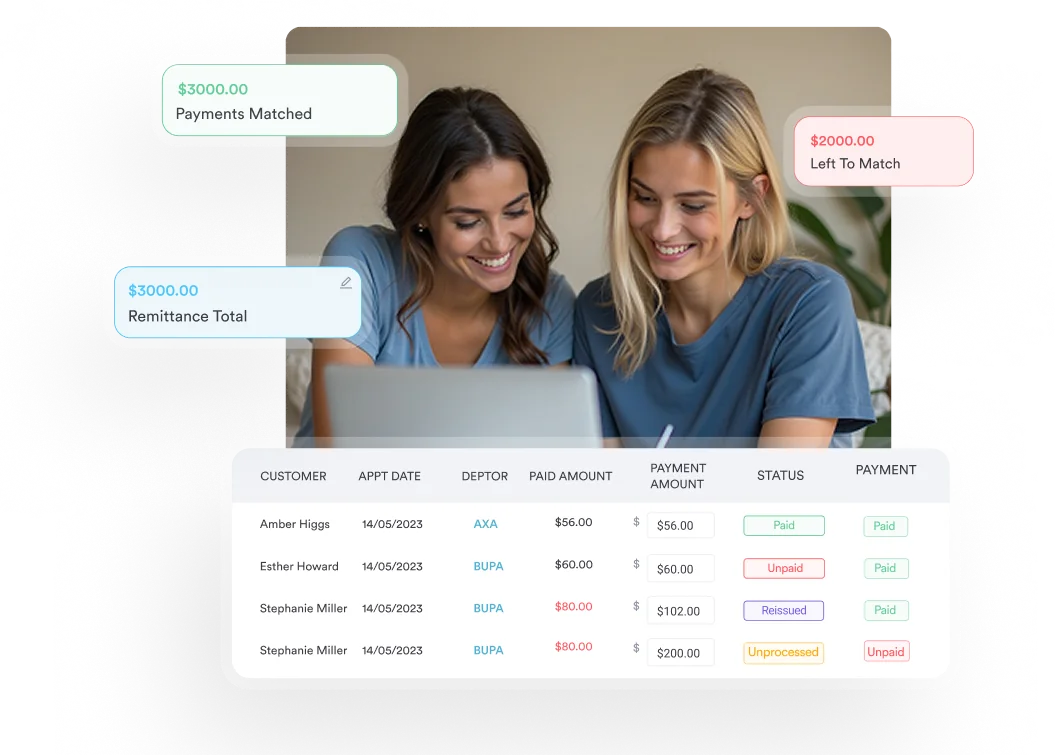
Claim.MD reaches more than 4,000 US payers and supports the CMS-1500 and 837P claim formats. Practices on Pabau submit vitamin D claims electronically, receive real-time eligibility responses, and process 835 remittance files without manual entry.
Tracking each 837 claim file through to ERA receipt shows billing teams where every claim stands, so nobody chases a payer for a status update.

Pabau validates CPT and ICD-10 pairings, checks eligibility in real time, and submits clean claims for lab tests including CPT 82306 through Claim.MD. Remittances match themselves against the claims you sent.

CPT 82306 pays under $20 and takes as much administrative work as a claim worth ten times that. Every denial you rework erases the margin on several paid tests, which is what makes the front end worth the effort here.
So decide the diagnosis before the requisition goes out, not after the remittance arrives. Confirm the qualifying ICD-10 code sits in the chart, keep the fractions on one line, and append QW or GA only where they belong.
Do that consistently and vitamin D testing stops appearing in your denial reports at all. Book a demo to see how Pabau builds, submits, and reconciles lab claims like CPT 82306.

Need to understand how clearinghouse billing works? Medical claims clearinghouse guide explains how clearinghouses validate and route electronic claims to payers.
Want to reduce claim denials across your practice? Denial management in healthcare covers the systematic approach to tracking, appealing, and preventing insurance denials.
Billing across multiple lab codes? Revenue cycle management explained walks through the full financial workflow from patient registration to final payment posting.
CPT code 82306 is the AMA procedure code for Vitamin D; 25 hydroxy, includes fraction(s), if performed. It describes laboratory measurement of 25-hydroxyvitamin D, which is the vitamin’s primary circulating form. Payers cover it to assess deficiency and sufficiency in patients with qualifying clinical conditions.
The most commonly accepted ICD-10 codes are E55.0 and E55.9 for vitamin D deficiency, plus M80.00 and M81.0 for osteoporosis. Chronic kidney disease uses N18.1-N18.6, malabsorption uses K90.0 and K90.1, and hypoparathyroidism uses E20.0 through E20.9. Always verify the code against Billing and Coding Article A57718 for your MAC jurisdiction.
Yes, Medicare covers CPT 82306 when it is medically necessary under Billing and Coding Article A57718, the CMS article associated with LCD L36692. Coverage requires a documented qualifying diagnosis such as vitamin D deficiency, osteoporosis, chronic kidney disease, or malabsorption. Routine screening in healthy individuals is not covered.
The 2026 Medicare national average reimbursement for CPT 82306 is approximately $17-19, though rates vary by MAC jurisdiction and place of service. Use the CMS Physician Fee Schedule lookup tool for the exact rate in your locality. Hospital outpatient departments bill under the Outpatient Prospective Payment System, which uses a different rate structure.
CPT 82306 measures 25-hydroxyvitamin D, the storage form used to assess overall vitamin D status. CPT 82652 measures 1,25-dihydroxyvitamin D, the active hormone form, used to evaluate calcium metabolism disorders, renal osteodystrophy, and granulomatous diseases. Billing 82652 when 82306 was clinically appropriate is an upcoding error. Payers may also bundle both codes if they are ordered on the same date of service.
Generally yes. CPT 82306 can be billed alongside other chemistry codes on the same date of service. Billing 82306 with 82652 on the same date may trigger an NCCI edit, with payers bundling both into a single payment. Billing the D2 and D3 fractions as separate line items is also incorrect, since fractionation is included in the 82306 descriptor.



