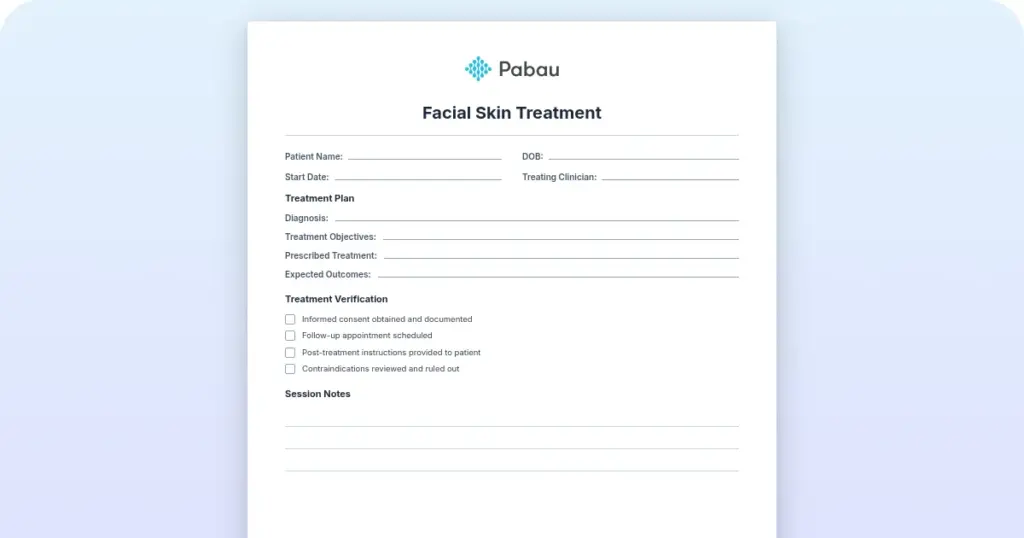
Facial skin treatment consent form template: Microneedling and phi-ion
A facial skin treatment consent form is the signed proof that a patient was scre...

2
Last Updated: Oct 21, 2026

A med spa is a hybrid facility offering medical-grade aesthetic treatments under physician or licensed provider supervision, distinct from a day spa.
Common med spa services include injectables, laser treatments, chemical peels, and body contouring, all of which need medical oversight.
State licensing rules vary widely, so verify a med spa’s medical director and compliance record before booking or opening one.
Practice management software like Pabau keeps consent forms, treatment records, and scheduling in one place for med spa teams.
More than 11,000 medical spas operate across the United States, according to the American Med Spa Association (AmSpa). The industry now generates over $17 billion in annual revenue, and that growth has outpaced most other healthcare service sectors. Eight platforms built for med spas are ranked on charting, payments and memberships in our medical spa systems comparison.
Yet many people still aren’t sure what separates a med spa from a day spa. That distinction matters legally and clinically, especially for practitioners thinking about opening one.
Below you’ll find what a med spa is, how it differs from a day spa, and which treatments it can legally offer. There’s also a section for operators on what running one involves day to day.
A med spa, short for medical spa, is a hybrid healthcare facility. It combines the relaxing environment of a day spa with clinical-grade aesthetic treatments. Licensed medical professionals perform or supervise those treatments, so patients come for results rather than relaxation alone.
The menu of treatments is only part of the difference. Medical accountability sits behind every service a med spa offers. A licensed physician must be involved in oversight, either on-site or as a medical director, depending on state law.
Three characteristics define a true med spa:
Merriam-Webster calls it “a medical facility where nonsurgical cosmetic procedures … are performed by health care professionals under the supervision of a licensed physician.” The examples it lists are botulinum toxin injections, chemical peels, microdermabrasion, and laser hair removal. That definition holds, though the regulatory picture is more layered than a dictionary entry can show.
Med spas and day spas share an aesthetic. Both offer a calm atmosphere and focus on how you look and feel. The differences show up in clinical depth, regulatory status, and what results are achievable.
Day spas operate under cosmetology or esthetician licensing in most states. Med spas operate under a medical framework. Offering injectable or laser services without that structure exposes a facility to serious liability.
The treatments on a med spa menu need a medical license, medical-grade equipment regulated by the FDA, or both. That is the practical reason a clinical environment matters.
Results at a med spa are measurable and clients expect them. Thorough clinical records carry as much weight as the treatment itself, which is why documentation habits separate the strong practices from the rest.
Treatments are performed by physicians, nurse practitioners, registered nurses, and licensed estheticians, each within their own scope. The staff hierarchy is not uniform across states, and scope-of-practice rules vary. Here is the structure most med spas follow.
Many med spa owners work with a hired or contracted medical director. Hiring a medical director takes more than finding an available physician. It requires written protocols, a defined supervision arrangement, and liability alignment. Employment terms matter too, including any physician non-compete that limits who you can hire.
The American Academy of Dermatology notes that safety in aesthetic settings depends on the training and oversight behind the person treating you. A credential on the wall tells you nothing about who supervises what.
Med spa requirements are set at the state level in the US, with no single federal framework for the category. That creates wide variation, which matters most for multi-state operators and anyone moving between states.
A few requirements hold across nearly all states:
California and Texas both add state-specific rules on top of that. California med spa licensing covers physician supervision, NP ownership, and corporate practice of medicine restrictions. Texas med spa licensing outlines the state board rules and ownership structures that come up most often.
Some states also require separate facility registration or inspection beyond a standard business license. Confirm your state’s rules with the medical board before you settle on an ownership or staffing structure.
Check whether your state uses a Medical Spa Practice Act or general Medical Practice Act to regulate med spas. Many states have issued specific guidance on delegation, supervision ratios, and which procedures require direct physician presence. AmSpa’s state law summaries are a useful starting point before consulting a healthcare attorney.
The clinical oversight that defines a med spa also drives its value for patients. A facial at a day spa can improve your skin for a few days. A medical-grade treatment under proper supervision can produce measurable, lasting change.
The American Society of Plastic Surgeons reports steady growth in non-surgical cosmetic procedures. Injectables now account for the majority of cosmetic treatments performed in the US. Med spas are the main setting for them outside physician offices.
A well-run med spa follows the same patient journey whatever the treatment. Here is what the process looks like from booking through to aftercare.
A med spa that skips the consultation or pushes a treatment without reviewing your health history is a red flag. How polished the space looks tells you nothing about that.
Not all med spas operate to the same standard, and the decor tells you very little. Use this checklist before you book any treatment.
Some practices now use AI in med spas for consultations and treatment documentation. If that comes up, ask how a recommendation was generated and who reviewed it.
The patient experience only looks effortless when the operational layer behind it is organized. Scheduling, consent, records, and compliance do not run themselves. For an operator, a med spa is a small, heavily regulated healthcare business.
Here is what those operational demands look like week to week:
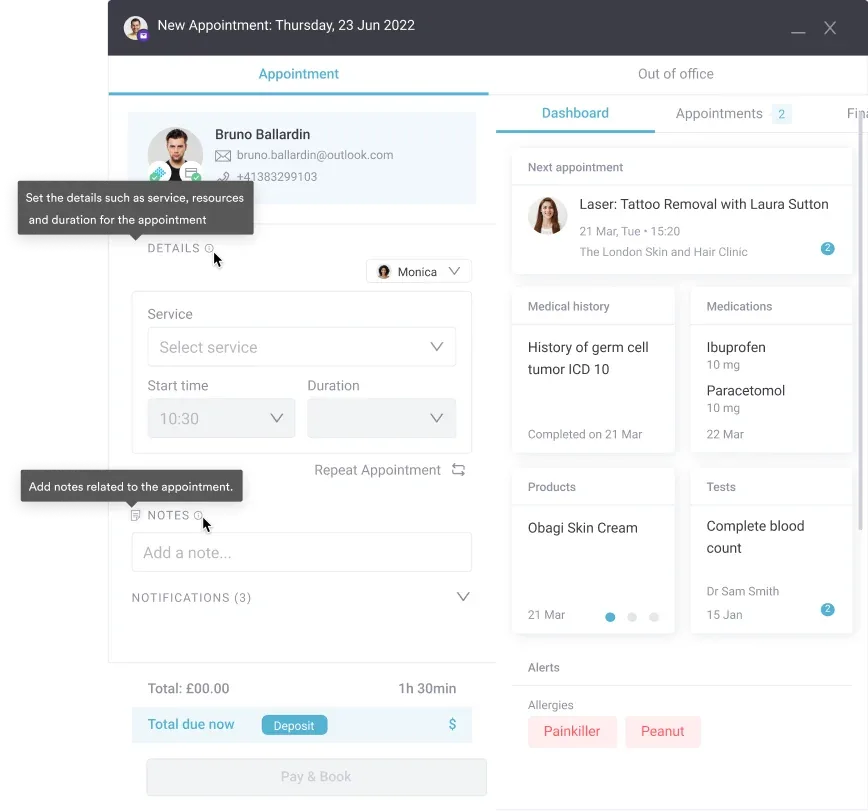
Practice management software like Pabau is built for this environment. It handles scheduling, automated recall workflows, digital intake and consent forms, treatment records, and before-and-after photos in one place. Reporting sits alongside them, so you can see revenue and provider performance without exporting anything.
The right setup depends on your service menu. Med spa software is built around injectables, consultations, and consent, while laser practice software covers the device-led side of the same workflow.
Moving off paper changes the working day more than most operators expect. One two-location med spa saves 10 minutes per patient after switching its records and check-in to Pabau.
Some med spa operators run through a management services organization, or MSO, particularly when non-physician owners are involved. Our guide to the MSO model explains why the business and clinical sides stay separate.

Pabau keeps digital consent forms, treatment notes, before-and-after photos, and automated recalls in a single patient record. Your team stops hunting for paperwork and your documentation is ready when an inspector asks.

The sign on the door matters less than the oversight behind it. A med spa earns the medical half of its name through a named physician, written protocols, and providers working inside their scope. Ask about those three things and you’ll know what kind of facility you are in.
For operators, the clinical standard you set is only as strong as the systems recording it. Consent forms, treatment notes, photos, and recalls decide whether an inspection goes smoothly. Book a demo to see how Pabau keeps that documentation in one place for your med spa.

Want a framework for how consultations should flow? Consultations for med spas and aesthetic practitioners covers the clinical and conversion structure behind a high-quality intake.
Thinking about the financial side of starting a med spa? What it costs to open a med spa breaks down realistic startup costs, from equipment to staffing and licensing.
Need a ready-made consultation form for your practice? Med spa consultation form template provides a downloadable starting point for client intake documentation.
Working out what it costs to launch? Aesthetics business startup cost breakdown splits one-off and ongoing expenses for a first-year budget.
Building out your treatment team? Guide to hiring estheticians covers finding and hiring the staff who shape the client experience.
A med spa combines the calm of a day spa with clinical-grade aesthetic treatments. Licensed medical professionals perform or supervise those treatments under physician oversight. That structure is what allows injectables, laser therapies, and body contouring.
Requirements vary by state. In most US states you need a licensed physician as medical director and a valid business license. Some states also require separate facility registration. Non-physician owners may need a management services organization structure. Our guide to med spa ownership rules covers the state-by-state detail.
In some US states, yes. Nurse practitioners with full practice authority may be able to own or operate a med spa. Corporate practice of medicine laws decide it, and California restricts NP ownership. Confirm the rules with a healthcare attorney before you structure ownership.
No referral is required in most cases. Med spas operate as direct-access facilities for elective aesthetic treatments. However, a reputable med spa will conduct its own consultation and health history review before recommending or performing any procedure.