Punch excision aftercare instructions template
Punch excision is a minor procedure that removes a small cylinder of skin with a...

2
Last Updated: Oct 15, 2026
Hiring estheticians for your med spa starts with your treatment menu, not the job ad. We call it scope-first hiring. You list every treatment the new hire will perform and check each one against your state’s esthetician scope of practice. Only then do you set the license level, the job description and the pay model. Our ranking of the top med spa software also compares how each platform handles staff commissions, if your pay model includes them.
From there, the hiring process runs in seven steps. You define the role, write a job description that filters, source and screen candidates, and interview with scenario questions. Then you run a paid working interview, check references and make an offer.
Below you’ll also find a scope-by-role table, Bureau of Labor Statistics pay data, three pay models compared, a working-interview scorecard and a 90-day onboarding plan.

Use scope-first hiring: map every treatment on your menu to your state’s esthetician scope of practice before you write the job ad.
Injectables are never within an esthetician’s scope, while lasers, IPL and microneedling depend on state law and medical supervision.
Verify every license in your state board’s online lookup, because training requirements range from 220 hours in Florida to 750 in Texas.
A paid 60–90 minute working interview, scored on screening, technique, hygiene, charting, retail and rebooking, tells you more than any interview answer.
Median skincare specialist pay is $21.79 an hour, per the Bureau of Labor Statistics, so set base pay first and add commission after review.
Licensed estheticians perform non-invasive skin treatments such as facials, superficial chemical peels and dermaplaning. Deeper treatments and medical lasers depend on state law, and injectables always require a licensed medical provider.
The esthetician scope of practice is set state by state, usually by a cosmetology or barbering board. California’s Board of Barbering and Cosmetology publishes a one-page esthetician scope list. Facials, superficial peels, dermaplaning, microdermabrasion and Hydrafacials are in scope. Lasers of any kind, IPL, microneedling and injections of any sort are out.
So what can estheticians do in your state? Check the board’s list against your menu before you hire. If your menu leans on laser hair removal, the California role you need is a nurse or another medical provider, not an esthetician.
The difference between an esthetician and a medical esthetician is usually training and setting rather than the license. Most states issue one esthetician license. “Medical esthetician” is then a job title for a medical spa esthetician or someone working in a dermatology office.
The exception is the master esthetician tier. Utah, Virginia and Washington license it, and each requires 1,200 training hours. A master esthetician can take on a wider treatment list in those states, but the list still stops short of injectables.
The table below shows how scope typically splits by role. Treat it as a starting map and confirm each row with your own state board.
| Treatment | Licensed esthetician | Master esthetician (where licensed) | Registered nurse (RN) | NP, PA or physician |
|---|---|---|---|---|
| Facials | Yes | Yes | Usually | Yes |
| Superficial chemical peels | Yes | Yes | Yes | Yes |
| Medium-depth peels | No in most states | Varies by state | Under supervision in some states | Yes |
| Dermaplaning | Yes in most states | Yes | Usually | Yes |
| Microneedling | Varies by state (out of scope in California) | Varies by state | Under supervision in some states | Yes |
| Laser hair removal and IPL | Varies by state (out of scope in California) | Varies by state | Under supervision in some states | Yes |
| Neurotoxin and filler injections | No | No | Under a provider’s order in most states | Yes |
Nurse practitioner (NP) and physician assistant (PA) independence varies by state, and many states require a medical director to oversee medical services. State law decides every cell in this table.
Every esthetician you hire needs an active state esthetician license, earned through a state-approved training program and, in most states, a board exam.
Required training hours vary widely by state. Florida registers facial specialists after 220 hours, California requires 600 and Texas requires 750. An esthetician certification from a school or association proves extra training. Only the state license lets someone practice.
For a state-by-state view of the wider field, see our guide to aesthetic qualifications.
Check every candidate’s esthetician license in the state board’s online lookup before the working interview, not after the offer.
Confirm the name matches, the status is active, the expiry date is ahead of the start date, and there’s no disciplinary action. A candidate licensed elsewhere may need to transfer the license first, although some states have reciprocity agreements.
In a med spa, the esthetician skills that matter most sit closer to clinical work than to spa work. Look for evidence of these on the resume and in the working interview:
Here’s the hiring process in order. Each step narrows the pool, so only two or three finalists reach the paid working interview.
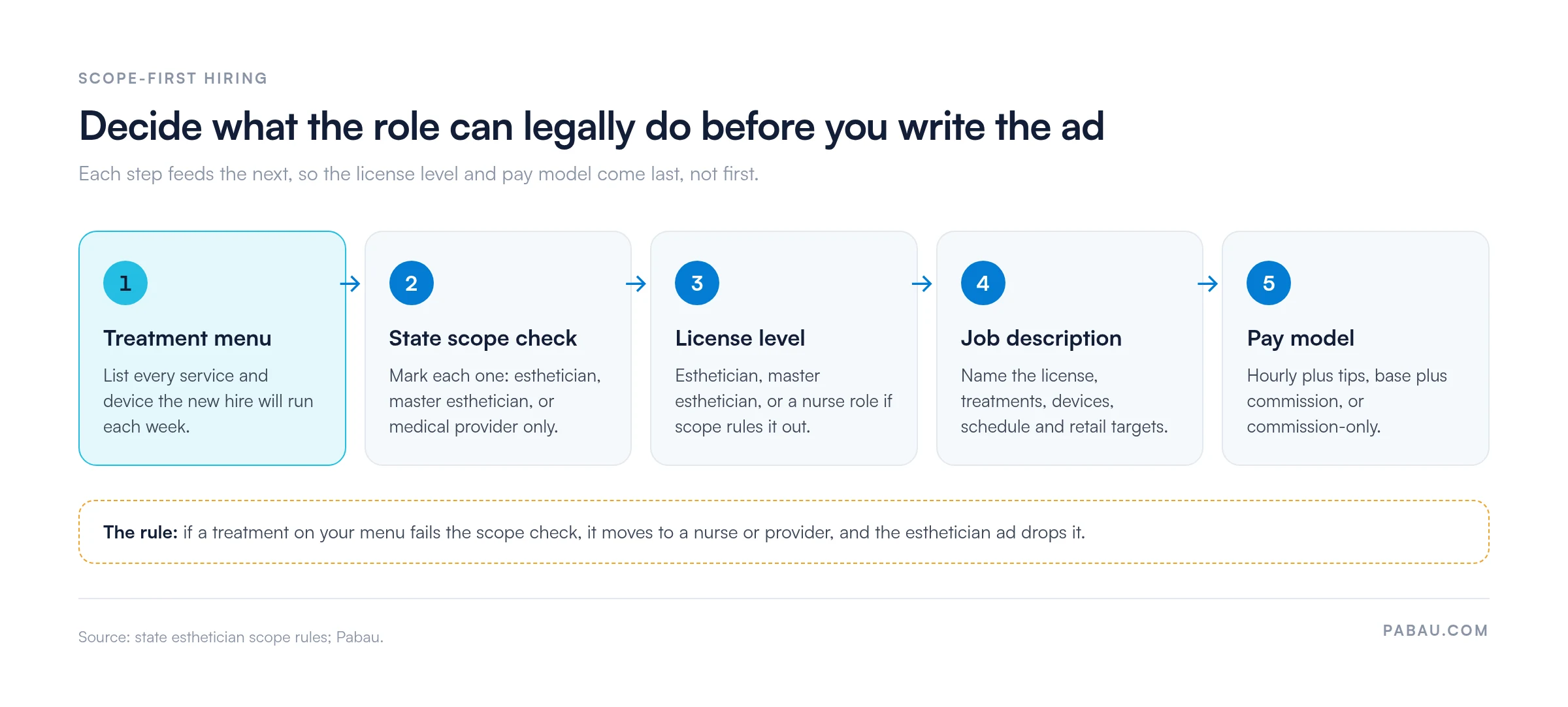
Scope-first hiring starts here. Write down the treatments the new hire will perform, the devices they’ll use and the retail you expect them to sell. Then mark each treatment against your state’s scope list.
Say your menu is Hydrafacials, dermaplaning, superficial peels and laser hair removal. In California, the first three fit an esthetician. Laser hair removal goes to a nurse or another medical provider, so the esthetician ad leaves it out.
When we onboard a new med spa, one early setup job is deciding which services each staff member can be booked for. Doing that exercise before you hire tells you exactly which license the role needs.
Next, count the treatment hours those services fill in a typical week, plus consultation and room-turnover time. That number tells you whether you need a full-time or part-time hire. The diagram below shows the whole sequence.
A strong esthetician job description names the license, treatments, devices and pay range, so unqualified applicants rule themselves out. Include these fields:
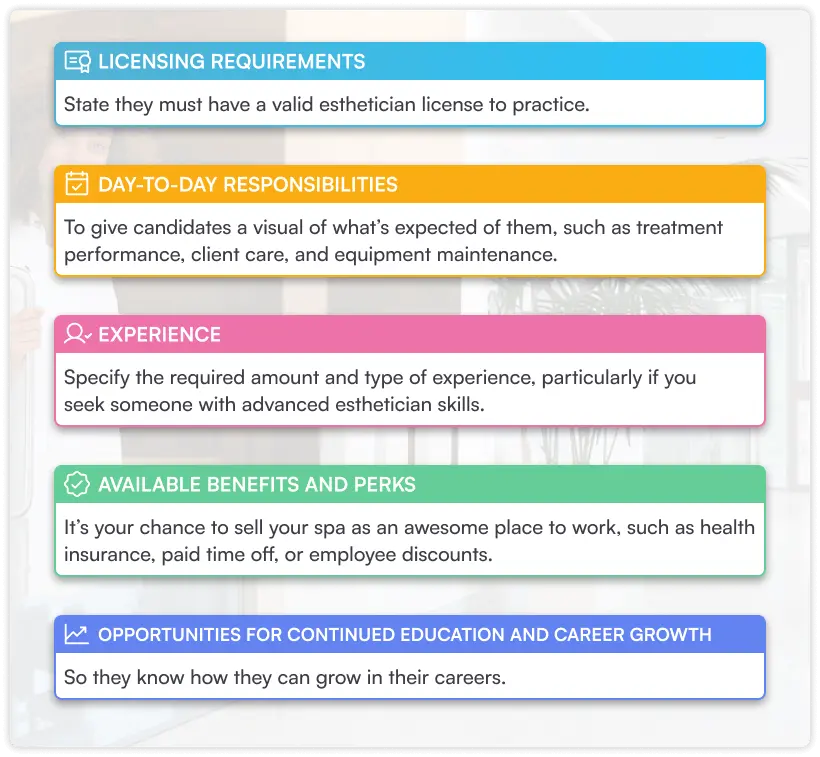
The job description also sets up the working interview. You’ll test the same treatments the ad lists, so candidates know what to expect.
The strongest esthetician pipelines pair a general job board with one or two relationship channels, such as a local esthetics school or staff referrals.
| Channel | Best for | How to use it |
|---|---|---|
| General job boards (Indeed, ZipRecruiter) | Reach and experienced hires | Filter by license and device experience, and publish the pay range. |
| Niche beauty boards (Beauty Cast Network, Salon Employment) | Beauty-trained candidates actively looking | Lead with the medical setting and the training you provide. |
| Esthetics schools | New graduates and part-time roles | Offer externship slots and attend career days. |
| Staff and industry referrals | Vetted, experienced hires | Pay a referral bonus once the hire passes 90 days. |
| Social media (Instagram, LinkedIn, Facebook groups) | Candidates who already follow your brand | Post a Reel from the treatment room with the pay range and an apply link. |
| Industry events (Face and Body Expo) | Meeting candidates face to face | Bring a one-page role summary and book trial dates on the spot. |
New graduates need more supervised hours before they run medical-grade treatments. Budget that time into Step 1 if a school is your main channel.
Screen for license status first, then treatment match, then evidence of results. Work through these in order:
Soft skills show up in a 15-minute phone screen. Listen for plain-language explanations, questions about your patients and warmth under pressure.
On the phone screen, ask the candidate to explain a chemical peel as if you were a nervous first-time patient. In under two minutes you’ll hear their rapport, their plain-language skills and their safety instincts.
The most useful esthetician interview questions are scenarios from your own treatment room, because they reveal judgment a resume can’t show. Use these and note what a strong answer includes:
A paid working interview is a 60–90 minute trial treatment on a model patient, scored against the same rubric for every finalist. Run it like this:
| Criterion | What strong looks like | What weak looks like |
|---|---|---|
| Consultation and contraindication screening | Reviews the intake form and asks about medications, retinoids and recent sun exposure. | Starts after a quick “any allergies?” |
| Treatment technique | Even pressure and correct timing, adjusted to how the skin responds. | Runs the same routine whatever the skin does. |
| Hygiene and sanitation | Clean setup, hand hygiene and single-use items discarded. | Reuses implements or touches product with bare hands. |
| Charting and notes | Records products, strengths, timings, reactions and photos. | Writes “facial done, tolerated well.” |
| Retail recommendation | Suggests one or two products tied to the skin concern. | Pushes the full line, or recommends nothing. |
| Patient rapport | Explains each step and checks comfort. | Works in silence or talks over the patient. |
| Rebooking ask | Proposes a next visit tied to a treatment plan. | Ends with “see you soon.” |
Score each row from 1 to 3. A candidate who scores 1 on screening or hygiene doesn’t progress, however strong the rest looks.
Before the offer, call two references, re-run the license lookup and put the pay model and review date in writing.
Ask references three things. Would they rehire the candidate? How did the candidate handle a reaction or complaint? What were their rebooking and retail numbers like?
The offer letter should state the pay model, the commission rules, the schedule and the 90-day review date. If a candidate negotiates, flexible scheduling, a continuing education budget or device training often matter as much as base pay.
Skincare specialists earned a median $21.79 an hour, or $45,330 a year, in May 2025. Med spa pay usually adds commission and tips on top of that base.
Those figures come from the Bureau of Labor Statistics (BLS) Occupational Outlook Handbook. BLS also shows medical settings pay more. The median in offices of physicians was $24.81 an hour, against $21.10 in personal care services.
The range is wide. The lowest 10% earned less than $14.22 an hour and the highest 10% more than $39.45. BLS projects 9% employment growth from 2025 to 2035, with about 14,200 openings a year.
When you’re hiring estheticians, treat the medical esthetician salary as base plus variable pay, and publish both in the ad. A medical spa esthetician weighing two offers will compare the whole package, not the hourly rate alone.
| Pay model | How it works | Best for | Watch out for |
|---|---|---|---|
| Hourly plus tips | A fixed hourly rate, with patients tipping on top. | New graduates and low-retail menus. | Little built-in reason to rebook or sell retail. |
| Base plus service and retail commission | Hourly pay or a salary, plus a percentage of services or retail. | Most med spas with steady bookings. | Commission rules must be written down and tracked accurately. |
| Commission-only | A percentage of each service, with no base. | Rarely the right fit for an employee role. | Employees must still earn at least minimum wage, and a 1099 label brings misclassification risk. |
Worker classification matters here. If you set the schedule, supply the products and dictate protocols, the IRS is likely to see an employee. Labeling that esthetician a 1099 contractor exposes you to back employment taxes. Read the IRS guidance on contractors and employees before you decide.
For commission rates, tiers and retail splits, see our guide to med spa compensation strategies.
A 90-day onboarding plan moves a new esthetician from supervised treatments to a full book, with commission set only after a day 60–90 review.
| Period | Focus | Done when |
|---|---|---|
| Weeks 1–2 | Protocols, intake and consent forms, device sign-off by your lead, and a charting audit on every note. | Each device on the treatment list is signed off. |
| Weeks 3–6 | Supervised treatments, booking slots opened in stages, and first retail and rebooking targets. | The new hire works unsupervised on core treatments. |
| Days 60–90 | A review of rebooking rate, retail per visit and chart quality. | Commission tier is set and the full treatment list is confirmed. |
Opening the calendar in stages is easier with medical spa scheduling software that limits which services a new hire can be booked for.
Once your new esthetician starts, the admin lands on you: staff schedules, bookable services, record access and month-end commission. Practice management software like Pabau keeps all four in one system, so a new hire doesn’t mean a new spreadsheet.
Pabau stores each staff profile with the services that person can perform. Your online booking then only offers the new hire treatments inside their scope. Role-based permissions control which patient records and reports each team member can open.
Pabau’s commission tracking calculates service and retail commission per staff member, so the day-60 review runs on recorded numbers instead of guesswork. See how Pabau’s team management software handles schedules and staff availability.
Pabau is built as medical spa software, so the same system holds the charting, consent forms and before-and-after photos your esthetician uses every day.

Pabau links each esthetician to the services they can be booked for, controls record access by role and tracks commission automatically. Your new hire’s first 90 days run on one system.

If you change one habit, make it scope-first hiring. Map the treatment menu to your state’s rules before you write a word of the ad. The license level, job description and pay model all follow from it.
The trade-off is a smaller applicant pool, because a scope-first ad asks for far more than a license. The candidates who remain are worth a paid working interview. The scorecard then tells you which one to hire.
Book a demo to see how Pabau sets up a new esthetician’s services, permissions and commission from their first day.

Paying commission to your new hire? Commission laws for med spas explains the wage rules that apply to commission-based pay.
Hiring in Texas? Texas med spa licensing laws covers ownership, scope of practice and compliance in Texas.
Hiring in California? California cosmetology laws walks through licensing and renewal rules under the Board of Barbering and Cosmetology.
Staffing more than one location? Multi-location med spa management shows how to keep schedules and standards consistent across sites.
Checking your practice against the rules? Med spa compliance for owners sets out the compliance basics every med spa owner needs.
No, Botox injections are outside the esthetician scope of practice in every state. Only licensed medical providers can inject, such as physicians, NPs, PAs and RNs working under a provider’s order where state law allows.
It depends on the state. California’s board lists microneedling as out of scope for estheticians, while some states allow shallow cosmetic microneedling or physician delegation in a medical spa. Check your board’s rule before adding it to an esthetician’s menu.
Only in some states, and an esthetician license alone rarely covers it. California bars estheticians from using lasers or IPL, and Texas requires a separate TDLR laser hair removal certificate. Confirm your state’s rule and the device training first.
Yes, licensed estheticians work in med spas performing facials, peels, dermaplaning and other treatments within state scope, often under a medical director’s oversight. Candidates stand out with med spa or dermatology experience, device training and clear charting.
The Bureau of Labor Statistics reports a median $21.79 an hour for skincare specialists in May 2025, and $24.81 in offices of physicians. A medical esthetician salary in a med spa usually adds service commission, retail commission and tips on top.
An esthetician can often manage a med spa’s business side, but its medical services need a licensed medical director. Many states limit non-physician ownership under corporate practice of medicine rules, so check your state’s law with a healthcare attorney first.