GLP-1 diet plan
A GLP-1 diet plan is a structured eating framework for patients taking semagluti...

2
Last Updated: Oct 13, 2026

The resisted supination external rotation test loads the biceps-labral complex to detect SLAP lesions and biceps tendinopathy in overhead athletes.
Pain reproduction or a painful arc between 60 and 120 degrees of external rotation, with or without a click, indicates likely SLAP pathology.
Published sensitivity is roughly 82.8% and specificity roughly 81.9%, which outperforms Speed’s test in the original Myers cohort.
No single special test is diagnostic alone, so pair the RSERT with a clinical cluster and confirm with MRI arthrography.
The resisted supination external rotation test (RSERT) is a shoulder special test used to identify superior labral anterior-posterior (SLAP) lesions and biceps tendon pathology.
It loads the biceps-labral complex by resisting forearm supination and glenohumeral external rotation at the same time.
Myers, Zemanovic and Andrews first described the test in the American Journal of Sports Medicine in 2005. It remains one of the most accurate clinical tests for SLAP pathology available to physical therapists and orthopedic clinicians. This guide covers patient positioning, resistance technique, how to read a positive result, and the published accuracy figures. It also compares the RSERT with Speed’s test and the O’Brien active compression test.
The resisted supination external rotation test is a shoulder special test that loads the biceps-labral complex. The examiner resists forearm supination and glenohumeral external rotation at the same time. The acronym RSERT is used widely in practice and in the orthopedic literature.
The test targets the anatomical relationship between the long head of the biceps tendon and the superior glenoid labrum. Under concurrent tensile load, a damaged or detached labrum produces pain or a mechanical response. A healthy biceps-labral complex does not.
SLAP tears are among the most commonly missed shoulder diagnoses, particularly in swimmers, pitchers, and tennis players. The RSERT was developed because Speed’s test showed limited specificity and generated too many false positives in mixed shoulder populations.
The long head of the biceps tendon originates at the supraglenoid tubercle and the superior labrum. Supination of the forearm generates a pull through the bicipital groove and onto the labral anchor.
External rotation of the glenohumeral joint tensions the posterior capsule and shifts the humeral head. That adds a rotational peel-back force on the superior labrum. Together the two motions produce a combined tensile and rotational load that isolated tests cannot reproduce.
This peel-back mechanism is the anatomical rationale Myers and colleagues used to justify the design of the test. An intact labrum absorbs the load. With a SLAP tear present, the peel-back force reproduces pain or provokes a click as the labral edge catches.
Understanding the anatomy helps you explain a positive result to patients and referrers. It also translates cleanly into the wording of an MRI or surgical request.
Use the RSERT when your clinical reasoning points at the superior labrum or the biceps-labral complex as the pain source. The primary indications are:
The test is less useful during acute inflammation, because the pain response is non-specific. It also fails when the patient cannot reach 90 degrees of shoulder abduction because of rotator cuff weakness or pain inhibition.
For practices built around throwing and swimming injuries, the RSERT is one of the highest-yield additions to a shoulder screen. Teams running sports medicine practice software can add it to the standing examination template so nobody skips it under time pressure.
Accurate positioning drives the result. The joint angles in the original protocol are what generate the peel-back load on the superior labrum. Deviating from them reduces both sensitivity and specificity, so the four settings below are worth setting deliberately every time.
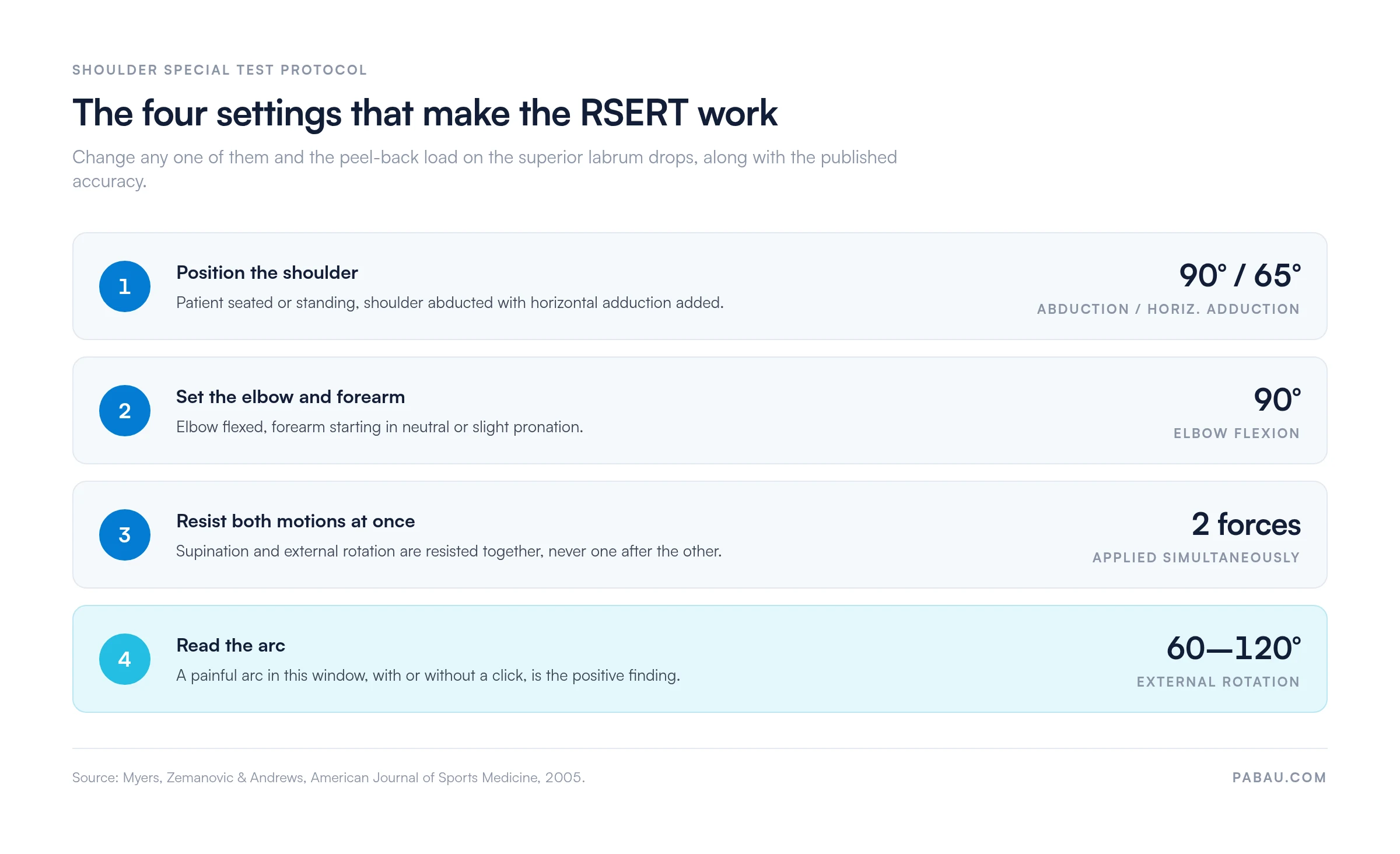
Position the patient seated upright or standing. Set the shoulder at 90 degrees of abduction with 65 degrees of horizontal adduction. Flex the elbow to 90 degrees. The forearm starts in neutral or slight pronation. Ask the patient to relax the shoulder musculature, so active contraction does not confound the forces you apply.
Stand facing the patient on the side being tested. Place one hand on the dorsal surface of the wrist to resist forearm supination. Place the other hand on the volar surface of the distal forearm, or at the elbow, to resist external rotation.
Apply both resistances at once. Ask the patient to supinate the forearm against your hand and externally rotate at the shoulder in the same movement. Maintain the resistance through a full arc of external rotation, from neutral to roughly 120 degrees.
The common technical error is applying one resistance at a time. Sequential testing reduces the mechanical load on the labral anchor and will underperform the published sensitivity. Both resistances have to run together throughout the arc.
A positive RSERT is any of the following responses during or immediately after the resistance arc:
A positive finding does not diagnose a SLAP tear on its own. It raises the pre-test probability enough to justify further investigation. MRI arthrography with intra-articular gadolinium remains the gold standard for confirmation and for classifying the lesion type. Arthroscopy gives a definitive diagnosis and allows repair in the same session.
Record the specific positive response rather than a bare “RSERT positive”. Note the concordant pain, the arc location, and whether a click was present. In a physical therapy EMR software record, those qualifiers sit in named fields, so the detail survives into the referral letter and the medicolegal file.
The original prospective study by Myers, Zemanovic and Andrews reported sensitivity of roughly 82.8% and specificity of roughly 81.9% for detecting SLAP lesions. A positive likelihood ratio of around 4.6 puts the test in the moderate range for clinical utility.
A positive result shifts post-test probability meaningfully toward a SLAP tear without confirming it. The negative likelihood ratio of roughly 0.21 gives reasonable power to reduce suspicion after a negative test in a low-to-moderate probability population. Check the figures against the original PubMed record (PMID 16002494) before quoting them in a clinical report.
These figures come from the original study population and may not carry over to every setting. Sample size, the mix of SLAP and non-SLAP cases, and patient demographics all change how the accuracy translates into your practice.
The RSERT outperformed both Speed’s test and the O’Brien active compression test for SLAP diagnosis in the original comparative data. That headline needs context. Each test stresses different structures, and the presentation in front of you decides how much weight each one carries.
The table below sets out the published figures from the same cohort. Read it as decision support, rather than as a reason to drop a test the patient’s history calls for.
Speed’s test still earns its place for biceps tendinopathy without a labral component. The O’Brien test is often positive in AC joint pathology, which muddies interpretation in patients with concurrent AC degeneration. The compression-rotation test has low sensitivity, but a palpable or audible click makes it reasonably specific.
Running the RSERT and the compression-rotation test together as a two-test cluster improves diagnostic yield over either test used alone.
Run the RSERT and compression-rotation test together as a two-test cluster. If both are positive, the combined post-test probability for a SLAP lesion is high. That justifies direct referral for MRI arthrography without a further special-test battery. Document both results, the exact arc of pain, and whether a click was present or absent.
No single shoulder special test is diagnostic in isolation. Four factors limit how the RSERT performs in practice compared with the published figures.
The American Physical Therapy Association recommends using shoulder special tests inside a structured examination cluster rather than alone, with imaging confirmation before a surgical referral.
Documenting an RSERT finding in free text is slow and inconsistent. One clinician writes “shoulder test positive”. The next writes “RSERT + painful arc 60-90 ER”. Neither entry can be searched, audited, or lifted cleanly into a referral letter.
Practice management software like Pabau replaces free text with a structured shoulder examination template. Custom SOAP forms prompt for each special test result, the arc of pain, and the patient’s concordant pain response. A covering clinician then reads the same record without decoding someone else’s shorthand.
Digital forms and medical records management capture RSERT results, special-test clusters, and range-of-motion measurements in named fields. Pabau Scribe, our AI scribe, transcribes verbal observations during the examination, so most of the note is written by the time the patient leaves.

Choosing a platform is its own exercise, and documentation depth matters more than feature count for a shoulder caseload. Our guide to physiotherapy practice management software weighs the options on charting, scheduling, and billing together.

Pabau lets physical therapy and sports medicine practices build custom shoulder examination templates, capture RSERT findings in named fields, and generate referral-ready notes. See how it fits your practice.

The RSERT is the strongest single clinical test available for SLAP lesions. It beat both Speed’s test and the O’Brien test in the original cohort. The anatomical rationale holds, and the technique is learnable in one session.
Run it as part of a two-test cluster with the compression-rotation test. Record the specific response rather than a bare positive, and confirm with MRI arthrography before any surgical referral. The trade-off to remember is spectrum bias. The published figures come from a surgical population, so expect lower positive predictive value in a general caseload.
Book a demo to see how Pabau captures shoulder examination findings in named fields and turns them into referral-ready notes.

List Item #1
List Item #2
The resisted supination external rotation test detects SLAP lesions and biceps tendon pathology. The examiner resists forearm supination and glenohumeral external rotation at the same time. It is used most often in overhead athletes and patients with anterior shoulder pain or a traction injury.
A positive RSERT indicates likely SLAP pathology. The positive responses are concordant pain, a painful arc between 60 and 120 degrees of external rotation, or a click. A positive result alone is not diagnostic, and MRI arthrography is needed for confirmation.
In the original prospective study by Myers, Zemanovic and Andrews, the RSERT showed sensitivity of roughly 82.8% and specificity of roughly 81.9%. The positive likelihood ratio was roughly 4.6. Those figures come from a surgical cohort, so read them against your patient’s pre-test probability.
The RSERT outperforms Speed’s test for SLAP diagnosis. Speed’s test showed sensitivity of roughly 32% against the RSERT’s 82.8% in the same cohort. Speed’s test suits isolated biceps tendinopathy without a labral component, while the RSERT is the more discriminatory test for SLAP lesions.
Yes. The RSERT stresses the long head of the biceps at its labral origin, so biceps tendon pathology can produce a positive result. It is not specific to tendon pathology alone, and a positive test may reflect a SLAP tear, tendinopathy, or both. Clinical context and imaging separate them.
The shoulder sits at 90 degrees of abduction with 65 degrees of horizontal adduction. The elbow is flexed to 90 degrees, and the forearm starts in neutral or slight pronation. These angles reproduce the peel-back mechanism described in the original Myers protocol.