Nitrates medication list
A nitrates medication list is a point-of-care reference that sets out the main c...

Last Updated: Oct 6, 2026

The ruler drop test is a zero-cost field test where drop distance converts to reaction time with the free-fall formula t = √(2d/g).
A 30 cm ruler covers the full adult reaction time range of roughly 100-250 ms, so it is the only equipment you need.
Anticipation is the main source of error, and randomizing the drop timing across five recorded trials cuts it sharply.
Norms shift with age, so a 22 cm catch sits inside the average band at 65 and well outside it at 18.
Practice management software like Pabau records, benchmarks, and trends reaction time results without a paper file.
Most reaction time assessments need lab equipment costing thousands. The ruler drop test needs a 30 cm ruler and a partner. That simplicity is why it has survived in sports science, physical education, and clinical practice for decades. It is still one of the most widely taught functional assessments in healthcare training.
The test measures simple reaction time: the interval between a visual stimulus (the ruler dropping) and a motor response (the fingers closing). In practice, drop distance converts to milliseconds through a standard free-fall equation, so one measurement gives a quantified result with no electronics.
This article covers the procedure, the conversion formula, published normative benchmarks, and the clinical contexts where the test earns its place.
The ruler drop test quantifies simple reaction time: how fast the nervous system spots a visual signal and fires a voluntary motor response. When the ruler falls, light hits the retina, the signal reaches the visual cortex, and the brain issues a motor command. Efferent signals then contract the finger flexors. Measured in centimeters of free fall, that whole loop takes roughly 100 to 250 milliseconds in healthy adults.
Overall, reaction speed matters in three settings. In sport, it underpins defensive agility, catching ability, and driving safety. In rehabilitation, a slowing reaction time is an early marker of neurological change, fall risk, and post-concussion status. In occupational health, it feeds fitness-for-duty decisions in time-critical roles. Knowing what the test measures, rather than only how to run it, changes how you read a borderline result.
In short, two mechanisms decide the result. One is how fast the nervous system processes the stimulus. The other is how physics turns that processing time into a distance you can read off a ruler.
Seeing the ruler fall activates the visual cortex. The signal passes through association areas in the frontal lobe, which generate a motor command. That command travels down the corticospinal tract and crosses the neuromuscular junction to contract the finger flexors. The total delay, roughly 100-250 ms in healthy adults, reflects conduction velocity, synaptic delay, and central processing speed together.
In practice, fatigue, distraction, caffeine, aging, and neurological disease each affect a different stage of that pathway. That is why the ruler drop test picks up changes you would not catch by watching someone move.
A falling object accelerates under gravity at 9.81 m/s². The kinematic equation for free fall is:
d = ½ × g × t²
Rearranged to solve for reaction time: t = √(2d / g)
Here d is drop distance in meters and g is 9.81 m/s². The result is reaction time in seconds, so multiply by 1,000 for milliseconds. A drop of 15 cm (0.15 m) gives t = √(2 × 0.15 / 9.81) = √(0.0306) = 0.175 seconds, or about 175 ms.
In total, the test needs three items, and that is the whole list.
Ultimately, standardization decides whether your results are reproducible. Small deviations in positioning or drop technique add variability that swamps genuine differences between people or between time points.
Seat or stand the subject with their dominant arm extended and the elbow slightly flexed. Support the wrist on a stable surface or hold it steady. The thumb and index finger sit open at the ruler’s zero mark, without touching it. The tester holds the ruler vertically, zero mark level with the fingers. Break eye contact before the drop, so the subject watches the ruler rather than the tester’s hand.
The tester drops the ruler with no warning and no countdown. Randomize the interval between trials, waiting 3, 5, or 8 seconds unpredictably. This single step does more than any other to control anticipation.
Run three familiarization trials before you record anything. Subjects catch the ruler higher on the first few attempts because they are learning the task, not because they are getting faster. Excluding those trials removes a systematic upward bias.
Record five test trials. Discard the highest and the lowest, then average the remaining three. That trimmed mean limits the effect of anticipation catches and fumbles without needing many repetitions. Read the distance at the top of the thumb and index finger, not at the nearest centimeter mark.
First, apply t = √(2d / g) to the averaged drop distance. Convert centimeters to meters first by dividing by 100, then substitute into the equation. The table below gives pre-calculated values for common drop distances, so you can read off reaction time without redoing the arithmetic each time.
These values come straight from the free-fall formula, so any correctly built conversion table produces the same numbers. BrianMac Sports Coach publishes the same formula with a worked example: a 9 cm drop equals 135 ms. Treat the rating categories as approximate guides rather than diagnostic thresholds, because age, fatigue, and test conditions all change how a result should be read.
In short, normative values let you place a result against a reference population. The benchmarks below reflect general population data published in sports science literature. Treat them as reference ranges rather than diagnostic cutoffs.
The bands matter more than any single number, because they slide steadily to the right with age. To clarify, the chart below plots all four of them on one scale.
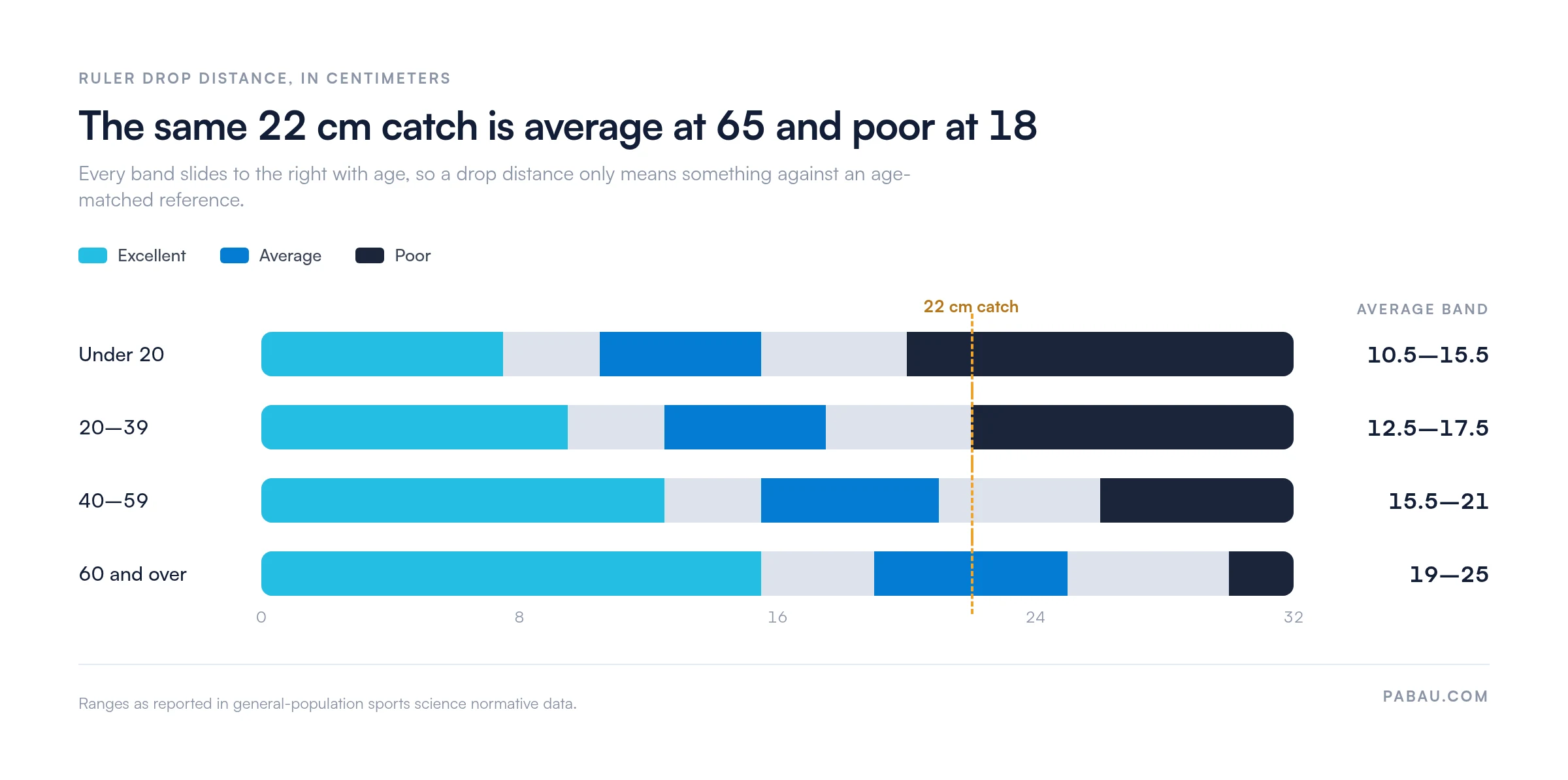
Two practical points follow. First, reaction time slows with age, so a 65-year-old catching at 22 cm sits inside their age-group average rather than below it. Second, compare a person against their own earlier results wherever you can. Serial measurements under standardized conditions tell you more than one snapshot against a population table.
Similarly, the same care applies to every norm-referenced instrument you score by hand. Our guide to Beery VMI scoring works through age-band interpretation in more detail.
In practice, four errors account for most of the variability in ruler drop test results. Protocol discipline controls each one.
Flag any catch under 7 cm, which converts to 119 ms. That sits close to the physiological floor for adult visual reaction time, so it almost certainly reflects anticipation rather than reaction speed. Discard the trial and run it again rather than averaging it in.
A 2024 peer-reviewed study published in PMC tested four ruler drop variants in community-dwelling older adults, mean age 72.67. Test-retest reliability varied by variant rather than holding up evenly across all of them.
The choice version scored an intraclass correlation coefficient (ICC) of 0.81, which counts as good. The discrimination and dual-task versions landed at 0.72 and 0.70, both moderate. The simple single-task version, the one most practitioners actually run, scored 0.57, which counts as poor.
As a result, that spread shapes how far you can push a single result. The standard version is stable enough to screen with, but not stable enough to carry a clinical decision on one reading.
Still, the test has clear limits beyond that. It measures simple reaction time only, not choice reaction time, where the subject picks between two or more responses. Laboratory chronometry with light-gate sensors or computer tasks is more precise and controls anticipation better. The ruler drop test trades precision for access, which suits field screening rather than fine-grained neurological assessment.
The dual-task variant asks the subject to count backwards while catching the ruler. It picks up the cognitive-motor interference that the single-task version misses, which is why it turns up in fall-risk work.
In fact, the ruler drop test is more than a classroom demonstration. Clinicians and sports practitioners use it in four applied contexts, and each one reads the result differently.
One note applies to all four. Document the protocol alongside the result: number of trials, hand tested, dual-task condition, and rest interval. Without that record, serial measurements across time or across practitioners cannot be compared.
Notably, a ruler drop test result on a paper sheet is the weakest link in an otherwise careful assessment. Without a structured record you cannot trend serial measurements, share results across clinicians, or trigger follow-up when a metric crosses a threshold.
Practice management software like Pabau fixes that at the point of capture. Its digital clinical forms let physical therapists, sports medicine practitioners, and occupational therapists build assessment templates with ruler drop test fields alongside other functional measures. Results land straight in the client record, next to appointment notes and treatment plans.
The outcome measurements tracking feature then graphs those results over time. You can show a patient their progress, catch a regression early, or flag a review when a score falls outside that person’s own baseline. For physical therapy practices running return-to-sport or falls prevention programs, that turns a simple field test into data you can act on.


Pabau lets physical therapy and sports medicine practices build custom outcome measure forms, track serial test results in the client record, and automate follow-up. No ruler drop test result ends up stranded in a paper file.

The ruler drop test earns its place because it is simple. In short, no batteries, no calibration, no equipment budget. The formula is straightforward and the normative tables are published. Standardizing it comes down to three decisions: fixed positioning, randomized drop timing, and a trimmed mean across five trials.
Ultimately, where it pays off is serial measurement. One result is a snapshot, and at an ICC of 0.57 the single-task version is not stable enough to carry a decision alone. Repeat testing under the same conditions, stored with the rest of the clinical record, is what makes it worth running. Book a demo to see how practices capture functional assessment data like this without a paper trail.

Running a physical therapy or sports medicine practice? Physiotherapy clinic management software covers the documentation and operational needs specific to allied health.
Screening older patients for falls? The 4-stage balance test pairs naturally with reaction time as a second fall-risk measure.
Need a lower-limb strength screen too? The 30-second chair stand test uses the same trimmed, standardized scoring approach.
Looking for another quick chairside test? The drop arm test shows how a special test is scored and documented in practice.
The ruler drop test measures simple reaction time: the interval between a visual stimulus (the ruler dropping) and a voluntary motor response (the fingers closing). It reflects the combined speed of visual processing, central decision-making, and motor nerve conduction. It does not measure choice reaction time, anticipatory movement, or strength.
Use the formula t = √(2d / g), where d is the drop distance in meters and g is 9.81 m/s². A drop of 15 cm (0.15 m) gives t = √(2 × 0.15 / 9.81) = 0.175 seconds, or 175 ms. Convert centimeters to meters by dividing by 100 before you substitute into the formula.
For adults aged 20-39, a drop distance under 9.5 cm (about 139 ms) is excellent, and 12.5-17.5 cm is average. Results shift meaningfully with age, so a 60-year-old catching at 20 cm sits within the average range for their group. Always read a result against age-matched norms and against that person’s own previous scores where you have them.
Reliability depends on which version you run. In a 2024 study of older adults, the choice variant scored an ICC of 0.81 (good), while the standard single-task version scored 0.57 (poor). The dual-task and discrimination variants sat in between, at 0.70 and 0.72. Treat one single-task reading as a screen and rely on repeat measurements under a standardized protocol.