

HCPCS code E0198: Water pressure pad billing guide
HCPCS code E0198 is a water pad for a standard mattress HCPCS code E0198 is the ...

Last Updated: Oct 13, 2026
L0623 is the HCPCS Level II code for a sacroiliac orthosis (SO) with rigid or semi-rigid panels over the sacrum and abdomen. It provides pelvic-sacral support, reduces motion about the sacroiliac joint, and is supplied prefabricated and off the shelf.
Bill L0621 when the belt is flexible with no panels, and L0624 when the paneled brace is custom-fabricated. Medicare covers L0623 under the Spinal Orthoses LCD (L33790), and the code needs no Medicare prior authorization.
Let Pabau's smart automation suggest the right codes, reduce claim denials, and keep your practice compliant—effortlessly.
Automate repetitive tasks and focus on what matters most—your patients.
Reduce coding errors and ensure compliance with the latest regulations.
Clean claims, fewer denials, and faster reimbursements.
Powerful insights and reporting to help your practice thrive.
HIPAA compliant SOC 2 certified GDPR-compliant Trusted by 4,000+ clinics worldwide

HCPCS code L0623 covers a sacroiliac orthosis with rigid or semi-rigid panels over the sacrum and abdomen, supplied prefabricated and off the shelf.
Bill L0621 for a flexible SI belt without panels, and L0622 or L0624 when the orthosis is custom-fabricated for the patient.
Medicare covers L0623 under the Spinal Orthoses LCD (L33790), and the code is not on the CMS Required Prior Authorization List.
A Medicare claim needs a standard written order, medical records that support an LCD indication, and a signed proof of delivery.
Claims software such as Pabau keeps the order, clinical notes, and delivery record on one patient file, so each L0623 claim matches its file.
HCPCS code L0623 is the Level II code for a sacroiliac orthosis (SO) with rigid or semi-rigid panels over the sacrum and abdomen. It provides pelvic-sacral support and reduces motion about the sacroiliac joint. The brace is prefabricated and dispensed off the shelf.
Two features make a brace L0623. The panels are rigid or semi-rigid, which separates it from the flexible L0621 belt. It also reaches the patient off the shelf, which separates it from the custom-fabricated L0624.
Medicare covers L0623 under the DMEPOS benefit and the Spinal Orthoses LCD (L33790). Unlike several rigid lumbar-sacral codes, L0623 is not on the CMS Required Prior Authorization List.
The official CMS HCPCS Level II code set describes L0623 by anatomy, function, and how the brace reaches the patient. The table breaks the full descriptor into its parts, in the order CMS lists them.
Each part should match the product you dispense and the notes in the patient’s file.
AAPC files L0623 under Sacral Orthotics (L0621-L0624), and two questions separate the four codes. Does the brace have rigid or semi-rigid panels? And did it reach the patient off the shelf or custom-fabricated? The table below uses the official CMS descriptors.
Run the two questions in order:
Medicare’s policy article A52500 adds one more check on the flexible side. The CG modifier goes on L0621 only when the belt is made mainly of nonelastic material, such as canvas, cotton or nylon. No such rule applies to L0623, because its panels already make it a rigid or semi-rigid device.
A brace that also extends up the lumbar spine is not an SO at all. It belongs in the lumbar and lumbar-sacral range that starts at L0625. The diagram puts that check first, then the panels, then how the brace was made.
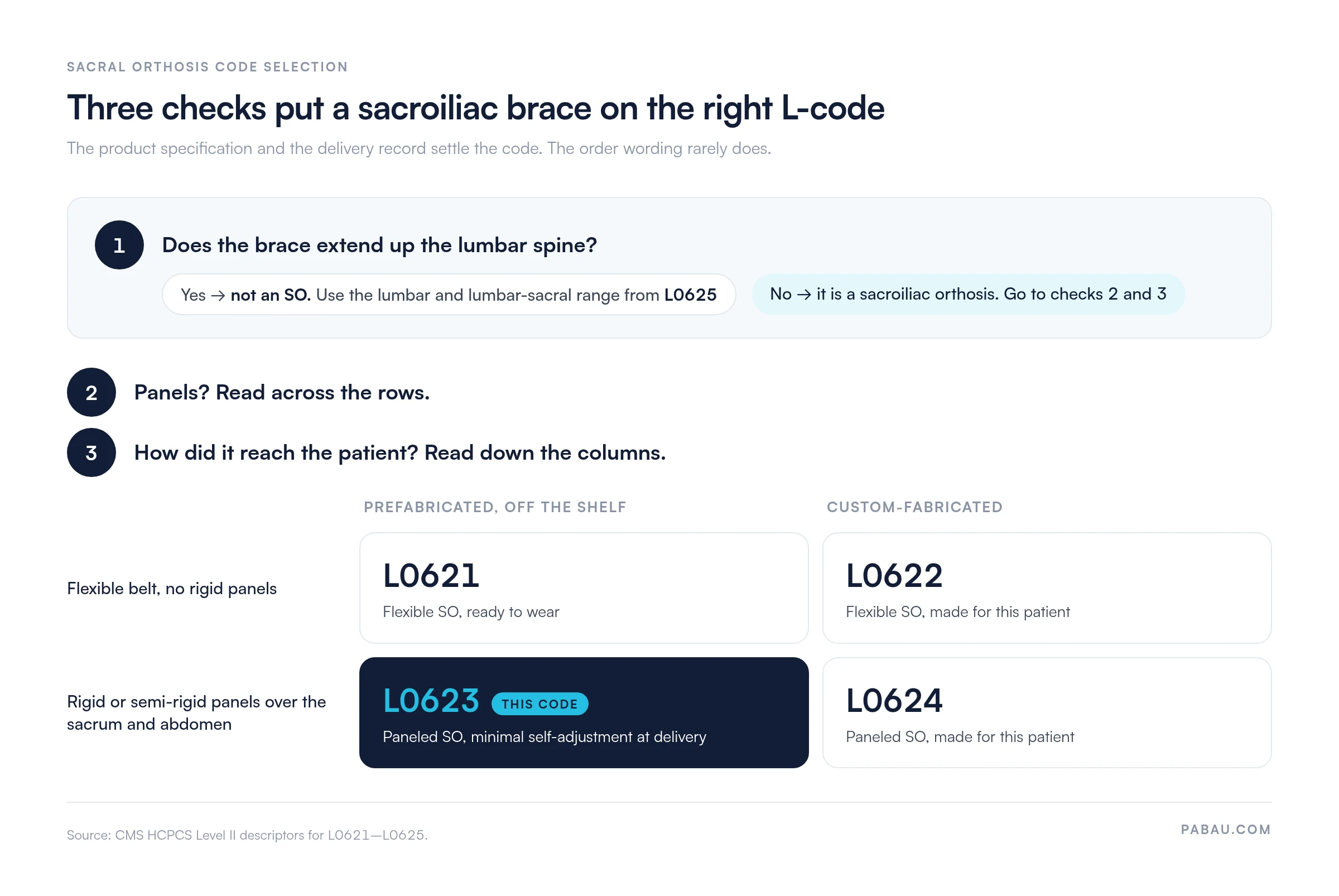
Code from the product specification and the delivery record. An order for an “SI belt” fits L0621, L0622, L0623 and L0624 alike. Only the product specification shows whether panels are present, and only the delivery record shows whether the brace was fabricated for the patient.
Medicare covers a sacroiliac orthosis billed with L0623 when the records show it is reasonable and necessary under the Spinal Orthoses LCD (L33790). The LCD recognizes four uses for a spinal orthosis:
For an SO, the notes should tie the brace to the sacroiliac joint or pelvic ring rather than to the lumbar spine. Commercial and Medicaid plans set their own criteria, so read the plan’s orthotics policy before delivery.
The diagnosis codes below often appear on sacroiliac orthosis claims, and M46.1 heads the list. The list is illustrative, not a covered-diagnosis list. Medical necessity rests on the clinical notes, so the diagnosis alone does not establish coverage.
L0623 does not appear on the CMS Required Prior Authorization List for DMEPOS, last updated July 29, 2026. That list covers rigid lumbar-sacral codes such as L0631, L0637, L0639, L0648 and L0650, not the sacroiliac range.
Running insurance eligibility verification before every delivery confirms which plan rules apply. It also shows whether the patient’s plan wants its own authorization.
An L0623 claim holds up only as well as the file behind it. Keep each of the following in the patient’s file before the claim goes out:
CMS expects DMEPOS suppliers to keep these records for seven years from the date of service. Organized medical billing compliance workflows file them at delivery, rather than leaving staff to chase them once an audit request arrives.
Medicare pays L0623 under the CMS DMEPOS fee schedule, which CMS updates each year and publishes by state. Look up the current allowed amount in the CMS file for your state. Third-party rate sites often carry last year’s figures after the January update.
Bill your usual charge for the device. Medicare pays the lesser of the fee schedule amount or the submitted charge, so a charge below the schedule lowers the payment.
Modifiers on an L0623 claim describe the claim’s circumstances, such as a replacement or an ABN on file. None of them tells Medicare how the brace was made, because the code itself carries that information. Confirm each requirement with your DME MAC or payer.
L0623 denials trace back to a short list of causes, and each one can be caught before the claim goes out. The payer reports them with standard denial codes on the remittance advice. Effective denial management in healthcare starts with a pre-claim review, so use the table below as a checklist.
Remittance advice often pairs these denials with CARC CO-50 (not deemed a medical necessity by the payer) or CO-167 (the diagnosis is not covered). CO-96 marks a non-covered charge. CO-5 means something else: the procedure code or bill type is inconsistent with the place of service.
Commercial insurers and Medicaid programs handle HCPCS code L0623 differently from Medicare. Check these points before you submit:
Most L0623 coding errors happen before anyone opens the claim. The order says “SI belt”, the product details sit in one place, and the delivery note sits in another. So the biller codes from the prescription, and L0621 and L0623 blur together.
Pabau, the practice management platform we build, keeps the written order, product details, and signed delivery record on one patient file. Its tools for faster, cleaner claims pull those details onto the claim form, so nobody rekeys them. In the US, Pabau’s Claim.MD integration submits and tracks claims.
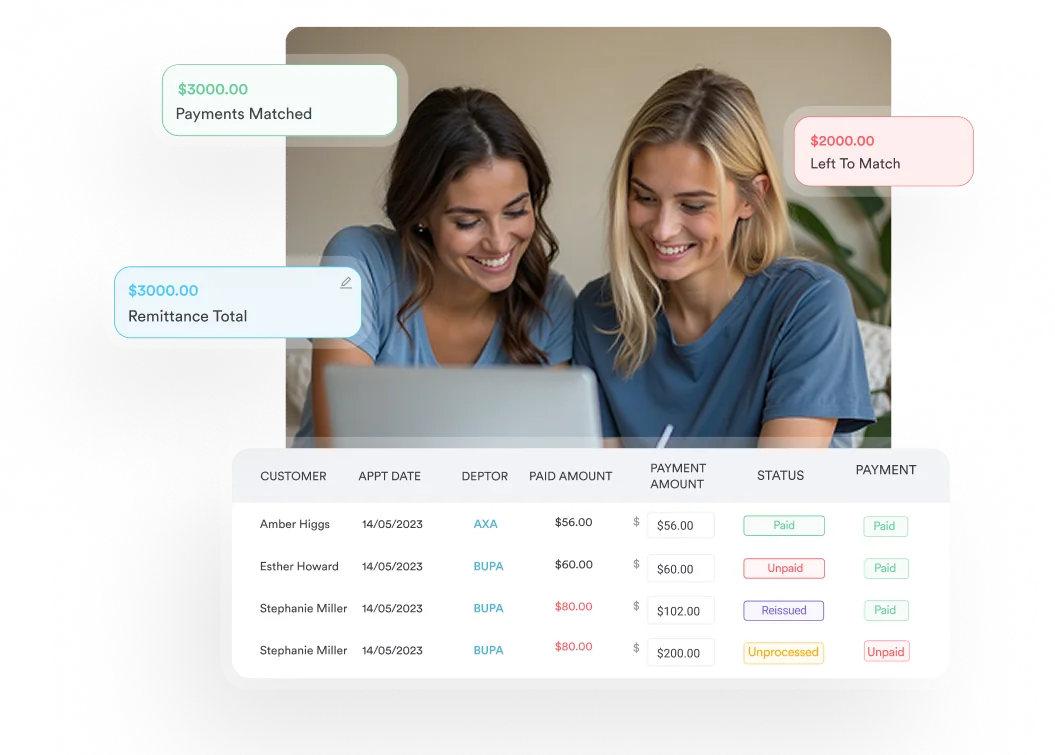
The result is a claim that matches its file. When a reviewer asks whether the brace has panels, the product details sit next to the order. Claim status tracking shows which claims came back denied, so staff can fix a repeat problem at intake.

Pabau keeps the order, product details, and delivery record for every sacroiliac orthosis claim on one patient file. Each L0623 claim then matches its documentation before it reaches the payer.

Treat L0623 as a statement about two facts: the brace has rigid or semi-rigid panels, and it reached the patient off the shelf. Change either fact and the code becomes L0621, L0622 or L0624.
The lumbar codes are the other trap. A brace that climbs the lumbar spine belongs in the L0625 range, however the order describes it. Settle the design, the delivery method and the medical records before the claim goes out.
Book a demo to see how Pabau keeps the order, product details and delivery record for each L0623 claim on one patient file.

Coding the injury behind the brace? ICD-10 code S33.6 explains how to code a sacroiliac joint sprain and pick the right seventh character.
Treating SI joint pain with injections too? CPT code 27096 walks through billing a sacroiliac joint injection and its imaging guidance requirement.
Sending DME claims electronically? Medical claims clearinghouse explains how 837P claims move from the billing system to the payer and where edits are applied.
HCPCS code L0623 covers a sacroiliac orthosis that provides pelvic-sacral support with rigid or semi-rigid panels over the sacrum and abdomen. It reduces motion about the sacroiliac joint and includes straps and closures. The brace is prefabricated and dispensed off the shelf.
L0621 is a flexible sacroiliac orthosis with no rigid panels, while L0623 has rigid or semi-rigid panels over the sacrum and abdomen. Both are prefabricated and off the shelf.
Both codes describe a sacroiliac orthosis with rigid or semi-rigid panels. L0623 is prefabricated and dispensed off the shelf, while L0624 is custom-fabricated for the patient.
No. L0623 is not on the CMS Required Prior Authorization List for DMEPOS, last updated July 29, 2026. Commercial and Medicaid plans may still require it, so check each plan.
The Medicare allowed amount for L0623 is published in the annual CMS DMEPOS fee schedule and varies by state. Medicare pays 80% of the allowed amount after the Part B deductible, and the beneficiary owes the 20% coinsurance.
A Medicare claim needs a standard written order and medical records that tie the brace to an LCD indication. It also needs a signed proof of delivery. Add an ABN when you expect a denial.



