Nitrates medication list
A nitrates medication list is a point-of-care reference that sets out the main c...

Last Updated: Oct 6, 2026

The scapholunate ballottement test assesses scapholunate ligament integrity by applying anteroposterior shear between the lunate and scaphoid
A positive result is indicated by pain, laxity, or crepitus at the scapholunate joint during translation
No published study has measured this specific maneuver’s sensitivity or specificity, so it cannot confirm a diagnosis on its own
The 69% sensitivity and 66% specificity often quoted for it belong to Watson’s scaphoid shift test, a different examination
Pabau’s clinical record tools support structured documentation of wrist instability tests, including bilateral grading and provocation findings
The scapholunate ballottement test is a provocative wrist assessment that checks the integrity of the scapholunate interosseous ligament (SLIL). To perform it, you fix the lunate, translate the scaphoid forward and back, and then watch for pain, laxity, or crepitus at the joint.
First, settle the accuracy question before you cite this test in a report. No study has measured this maneuver’s sensitivity or specificity, and the 69% and 66% figures often quoted for it actually come from the Watson test.
Still, that does not make the test useless. A positive finding tells you to image the wrist, and it tells you which side of the carpus to look at. It just cannot carry a number into a referral letter.
The scapholunate ligament connects the scaphoid and lunate carpal bones at the proximal row of the wrist. It has three parts, and they do not fail equally. In sports medicine practices, for example, SLIL damage most often shows up after a high-energy fall on an extended wrist.
When the SLIL fails, the scaphoid flexes while the lunate extends, which produces the classic dorsal intercalated segment instability (DISI) pattern on plain radiographs. If left untreated, progressive scapholunate dissociation then leads to scapholunate advanced collapse (SLAC wrist), a degenerative pattern that is hard to reverse.
Knowing which part is injured guides both the clinical exam and the imaging request. For example, a partial dorsal tear may cause pain without real laxity, while a complete three-part tear usually shows both.
The scapholunate ballottement test applies anteroposterior shear across the SL joint to bring out symptoms that match a ligament tear. As a result, accuracy depends mostly on steady hand placement and a relaxed patient.
First, seat the patient with the forearm resting on a firm surface and the elbow flexed to about 90 degrees. Then keep the wrist neutral, neither flexed nor extended, and neither pronated nor supinated.
Neutral positioning removes extra muscle tension, which could otherwise hide or increase the provocation response. So, set the surface height so the forearm rests fully supported, because a patient who has to actively hold up the limb will guard against you.
Perform the full sequence two to three times before recording findings, because a single pass may miss a repeatable clunk that appears only on repeated loading.
Record a positive scapholunate ballottement test when anteroposterior translation provokes any of the following signs.
Not all positive findings carry equal clinical weight. For instance, pain without laxity suggests a partial ligament tear or synovitis, while gross laxity, with or without pain, points to a more complete SLIL disruption. Crepitus, meanwhile, often reflects damage to the joint cartilage or an ongoing degenerative process.
Grade laxity against the other side instead. That is the most practical approach available, because no validated numerical grading scale exists for this test.
A positive result does not confirm scapholunate ligament rupture on its own. Instead, it tells you the joint needs a closer look. The American Society for Surgery of the Hand (ASSH) advises following clinical provocative tests with imaging before surgical planning, and that usually means an MRI arthrogram or wrist arthroscopy.
In an MSK practice, document the provocation response and refer when laxity or crepitus appears alongside a history of acute wrist trauma.
No published study has measured the sensitivity or specificity of the scapholunate ballottement test on its own. Instead, the accuracy figures usually attached to it were measured on a different exam.
LaStayo and Howell compared wrist provocative tests with arthroscopy in 50 wrists in 1995. Their 69% sensitivity and 66% specificity describe the Watson (scaphoid shift) test, not the ballottement move. So, when set side by side, the numbers land on the two tests the study actually measured.
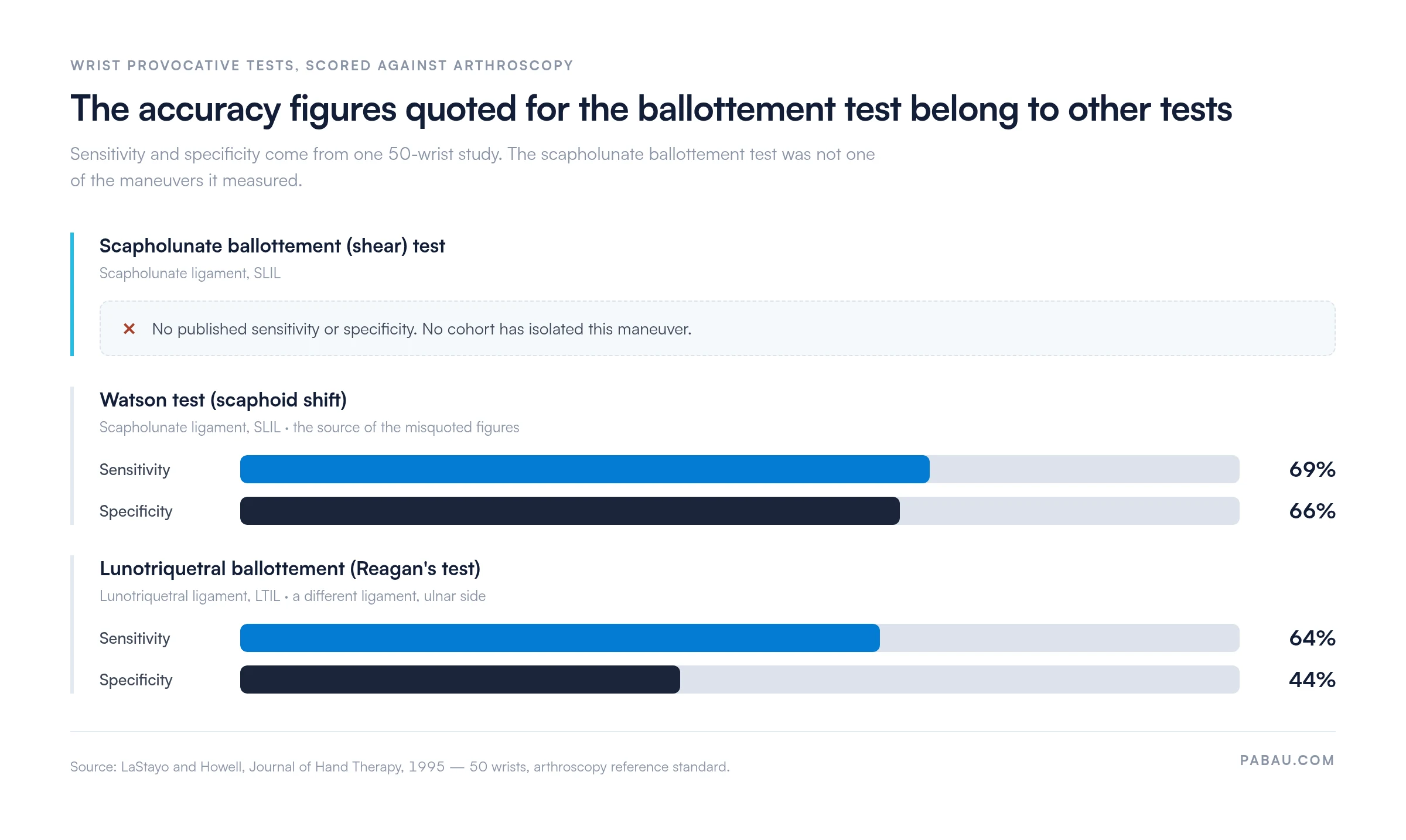
The table below separates the figures from the tests they belong to, and adds the reference standard behind each one.
Accuracy figures from LaStayo P and Howell J, Clinical provocative tests used in evaluating wrist pain: a descriptive study, Journal of Hand Therapy, 1995.
Two rules follow from that. Do not quote a sensitivity or specificity for the ballottement test in a report or a referral letter, because none has been established.
Do not borrow the lunotriquetral numbers either, because Reagan’s test examines a different ligament on the other side of the wrist.
Systematic reviews of wrist provocative testing report accuracy for the scaphoid shift test, but not for the ballottement or shear move. So, in practice, use it alongside Watson’s test, with an MRI arthrogram or arthroscopy as the final check.
A positive ballottement finding raises suspicion and justifies imaging, though it does not carry a measured post-test probability you can cite.
Always compare the scapholunate ballottement test result bilaterally and document which side was tested first. Contralateral baseline laxity is the single most useful reference point for grading a positive finding. Record it in your clinical notes before forming an impression.
Two other tests sit alongside the scapholunate ballottement test in a wrist instability battery. The mechanical differences decide which one you reach for first, and how you read a combined result.
Both tests target the SLIL, but the Watson test uses wrist motion to do it. Radial-to-ulnar deviation passively flexes the scaphoid against thumb resistance. When the SLIL is disrupted, the scaphoid subluxes over the dorsal lip of the radius, producing a clunk on release.
The ballottement test applies direct anteroposterior shear without involving wrist motion, so it is more sensitive to subtle translational laxity. The Watson test, however, tends to give a clearer positive in moderate-to-complete tears, and it is quicker to perform. So, run both when the history points to the radial side.
The lunotriquetral ballottement test, also called Reagan’s test or the shuck test, is the anatomical mirror of the scapholunate version. It targets the ulnar side of the proximal carpal row. The lunate is stabilized and the triquetrum is translated anteroposteriorly, and pain or laxity indicates lunotriquetral ligament (LTIL) disruption.
The symptoms differ too. SLIL injury typically causes dorsal radial wrist pain, and LTIL injury causes dorsal ulnar pain. Applying the scapholunate ballottement test to an ulnar-sided case risks a false negative and a missed LT diagnosis.
Where the pain sits on the ulnar side, pair Reagan’s test with the fovea sign test. That one loads the soft tissue at the ulnar fovea rather than the carpal ligaments.
The scapholunate instability test earns its place when wrist pain has a likely cause. A fall on an outstretched hand, a high-energy twisting injury, or contact sports trauma all qualify. Beyond acute injury, also consider it in patients who have:
The test is less useful in three situations. First, acute swelling can prevent reliable palpation of the lunate and scaphoid. Second, some patients cannot tolerate the required compression. Third, others carry an abnormal bilateral baseline, as in generalized hypermobility syndromes. In those situations, go straight to imaging.
The British Society for Surgery of the Hand (BSSH) treats MRI arthrogram as the preferred first-line imaging for suspected SL ligament pathology. That applies when the clinical exam is unclear. Even so, wrist arthroscopy remains the final reference standard for grading SLIL tears.
Build the test into a standard wrist instability battery, because a single provocative finding carries far less weight on its own. Instead, a pattern across three or four tests is what moves a referral.
The lack of published accuracy data is not the only problem with this test. Several practical factors can also affect how well it performs at the bedside.
Document these factors clearly in your notes. That matters most when you report a negative ballottement test alongside high clinical suspicion.
Clear documentation of the test protects the clinician and informs the next practitioner. It also supports any later imaging request or surgical referral. So, a complete record captures six elements.
A concise SOAP note entry for a positive result might read: “Objective: SL ballottement test positive (L) wrist. Dorsal pain provoked with AP shear. Approximately 2 to 3 mm excess translation compared to (R). Crepitus present on palmar loading. No audible clunk. (R) side: no pain, no excess translation. Assessment: positive SL ballottement test, clinical suspicion for SLIL disruption. Plan: refer for MRI arthrogram.”
Practices using clinical records management software can build reusable wrist instability templates. Those templates prompt for bilateral findings, grading, and imaging referral triggers, so fewer records reach the next practitioner incomplete.
In fact, the platform holding those templates matters as much as the template itself. Physiotherapy clinic management software sets out the assessment and record-keeping features worth checking before you commit.
Left to free text, the wrist exam gets recorded differently every time. The bilateral comparison is typed one way on Monday and another way on Thursday, and the imaging referral sits in a separate letter.
Practice management software like Pabau replaces that with a structured form. You build a wrist instability template once, with fields for the side tested, the provocation response, the contralateral baseline, and the referral trigger. Every clinician then records the exam the same way.
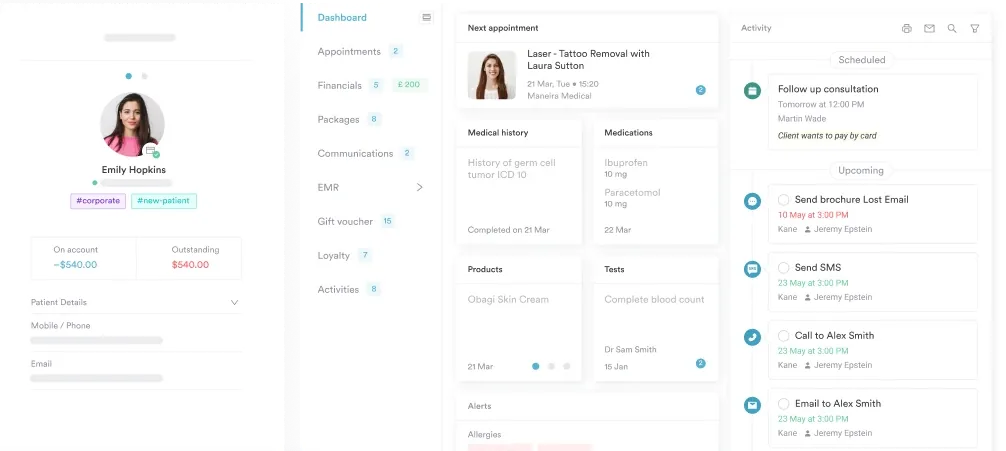
Pabau’s physical therapy EMR holds those forms in the same patient record as the appointment, the imaging referral, and the follow-up. So when a hand surgeon asks what the exam showed, the answer is one click away rather than a search through three systems.
If your practice dictates rather than types, Pabau Scribe, our AI medical scribe, drafts the note from the recording. That helps most after a multi-test wrist assessment, where recall fades as the session goes on.
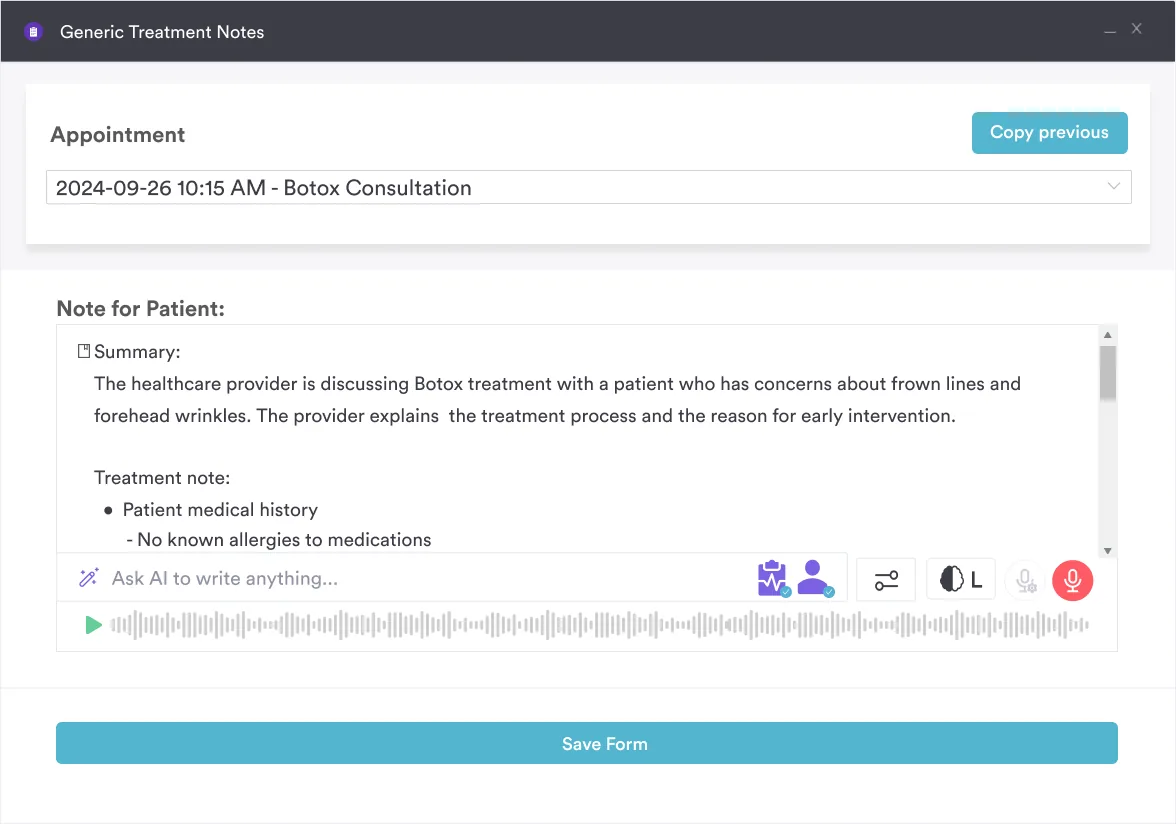

Pabau’s clinical record tools let physical therapists and hand clinicians capture structured examination findings, bilateral comparisons, and follow-up plans in one patient record. See how it works for MSK and sports medicine practices.

Scapholunate ligament injuries are among the most serious missed diagnoses in wrist trauma. The ballottement test is a reasonable first move on a radial-sided wrist. So, treat what it gives you as a reason to image, never as a number to quote.
The trade-off worth remembering is that the test’s value sits entirely in the comparison. Without a contralateral baseline in the note, a positive result reads as an opinion rather than something the next clinician can act on.
So build the bilateral comparison and the referral trigger into the form, not into your memory. Book a demo to see how Pabau structures wrist instability assessments inside the patient record.

Need the companion test for the radial side? Watson test walks through the scaphoid shift maneuver and the accuracy data that belongs to it.
Ruling out a fracture before you blame the ligament? Scaphoid fracture test covers the clinical tests for scaphoid injury and when to send the wrist for imaging.
Screening the nerves in the same visit? Hand nerve tests sets out the sensory and motor checks for median, ulnar, and radial involvement.
Running a physical therapy or MSK practice and want to tighten up patient management? Physiotherapy clinic management software explains the key operational features worth evaluating.
Looking for compliance guidance specific to physical therapy practice? Mandatory compliance for physiotherapy clinics outlines the regulatory requirements that apply to MSK assessment records.
The test checks the integrity of the scapholunate interosseous ligament (SLIL). In particular, it applies anteroposterior shear stress between the lunate and scaphoid carpal bones. Clinicians use it to spot scapholunate ligament disruption in patients with dorsal wrist pain, instability symptoms, or a history of wrist trauma.
A positive result means pain, laxity, crepitus, or a clunk at the scapholunate joint. These signs appear during anteroposterior translation of the scaphoid on the fixed lunate. For example, pain without laxity suggests a partial SLIL tear or synovitis, while gross laxity alongside pain points to a more complete disruption. Still, a positive test alone does not confirm ligament rupture, so imaging with MRI arthrogram or wrist arthroscopy is needed for a final diagnosis.
DISI (dorsal intercalated segment instability) is the alignment pattern seen on X-ray that results from scapholunate ligament disruption. When the SLIL fails, the scaphoid flexes while the lunate extends, which creates an abnormal scapholunate and radiolunate angle on lateral wrist radiographs. So, DISI confirms established SL dissociation and is looked for on imaging after a positive scapholunate ballottement test.
MRI arthrogram is the preferred first-line imaging for suspected SLIL pathology when the clinical exam is positive or unclear. Plain radiographs, meanwhile, may show SL interval widening or DISI alignment in established dissociation. Wrist arthroscopy is the final reference standard for grading SLIL tears, and it is used when imaging is unclear or surgical planning is needed.