Best chiropractic billing software in 2026: Top 5 compared
Chiropractic billing software automates insurance claims, CPT coding, eligibilit...

Last Updated: Oct 8, 2026
A postural assessment is a structured clinical evaluation of how a patient’s body is aligned at rest and during movement. It identifies deviations from neutral posture and the muscle imbalances behind them.
Physical therapists, personal trainers, occupational therapists and chiropractors use it to plan treatment, choose corrective exercises and measure progress.
The standard method compares bony landmarks against a plumb line from three views: lateral, posterior and anterior. Our free postural assessment template walks you through all three. It also gives you space for deviation notes, body diagrams, a corrective exercise plan and clinician sign-off.
A four-page form with patient details, a setup checklist, and lateral, posterior and anterior alignment checks against plumb-line landmarks. It also covers palpation, body diagrams, a deviation log, dynamic tests, a corrective exercise plan and clinician sign-off.
Download template
A postural assessment compares bony landmarks against a plumb line to find the deviations that shape a treatment plan.
From the side, the plumb line should pass through the earlobe, acromion, greater trochanter, lateral knee joint line and lateral malleolus.
Static assessment captures resting alignment, while dynamic assessment shows how the patient moves and compensates, so the two work best together.
Consistent photos, one notation system and a dated sign-off make each reassessment comparable with the baseline.
Pabau, the practice management platform we build, stores the completed form, photos and reassessment reminders in the patient record.
A postural assessment is a standardized clinical evaluation of how a patient holds their body at rest and during movement. It identifies postural deviations that contribute to pain, dysfunction or injury risk. Common ones include forward head posture, kyphosis, lordosis, scoliosis and muscle imbalances.
Physical therapists, personal trainers, occupational therapists, chiropractors and sports medicine clinicians all run postural assessments. In a practice setting, the assessment forms part of the intake evaluation. Its findings then guide corrective exercise programs, treatment priorities and outcome measurement.
Postural assessment takes two complementary approaches: static and dynamic. Knowing when to use each one gives you a complete clinical picture.
Each approach supplies different data. Static assessment identifies structural deviations and resting muscle imbalances. Dynamic assessment shows how well the body moves despite those deviations, exposing the compensatory patterns that often drive injury. Where it reveals a control problem, postural stability exercises are a common next step in the plan.
Accurate postural assessment depends on consistent bony landmarks. The plumb line, an imaginary vertical reference, is the standard every landmark is compared against.
From the side, the plumb line should pass through the earlobe, acromion process, greater trochanter, lateral knee joint line and lateral malleolus. A landmark that sits off the line points to a postural fault.
From the front, assess shoulder level symmetry, elbow angle, wrist position and lower-limb symmetry. From behind, observe scapular position, spinal alignment, iliac crest height, and knee or ankle valgus or varus. If the feet look misaligned, the Foot Posture Index scores foot alignment in more detail.
The checklist below sets out what to look for in each view, in the order the protocol runs them.
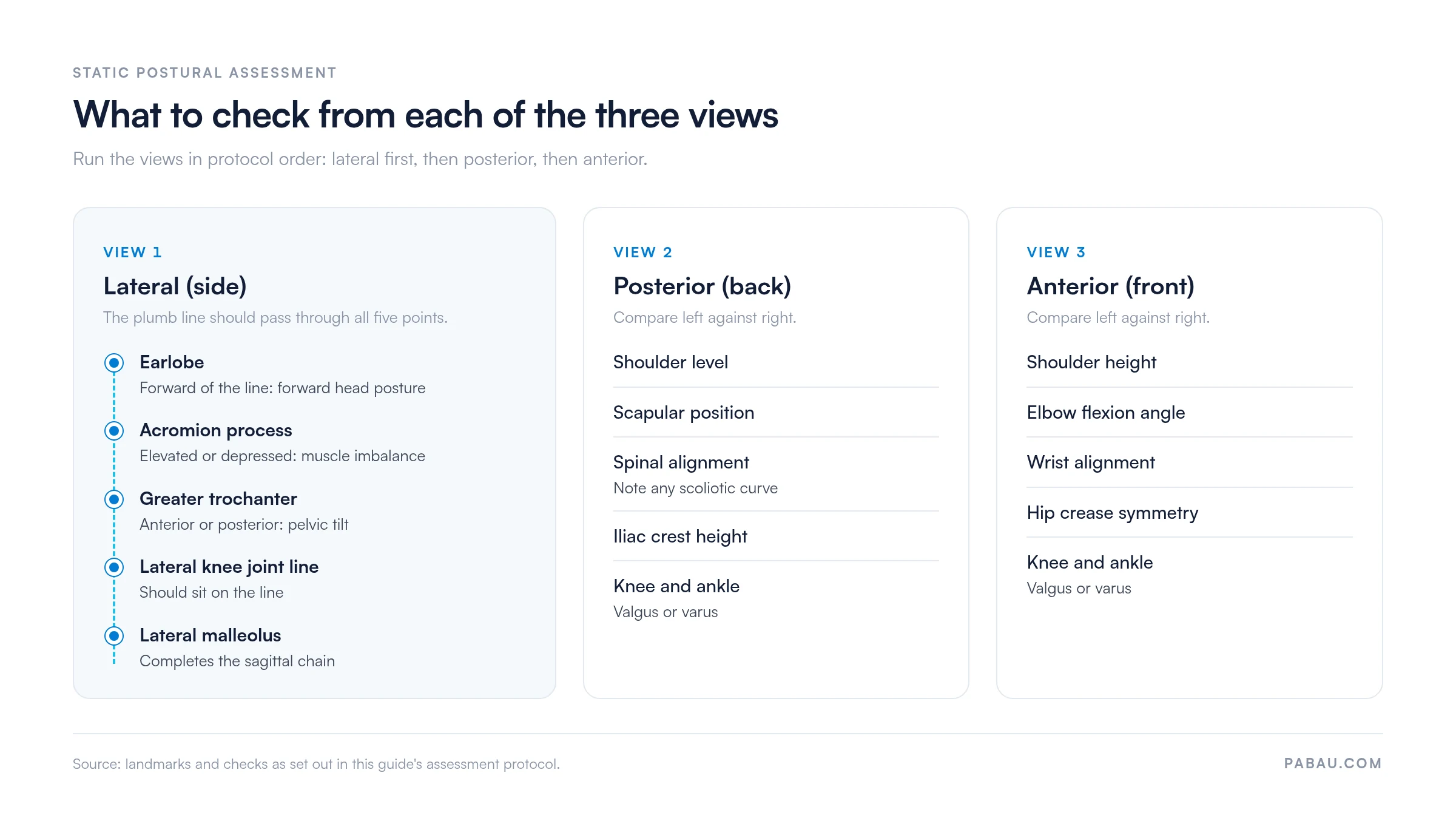
A set protocol keeps every assessment consistent and every record comparable. Work through these eight steps in order.
Postural deviations are structural or functional misalignments caused by muscle imbalance, habit or injury. Recognizing the most common ones speeds up clinical triage and keeps intervention targeted.
Kyphosis (excessive thoracic curve): The upper back rounds forward, often with forward head posture. It’s common in sedentary people and office workers, and it’s linked to shoulder impingement and cervical strain.
Lordosis (excessive lumbar curve): The lower spine overarches, often alongside anterior pelvic tilt. This increases compressive load on the lumbar facet joints and contributes to low back pain.
Scoliosis (lateral spinal curvature): The spine deviates sideways. Structural scoliosis needs medical referral, while postural scoliosis may respond to corrective exercise and muscle balancing.
Forward head posture: The head sits forward of the shoulders. This increases cervical load and is a major driver of neck pain and tension headache.
Pelvic tilt: The pelvis tilts anteriorly, with an excessive lumbar curve, or posteriorly, with a flat lumbar spine. Both disrupt proximal stability and create compensatory patterns further down the chain. Our guide to anterior pelvic tilt covers its causes and corrective work.
A postural assessment station needs only basic tools, and you probably own most of them already.
Clear, standardized documentation supports continuity of care, outcome measurement and clinical defense. Your form should capture these elements.
Patient information: Record the name, date of birth, assessment date and clinician name. This supports accountability and lets you track the patient over time.
Observation findings: Record anterior, posterior and lateral view observations. Use simple notation, with checkmarks for normal and circles or crosses for deviations. Anchor each observation to a landmark, such as the earlobe or acromion.
Body diagrams: Annotated front and back silhouettes show deviations at a glance. Mark each misalignment directly on the diagram.
Corrective exercise plan: Link the postural findings to your intervention. Note which muscle groups need stretching or strengthening, based on the deviations you observed.
Clinician signature and date: A signed, dated record supports legal accountability and compliance with clinical standards.
Photos (if applicable): Anterior, posterior and lateral photos give you an objective baseline and a record of progress. Always get informed consent before taking clinical photos.
For documentation standards in your scope, check your professional body’s guidance. Physical therapists can start with the American Physical Therapy Association (APTA), and personal trainers with the National Academy of Sports Medicine (NASM).
Photograph patients from the same distance and angle at every assessment, against a fixed background such as a wall grid or plumb line. Store the photos securely in your patient records system, in line with HIPAA or GDPR. In Pabau, photos sit in Client records with encryption and an audit trail.
Paper postural assessment forms take time to fill in and scatter patient data across folders and inboxes. Pabau’s digital forms let you build the form once and reuse it for every patient.

Once the form is complete, the findings are saved straight to the patient’s clinical record. Nobody re-enters data, and no sheets get misfiled.

Attach the anterior, posterior and lateral photos to the same record. Track change across sessions with Pabau’s measurement-tracking tools, and schedule automated reminders when a reassessment is due.

Pabau’s digital forms capture all three postural views, store photos against the patient record, and remind patients when reassessment is due.

A postural assessment is only as useful as its consistency. Use the same landmarks, camera setup and notation at every visit. That way, any change between records comes from the patient’s progress.
Start with the free template on paper if that’s how your practice works today. Once you’re reassessing patients every few weeks, comparing paper forms side by side gets slow. At that point, a digital form tied to the patient record saves the most time.
Book a demo to see how Pabau keeps postural assessments, photos and reassessment reminders in one patient record.

Setting up a new patient’s first visit? Physical therapy intake form collects history and symptoms before the assessment starts.
Measuring joint movement next? Range of motion assessment explains how to measure and record joint mobility.
Found scapular asymmetry from behind? Scapular winging exercises sets out corrective work for the shoulder blade.
Adding gait to your dynamic assessment? Functional gait assessment template gives you a structured way to score walking tasks.
Screening new personal training clients? Personal trainer assessment gives trainers a structured template for new-client screening.
A postural assessment is a clinical evaluation of body alignment at rest and during movement. It is important because it identifies postural deviations (kyphosis, lordosis, forward head posture) that contribute to pain, injury, and functional limitation. Early detection guides corrective intervention and improves long-term outcomes.
The key landmarks assessed are the earlobe, acromion process (shoulder), greater trochanter (hip), lateral knee joint line, and lateral malleolus (ankle). These points should align vertically with the plumb line when viewed from the side.
Static postural assessment evaluates standing posture at rest, identifying structural deviations and resting muscle imbalances. Dynamic assessment evaluates body alignment during movement and functional tasks, revealing compensatory patterns and functional control deficits. Both are complementary and together provide a complete clinical picture.
Physiotherapists, personal trainers, occupational therapists, chiropractors, and sports medicine clinicians all conduct postural assessments as part of their clinical scope of practice. The assessment protocol is the same across disciplines, though intervention focus varies by professional role.
Initial assessment occurs at intake to establish a baseline and guide treatment planning. Reassessment typically occurs every 4-6 weeks during active intervention to measure progress, or at the start of a new treatment phase. Frequency depends on the clinical condition and treatment goals.
The NASM postural assessment follows a systematic three-view protocol (anterior, posterior, lateral) using plumb line reference and anatomical landmarks. It identifies common postural deviations and guides corrective exercise selection within NASM’s Optimum Performance Training (OPT) model framework.