Moberg pick-up test: How to administer, score, and interpret
The Moberg pick-up test is a timed hand assessment that measures tactile gnosis,...

Last Updated: Sep 23, 2026
The stroke impact scale (SIS) is a 59-item questionnaire in which stroke survivors rate how much difficulty they have across eight areas of daily life. Each domain is scored from 0 to 100, and a higher score means better function.
Pamela Duncan and colleagues at the University of Kansas Medical Center developed the scale, and version 3.0 is the one in use today. A 16-item short form, the SIS-16, covers only the four physical domains for quicker checks.
The NIH Stroke Scale (NIHSS) grades the acute neurological deficit. The SIS instead tracks recovery from the patient’s side over the weeks and months that follow.
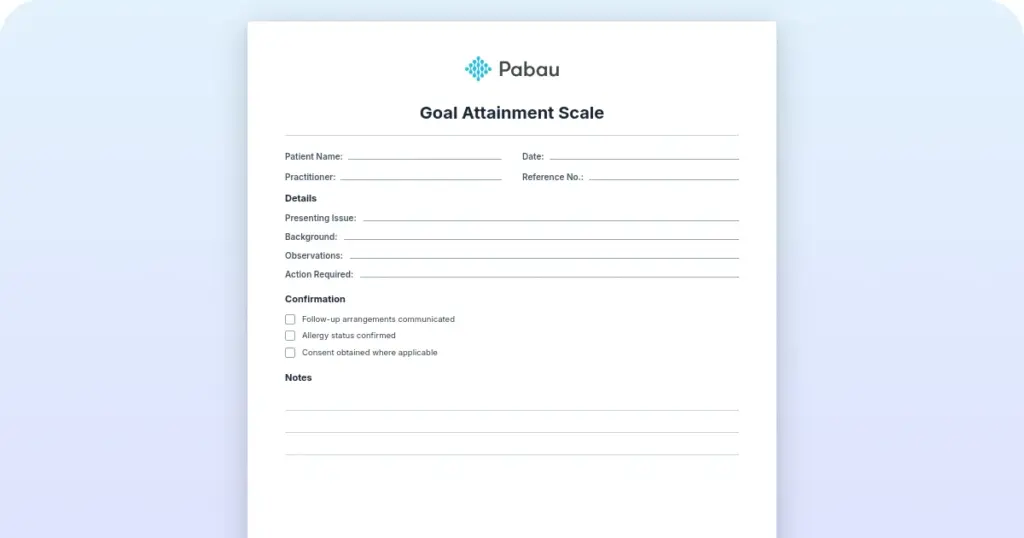
A printable SIS 3.0 form with all 59 items grouped under its eight domains, from strength and hand function to emotion and participation. It also includes the 16-item SIS-16 short form for quicker physical-function checks.
Download template
The stroke impact scale measures eight domains of stroke recovery: strength, hand function, ADL/IADL, mobility, communication, emotion, memory and thinking, and participation.
The full SIS 3.0 has 59 items rated on a five-point scale, while the SIS-16 uses 16 items drawn from the four physical domains only.
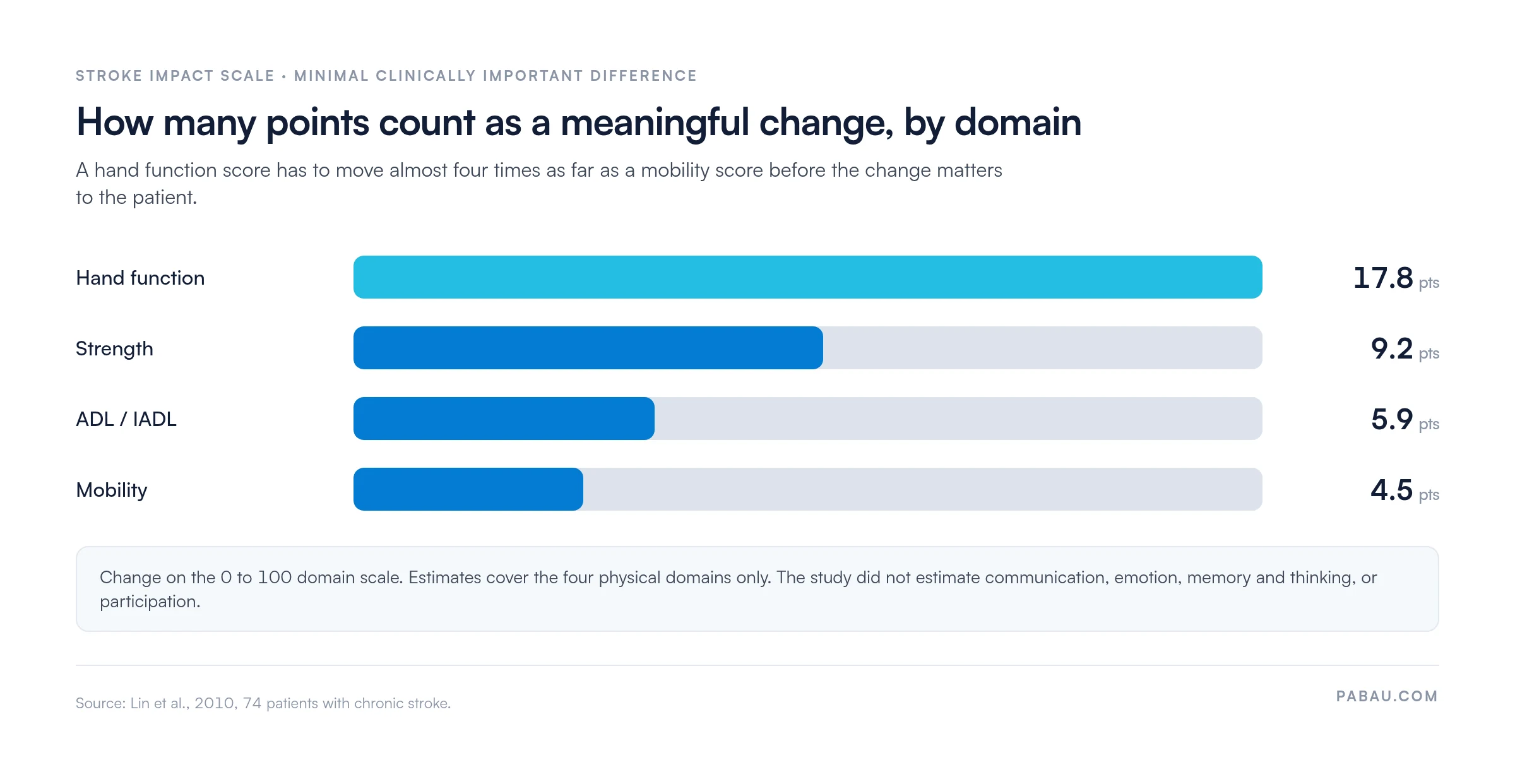
Domain scores run from 0 to 100, and higher scores mean better function. A meaningful change ranges from about 4.5 points for mobility to 17.8 for hand function.
Reliability is strong for most domains, but the emotion domain is the least stable, so read changes there with extra caution.
Pabau, the practice management platform we build, sends the questionnaire before each visit and saves every completed form to the patient record.
The SIS is a self-report health status measure, built from interviews with stroke survivors and their caregivers. It can be completed in person, by a proxy, by mail or over the phone.
Rehab teams give it at baseline, at routine follow-ups, and before and after a targeted intervention. It captures how patients see their own recovery, which often differs from what the clinician observes. That view helps decide on discharge, progression to harder activities, or more intensive therapy.
Two versions exist, trading depth for speed. The full SIS 3.0 remains the standard for research and detailed outcome tracking. The SIS-16 speeds up screening in busy or time-limited settings, but it only looks at physical function.
That limit matters in practice. A patient whose main problem is low mood or memory can still score well on the SIS-16. Use the full version whenever those domains are in question.
Each domain measures a separate consequence of stroke, so the scale looks well beyond motor recovery.
The SIS is designed for self-report. A caregiver or family member may complete it as a proxy when aphasia, cognitive impairment or severe disability stops the patient answering alone.
Scoring turns raw five-point responses into a 0 to 100 score for each domain. One fixed formula keeps scores comparable across visits and between patients.
Interpretation depends on the domain and the patient’s baseline. There is no single “normal” range, so clinicians track change over time. The bands below are a practical reading guide rather than published cut-offs.
The minimal clinically important difference (MCID) is the smallest change a patient would notice as meaningful. Lin et al. (2010) estimated it for the physical domains: 4.5 points for mobility, 5.9 for ADL/IADL, 9.2 for strength and 17.8 for hand function. A 6-point gain in mobility clears that bar, while the same gain in hand function does not. The chart shows how far apart those thresholds sit.
Most domains hold up well across validation studies. The emotion domain is the consistent weak spot.
In practice, treat a shift in the emotion score as a prompt to ask more questions, not as proof that mood has changed.
The Rehabilitation Measures Database at Shirley Ryan AbilityLab summarizes these studies. The developers at the University of Kansas Medical Center hold the official versions of the instrument.
The SIS fits any rehab setting where patient-reported function shapes clinical decisions.
Clinicians often use the SIS alongside other scales. Knowing what each one captures prevents duplicate testing.
The NIHSS grades acute neurological severity, while the SIS measures recovery and quality of life weeks to months later. The Barthel Index is clinician-rated and quicker, whereas the SIS is patient-reported and broader. Many stroke programs use several of these scales at different points in recovery.
On paper, the SIS is filled in at the front desk, scored by hand and filed. Comparing this month’s mobility score with the baseline then means finding two sheets and redoing the math.
With Pabau’s physical therapy EMR, you build the questionnaire once in the digital forms builder. Then you attach it to the appointments where it belongs, such as a rehab intake or a four-week review.
Patients complete it through the patient portal before they arrive, so the session starts with the answers already in. Each completed form is saved to the patient’s clinical record, next to their treatment notes.
Open the baseline and the latest form side by side. You can then see whether a domain moved past its MCID before you change the plan.

Pabau sends the stroke impact scale before each session and saves every completed form to the patient record. Your team compares scores across visits without hunting for paper.

Use the full SIS 3.0 at baseline and discharge, when you need the whole picture, including mood, memory and participation. Use the SIS-16 for quick physical checks in between, knowing it cannot see those other four domains.
Judge each domain against its own threshold, not one blanket number. A 6-point gain means progress in mobility but sits inside the noise for hand function. Give emotion scores extra caution, since that domain is the least reliable.
Book a demo to see how Pabau keeps every SIS form on the patient record, so progress reviews take minutes instead of a paper hunt.

Need a finer self-care score? Modified Barthel Index rates 10 daily activities with more levels of assistance than the original index.
Tracking motor recovery after stroke? Motor Assessment Scale scores everyday motor tasks such as sitting, standing and walking.
Is spasticity holding back hand function? Modified Ashworth Scale grades muscle tone from 0 to 4.
Want an objective mobility measure? 10-meter walk test times gait speed to sit alongside the SIS mobility score.
Need a broader function check? Functional Status Questionnaire covers physical, psychological and social role function.
The stroke impact scale measures how stroke affects a survivor’s physical abilities, thinking, emotional well-being and participation in daily life across eight domains. Rehab teams use it to measure recovery, adjust treatment and document functional outcomes.
Sum the item responses for each of the eight domains, then apply a standard transformation formula to convert each raw sum to a 0-100 scale. Domain scores are reported separately, with no single total score. The SIS-16 instead sums its 16 physical-domain items into a single physical-function score.
The SIS 3.0 contains 59 items and takes 15-20 minutes to complete. The SIS-16 short form contains 16 items, all from the 4 physical domains (strength, hand function, mobility, ADL/IADL), and takes 5-10 minutes. The short form suits rapid screening, but it does not measure emotion, communication, memory or participation.
Domain scores range from 0 to 100, and higher scores mean better function. Scores of 0-20 suggest severe difficulty, 21-40 marked difficulty, 41-60 moderate difficulty, 61-80 mild difficulty and 81-100 no difficulty. A meaningful change ranges from about 4.5 points in mobility to 17.8 in hand function.
Yes. Test-retest reliability is strong in most domains (ICC 0.70 to 0.92), though weaker for emotion. The scale also shows strong construct validity and responsiveness to change, and it has been translated into more than 15 languages. Its four physical subscales appear in the recommended measures table of the 2016 AHA/ASA adult stroke rehabilitation guideline. The Academy of Neurologic Physical Therapy’s StrokEDGE II task force rates the full scale as highly recommended for stroke rehab.
The downloadable stroke impact scale template is available from Pabau’s template library (shown above). The Mapi Research Trust ePROVIDE instrument registry also holds the official licensed versions.