Skin clinic software Australia: 6 best picks, AUD prices
Skin clinic software in Australia costs a two-practitioner practice between A$84...

Last Updated: Sep 22, 2026

The Ahpra question asks whether your billing privileges were withdrawn or restricted, not whether you are able to bill Medicare.
For most practitioners the answer is no, including private GPs and consultants who bill Medicare every day.
Only a Medicare sanction changes that answer, such as disqualification following Professional Services Review action.
No Commonwealth Act has been called the Medicare Australia Act 1973 since 1 July 2011, which is why the wording confuses people.
Ahpra’s current forms name the Human Services (Medicare) Act 1973 or the Health Insurance Act 1973 instead.
You are part-way through an Ahpra registration or renewal form, and one question has stopped you cold. Do you have billing privileges under the Medicare Australia Act 1973 (Cth)? Practitioners who also run cash-pay aesthetic services alongside Medicare-billed care can compare charting and billing tools in our guide to med spa management software.
Here is the short answer. The question is a disciplinary declaration. Ahpra wants to know whether your Medicare billing rights were taken away or limited because of your conduct, professional performance or health. If that has never happened to you, answer no.
That holds whether you are an intern who has never billed a service or a specialist who bills all week. This is general information, and Ahpra or Services Australia can confirm your own circumstances.
Below is the wording Ahpra uses on its own forms, and a scenario table covering interns through allied health. After that comes the reason the Act’s name matches no law on the books.
It asks whether a Medicare sanction has been imposed on you. Ahpra’s application forms ask whether, during your preceding period of registration:
… have your billing privileges been withdrawn or restricted under the Human Services (Medicare) Act 1973 (Cth) because of your conduct, professional performance or health?
Ahpra, Fast track application for general registration (form AFTR-811), effective 2 January 2025
Every load-bearing word sits in the second half of that sentence. Withdrawn or restricted. Because of your conduct, professional performance or health. The question turns on something being taken away from you, for a reason.
So it sits closer to a criminal history declaration than to a capability check. What Ahpra wants on the record is your Medicare disciplinary history.
Ahpra’s renewal forms have since moved to different wording again. They name a different Act and a narrower test, asking whether, during your preceding period of registration:
… have you been disqualified or subject to a final determination under the Health Insurance Act 1973 (Cth) because of your conduct, professional performance or health?
Ahpra, Application for renewal of limited registration (form RMLR-91), effective 18 September 2025
That form then tells you plainly when to answer no. Answer no if:
The shorter phrasing many practitioners report seeing online — “do you have billing privileges under the Medicare Australia Act 1973 (Cth)?” — is the same declaration in fewer words. The withdrawal test still governs how you answer it.
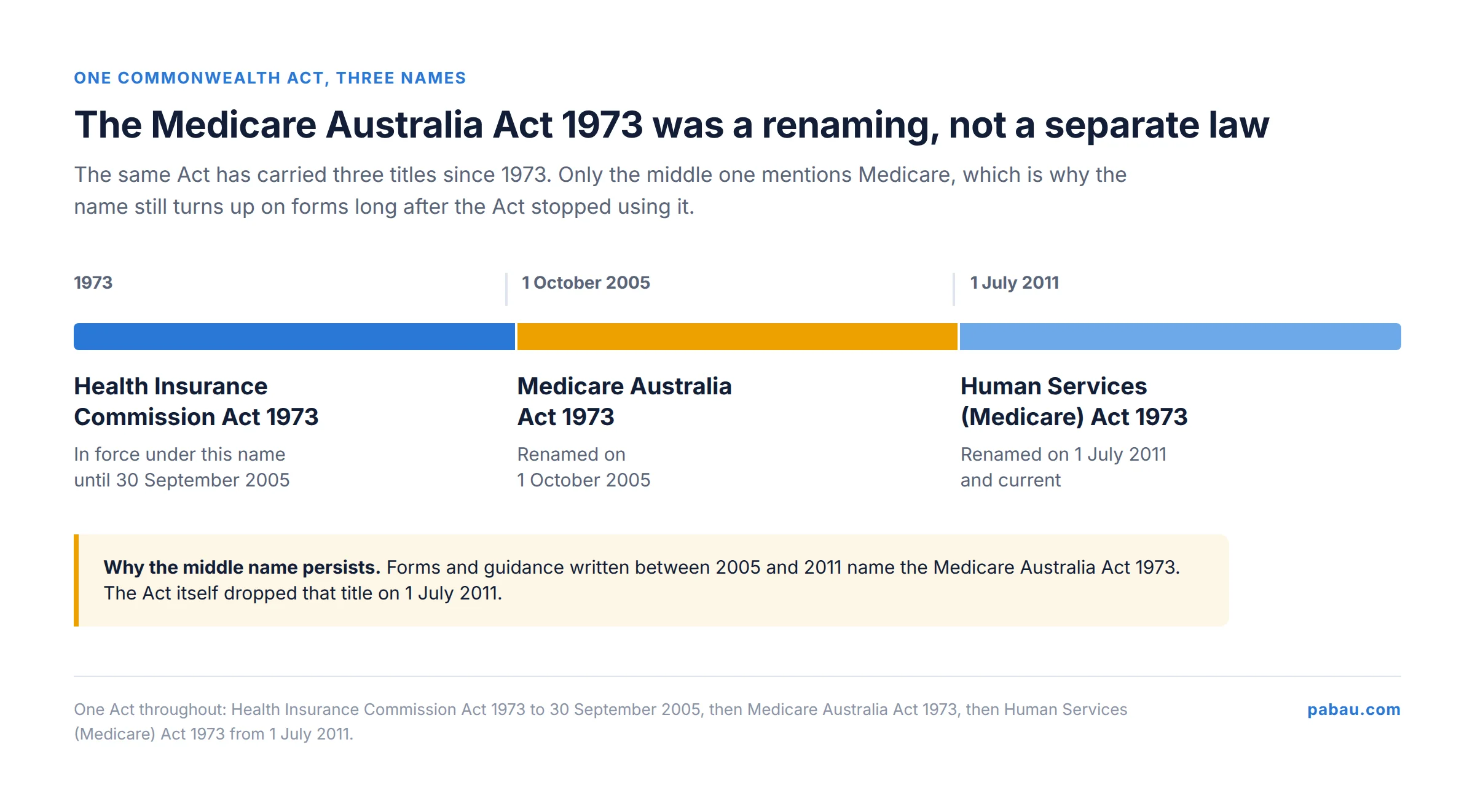
Because nothing has been called the Medicare Australia Act 1973 for 15 years. The Act named on the form was renamed twice, and the register of Commonwealth legislation records both changes.
It is one Act throughout, Act No. 41 of 1974. Only the short title changed. You can watch the name move across compilations on the Federal Register of Legislation:
Ahpra knows. Its guide to the 2022 National Law amendments names the problem outright. There has been “some uncertainty and confusion about practitioner obligations as the Commonwealth Medicare Act was repealed some time ago”.
One small correction to that: the register shows the same Act still in force, under its current name. Either way, the label on the form points at a law nobody cites anymore.
The fix was to point the National Law at the Health Insurance Act 1973 instead, which is where Medicare billing sanctions live. Ahpra’s 2025 forms show that change working through, one form at a time.
It is a mandatory declaration attached to registration and renewal, designed to surface practitioners whose Medicare billing rights have been restricted or removed. The obligation sits in section 109 of the Health Practitioner Regulation National Law, which governs the annual statement.
A National Board wants to see the same event from both directions. If a Commonwealth process stopped you billing Medicare over your conduct, performance or health, that bears on your registration too.
Section 130 of the same law carries a companion duty. If your billing privileges are withdrawn or restricted for those reasons, you must notify your National Board within seven days of becoming aware of it.
Ahpra’s own guidance adds the reassuring part. Registered health practitioners only need to make this declaration if it applies to their circumstances.
Two different questions get tangled here, so the table below separates them. One column covers whether you hold Medicare billing rights of your own. The last column covers what you write on the form.
Notice that the last column barely moves. That is the point of the question, and the reason a PGY2 and a private dermatologist answer it the same way.
| Your role | Medicare billing rights of your own? | What that rests on | Your answer on the Ahpra form |
|---|---|---|---|
| Medical intern (hospital-employed) | No | Public hospital work is funded outside Medicare, and section 19AA blocks rebates without fellowship or an approved placement | No |
| Resident or RMO (hospital-employed) | Usually no | Same position as an intern, unless you hold a section 3GA placement or fellowship | No |
| GP registrar | Often yes | An approved placement under section 3GA of the Health Insurance Act gives training-time Medicare access | No |
| Hospital specialty registrar | Usually no | Salaried hospital work, with no section 3GA placement in most non-GP training programs | No |
| Salaried hospital specialist | Sometimes | Depends on a right of private practice in your contract, and on private patients being admitted | No |
| Private specialist or consultant | Yes | Specialist registration plus a provider number for each location where you practice | No |
| GP in private practice | Yes | Vocational recognition or fellowship, plus a provider number for each practice location | No |
| Practice nurse | No | Your services are claimed under the supervising medical practitioner’s provider number, so they render the service | No |
| Nurse practitioner | Yes | Endorsement as a nurse practitioner, a provider number per location, and private practice or a section 19(2) exemption | No |
| Endorsed midwife | Yes | Endorsement for scheduled medicines, a provider number per location, and the same practice-setting rule | No |
| Allied health professional | Often yes | An eligible profession plus a referral, since most allied health items need a GP referral to attract a benefit | No |
One row changes only if a Medicare sanction has landed on you. Then the answer becomes yes, and you give the details Ahpra asks for.
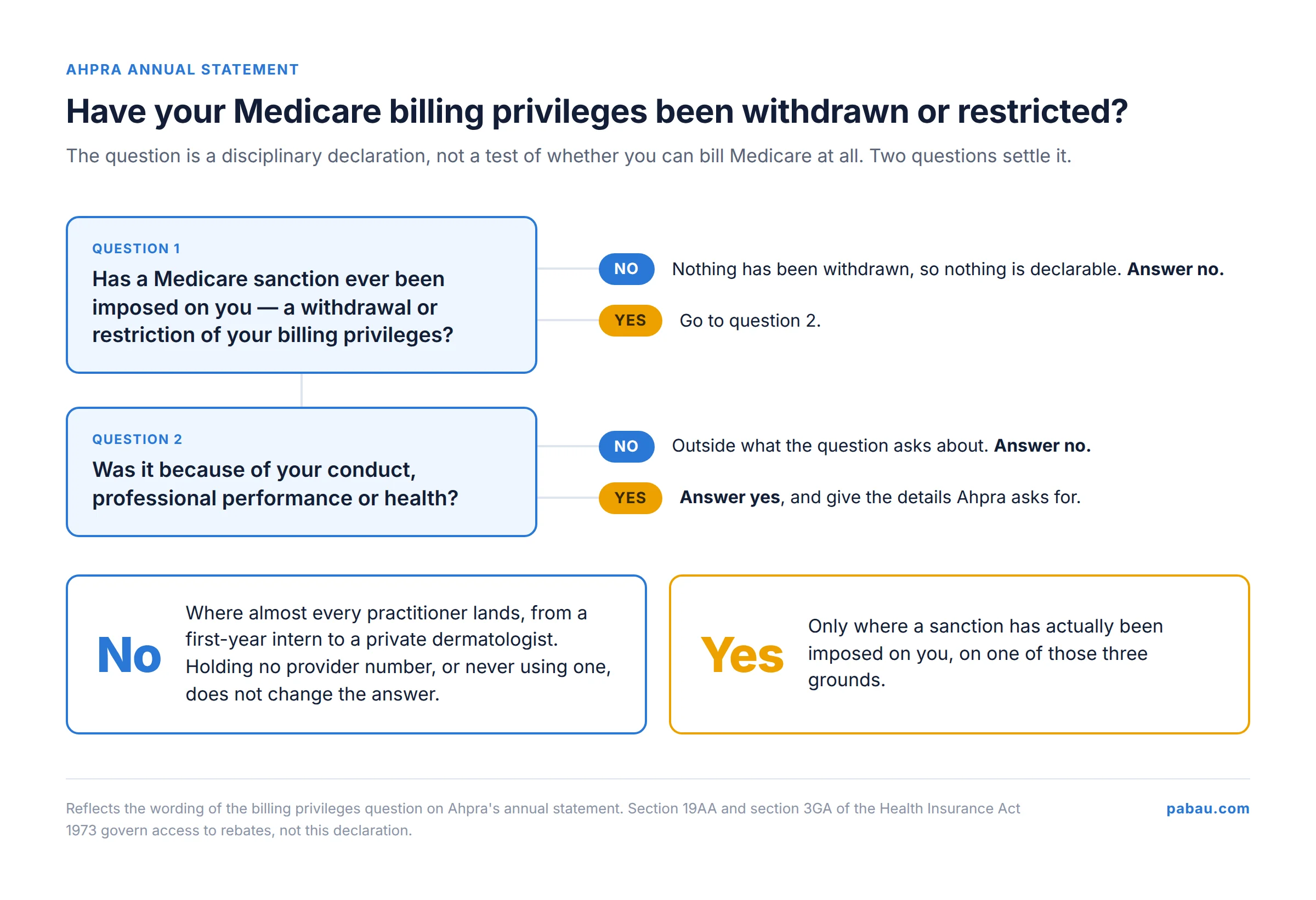
If a sanction had been imposed on you, you would already know. The Commonwealth process that imposes one writes to the practitioner, so it does not arrive as a surprise on a renewal form.
That said, three checks cover the ground if you want certainty before you submit.
Holding a provider number you never use does not change your answer. Neither does having billed nothing all year. The declaration tracks sanctions, not activity.
Three terms get used interchangeably in practice corridors, and they do three different jobs.
A Medicare provider number is the identifier Services Australia issues to a practitioner at a specific practice location. You need one for each location, and it is what appears on a claim.
The item number on that claim is a different identifier again. Each MBS item number carries its own eligibility rules and scheduled fee, set by the service rather than by the practitioner.
A prescriber number is separate, and it lets you prescribe medicines subsidized under the Pharmaceutical Benefits Scheme. Many practitioners apply for both at once, which is partly why the two blur together.
Billing privileges is not an identifier at all. On the Ahpra form it is shorthand for your standing to charge services to Medicare. The question only bites when that standing has been cut back.
An Ahpra registration number is a fourth thing again. Ahpra grants your registration, and Services Australia decides your Medicare arrangements. Neither one issues the other’s number.
Almost always through the Professional Services Review, the body that examines whether a practitioner has engaged in inappropriate practice. Two routes lead to a sanction.
The PSR Director can negotiate an agreement with a practitioner under section 92 of the Health Insurance Act. It takes effect once the Determining Authority ratifies it. Otherwise a committee of peers reviews the case and makes a finding.
Where a finding of inappropriate practice stands, the Determining Authority sets the sanction. Those range from a reprimand and counselling up to disqualification from billing specified items, or from billing Medicare entirely, for as long as three years.
The trigger practices hear about most is the 80/20 rule. It catches 80 or more relevant services on each of 20 or more days in a 12-month period. That pattern is deemed inappropriate practice, absent exceptional circumstances.
Volume rules are not the only part of Medicare that moves under a practitioner. The July 2026 bulk billing incentive changes reset what a practice earns per consultation, which is worth checking alongside your own billing pattern.
That is the whole reason the question exists on a registration form. A practitioner disqualified from billing Medicare is something a National Board wants on the record. Careful medical billing is what keeps most practices well clear of it.
Answering the Ahpra question takes a minute. Getting a practitioner productive takes rather longer, and that job lands on whoever runs the practice. Practices setting up billing can compare software built for Australian Medicare claiming before choosing a system.
Practice management software like Pabau holds the diary, client records, digital forms and consent, invoicing, and reminders in one system. A practitioner joining a practice gets a calendar and a record to write into on day one. Their first week does not run out of a spreadsheet and a paper pad. Practices based in the UK should instead compare medical billing software built for CCSD coding and CQC compliance.
Pabau lodges Medicare and DVA claims through its integrated Tyro Health connection, with assignment of benefit captured digitally at claim time. And everything around the claim — the booking, the notes, the invoice, the recall — sits in the same place, which is where practice managers lose or save their week. A clean claim needs the code, the modifiers and the diagnosis to agree, which is the check claim submission software runs.

Pabau gives a practitioner joining your practice their calendar, client records, digital forms, and invoicing in one system from their first clinic. Structured onboarding means your team is not configuring it alone.

Answer the question on your sanction history, and the wording stops mattering. No withdrawal, no restriction, no disqualification means no, whatever the form calls the Act and whatever you bill in a week.
The confusion is worth understanding rather than shrugging off, because it comes from a label the law dropped in 2011. Read the second half of the sentence, not the Act’s name, and the question answers itself in seconds.
If a sanction does apply to you, say so and give the details. Ahpra asks because a National Board is meant to know, and a late disclosure is a worse problem than the disclosure itself.
For practice managers onboarding a practitioner once the paperwork clears, the operational side is the part you control. Book a demo to see how Pabau gets a new starter’s diary, records, and invoicing running from their first clinic.

Comparing systems for an Australian practice? Best medical billing software in Australia weighs the platforms Australian practices actually shortlist, and what each one handles.
Coding a head or neck tumor? Soft tissue neoplasm coding covers how to document tumor location for accurate code assignment.
Coding a uterine cancer diagnosis? Myometrial neoplasm ICD-10 code explains when to assign this code instead of an endometrial or unspecified uterine code.
It means your standing to charge services to Medicare. The question asks whether that standing was withdrawn or restricted because of your conduct, professional performance or health. So it works as a disciplinary declaration rather than a capability test.
No, and the answer on the form is no either way. Public hospital services are funded outside Medicare. Section 19AA of the Health Insurance Act also keeps rebates out of reach without fellowship or an approved placement. Nothing has been withdrawn from an intern, so nothing is declarable.
It depends which nurse. A practice nurse does not claim in their own right, because their services are billed under the supervising medical practitioner’s provider number. An endorsed nurse practitioner does hold a provider number and bills their own MBS items. Both answer no to the Ahpra question absent a sanction.
No. A Medicare provider number is an identifier Services Australia issues to you at a specific practice location. Billing privileges describes your standing to charge Medicare at all. Holding a provider number you never use does not change how you answer the Ahpra question.
Not under that name. The same Commonwealth Act ran as the Health Insurance Commission Act 1973 until 30 September 2005. It then became the Medicare Australia Act 1973. Since 1 July 2011 it has been the Human Services (Medicare) Act 1973. Ahpra’s current forms name newer Acts instead.
Contact Ahpra and correct it. The annual statement is a formal declaration to your National Board, so an error is worth fixing promptly rather than leaving in place. Ahpra’s guidance notes that practitioners only need to make this declaration where it applies to their circumstances.