Free model waiver form + what it is and when your practice needs one
A model waiver form is a signed document that lets a healthcare practice use a p...

6
Last Updated: Sep 29, 2026

Yes, a registered nurse can own a cosmetic clinic in Australia, because no law reserves it for doctors.
Ownership and prescribing are separate questions. A nurse owner still needs a doctor or nurse practitioner to prescribe Schedule 4 injectables.
The ownership cost floor starts near $432 in year one. That covers insurance from $385 plus a $47 ASIC business name.
Queensland now requires an onsite doctor or nurse practitioner to hold injectable stock. Nurse-led practices there run two appointments per patient.
Employed cosmetic nurses average $87,500 a year on SEEK. Ownership has to beat that salary, not the award minimum.
Can a nurse own a cosmetic clinic in Australia? Yes, and no Australian law says otherwise. Most of the conflicting advice online comes from mixing up who can own the business, and who can prescribe what gets injected.
A registered nurse can hold the business, sign the lease and hire the team. That same nurse still can’t write the script for the botulinum toxin or dermal filler.
That prescribing gap shapes how you structure a medical director, which state’s stock rules apply, and what ownership actually costs against a salary. We call that last figure the ownership cost floor, and it starts near $432. All figures below are Australian dollars.
Yes, a registered nurse can own a cosmetic clinic outright. The law places no restriction on who may own the business. What it restricts is who may prescribe and supply Schedule 4 cosmetic medicines.
The Nursing and Midwifery Board of Australia sets the rules for nurses in cosmetics. Its guidance never mentions business ownership. Scope of practice means what you are educated, trained and authorized to do with a patient.
Ownership is answered somewhere else entirely. The Australian Business Register issues your ABN. The Australian Securities and Investments Commission registers your business name or company. Neither body asks whether the owner holds a medical degree.
In the Australian practices we onboard, the owner named on the ASIC record is rarely the prescriber. Someone else usually signs the treatment authorization. That split is normal, and it is legal.
Ownership and prescribing sit under different laws in Australia. Business registration runs through ASIC. Prescribing authority comes from state drugs and poisons legislation, plus your own registration.
Read down the ownership column and every row says yes. That uniformity is why the ownership question keeps getting confused with the prescribing question. The column that separates these roles is the third one.
A nurse practitioner is the one nursing role that can own the practice and write the script. Every other nurse-owned practice needs a prescriber in the treatment chain. That prescriber can be employed, contracted, or engaged as a medical director.
Cosmetic nurses assess patients, plan treatment and administer non-surgical procedures such as botulinum toxin and dermal filler.
Registered nurses need national registration and procedure-specific training. New entrants also need nursing experience outside cosmetics first.
The work runs wider than the injection itself. A nurse injector also handles the suitability assessment, the consent conversation and the batch record. The follow-up when something goes wrong lands there too.
Since September 2, 2025, one shared document has governed this work. The Nursing and Midwifery Board retired its own nurses-and-cosmetics position statement. In its place came the Guidelines for health practitioners who perform non-surgical cosmetic procedures.
The board registers nurses through the Australian Health Practitioner Regulation Agency, known as Ahpra. The guidelines build on safeguards the Medical Board of Australia introduced in 2023.
The training minimum has two parts. First, you need training in assessing whether a patient suits the procedure. Second, you need theoretical and hands-on training in the procedure itself, with assessed competence in performing it and managing complications.
One point catches people out. The board does not approve professional development programs, so injectable courses for nurses carry no regulator’s tick. It approves only programs of study leading to registration or an endorsement. Judging any course is therefore left to you.
The board also expects a graduate registered nurse to consolidate foundational skills outside cosmetics first. If you have worked only in cosmetics since graduating, you are not expected to meet that requirement retrospectively. That answer matters for anyone whose whole nursing career has been in aesthetics.
The exemption does not cover the rest. If a notification is lodged, you still have to show that the procedure sits inside your scope. Your education, training, authorization and experience are the evidence.
The rules for enrolled nurses sit in an appendix to the guidelines. The difference runs deeper than one year of experience. An enrolled nurse entering the field has to clear three requirements.
Those steps add up to two years before an enrolled nurse starts. A registered nurse serves a single consolidation period instead. Two responsibilities also stay with registered nurses and nurse practitioners. Enrolled nurses cannot assess patient suitability, and cannot take on the extra duties for patients under 18.
A flat 12-month rule circulates on training-provider and vendor pages, presented as though a regulator set it. The board’s own wording differs, and the board’s wording is the one that counts.
With the legal question settled, setting up is mostly admin. Four of the steps below take an afternoon each. The fifth, the licensing check, is where states diverge and where owners get caught.
Apply for an Australian Business Number through the Australian Business Register. You need the ABN, or an application reference, before you can register a business name.
Choose a structure. Sole trader is the cheapest to start. A partnership splits it, and a Pty Ltd company limits your exposure to business debts.
Register with ASIC. A business name costs $47 for one year or $108 for three years. Registering a Pty Ltd company costs $636.
Tell your local council and your state government that the practice is operating. Zoning and premises rules are decided locally, so this is not a formality.
Where owners get caught
Check your state’s licensing. Some states license personal appearance services, and adjunct services such as laser may need a separate permit.
The ASIC fee schedule rises every July with the consumer price index. The figures above took effect on July 1, 2026.
The prescriber is the one setup decision ASIC cannot help with. A medical director provides paid clinical oversight and no ownership stake. The agreement is a service contract, so it transfers no share of the business to a doctor.
Two structures are common. Some nurse-owned practices employ or contract a doctor or nurse practitioner directly. Others buy oversight from a third-party service that supplies prescribing and complication cover across many practices.
Neither structure changes the shareholder register. What changes is your cost base, and how quickly you can treat a patient. The oversight rules are a longer subject, and we set out the medical director requirements for Australian cosmetic practices separately.
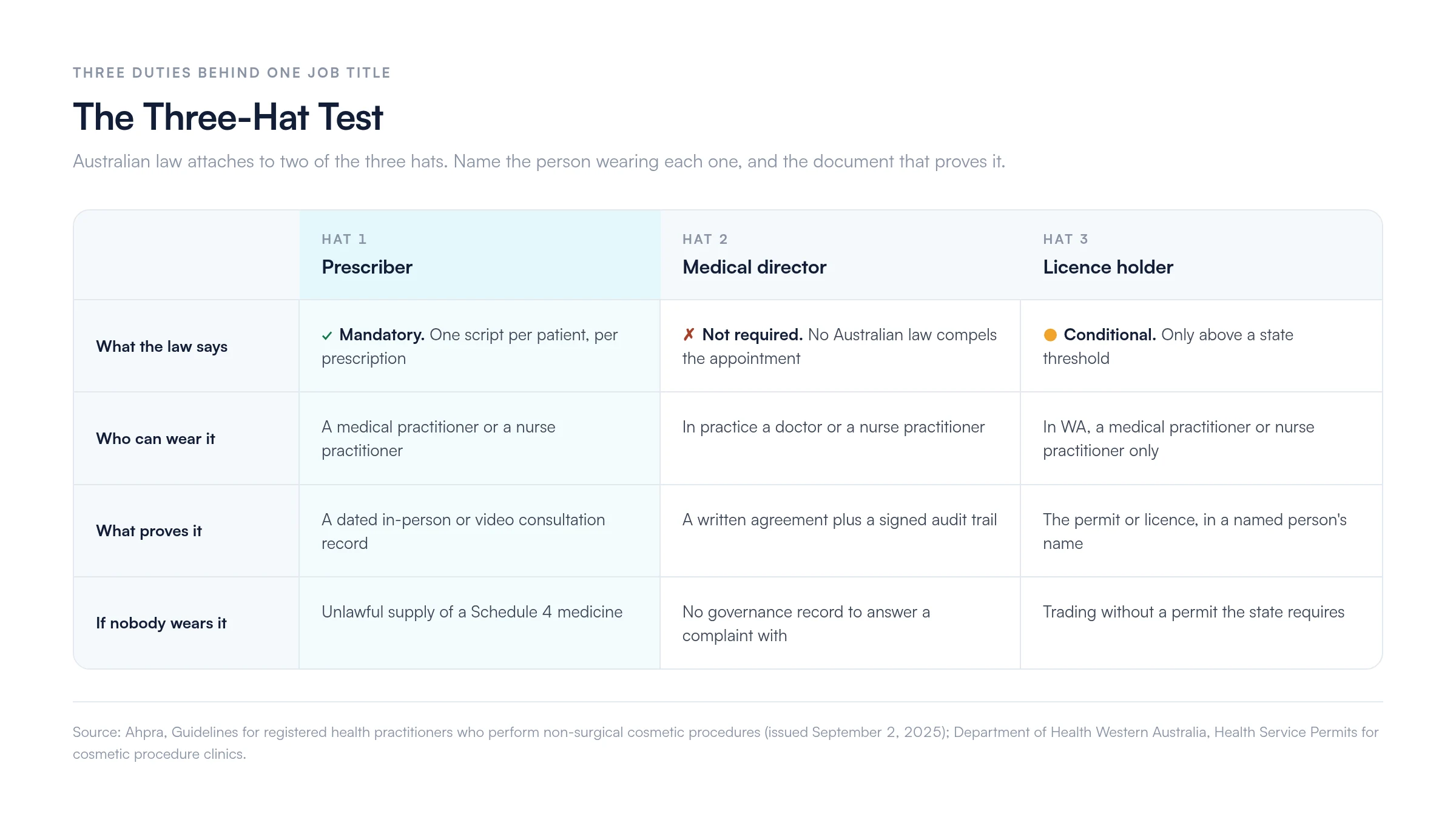
No public Australian source states a typical medical director fee. Rates are negotiated privately, and they vary with how much prescribing, review and on-call cover you need. Budget it as a line item rather than a benchmark.
Where you practice then decides how that prescriber arrangement works day to day. Schedule 4 storage and handling rules are set by each state and territory, not nationally. Queensland and New South Wales show how far apart two states can sit on the same medicine.
Queensland’s change came from revised agency advice, not new legislation. The Australian College of Nursing reports that the Medicines and Poisons Act 2019 and its regulation are unchanged. Only Queensland Health’s guidance moved.
For a nurse-led practice in Queensland without an onsite prescriber, that is a business change rather than a paperwork change. Two appointments per patient is a longer path to the same treatment. Some patients will not make the second trip.
These two states are illustrations, not a full map. Before you commit to premises anywhere in Australia, work through five checks:
Confirm whether your state lets a nurse hold Schedule 4 stock onsite, or requires a prescriber to hold it.
Ask your council about zoning for a health service at that address, before you sign the lease.
Check whether your state licenses personal appearance services, and whether laser needs its own permit.
Price a prescriber arrangement early, because no public benchmark exists to check a quote against.
Confirm the premises can store stock where unauthorized people cannot reach it.
Once the premises question is settled, the compulsory numbers are small. Owning a cosmetic clinic in Australia adds about $432 of new cost in year one. That covers indemnity and liability insurance from $385, plus $47 for an ASIC business name.
We call that the ownership cost floor. It is the minimum new spend before a single patient books, and it is lower than most people expect. The third column below is the one worth reading twice.
Two routes, two numbers. A sole trader with a one-year business name and their own cover spends $432 of new money in year one. Incorporating pushes that to $1,021, then $727 a year afterwards once the review fee and the insurance renew.
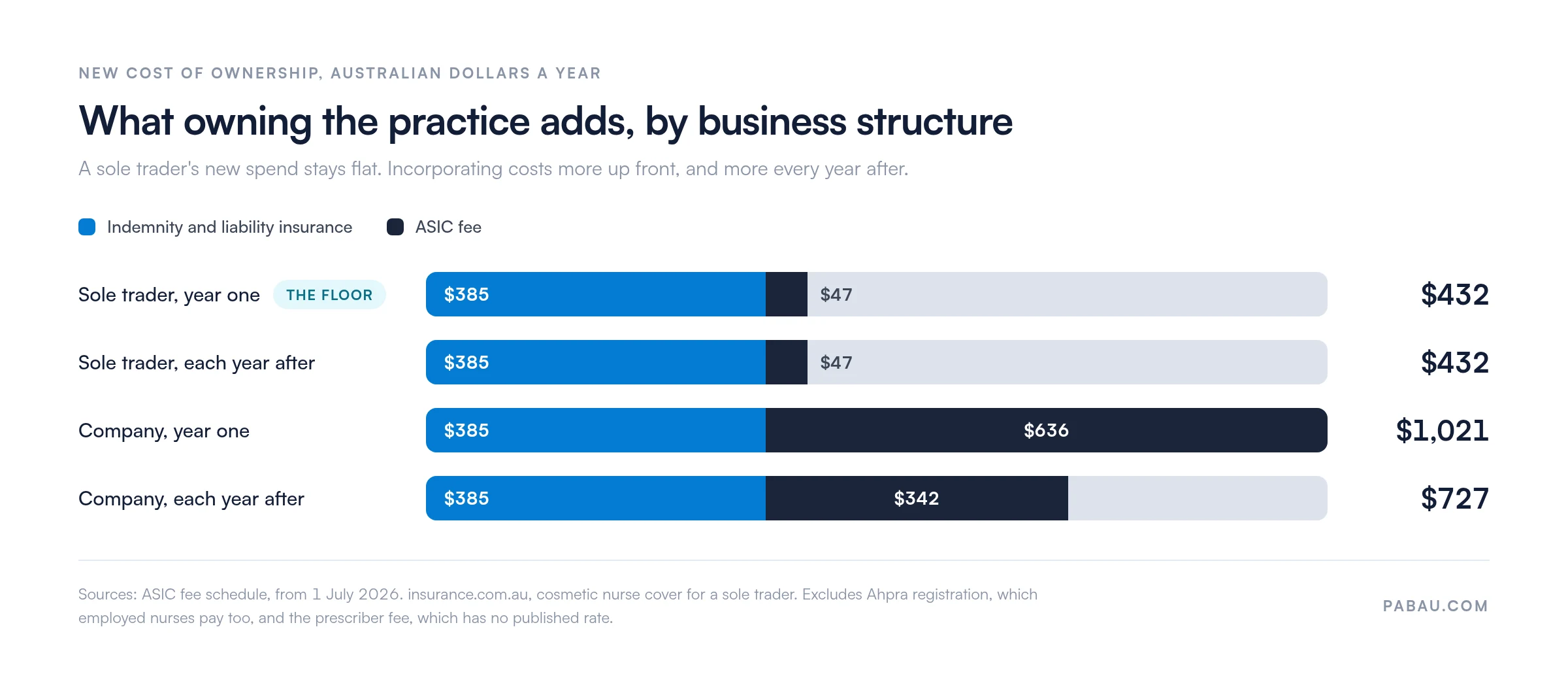
Add your Ahpra registration and the year-one total reaches $625 as a sole trader. That is less than half a week of an employed cosmetic nurse’s pay. The $193 comes from the board’s fee announcement of September 18, 2025, which lifted general registration from $185.
The number the floor cannot include is the prescriber. No public Australian source states a typical medical director fee. Treat it as the one line you have to negotiate before you can model the business.
Fit-out, stock, rent and marketing sit outside this floor, and they vary too widely to price here. Our breakdown of what cosmetic clinics make covers the revenue side of the same decision.
That floor only means something against what you would earn as an employee. Cosmetic nurse salary in Australia averages $87,500 a year on SEEK, well above the Nurses Award floor of $63,414. Ownership trades that salary for whatever margin the practice leaves.
Five benchmarks put the employed side of the decision in one view.
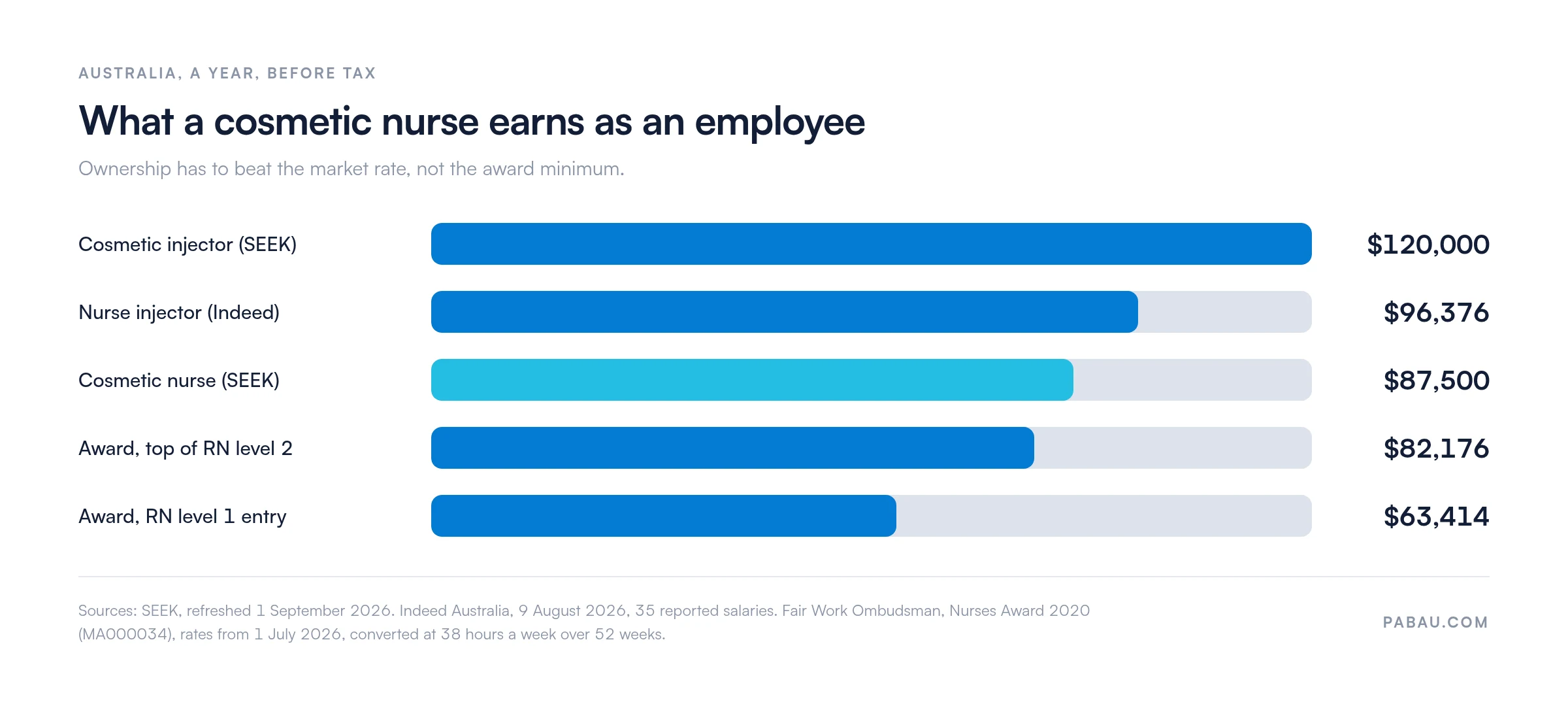
SEEK puts cosmetic nurse jobs at $85,000 to $90,000 a year, averaging $87,500, refreshed on September 1, 2026. Cosmetic injector roles on the same site run $110,000 to $130,000, averaging $120,000.
Indeed Australia reports a nurse injector average of $96,376. That figure draws on 35 salaries over three years, updated on August 9, 2026. The reported spread runs from $58,346 to $159,195, which shows how much the job title alone hides.
The legal minimum sits lower again. From July 1, 2026 the Nurses Award 2020 sets the level 1 entry rate for a registered nurse. That rate is $1,219.50 a week, or $32.09 an hour. The top of level 2 reaches $1,580.30 a week, or $41.59 an hour.
Over a 38-hour week and 52 weeks, that band works out at $63,414 to $82,176 a year.
So how much does a cosmetic nurse make in Australia? The honest answer sits between the award floor and roughly $120,000. The title on your contract moves it more than your years do. Our figures on what aesthetic nurses make break the range down further.
Ownership changes the shape of that income as well as the size. You stop drawing a salary and start drawing whatever survives rent, stock, insurance, the prescriber and the $432 floor. No public Australian dataset tracks what nurse owners take home. Treat any figure you see as a claim rather than a benchmark.
The ownership cost floor is the one side of that equation you can price today. New spend of $432 against $87,500 of guaranteed pay is a small bet. The prescriber fee decides whether it stays small.
Whatever the margin turns out to be, the record-keeping load changes the day you own the practice. As an employee you follow someone else’s protocols.
As the owner you hold the suitability assessment, the prescriber’s authorization, the consent, the batch numbers and the before-and-after photos.
If a notification is lodged, the board wants that evidence in one place. Your education, training and authorization all have to line up with the procedure. Scattered records only help if someone assembles them first.
Scheduling gets harder too. Picture a Brisbane practice. The patient sees the prescriber on Monday and comes back on Wednesday for treatment.
Whoever injects on Wednesday needs Monday’s authorization, the signed consent and somewhere to record the batch number. If any of those sits in a separate folder, a ten-minute appointment becomes twenty.
Practice management software like Pabau pulls that evidence trail onto one patient record. The consent form, the treatment note, the prescriber’s authorization and the batch number sit together instead of in four places.
Pabau GO, our iOS app for practitioners, captures before-and-after photos straight onto that record. Images stop living on a personal camera roll. Digital forms collect consent before the visit, so nobody chases signatures in the treatment room.
Pabau is purpose-built med spa software rather than a general booking tool, and every subscription includes every feature.
Still comparing systems? Our roundup of the best aesthetic clinic software sets out what each one does well.

Pabau links consent forms, treatment notes, batch numbers and before-and-after photos to one patient record. Nurse owners can produce the full evidence trail without hunting through folders.

The legal answer was never the hard part. Ownership is open to you as a registered nurse, and it has been all along.
What decides whether it works is the prescriber relationship and the state you practice in. Queensland’s exclusive custody rule shows how one line of agency guidance can reshape a business model overnight.
So get the prescriber quote before the fit-out quote. The ownership cost floor is small enough that it will not stop you. The prescriber fee is the one number that might.
Once the doors open, the records become the job. Book a demo to see how Pabau keeps consent, photos and prescriber authorizations on one patient record.

Worried about staying compliant as you grow? Med spa compliance walks through the licensing, consent and privacy duties an owner carries.
Not sure which training a treatment needs? Aesthetic qualifications sets out the courses and registrations behind each service you might offer.
Comparing ownership rules in other markets? Who can open a medical spa covers the ownership and supervision rules that apply outside Australia.
Wondering what owners take home? Med spa owner salary looks at the income side that no Australian dataset tracks.
Planning a surgical arm later on? Opening a cosmetic surgery clinic covers the extra facility, staffing and accreditation steps.
No. Sections 42DL and 42DLB of the Therapeutic Goods Act 1989 ban advertising Schedule 4 medicines to the public. The TGA also rejects substitute wording such as ‘wrinkle-reducing injections’. Promote the consultation and the practitioner instead of the product.
Once turnover reaches $75,000 a year, yes. The ATO treats procedures that only change appearance as taxable, so most injectable revenue carries GST. Reconstructive work that attracts a Medicare benefit is treated differently.
Sometimes, and the answer is local rather than national. Your council decides whether a health service may operate at a residential address. Then your state’s drugs and poisons rules decide whether Schedule 4 stock can be stored there.
Yes. Business ownership is open to enrolled nurses on the same terms as anyone else. Their clinical scope is narrower, though. An enrolled nurse cannot assess whether a patient suits a procedure, so someone else has to.
The registrations are fast. An ABN application is usually decided on the spot, and a business name follows within minutes. Council approval, premises licensing and a signed prescriber agreement decide your opening date, and those run to weeks.