



CCSD code G5100: Bypass of duodenum billing guide
CCSD code G5100 bills a bypass that leaves the duodenum in place CCSD code G5100...

Last Updated: Oct 16, 2026
CPT code 32555 is the procedural billing code for thoracentesis, needle or catheter aspiration of the pleural space, performed with imaging guidance. Pulmonologists, interventional pulmonologists, and hospitalists report it when ultrasound or fluoroscopic imaging guides the needle. The American Medical Association (AMA) created 32554 and 32555 in 2013, replacing the deleted codes 32421 and 32422. Imaging guidance was bundled into 32555 from the start.
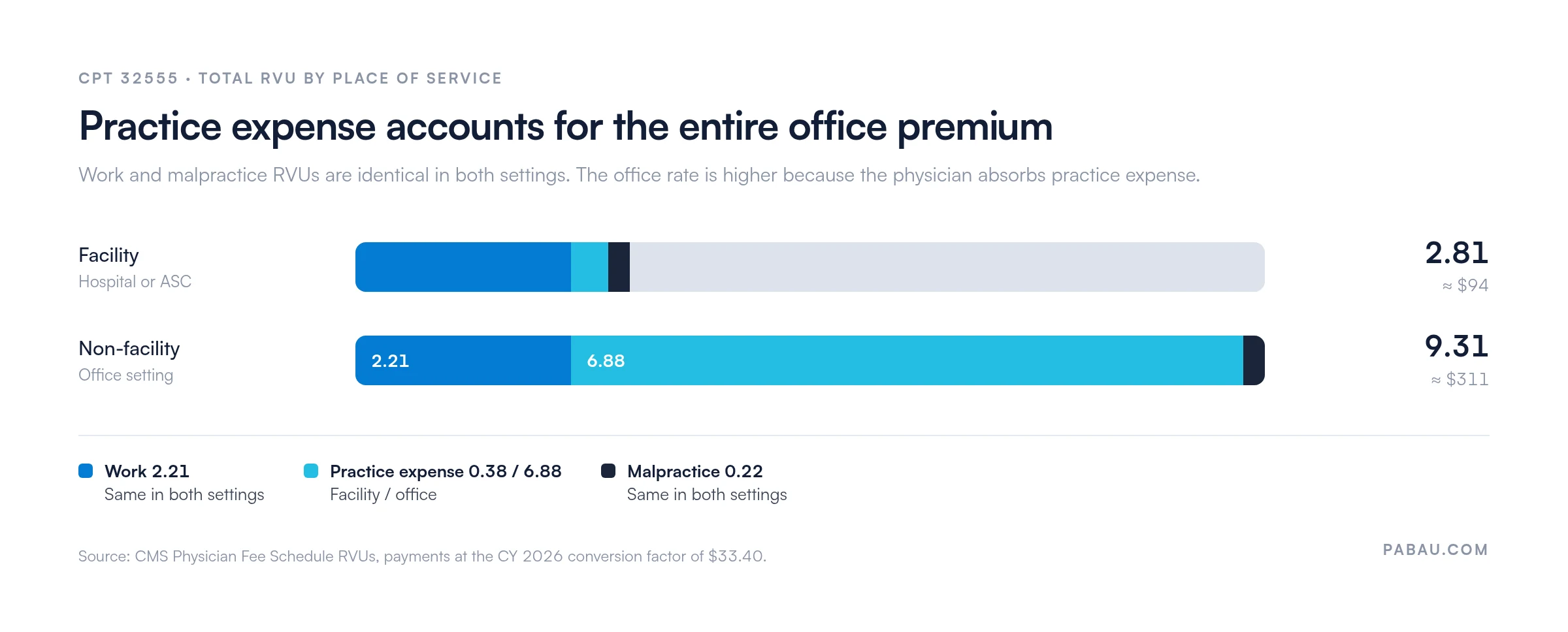
Because the imaging is bundled, CPT 76942 and CPT 77002 cannot be reported alongside 32555. Medicare pays roughly $94 in a facility setting and roughly $311 in an office. The record also has to state which imaging modality was used, or payers downcode the claim to 32554.

CPT code 32555 covers thoracentesis with imaging guidance, and CPT 32554 covers the same procedure without it. Pick the code the operative note supports.
Ultrasound code 76942 and fluoroscopic code 77002 are bundled into 32555. Reporting either one alongside it is a leading cause of NCCI-edit denials.
Medicare pays roughly $94 in a facility setting and roughly $311 in an office in 2026. Practice expense RVUs drive almost all of that difference.
Pabau’s claims management and digital documentation workflows help practices capture imaging notes, apply correct modifiers, and submit clean 32555 claims.
CPT code 32555 is defined as: Thoracentesis, needle or catheter, aspiration of the pleural space; with imaging guidance. It sits within the AMA’s Introduction and Removal Procedures on the Lung and Pleura subsection (CPT codes 32550-32557). It is the guided half of a two-code pair, with 32554 covering the same drainage performed without imaging.
A resection moves the claim out of this subsection. When the operative note documents a thoracoscopic lobectomy, the claim belongs to the surgical thoracoscopy family, 32650-32674. CPT code 32663 covers that procedure and carries a 90-day global period.
The procedure itself – also called a pleural tap or thoracocentesis – involves inserting a needle or catheter into the pleural space to aspirate fluid or air. When a physician uses real-time ultrasound or fluoroscopic imaging to guide needle placement, CPT 32555 applies. That imaging work is included in the code’s value; it is not a separately billable service.
CPT 32554 applies when thoracentesis is performed without imaging guidance, and CPT 32555 applies when imaging guidance is used. The choice has to reflect what happened during the procedure rather than a clinical preference. Billing 32555 with no imaging, or 32554 when imaging was used, are both inaccurate coding.
Ultrasound-guided thoracentesis is now the accepted safety standard, so most institutions perform the procedure with imaging. CPT 32555 is therefore the more common billing scenario, and its bundling rules are where most coding errors occur.
Imaging guidance has been bundled into CPT code 32555 since 2013, when CPT introduced the 32554/32555 pair. The National Correct Coding Initiative (NCCI) edits pair 32555 with CPT 76942 (ultrasonic guidance, needle placement) and CPT 77002 (fluoroscopic guidance, needle placement). Payers deny the imaging code on those pairs as a duplicate service.
The practical implication is short. If the operative note documents real-time ultrasound guidance during thoracentesis, bill 32555 alone. Adding 76942 triggers an NCCI edit denial whatever modifier is appended.
Several modifiers apply to CPT code 32555, depending on the billing scenario and the place of service. Applying the wrong one, or omitting a required one, is a documented trigger for payer audits.
Modifiers 26 and TC apply when the global service is split between a physician group and a facility. Confirm with the payer whether 32555 sits on the global surgery indicator list before you split the components. Where the modifier choice is uncertain, a coding professional’s review reduces audit exposure.
Medicare reimburses CPT code 32555 through the CMS Physician Fee Schedule (MPFS), with separate rates for facility and non-facility settings. The distinction matters. When the procedure is performed in an outpatient hospital or ambulatory surgery center, practice expenses are paid directly to the facility. The physician then receives the lower rate. In an office, the physician absorbs those costs and is reimbursed at a higher rate.
These figures are national averages. Payments vary by geographic practice cost index (GPCI) locality, so practices in high-cost areas such as San Francisco, Manhattan, or Alaska receive adjusted amounts. Verify exact 2026 rates using the CMS fee schedule lookup tool with your own MAC locality. The CY 2026 conversion factor applies to all of these RVU calculations. Confirm it against the published final rule before you bill.
Practice management software like Pabau connects to Claim.MD, our US clearinghouse partner, which routes 32555 claims electronically to thousands of US payers. The integration adds CPT code validation, real-time eligibility checks, and ERA (835) remittance posting. That shortens the manual work between a signed note and a posted payment.
Almost the whole difference between the two rates sits in one component. Practice expense rises from 0.38 RVUs in a facility to 6.88 in an office, while work and malpractice stay flat.
Before billing CPT 32555 in an office setting, check your MAC’s Local Coverage Determination (LCD) for thoracentesis. Confirm that it permits the procedure outside a facility, and that your imaging note meets its stated requirements for guidance. Non-facility rates are higher, but they require documentation standards to match.
Medical necessity for CPT code 32555 must be supported by an appropriate ICD-10-CM diagnosis code. Payers, and Medicare in particular, review whether the documented diagnosis aligns with the LCD for thoracentesis. A non-specific or unsupported diagnosis code is one of the faster routes to a medical-necessity denial.
Not every pleural effusion code automatically satisfies LCD medical necessity criteria. Your MAC’s LCD specifies which diagnosis codes are covered indications for thoracentesis. Cross-check the diagnosis against that policy before submitting, and confirm the character-level detail in the full ICD-10-CM code reference.
Complete documentation is what carries a CPT code 32555 claim through payer review. Because imaging guidance is bundled into the code, the record has to state that imaging was used. A missing statement is read as an absence of imaging, and the claim is denied or downcoded to 32554.
Specimen handling points to a second code on the same episode. When pleural fluid goes for cytology, the laboratory prepares and interprets it, and reports that work as 88112.
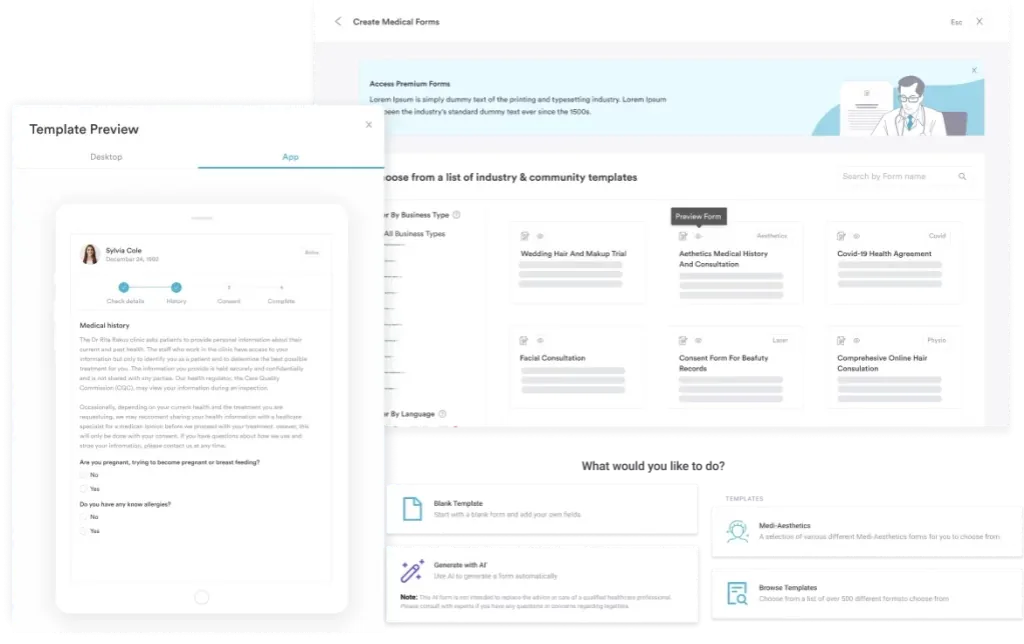
Structured digital procedure forms stop checklist items from being overlooked. When the documentation template mirrors payer audit requirements, every required field is prompted before the note is finalized. Capturing the details at the bedside also keeps the imaging statement inside the same record the coder reads later.
Thoracentesis claims deny in a predictable pattern. A handful of recurring errors account for most of them, and the right documentation and coding workflow prevents each one. A working approach to denial management in healthcare lets a practice prevent them in batches rather than appeal claim by claim.
One of those denials starts with the chest tube. When one goes in on the same side in the same session, NCCI bundles the aspiration into CPT code 32551.
A clean 32555 claim aligns five things before it leaves the practice. The diagnosis code, the procedure code, the modifier, the place of service, and the documented imaging narrative all have to agree. Each mismatch is an independent denial trigger.
Run a quarterly audit of your 32555 denial patterns by denial reason code. Group the denials by CARC code, such as CO-97 for bundling or CO-50 for a non-covered service. That shows which documentation step keeps failing, far faster than reading claims one at a time. Pabau’s reporting module surfaces procedure-level denial trends without requiring a separate RCM engagement.
Denials for CPT code 32555 usually trace back to the clinical note. The imaging statement is incomplete, or the code gets picked without anyone rereading what the clinician recorded. Pabau connects documentation to billing in one workflow, so the person coding the claim reads the note that was actually signed.
Every Pabau subscription includes every feature, so a solo pulmonologist and a twelve-physician group work from the same documentation and billing toolset. Pabau’s claims management software keeps coding, submission, and remittance attached to the record the procedure was documented in.

Pabau connects clinical documentation to claim submission, so pulmonology practices capture imaging notes and apply the correct modifiers. Clean CPT 32555 claims then go out through our Claim.MD clearinghouse integration.

Accurate billing for CPT code 32555 rests on one discipline. The note has to confirm that imaging guidance was used, backed by the right diagnosis code and the right modifier for the place of service. Bundling 76942 and 77002 into 32555 causes more avoidable thoracentesis denials than anything else on this page. Every one of them is preventable while the note is still being written.
Pabau’s clinical documentation and claims submission tools prompt for each required element before the note is signed. That shortens the distance between a completed thoracentesis and a paid claim. To see how it runs in your own workflow, book a demo with our team.

Need a framework for submitting cleaner claims? What makes a clean claim explains the components payers validate before processing any procedure code.
Want to understand how electronic claims reach payers? The 837 transaction file explained covers how CPT claims are formatted and transmitted through a clearinghouse.
Exploring other CPT reference guides? ADHD screening CPT codes covers procedure coding for neurodevelopmental assessments with similar documentation requirements.
CPT code 32555 bills thoracentesis, the needle or catheter aspiration of the pleural space, when imaging guidance such as real-time ultrasound or fluoroscopy is used. It covers the complete procedure, including the bundled imaging component. The imaging code cannot be reported separately.
CPT 32554 describes thoracentesis without imaging guidance. CPT 32555 describes the same procedure performed with imaging guidance. When imaging guidance is used, 32555 applies and imaging codes 76942 and 77002 cannot be billed separately. When no imaging is used, 32554 applies and those imaging codes may be separately reportable.
Yes. Ultrasound guidance (CPT 76942) and fluoroscopic guidance (CPT 77002) have been bundled into CPT 32555 since the code was introduced in 2013. Billing either imaging code alongside 32555 triggers a denial. Modifier 59 does not override these specific bundling edits.
The approximate 2026 Medicare facility payment for CPT 32555 is $94, and the non-facility payment is approximately $311. Both figures use national average RVU values and the CY 2026 conversion factor. Exact amounts vary by MAC locality. Verify current rates using the CMS Physician Fee Schedule lookup tool before billing.
The most common ICD-10-CM code paired with CPT 32555 is J90 (pleural effusion, not elsewhere classified). Other codes include J91.0 (malignant pleural effusion), J91.8 (pleural effusion in other conditions), J94.2 (hemothorax), and J86.9 (pyothorax without fistula). Always confirm that the diagnosis code meets your MAC’s LCD criteria for thoracentesis medical necessity.
The record needs the procedure indication, the imaging modality, and a statement that guidance was used in real time. It also needs a separate imaging narrative, informed consent, pre- and post-procedure assessments, fluid volume, specimen handling, and physician supervision. Missing imaging documentation is the most common reason 32555 is denied or downcoded to 32554.



