Skin clinic software Australia: 6 best picks, AUD prices
Skin clinic software in Australia costs a two-practitioner practice between A$84...

Last Updated: Sep 22, 2026

Services Australia issues Medicare provider numbers, and you need one for every practice location and every profession you work in.
Most practitioners apply online through HPOS using a PRODA account, and three paper forms cover everyone who cannot.
Services Australia says most provider number applications take up to 28 days from the date it receives them.
Nobody can claim a Medicare benefit at a location until the number for that location has been issued.
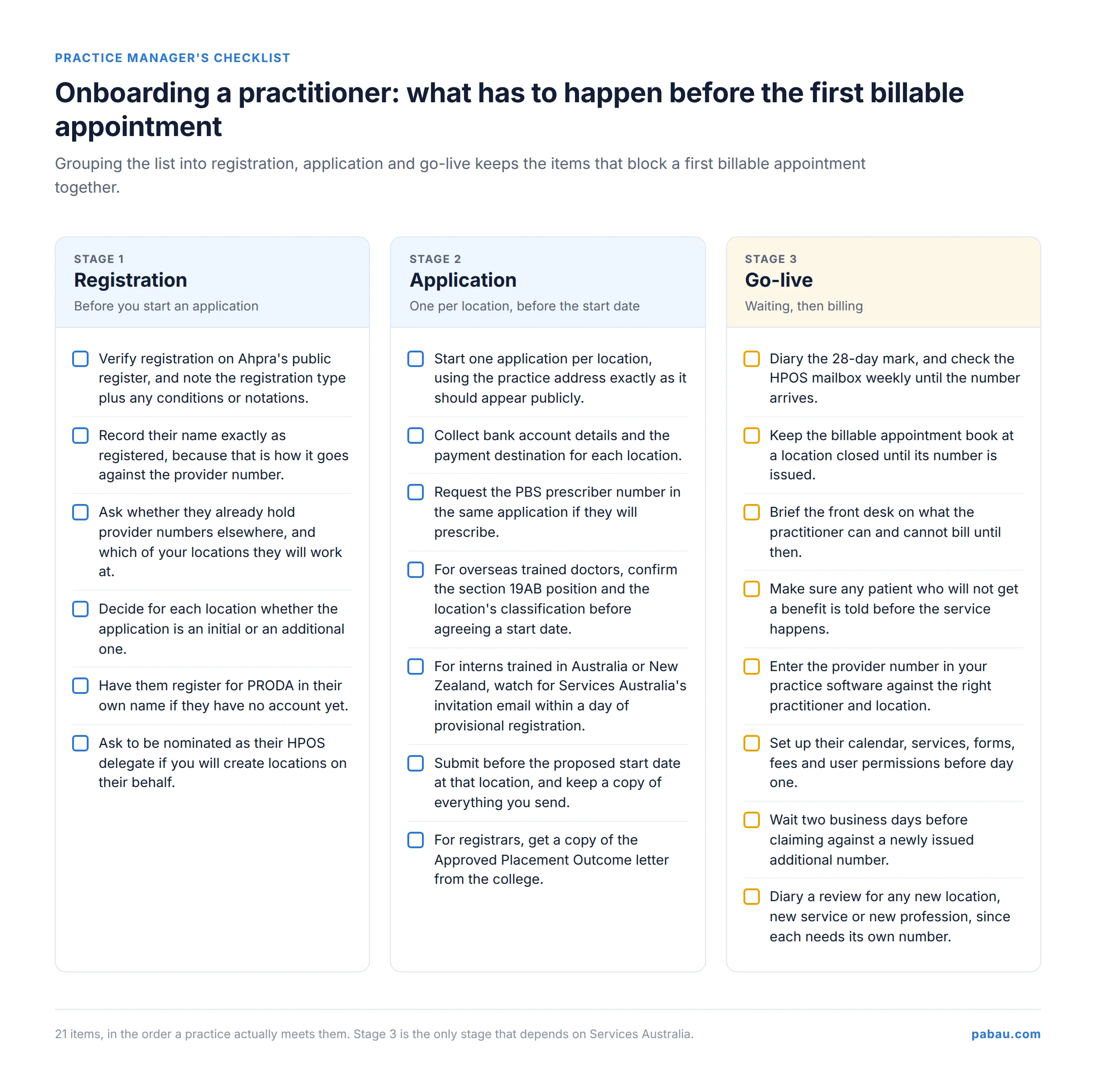
The onboarding checklist below covers what a practice manager should trigger the day a new practitioner signs.
A new practitioner’s start date and their first billable appointment are rarely the same day. Services Australia issues the Medicare provider number, and no service at your address attracts a Medicare benefit until that number exists. Practices adding elective aesthetic services while waiting on this number can start comparing options in our guide to the best medical spa software.
Most applications now go through Health Professional Online Services, or HPOS, with a Provider Digital Access account. Some still go on paper. Services Australia publishes one processing figure for both routes. It is up to 28 days from the date it receives your application.
Below are both routes, the timings the official sources actually state, and a day-one checklist for whoever is doing the onboarding.
The steps below explain how to apply for a Medicare provider number through HPOS and PRODA. We go into more detail on each step a bit further.
A Medicare provider number is the identifier Services Australia issues to an eligible health professional at one specific practice location. Services delivered there are claimed against it, and it identifies you when you refer or request services.
The number runs to eight characters. Six digits come first, then a practice location character, then a check character drawn from a fixed set. That location character is why one practitioner’s numbers differ between your rooms and the practice down the road.
Two other numbers get confused with it. A PBS prescriber number is seven digits, identifies your right to prescribe PBS medicines, and is not location specific. An Ahpra registration number proves you are registered to practice, and it has to exist first.
| Number | Who issues it | What it does | Location specific? |
|---|---|---|---|
| Medicare provider number | Services Australia | Identifies you for Medicare claims, referrals and requests at one practice location | Yes |
| PBS prescriber number | Services Australia | Identifies your right to prescribe medicines under the PBS | No |
| Ahpra registration number | Ahpra, or the relevant board or professional body | Proves you are registered to practice, and is the prerequisite for the other two | No |
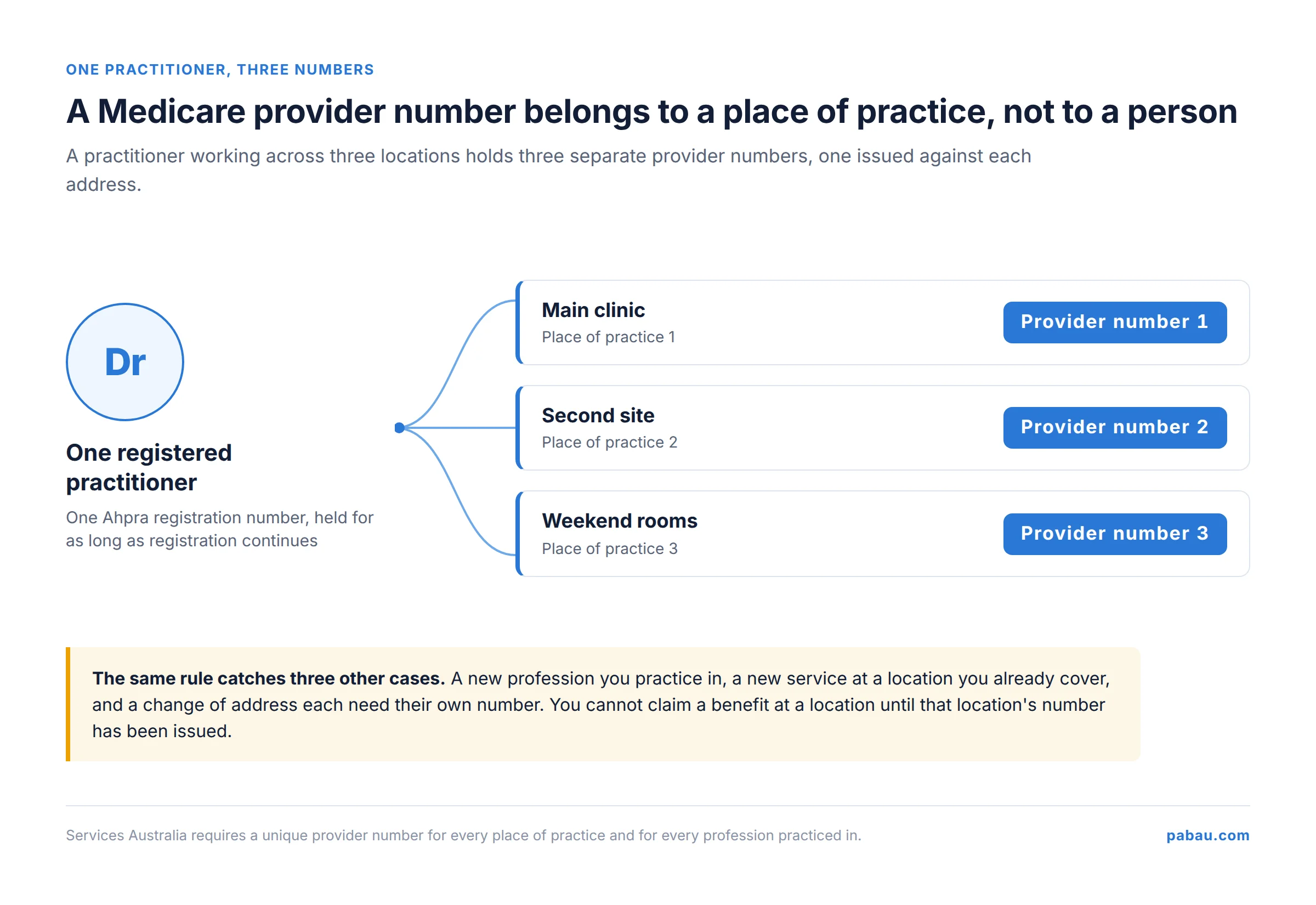
You need a separate Medicare provider number for every practice location, and for every profession you practice in. A practitioner working across three sites holds three numbers.
Services Australia lists four situations that call for more than one number:
Initial and additional applications are not interchangeable. A new location, or a new service at a location you already cover, needs an additional provider number. A new health profession or discipline needs a fresh initial application instead.
Tell the practitioner one thing before they start typing. The practice location address on the application is published publicly, so their home address does not belong in that field.
Registration comes first. You must hold registration with Ahpra, or with the relevant board or professional body, before Services Australia will issue a provider number.
Services Australia assesses eligibility under the Health Insurance Act 1973 and the determinations beneath it. It writes to you when the application is finalized, and that letter states the date you can start claiming MBS items. The same Act governs the billing privileges that number carries once it is live.
Have this ready before anyone opens the application:
Two sections of the Health Insurance Act 1973 decide which doctors can access Medicare benefits. To satisfy section 19AA, a doctor must be one of the following:
Interns, registrars and trainees can still get a provider number. Until they meet the GP or specialist eligibility requirements, their access to Medicare benefits is limited rather than full.
Section 19AB is the one that decides where a doctor can work. Overseas trained doctors and foreign graduates of an accredited medical school face location restrictions. GPs have to work in a Distribution Priority Area, and non-GP specialists in a District of Workforce Shortage.
That obligation runs for 10 years, which is where the phrase 10-year moratorium comes from. Scaling can reduce the time served, and the Health Workforce Locator shows how an address is currently classified. Read the department’s guidance on section 19AB rather than a summary of it, because the doctor needs an exemption alongside the provider number. Fee schedules change and payer rules move, so practices check both inside their insurance claims software before submitting.
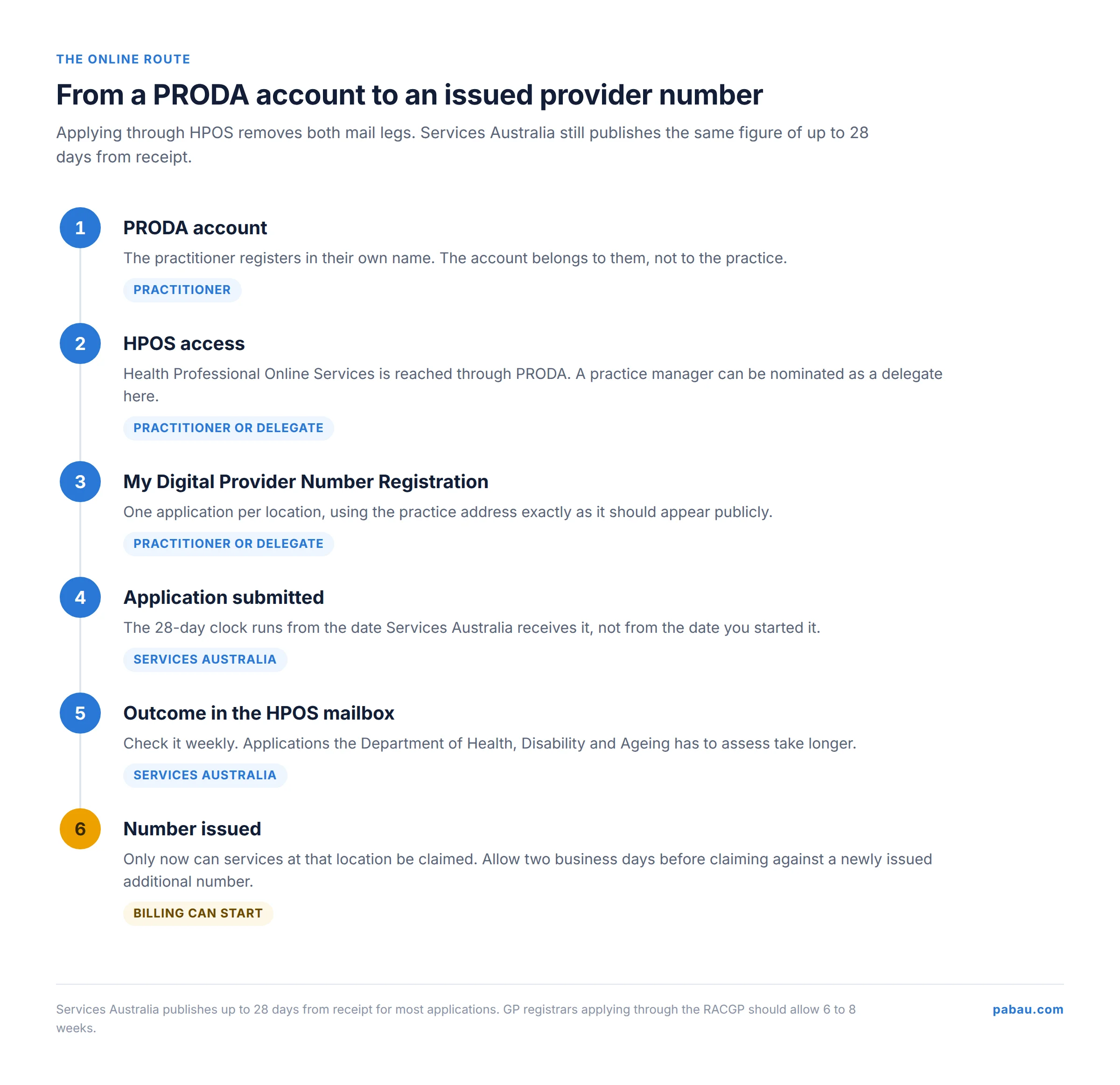
The online route runs through HPOS, and you reach HPOS with a PRODA account. Services Australia’s steps for an initial provider number are these.
A part-finished application can be saved and picked up later. To resume it, open My Digital Provider Number Registration and select Continue.
Ask for a PBS prescriber number in the same application if the practitioner will prescribe. Go to the Location Details section of the Practice Address tab, then answer yes to the prescriber number question.
Allied health professionals who are not registered with Ahpra can also apply online. They need registration with their respective board or professional body.
Services Australia sends the outcome of an online application as an HPOS message, and a letter for a paper one. If it asks for supporting documents, it has to review the application, so the number may not arrive straight away.
An additional number for a new location follows a shorter path in HPOS.
Wait two business days after an additional number is issued before you submit claims against it. That is Services Australia’s own instruction, and it saves a batch of rejections.
Applying online for an additional number is open to:
Medical practitioners have their own online route for additional numbers. A Medicare Urgent Care Clinic can also apply online for an additional number at the same location, for its urgent care services.
Three forms cover the applications HPOS cannot take, and the profession decides which one you use.
| Form | Who it covers |
|---|---|
| HW019 | Medical practitioners |
| HW088 | Nurse practitioners and midwives |
| HW093 | Allied health, other primary health care and non-medical health professionals |
The same three forms apply if you are asking for a prescriber number on its own, rather than alongside a provider number.
Medical interns have two triggers for paper. Training outside Australia or New Zealand is one. Conditions or notations on their provisional registration is the other.
Send the completed form and supporting documents to the lodgement address or fax number printed on the form. Services Australia’s Medicare provider mail address is GPO Box 9822 in your capital city.
Three things about the paper route are worth planning around:
One line on the HW019 page is the most useful of the lot. Submit the application and supporting documents before the proposed location start date.
Allied health professionals and nurse practitioners apply through the same two routes, but their eligibility is judged against different rules.
An allied health professional has to meet the qualification requirements in the Health Insurance (Allied Health Services) Determination 2014. They also need registration with Ahpra, or with their board or professional body. Services Australia must recognize them in their field, and the work has to be private practice in a private capacity.
There is a separate route for allied health professionals employed by an Aboriginal and Torres Strait Islander Community Controlled Health Service. It also covers a state or territory clinic holding an exemption under subsection 19(2) of the Act.
Services Australia names the professions that may qualify under the allied health professional initiative:
A provider number is only half of what allied health billing needs. Most allied health MBS items are referral-based, and the patient needs a GP chronic condition management plan behind the referral. Referrals written from 1 July 2025 take the form of a letter, and eligible patients get five services per calendar year.
Nurse practitioners and midwives need registration with the Nursing and Midwifery Board of Australia, and have to satisfy its registration standards. They also need endorsement as a nurse practitioner, or an endorsement for scheduled medicines as a midwife. The work must be private practice, or a public facility with a subsection 19(2) exemption.
Dental prosthetists sit in an odd position worth knowing about. They can register for a Medicare provider number, but they cannot use it for Medicare billing.
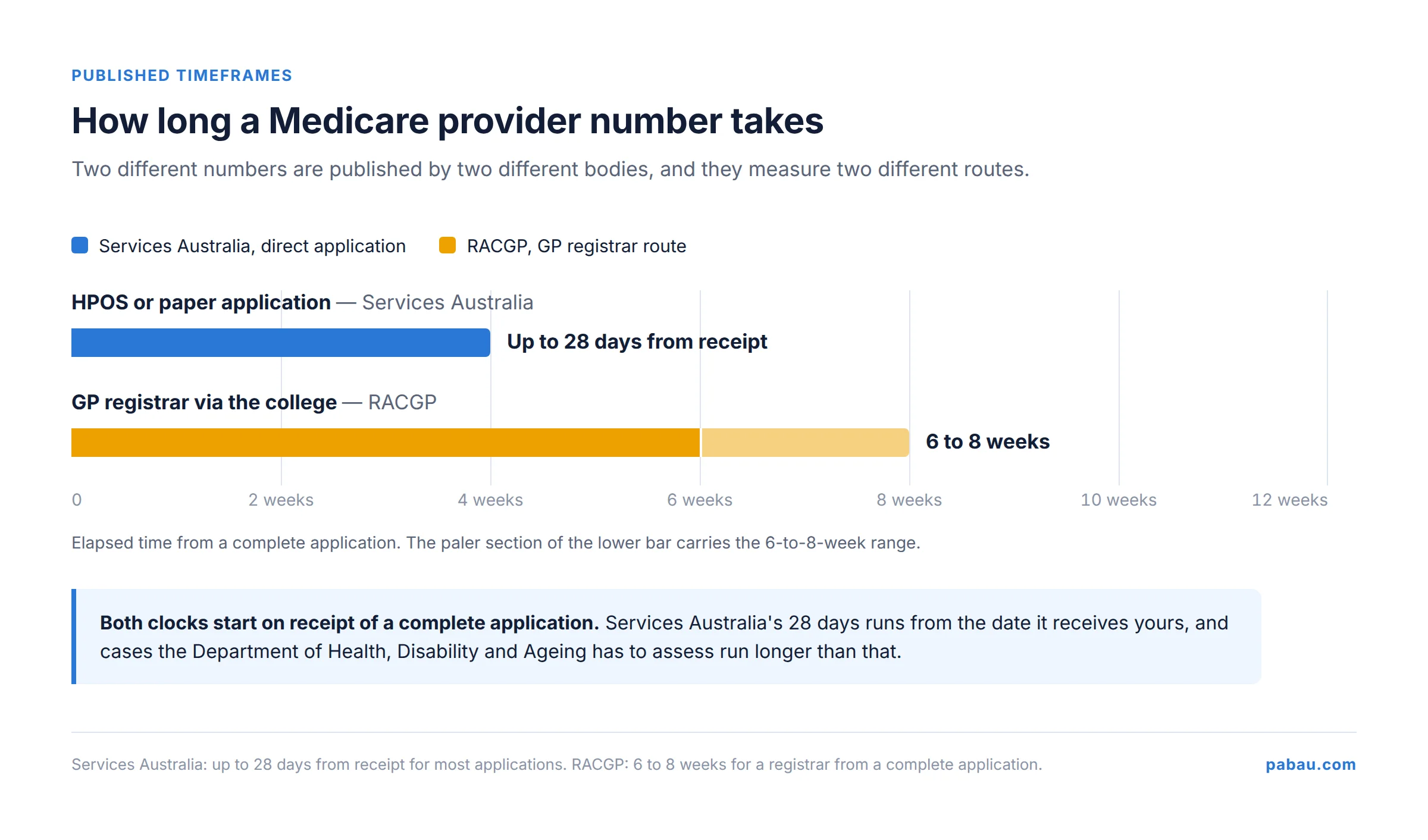
Services Australia says most Medicare provider number applications take up to 28 days to process from the date it receives them. Some take longer, where the Department of Health, Disability and Ageing has to assess them.
GP registrars have a longer published figure, because their paperwork goes through their college first. The RACGP states 6 to 8 weeks from a complete application to the number being issued. That covers its own processing and Services Australia’s.
Both organizations name their busy periods. Services Australia sees a surge between December and April. The RACGP’s peaks are April to June and October to December, matching training program start dates, and it handles about 10,000 provider numbers a year.
| Route | Who uses it | Published timeframe |
|---|---|---|
| HPOS online | Most practitioners, including interns trained in Australia or New Zealand | Up to 28 days from the date Services Australia receives it |
| Paper form | Anyone HPOS cannot take, including doctors trained overseas | Up to 28 days from receipt, plus mail time in each direction |
| Through the RACGP | GP registrars on a college training program | 6 to 8 weeks from a complete application, per the RACGP |
Applications slow down for predictable reasons:
Chase it in the right order. Check the HPOS mailbox first, since that is where online outcomes land. Then call the Medicare provider enquiry line on 132 150 and choose option 2. That option runs 24 hours a day, seven days a week.
One rule sets the appointment book. You cannot claim a Medicare benefit at a location until the number for that location is issued. If a patient will not get a benefit, you have to tell them before you provide the service. Once the number is issued, the practice also has to settle how bulk billing incentives apply to that practitioner. Failing to do that is an offense.
The trigger for this list is the practitioner signing, not their start date. Working backwards from a first billable appointment is how start dates slip. The software half of the list is covered in more depth in our guide to medical billing software in Australia. UK-based practices should compare medical billing software built around CCSD codes and CQC documentation requirements instead.
Practices billing outside Australia run the same groundwork against a different identifier, then code each service for the payer. CPT code 75572 shows how that works, since its 3D postprocessing and function assessment cannot go on separate lines.
The provider number is the one part of onboarding you cannot speed up. Everything else on that checklist is software and process, and that is usually where the days actually go.
Practice management software like Pabau holds what a new starter needs in one system. Their calendar and services, client records, digital forms and consent, invoicing and payments, reminders and reporting all sit together. So when the number lands, the diary is already configured and the first appointment simply runs.
Provider number applications and Medicare claiming happen in Services Australia’s own channels. What Pabau covers is the work around them, from the booking and the consent form through to the invoice and the recall.
Onboarding a practitioner is also when practices set up or switch systems. Pabau customers get structured onboarding with a dedicated Client Coordinator and the Pabau Portal, so nobody configures a new site alone. Our guide to EHR training covers getting the team confident once it is live.

Pabau brings a new practitioner’s calendar, client records, digital forms and invoicing together in one system. Structured onboarding means your team is not configuring a new site alone.

Two dates decide how smoothly a new practitioner starts. One is the date you submit the application, and the other is the date the number is issued. Only the first is yours to control.
So treat the application as the first task of onboarding, not paperwork someone chases in week two. Apply online where you can, run one application per location, and get it in before the start date you promised.
Do that and the rest of day one is your own setup work, on your own timetable. Book a demo to see how Pabau has a new practitioner’s diary, records and invoicing ready before their first appointment.

Setting up billing for an Australian practice? Best medical billing software in Australia compares the systems practices run their invoicing and claiming workflows on.
Coding an ear infection from another illness? Otitis media coding guide covers the sequencing rule that keeps this claim from being denied.
Coding hearing loss without a documented side? Conductive hearing loss coding explains when to use this code instead of the ear-specific alternatives.
Services Australia says most applications take up to 28 days from the date it receives them. Some take longer, where the Department of Health, Disability and Ageing has to assess them. GP registrars applying through the RACGP should allow 6 to 8 weeks.
Log in to PRODA, open HPOS, then select My details followed by My provider numbers. Your provider numbers, banking details, practice details and locations are all managed in that one place.
No. Ahpra issues your registration number, and Services Australia issues your provider number. The registration has to come first, and the provider number is what makes services at a location claimable under Medicare.
Yes. You need a unique provider number for every place of practice, and for every profession you practice in. A new service at a location you already cover needs its own number too.
No. You cannot claim a Medicare benefit at a location until the number for that location has been issued. You also have to tell patients they will not get a benefit before you provide the service.
The PRODA account and the application belong to the practitioner. They can nominate a delegate in HPOS to create a new provider location for them. Bank details for that location are then left pending.