CPT code 44625: Enterostomy closure with resection
CPT code 44625 needs three things in one operation CPT code 44625 reports an ope...

Last Updated: Oct 8, 2026
CPT Code 37215 is the billing code for transcatheter placement of an intravascular stent in the cervical carotid artery with distal embolic protection. The code bundles stent placement, angioplasty when performed, and radiological supervision and interpretation into one unit of service.
Its companion code, 37216, describes the same procedure without an embolic protection device, so the device is what separates the pair. This guide covers the descriptor, the applicable modifiers, the ICD-10 crosswalk, NCCI edits, 2026 Medicare reimbursement, and the documentation an operative note needs.

CPT Code 37215 reports carotid artery stenting with a distal embolic protection device. CPT 37216 covers the same procedure without one.
The code bundles stent placement, angioplasty (when performed), and radiological supervision and interpretation into a single unit of service that cannot be unbundled.
Medicare NCD 20.7 now covers standard-risk patients as well as high-risk ones, after CMS dropped the high-risk limit in October 2023. The thresholds are 50% stenosis if symptomatic and 70% if asymptomatic.
Pabau’s claims management software works with the Claim.MD clearinghouse to submit claims, check eligibility, track status, and post remittances against the patient record.
CPT Code 37215 is the AMA-maintained procedural code for transcatheter stent placement in the cervical carotid artery, with distal embolic protection. The approach may be open or percutaneous.
It includes angioplasty when performed, plus radiological supervision and interpretation. The code sits in the Surgery chapter of the CPT code set, under the Transcatheter Procedures subsection.
Three clinical components are always bundled into this single code and cannot be billed separately:
The distinguishing clinical element is the distal embolic protection device (EPD). When the operating physician deploys an EPD to capture embolic debris during the procedure, CPT 37215 applies.
When no EPD is used, CPT 37216 applies instead. The choice carries consequences for both reimbursement and compliance, so the operative note has to record it clearly.
The 37215 vs 37216 distinction is the most frequent source of coding errors on carotid stenting claims. Both codes describe carotid artery stent placement, and embolic protection is the single differentiator.
Reporting 37215 when no EPD was deployed constitutes upcoding. Reporting 37216 when an EPD was deployed results in underpayment and misrepresents the clinical complexity performed.
Carotid artery stenting (CAS) is an endovascular alternative to carotid endarterectomy for patients with significant carotid stenosis. The procedure follows a consistent sequence, whether the approach is open or percutaneous.
This entire sequence is captured within CPT Code 37215. No component of steps 3 through 8 can be unbundled into separate procedure codes.
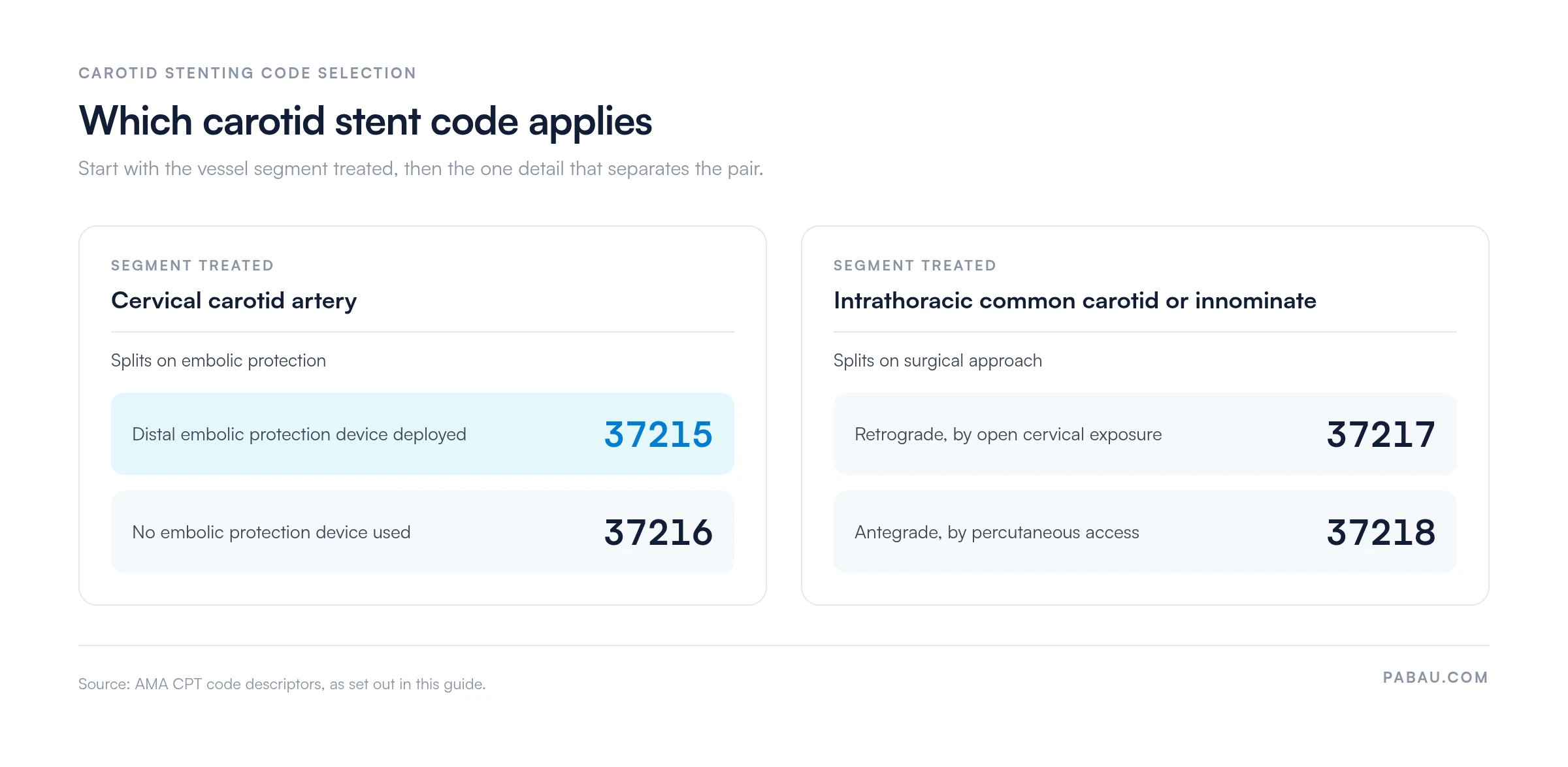
The 37215 family covers stenting of the carotid and innominate arteries across different anatomical segments and approaches. Knowing the full code set prevents incorrect code substitution.
Read as a decision, the four codes turn on only two questions: which segment was treated, and how. The chart below sets them out in that order.
Diagnostic angiography performed at the same session as CPT 37215 may be separately reportable. The findings must have led to the decision to intervene, and they must be documented separately in the operative note. Selective internal carotid angiography is reported with 36224, so check payer policy before the two appear on the same claim.
Modifier selection for carotid stent claims affects both payment and payer audit risk. Apply only the modifiers that accurately reflect the clinical circumstances documented in the operative report.
Always attach -LT or -RT to specify laterality. Omitting them is one of the most common reasons a carotid stenting claim comes back as incomplete. It also triggers payer requests for more documentation.
The ICD-10-CM diagnosis code submitted with CPT 37215 must reflect the clinical indication documented in the medical record. Carotid artery stenosis codes from category I65 are the primary pairings.
All four I65.2x codes describe stenosis, so confirm laterality in the record before selecting one. When the documented vessel sits outside category I65, our ICD-10-CM code reference indexes the rest of the diagnosis code library.
For Medicare claims, the diagnosis code must support medical necessity under NCD 20.7. The covered thresholds are stenosis of 50% or greater in a symptomatic patient, and 70% or greater in an asymptomatic patient. A TIA diagnosis (G45.x) frequently appears as the primary diagnosis when the patient presented with symptoms before the procedure.
The National Correct Coding Initiative (NCCI) edits define which codes are bundled into CPT 37215 and cannot be separately reported. Submitting a bundled code alongside 37215 without a valid modifier results in an automatic denial, which a pre-submission check catches in seconds.
The key distinction for diagnostic angiography is documentation. Separate billing is supportable when the angiography findings drove the decision to stent. The operative note must record those findings independently. Without that documented decision point, the angiography is treated as part of the global procedure.
The same logic covers radiological supervision and interpretation, which 37215 already includes. Standalone diagnostic radiology is reported on its own, so a study like CPT 74240 can split into modifier 26 and TC components.
Flag potential NCCI conflicts before submission, not after denial. Build a claim scrubbing step into your vascular billing workflow that checks 37215 for commonly paired companion codes. Catching a bundling error before it reaches the payer takes seconds, while appealing a denial takes weeks.
CPT Code 37215 carries significant relative value units, reflecting the clinical complexity of carotid artery stenting with embolic protection.
According to the CMS Physician Fee Schedule, payment rates are structured by facility and non-facility place of service. They are then adjusted by the Geographic Practice Cost Index (GPCI) for each Medicare Administrative Contractor (MAC) locality.
The estimated 2026 national average facility payment of roughly $1,800 to $2,200 comes from third-party fee schedule data. Check it against the official CMS Physician Fee Schedule for your locality before using it in revenue projections. Non-facility rates and commercial payer rates will differ.
Medicare coverage for carotid artery stenting under CPT 37215 is governed by National Coverage Determination (NCD) 20.7. CMS revised that determination on October 11, 2023, and the revision widened coverage considerably. Standard-surgical-risk patients are covered alongside high-risk patients, and the asymptomatic stenosis threshold dropped from 80% to 70%.
Commercial payer policies on carotid artery stenting vary, and some impose stricter criteria than CMS. Verify payer-specific Local Coverage Determinations (LCDs) and prior authorization requirements before the procedure is scheduled. Prior authorization failures account for a significant share of initial denials on high-value vascular codes.
Correct documentation is the foundation of a defensible CPT 37215 claim. Thin operative notes are the most common underlying cause of audits, post-payment reviews, and recoupment demands on carotid stenting claims. Each element below belongs in the operative report before the claim goes out.
Vascular codes like 37215 carry bundled components, coverage criteria, and documentation requirements that all have to line up before a claim is clean. Most denials on these claims trace back to something the operative note left out. Others come from a detail that never made it onto the claim form.
Practice management software like Pabau keeps the clinical record and the claim in one system. The billing team works from the operative note itself, not from a re-keyed summary. Pabau’s claims management software handles submission, eligibility checks, claim status, and remittance posting in that same place.
Claims route out through the Claim.MD clearinghouse, which reaches thousands of US payers. Eligibility responses, claim status updates, and electronic remittance advice come back against the same patient record. A practice billing a handful of carotid stents a month sees a rejection on the day it happens. The alternative is finding it at month-end reconciliation.
Run a short pre-submission check on every 37215 claim. Confirm the EPD is documented and the laterality modifier is attached. Check that the ICD-10 code matches the coverage threshold and the shared decision-making note is there. Five minutes here saves a 30-day denial and appeal cycle.

Pabau’s claims management software submits claims through the Claim.MD clearinghouse, checks patient eligibility, and posts remittances against the patient record. See how it handles complex procedure billing.

Two facts decide a carotid stent claim, and a coder cannot infer either from the chart. They are the segment treated, and whether an embolic protection device was deployed. Both belong in the operative note, in plain language, written on the day of the procedure. Get those two lines right and the rest of the claim follows.
The coverage side has moved in the practice’s favor. Since October 2023, a standard-surgical-risk patient can qualify, so a case that would have failed NCD 20.7 two years ago may well be payable today. What has not changed is that the record has to say so. Book a demo to see how Pabau keeps operative documentation and claim submission in one workflow.

Need to understand how clearinghouse submission works for complex CPT codes? Pabau’s Claim.MD clearinghouse guide explains how electronic claim routing reduces denials for high-value procedures.
Want to reduce claim rejection rates across your vascular billing team? Revenue cycle management explained covers the end-to-end process from procedure to payment posting.
Billing the anesthesia side of a carotid intervention? CPT code 01925 covers anesthesia for carotid and coronary interventional procedures.
CPT Code 37215 covers transcatheter placement of intravascular stent(s) in the cervical carotid artery with distal embolic protection. It also includes angioplasty when performed, plus radiological supervision and interpretation. Stent placement, angioplasty, and RS&I are all bundled into this single code and cannot be billed separately.
CPT 37215 is reported when a distal embolic protection device was deployed during carotid artery stenting. CPT 37216 is reported when no embolic protection device was used. The EPD is the only clinical differentiator between the two codes. To support 37215, the operative note must document the device type, deployment, and retrieval.
The most commonly applied modifiers are -LT (left carotid) and -RT (right carotid) to indicate laterality. Modifier -59 is used when a separately reportable companion code such as diagnostic angiography is billed with documented clinical justification. Modifier -50 applies for bilateral carotid stenting in the same session, which requires payer-specific authorization.
Yes. Medicare covers carotid artery stenting under NCD 20.7 for symptomatic stenosis of 50% or greater, and for asymptomatic stenosis of 70% or greater. CMS removed the high-surgical-risk limitation in October 2023, so standard-risk patients now qualify as well. A formal shared decision-making discussion must take place before the procedure, and the stent and embolic protection device must be FDA-approved or cleared.
Yes, in specific circumstances. Diagnostic angiography may be separately reported when the decision to intervene was based on diagnostic findings that are documented separately from the procedural note. Modifier -59 is required. Anesthesia, access site repair, and E&M codes for distinct encounters are also separately reportable when medically justified and documented.
The primary ICD-10-CM codes paired with CPT 37215 are I65.21, I65.22, I65.23, and I65.29. They cover the right, left, bilateral, and unspecified carotid arteries. Transient ischemic attack codes from the G45 category are frequently used as the primary diagnosis for symptomatic patients.
Carotid endarterectomy (CEA) is reported with CPT 35301, which describes thromboendarterectomy of the carotid, vertebral, or subclavian artery by neck incision. CEA removes the atherosclerotic plaque through an open surgical approach, while CPT 37215 describes an endovascular approach using a stent. Since October 2023, Medicare no longer limits stenting to patients at high risk for CEA. The two procedures now suit a wider overlap of patients.