



CCSD code G5100: Bypass of duodenum billing guide
CCSD code G5100 bills a bypass that leaves the duodenum in place CCSD code G5100...

Last Updated: Oct 16, 2026
CPT code 36416 is the billing code for collecting a capillary blood specimen by finger stick, heel stick, or ear stick. It covers the collection act alone. The laboratory test run on the specimen is billed separately, under its own analyte or panel code.
Medicare assigns 36416 status indicator B on the physician fee schedule, so it is bundled into the related service and never paid on its own. Commercial policy varies by contract. That makes 36416 a documentation code first and a revenue line second.
This reference covers the AMA descriptor, the split between 36416 and 36415, and the modifiers that apply. It also sets out how payers handle the code in 2026 and the record they expect to see.

CPT code 36416 describes capillary blood collection by finger, heel, or ear stick, which is distinct from the venous draws covered by 36415.
The code covers collection only, so the laboratory test is billed separately under its own panel or analyte code.
Medicare assigns 36416 status indicator B, so payment is bundled into the related service and never made separately, in any setting.
Commercial and Medicaid treatment varies by contract, so check the fee schedule before you build the collection line into a forecast.
Pabau’s claims management software automates modifier checks, code lookups, and 837 claim submission so 36416 reaches payers accurately the first time.
CPT code 36416 is defined by the American Medical Association as: Collection of capillary blood specimen (e.g., finger, heel, ear stick). It sits in the Surgery section of the CPT code set, under the Cardiovascular System subsection that covers venipuncture and transfusion procedures. That range runs from 36400 to 36430. The descriptor has not changed in years, and the code remains active and billable for 2026.
The XXX global period means standard surgical follow-up rules do not apply, which simplifies billing across visit types. What matters for coders is the specimen type: capillary blood only. The moment a practitioner switches to a venous draw, CPT code 36416 is no longer appropriate.
These two codes are the most commonly confused pair in the blood collection family. CPT 36415 covers routine venipuncture, a venous draw. CPT code 36416 covers capillary collection only. Reporting one when the other was performed triggers an edit flag, and often a denial or a request for records.
The payment rows are where most teams get caught out. The two codes sit on different fee schedules, so a rate you find for 36415 tells you nothing about 36416. If your point-of-care device draws from a fingertip lancet, the code is 36416 every time, whatever the result is called.
CPT code 36416 applies whenever the practitioner collects blood from a capillary source with a lancet or similar puncture device. The three accepted sites are the fingertip, the heel, and the earlobe, and the code applies at any patient age. The common clinical scenarios are these:
Do not use CPT code 36416 when a venous catheter or butterfly needle is involved. If a nurse performs a venous draw in the same session, bill 36415 for that draw. Add 36416 only when a separate capillary collection also takes place.
Solid documentation is what converts a submitted claim into a paid one. For CPT code 36416, the medical record has to show both that a capillary collection happened and that it was clinically necessary. Build these elements into every point-of-care and fingerstick workflow:
Medicare requires medical necessity documentation for all services. Stating the ICD-10-CM diagnosis code that supports the test, in both the claim and the record, is the primary audit defense for this code.
Modifiers for CPT code 36416 are used sparingly, and some situations require them to avoid denials or bundling edits. Verify modifier applicability against current National Correct Coding Initiative (NCCI) edits before submitting, since bundling rules are updated quarterly.
Modifier -59 is the most misapplied of the four. Appending it to CPT code 36416 without a confirmed NCCI edit pairing is a compliance error that can attract OIG scrutiny. When you are unsure, call the payer’s provider relations line before submitting.
Medicare does not pay CPT code 36416 separately, in any setting. The code carries status indicator B on the physician fee schedule. Payment for it is always bundled into the related service or visit billed that day. No modifier unbundles it, and no place of service changes the answer. Status indicators are published in the CMS relative value files.
Commercial and Medicaid treatment is the part worth checking, because it varies by contract and by state. The table below sets out how each payer type handles the code.
Because Medicare assigns no RVUs to 36416, an RVU or GPCI calculator returns nothing for it, and there is no underpayment to appeal. The money on a capillary encounter sits in the lab test and the visit. The collection line supports those two, rather than replacing them. Report 36416 on every eligible encounter anyway, since payers use it to confirm that the specimen was collected in your office.
Most denials tied to CPT code 36416 fall into three categories: incorrect bundling, missing medical necessity documentation, and wrong code selection. Knowing the rules before you submit is what keeps them off the rejection report. Our guide to denial codes sets out how payers classify each rejection.
CPT code 36416 can be reported alongside an office visit. That holds only when the capillary collection is a distinct service the E/M work does not already include. Many payers bundle it into the visit by default. When you bill both on the same date, place modifier -25 on the E/M code and make sure the chart supports two distinct clinical activities. Payer policy overrides the general rule here, so verify before you assume separate billing is allowed.
CPT code 36416 covers collection only. The laboratory test performed on the specimen is billed with a separate analyte or panel code. Examples are 82962 for glucose using a reagent strip, and 85013 for hematocrit. Never merge the collection and the test onto a single line, because they are two distinct services. Do not report 36416 when a lab performs the collection on a referred specimen either, since the collection code follows whoever performs the stick.
A blood lead test follows the same rule, with the quantitative assay reported under 83655 and the collection kept on its own line. A capillary blood gas is billed the same way, with the gas panel under CPT code 82803 and the stick on its own 36416 line.
Point-of-care testing creates a specific bundling risk. Some NCCI edits pair POCT lab codes with 36416, so submitting both without an appropriate modifier can get one of them denied. Review the current NCCI edit table for any POCT code you pair with 36416. A claim that clears on the first pass is worth more than any appeal. That matters doubly on a code with no separate Medicare payment to recover.
Run a monthly denial analysis on CPT 36416 specifically. Filter your rejection report by this code and categorize each denial reason. If bundling edits dominate, adjust your billing workflow to add modifier -59 only where NCCI edits confirm it applies. If medical necessity denials are the issue, audit your documentation template for fingerstick encounters and make the necessity statement a required field.
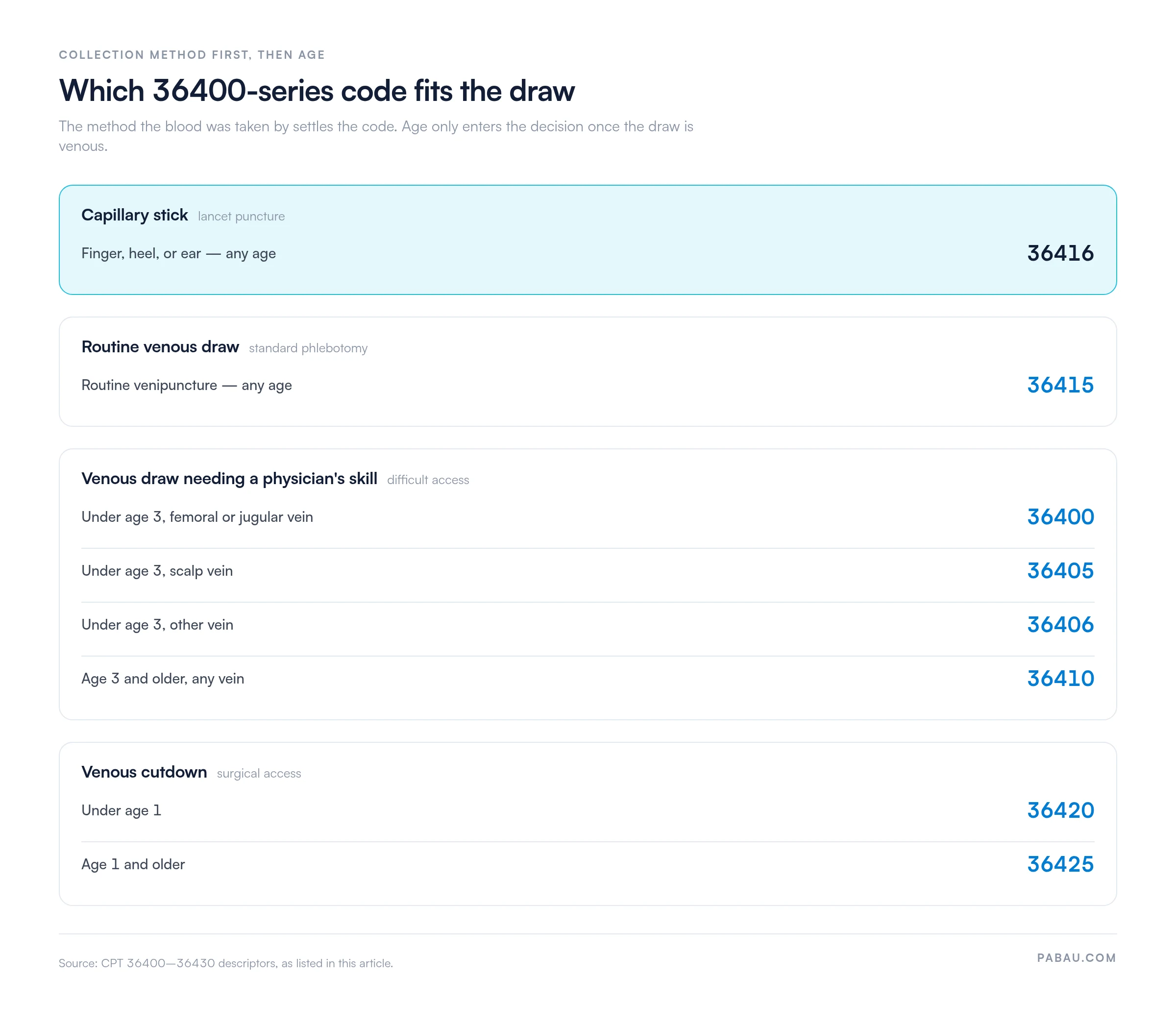
CPT code 36416 belongs to the 36400 series, which covers blood collection from scalp vein needles in infants to femoral draws in difficult-access patients. Knowing the whole family prevents miscoding when the collection is not a standard capillary stick. The chart below routes a draw to its code in two decisions.
The AAPC Codify CPT lookup lets you search the full 36400 range by descriptor text. That helps when chart notes use non-standard language such as “prick” or “lancet.”
Every code in this family assumes the patient comes to you. When a laboratory technician travels the other way, to a homebound or nursing home patient, the lab bills that trip separately under P9604. If that technician catheterizes several patients for urine specimens on one trip, each collection is billed under P9615.
Billing a capillary collection by hand creates three friction points for the coder:
Practice management software like Pabau closes each of them inside the claim itself. Our claims management software holds the code relationships and NCCI edit logic in the claim workflow. A correct 36416 line no longer depends on what the coder remembers.
Pabau’s electronic claims integration with Claim.MD runs eligibility checks and validates claim data against payer-specific rules before the 837 file is transmitted. On a capillary blood collection encounter, that means a missing modifier is flagged before submission rather than after a denial. Fewer claims come back rejected, which matters when 36416 is reported dozens of times a week.
The documentation side is handled the same way. Digital forms prompt the clinician to record the collection method, the site, and the reason for the test at the point of care. The billing team then opens a chart that is already audit-ready. That removes the most common denial on this code, where the record shows the stick but never says why it was needed.

Pabau’s built-in claims management and Claim.MD integration automate code validation, modifier checks, and 837 claim submission. Capillary blood collection encounters reach payers accurately the first time.

A capillary collection is a two-line billing event. CPT code 36416 records the stick, the analyte or panel code records the test, and the chart has to say why the test was ordered. Practices that hold all three together stop losing the lab payment to bundling denials.
Treat the collection line as documentation rather than income. Medicare pays nothing extra for it and commercial payment turns on the contract, so the win here is a claim that clears first time. Book a demo to see how Pabau keeps 36416 claims accurate before they reach the payer.

Need to understand how denials are classified after a 36416 claim is rejected? Denial codes in medical billing explains the most common rejection reason codes and how to respond to each.
Want a practical guide to what goes into a billable claim? Medical billing workflows covers the end-to-end process from encounter to payment posting.
Looking for guidance on how clearinghouse submission works? Electronic remittance advice explains how ERA files and 835 transactions close the payment loop after a claim is adjudicated.
CPT code 36416 is the billing code for the collection of a capillary blood specimen via finger stick, heel stick, or ear stick. It covers the collection act itself, not the laboratory test performed on the specimen. That test is billed separately, using the appropriate analyte or panel code.
CPT 36415 covers routine venipuncture, which is a venous blood draw from sites such as the antecubital fossa. CPT 36416 covers capillary blood collection via a lancet-based fingertip, heel, or ear prick. The specimen source determines which code applies: venous equals 36415, capillary equals 36416.
Medicare does not reimburse CPT code 36416 separately. The code carries status indicator B on the physician fee schedule, so payment is bundled into the related service billed that day. Locality and GPCI adjustments do not change that, and no modifier unbundles it.
Yes, in many cases CPT code 36416 can be billed separately from an E/M office visit, but this depends on payer policy. When billing both on the same date, append modifier -25 to the E/M code to indicate a significant, separately identifiable visit. Some commercial payers bundle capillary collection into the office visit and will deny 36416 as inclusive, so verify with each payer’s fee schedule before submitting.
No. CPT code 36416 covers the collection service only, not any analysis performed on the specimen. The laboratory test is reported separately, using the appropriate CPT lab code. Examples are 82962 for a glucose test on a reagent strip device, and 85013 for hematocrit. Billing a collection code and a lab code on the same claim is standard practice. It is not a bundling violation when both services genuinely occur.



