Montgomery-Åsberg Depression Rating Scale (MADRS)
The Montgomery-Åsberg Depression Rating Scale (MADRS) is a clinician-administer...

Last Updated: Oct 6, 2026
A relationship anarchy worksheet is a therapeutic tool that helps individuals and couples define their own relationship values, boundaries, and structures. It drops the assumption that every relationship has to follow one predetermined shape.
The free worksheet below covers five domains: values and needs, intimacy, boundaries, commitment, and cohabitation. Each one is answered on its own, so a client can be exclusive in one area and open in another.
The framework comes from Andie Nordgren’s 2006 relationship anarchy manifesto. Therapists, counselors, and coaches now use it with clients exploring ethical non-monogamy, polyamory, or simply questioning the relationship script they inherited.
This guide covers what the worksheet contains, how to introduce it in session, and how it works alongside the relationship anarchy smorgasbord.

A relationship anarchy worksheet helps clients design their relationships without predefined labels or inherited scripts.
It covers five domains that each get answered on their own: values and needs, intimacy, boundaries, commitment, and cohabitation.
Therapists, counselors, and coaches use it with clients exploring ethical non-monogamy, polyamory, or relationship uncertainty.
Relationship anarchy describes how relationship decisions get made, so it is not the same thing as polyamory or non-monogamy.
Pabau’s digital forms let therapists complete the worksheet inside the client record, so responses stay with the notes.
A ready-to-use therapeutic worksheet covering values, boundaries, intimacy preferences, commitment, and cohabitation. It includes guided prompts for individual reflection or couples work.
Download templateA relationship anarchy worksheet is a structured clinical tool that walks a client through their relationship values, needs, and boundaries without assuming a hierarchy. It turns the philosophy into something a client can actually fill in. Relationship anarchy rejects the idea that a romantic partnership automatically outranks every other bond in a person’s life.
The worksheet does three jobs at once. It creates a shared language for discussing how a relationship is built. It surfaces unstated assumptions about what commitment, intimacy, or cohabitation mean to each person, and it documents the process for later reference.
For therapists it works as an assessment tool and an intervention in the same sitting. Clients move from vague dissatisfaction to specific statements about what they want their relationships to look like.
Generic relationship questionnaires start from a couple and work outward. This one starts from the individual and makes no assumption about the structure they end up describing.
Relationship anarchy rests on five principles, and the worksheet is built around them:
The worksheet turns those principles into five separate areas for reflection. A client answers each area on its own instead of accepting a bundled arrangement that arrived with a label.
Working this way with non-monogamous clients is a competency in its own right. Therapists who want a formal credential in it can pursue AASECT certification in sexuality counseling or sex therapy.
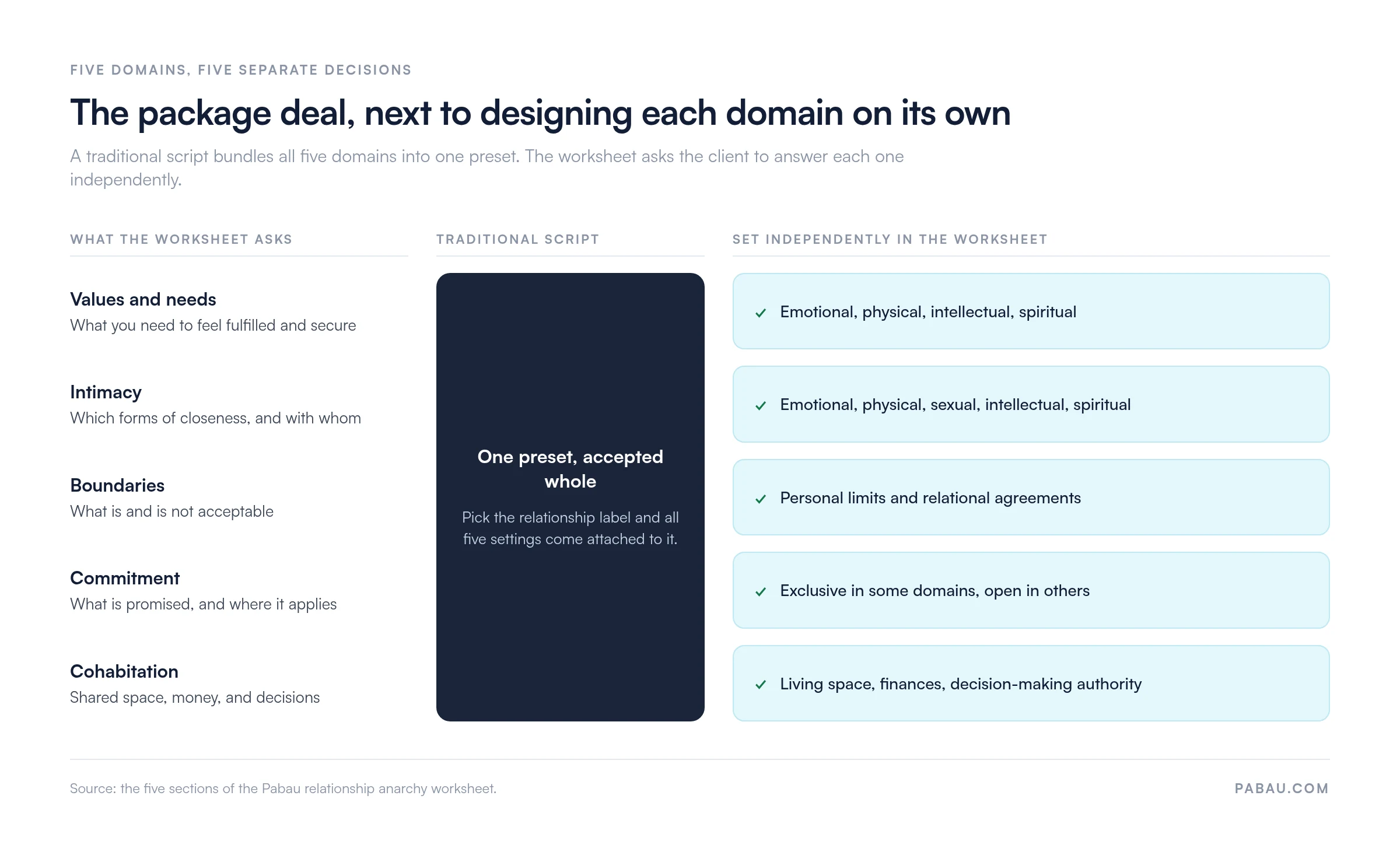
The worksheet is organized into five sections. Each one surfaces an assumption first, then asks the client to state a preference:
Keeping those five sections apart is the whole point of the tool. A traditional script hands all five over as one preset, while the worksheet asks the client to answer each one separately.
Other forms in Pabau’s template library cover different ground. The psychiatric evaluation template is built for diagnosis and treatment planning, while this one supports relational design.
The relationship anarchy smorgasbord is a companion tool that lays out possible relationship elements as options to pick from. Its categories mirror the worksheet’s sections: communication, intimacy, commitment, cohabitation, and finances.
The worksheet is discovery-focused and asks what you want. The smorgasbord is menu-focused and shows what is on offer. Therapists often run the two in sequence rather than choosing between them.
Together they make a two-step process. The client clarifies their values privately on the worksheet, then the couple or polycule talks through the possibilities on the smorgasbord.
The worksheet works best when it is adapted to the client in front of you. Here is the sequence most therapists follow:
Tracking those revisions across a caseload is where the admin piles up. Therapy practice management software keeps each version of a client’s worksheet attached to their record, so you can see what changed and when.
Introduce the worksheet early in the therapeutic relationship, but not in the first session. Use the opening sessions to build trust and to work out whether the presenting concern involves relationship structure at all. A worksheet handed over too early feels clinical and impersonal. Timing it to the client’s readiness signals that you take the question seriously.
The worksheet earns its place in a session in five ways:
Most practices hand this worksheet over as a PDF. The client downloads it, fills it in at home, emails it back, and the therapist retypes the useful parts into a progress note. The completed form then lives in an inbox rather than in the chart.
Pabau, practice management software built for therapy practices, takes a different route. You can rebuild the worksheet as a digital intake form, send it before the session, and have the answers save straight into the client’s record. The completed form is then searchable and sits alongside the notes it informed.
Pabau Scribe, our AI scribe, drafts the session summary from what was discussed, so worksheet findings reach the note without a retyping step. Across a full caseload that removes a recurring admin task from relationship-focused work.
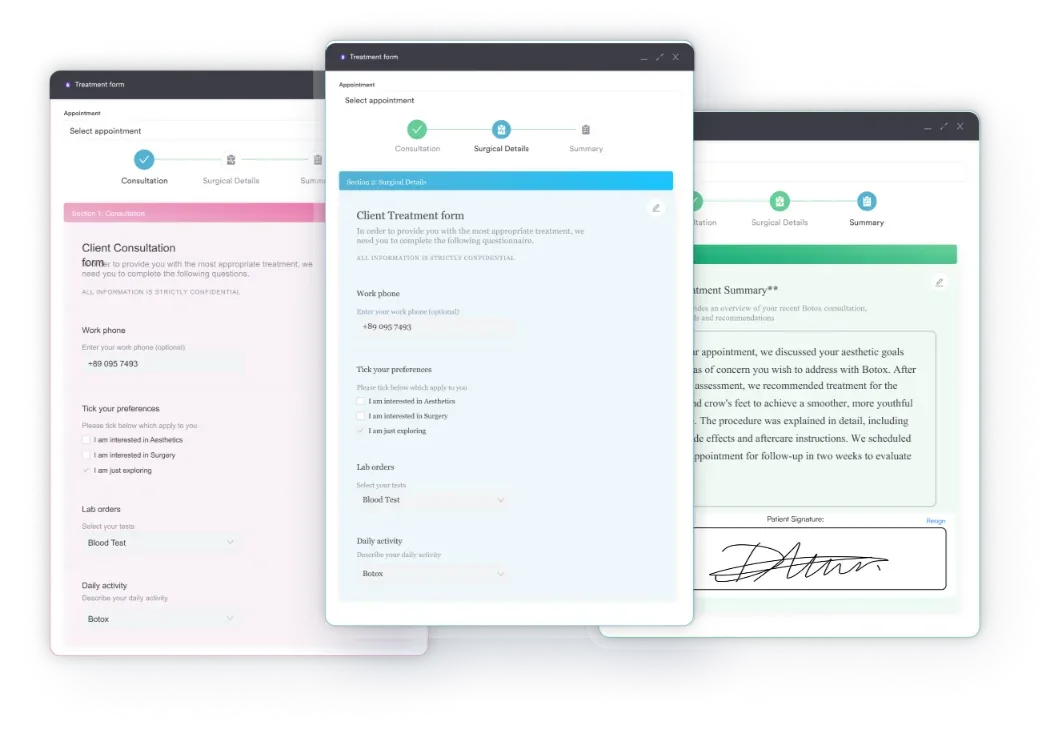
Every Pabau subscription includes every feature, so digital forms, client records, and the online booking portal all come as standard. Nothing here sits behind a higher tier.

Book a demo to see how digital forms, client records, and AI documentation work together for relationship-focused therapeutic work.

Reach for this worksheet when a client’s difficulty is structural rather than behavioral. Somebody who cannot say what they want from a relationship will not get far negotiating it. Five separate prompts do more work than one open question.
Set expectations about the pace. A first pass usually produces a rough draft of someone’s preferences, and the useful version arrives after a joint conversation and a revision. Treat it as a document you return to, not a form you file.
The trade-off worth remembering is that this tool creates a record you then have to maintain. Book a demo to see how Pabau keeps every worksheet, note, and revision in one client record.

Working with a couple rather than an individual? Couples therapy worksheet gives you structured prompts for joint sessions where both partners complete the same exercise.
Need to get boundaries on paper? Marriage boundaries worksheet covers limits and agreements in more depth than a single worksheet section allows.
Running a longer course of relationship work? Couples therapy workbook collects exercises you can sequence across several sessions.
A relationship anarchy worksheet is a therapeutic tool that guides structured reflection on five relationship domains. Those domains are values, intimacy, boundaries, commitment, and cohabitation. Each one is designed independently rather than accepted as part of a package.
No. Relationship anarchy is a philosophy about how relationship decisions get made, and it is consent-based and non-hierarchical. Polyamory is a structure involving romantic or sexual involvement with several people. A relationship anarchist can be monogamous, and a polyamorous person can be hierarchical.
In 2006, Andie Nordgren published “The short instructional manifesto for relationship anarchy.” It set out the core principles: autonomy, consent, diversity of relationship forms, and a rejection of hierarchical ranking. That manifesto is the foundational text for the philosophy and for tools like this worksheet.
Yes. Therapists working with clients who are exploring ethical non-monogamy or questioning traditional structures can use it as both an assessment and an intervention. It supports individual reflection as well as couples or group conversation, and responses can be documented in the client record.
The free PDF sits in the download box near the top of this page. It is ready to print or send digitally to clients. Practices using Pabau can rebuild it as a digital form inside the client record.
No. Non-monogamy describes a structure with sexual or romantic involvement with several people. Relationship anarchy describes an approach to designing relationships that is consent-based and non-hierarchical. Many non-monogamous relationships stay hierarchical, and many relationship anarchists choose monogamy.