Journal prompts for mental health
Journal prompts for mental health are guided questions that help people process ...

2
Last Updated: Oct 13, 2026

A relationship goals checklist turns loose intentions into dated commitments across eight areas, from communication to future planning.
The at-a-glance table pairs every category with an example goal, a suggested cadence, and who starts the conversation.
Review the checklist every 90 days at minimum, with a 30-minute monthly check-in and a full rewrite each anniversary.
Pick two to three goals per category rather than all eight at once, and give every goal a date.
Therapists and coaches can standardize goal work with the Practice Check-In Protocol, a loop of in-session review, checklist homework, and a booked follow-up.
A printable checklist covering eight goal categories: communication, trust and respect, intimacy, finances, fun and adventure, personal growth, conflict resolution, and future planning. Each category has space for two to three goals, a timeline, and a monthly progress note.
Download templateA relationship goals checklist is a written list of what you and your partner are working toward across eight areas, reviewed together every 90 days. The eight areas are communication, trust and respect, intimacy, finances, fun and adventure, personal growth, conflict resolution, and future planning.
Most couples know roughly what they want more of. Fewer have written it down in a form they can both point at three months later. The table further down pairs each category with an example goal, how often to revisit it, and who starts that conversation.
Use the checklist on your own, or bring it to a therapist or coach who can slow the conversation down where it matters. The last two sections cover the practitioner side of that, including a repeatable session loop we call the Practice Check-In Protocol.
Relationship goals are specific, dated commitments two partners make to each other, such as a weekly phone-free check-in or a monthly finance review. “Be happier together” is a hope. The difference is that you can tell whether one of them happened.
Useful examples of relationship goals share three traits. Each one names a behavior rather than a feeling, attaches a frequency, and carries a date. “Initiate physical affection daily” passes. “Be more affectionate” does not, because neither partner can score it a month later.
Writing goals down does three things a conversation on its own doesn’t. It stops one area quietly dropping off the list, usually money or physical intimacy. It gives you something to measure against next month. And it lets both partners see the same agreement instead of two slightly different memories of it.
This checklist is a planning document, filled in together by both partners. It sets out what a couple wants to build next and gives them something to score against later. It is not a clinical screening instrument, and it does not rate how healthy a relationship is today.
Couples therapists tend to start here for the same reason. Before anyone works on a pattern, both people need to say out loud what they are working toward. Practices running on a mental health EMR often store that first goal list in the client record, so later sessions can be measured against it.
The relationship goals checklist covers eight categories, and each one carries an example goal, a review cadence, and a default person to start it. Read the table as a relationship needs checklist first. Any row that makes one of you uncomfortable is the category to open with.
The “who initiates” column is the one couples skip, and it is the reason goals stall. A goal nobody owns waits for whoever minds most, which is usually the same person every time. Assigning the opener stops that pattern before it sets.
Communication goals set when you talk and how, so small concerns get a scheduled place to land before they turn into a bigger conversation. Frequency and manner do the work here, not volume.
Active listening and “I” statements carry most of the weight. Couples therapists teach both as skills rather than intentions, because they change how a disagreement starts.
The Gottman Institute’s long-running study of married couples found a 5-to-1 ratio of positive to negative interactions during conflict in stable relationships. That ratio is a useful target for the daily appreciation goal above. Five small positives a week cost nothing and change what an argument feels like.
Trust is built out of small kept promises, not big declarations. Writing these down makes “reliable” and “open” mean something specific in your relationship rather than something each of you defines privately.
Trust and conflict resolution are the same muscle. A couple who repair well after an argument build trust faster than a couple who avoid arguing at all. Every repair goal in the conflict resolution section below rests on a promise kept in this one.
Marriage goals tend to arrive as feelings, such as being closer or arguing less. Turn each one into a named behavior with a frequency and this category starts doing measurable work. “Apologize the same day” is a marriage goal. “Be kinder” is not.
Intimacy goals put closeness in the calendar, because the category couples most often assume will look after itself is the one that quietly erodes first. Scheduling it feels unromantic and works anyway.
Money is a common source of couple conflict, and most of it comes from surprises rather than shortfalls. Agreeing on thresholds in advance removes the surprise.
Shared values and household responsibilities belong in the money section for the same reason. Both get settled by whoever cares most in the moment, which is a running negotiation rather than a decision. Writing the split down ends the negotiation.
Fun is the category that gets cut first when life gets busy, and the one whose absence couples feel most. Goals here protect it from the calendar.
Personal growth goals belong on a couple’s checklist because each partner’s own progress is what they bring back to the pair. A relationship where neither person is growing tends to stall quietly.
Long term relationship goals depend on this category more than any other. A partner who parks their own ambitions for five years brings quiet resentment to the ten-year plan. Two people still growing separately have more to bring back to the table.
Every couple argues. The goals in this category are about how an argument runs and how it ends, not about arguing less. Agreeing on the rules while you are calm is the whole point.
Write the break rule down while things are good. Nobody negotiates a fair timeout mid-argument, which is exactly when a couple needs one.
Future planning is where couples find out whether they have actually agreed on anything. This category is also the one most likely to surface a difference worth taking to a therapist.
You do not have to resolve all of these to write them down. Naming a difference is progress. A couples therapy worksheet is a useful next step when one of these answers turns out to be a genuine disagreement.
Relationship milestones are the dated events a couple is heading toward, such as moving in together, meeting family, engagement, marriage, or a first child. Goals describe how you treat each other. Milestones mark where the relationship is going.
Most descriptions of the stages of a relationship track how a couple feels over time, moving from infatuation to reality to commitment. Milestones track what a couple does instead. Attaching a date is what makes a milestone something you can both argue with.
Put each milestone in the future planning section of the checklist with a target date next to it. The 90-day review is where a date either holds or gets moved on purpose. A milestone that slips three reviews running is telling you something.
Set relationship goals in one 60 to 90 minute sitting, walking the eight categories in order and picking two to three dated goals in each. Run the first session well and the rest is maintenance.
Therapists and coaches usually keep this list somewhere the client can see it between appointments. Therapy practice management software handles that, and a shared folder works fine if you are doing it yourselves.
Review the checklist every 90 days at minimum, with a shorter monthly check-in in between and a full rewrite on your anniversary each year. A checklist nobody reopens is a nice afternoon and no more.
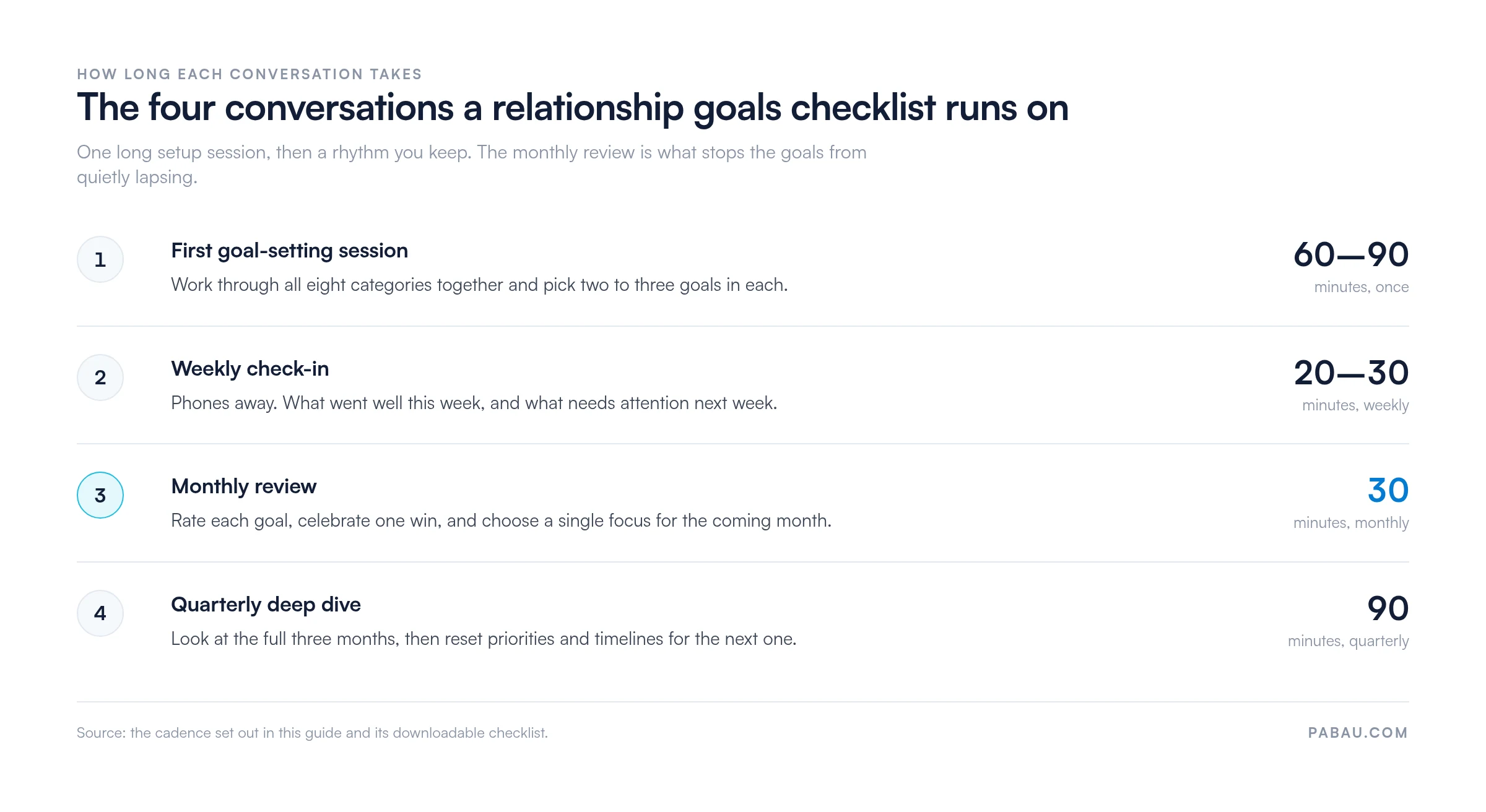
The weekly check-in, in 20 to 30 minutes: catch anything small before it grows. The weekly slot is the conversation the communication goals are built around, and it needs no agenda beyond the last seven days.
The monthly review, in 30 minutes: go through each goal and say whether you are on track. Celebrate one win out loud. Pick a single goal to push harder on next month. Listen without defending yourself, because the point is understanding rather than a verdict.
The 90-day deep dive, in 90 minutes: look at the full quarter instead of the last four weeks. Ask whether your priorities have moved, and rewrite the goals that no longer fit. Then set the next quarter’s timelines and milestone dates.
The anniversary rewrite is the one worth protecting. Once a year, start the checklist from a blank page rather than editing last year’s. Couples who only edit tend to carry a dead goal for three years because deleting it feels like an admission.
Couples working with a therapist often keep the current version of the list in a client portal. Both partners and the therapist then read the same page between sessions.
Goals for couples therapy hold best on a repeating three-step loop of in-session review, one checklist goal as homework, and a booked follow-up. We call that loop the Practice Check-In Protocol.
The Practice Check-In Protocol exists because the checklist itself is not the intervention. The cadence around it is. Running the same three steps with every couple on a caseload turns a one-off worksheet into a measurable course of work.
In practices we onboard, the step that slips is the third one. Reviewing and assigning happen naturally in the room. Booking the follow-up gets left to reception or to the client. The couple who most needed that appointment is the one who never makes it.
The Practice Check-In Protocol also gives a practice something to compare across clients. When every couple is scored on the same eight categories, a clinical supervisor can see which categories a therapist tends to skip. Spotting that pattern is a training conversation the session notes alone would never surface.
Screening and goal-setting are two different jobs, and the order matters. Where a couple’s difficulties are not yet clear, our broader relationship checklist template assesses how things are functioning now. Use this goals checklist once you know what you are working toward.
Send the blank checklist before the first session and the couple arrives with answers instead of a pen. Practice management software can automate that send, along with the halfway reminder in step three.
These questions move a review from “are we on track?” to “what do we need from each other?” Use one or two per check-in rather than all of them at once.
The sixth question is the one that needs the most safety around it. If an honest answer would cost either of you something, that is worth raising with a therapist rather than over dinner.
Start with the two or three categories where you already feel friction, fill those in properly, and leave the rest until a review raises them. The eight categories are a frame, not a syllabus.
Download the relationship goals checklist PDF and print two copies. Fill them in separately first, then compare. The categories where your two sheets disagree are the ones worth the evening.
Customize freely. Rename a category, delete one that does not apply, or add a ninth of your own. A blended family or a long-distance stretch often earns its own section. A category you skip this year may be the main one next year.
Then commit to the review before you file the sheet. If you already see a therapist, coach, or counselor, bring the filled-in version to your next session. The appointment then starts with the answers rather than the paperwork.
In most therapy and coaching practices, a goals checklist starts as a PDF emailed the night before a session. The client forgets it, so the session opens with 10 minutes of form-filling. The completed sheet then goes into a folder nobody reopens until someone asks about progress.
Practice management software like Pabau moves that work off the session. You send the checklist as a digital form ahead of the appointment, and the client’s answers land straight in their record. The next time you open that record, the goals sit next to the notes from every session since.
Pabau’s automated reminders cover step three of the Practice Check-In Protocol, so the halfway nudge and the next appointment are not left to reception. Every subscription includes the digital forms, client records, and reminders this workflow needs.
Set the sequence up once and you stop retyping goals into a separate document. The practical win is a therapist who opens a record and sees the last score, the current homework goal, and the date it was agreed.

Send the goals checklist as a digital form before the session, and the answers land in the client record. Automated reminders bring couples back for the 90-day review, so you can stop chasing them.

The checklist is the easy part. Most couples can fill in eight categories in an evening and feel good about it. What separates the couples it helps from the ones it doesn’t is whether the review survives past the second month.
So book the 90-day review before you close the document, and keep the monthly one short. Thirty minutes a month is a small enough ask to hold for a year. A year of small honest conversations changes more than one big one ever does.
If you run a therapy or coaching practice, the Practice Check-In Protocol is the version of this that scales. Book a demo to see how Pabau keeps client goals and session notes in one record, so progress is visible without anyone digging for it.

Need structured prompts for a session? The couples therapy worksheet gives you exercises to work through once the goals are agreed.
Working with a couple over several weeks? The couples therapy workbook sets out a longer sequence you can run session by session.
Is a boundary the underlying issue? The marriage boundaries worksheet helps couples name what is and is not acceptable before goal-setting starts.
Need a goal to become a habit? The change plan worksheet breaks one commitment down into steps, obstacles, and supports.
Running group or couples work? Our guide to group therapy informed consent covers what to agree with clients before the first session.
A relationship checklist is a structured tool that helps couples name and track goals across the main areas of a relationship. Those areas are communication, trust, intimacy, finances, fun, personal growth, conflict resolution, and future planning. A checklist turns loose intentions into commitments with dates.
Workable examples include a weekly 30-minute check-in without phones, daily physical affection, and a monthly finance review. Others are one overnight trip a year, a 20-minute break rule during arguments, and one personal growth goal each. A good goal is specific, measurable, and dated.
Set aside 60 to 90 minutes at a calm moment, with no phones. Work through the eight categories in order and pick two to three goals in each. Write each one down with a timeline of three months, six months, or a year. Then book the 90-day review before you finish.
Every 90 days at minimum, with a 30-minute check-in each month in between. The monthly slot is enough to rate each goal, celebrate one win, and pick a focus. The 90-day review looks at the full quarter and resets any goal your circumstances have overtaken.
Yes. Many couples therapists and coaches use a goal-setting checklist as part of the treatment plan. Send it before the first session, work through it with the couple, then measure later sessions against it. The completed sheet also files neatly in the client record.
The 10 that come up most often are a weekly phone-free check-in, daily appreciation, and honest conflict repair. Next come regular date nights, physical affection, a monthly finance review, and an emergency fund. The last three are one shared adventure a year, one individual growth goal each, and an agreed five-year plan.
Answer with one specific commitment per area rather than a feeling. A weekly check-in without phones and a monthly finance review beats wanting to be happier together. Name the goal, its timeline, and who starts the conversation.
The 7-7-7 rule is a dating-coach shorthand for keeping a couple’s connection scheduled. The rule sets a date night every 7 days, an overnight away every 7 weeks, and a longer trip every 7 months. No research backs the specific numbers, but the cadence idea holds.
The 3-6-9 rule is a dating shorthand that sets three decision points in a new relationship. At 3 months you check whether the early infatuation has settled into something you recognize. At 6 months you test values and meet the people who matter. At 9 months you decide about long-term commitment.
The most common are avoiding conflict, keeping score, criticizing character instead of behavior, and letting one area quietly drop off the list. Money and physical intimacy are the two that go unspoken most often. A checklist surfaces them early, because a blank category is visible in a way a silence is not.