Questions about gender roles
Questions about gender roles are structured prompts that help clinicians, counse...

1
Last Updated: Oct 20, 2026
Couples therapy questions are the prompts a therapist uses to learn how a relationship works. They cover how partners talk, argue, and support each other, and what each wants from therapy. This free template gives you 15 open-ended questions for the first sessions, grouped around communication, conflict, trust, intimacy, and shared goals.
Ask them with both partners in the room so you can watch how each responds to the other. Then add your own intake questions on history and safety, which this guide covers alongside question sets for group and teen sessions.
A two-page PDF with name and date fields and 15 open-ended questions. They cover the relationship’s current state, communication, conflict, trust, intimacy, recent stressors, and long-term goals.
Download template
Couples therapy questions map how partners communicate, handle conflict, support each other, and define shared goals, which gives the first session a clear direction.
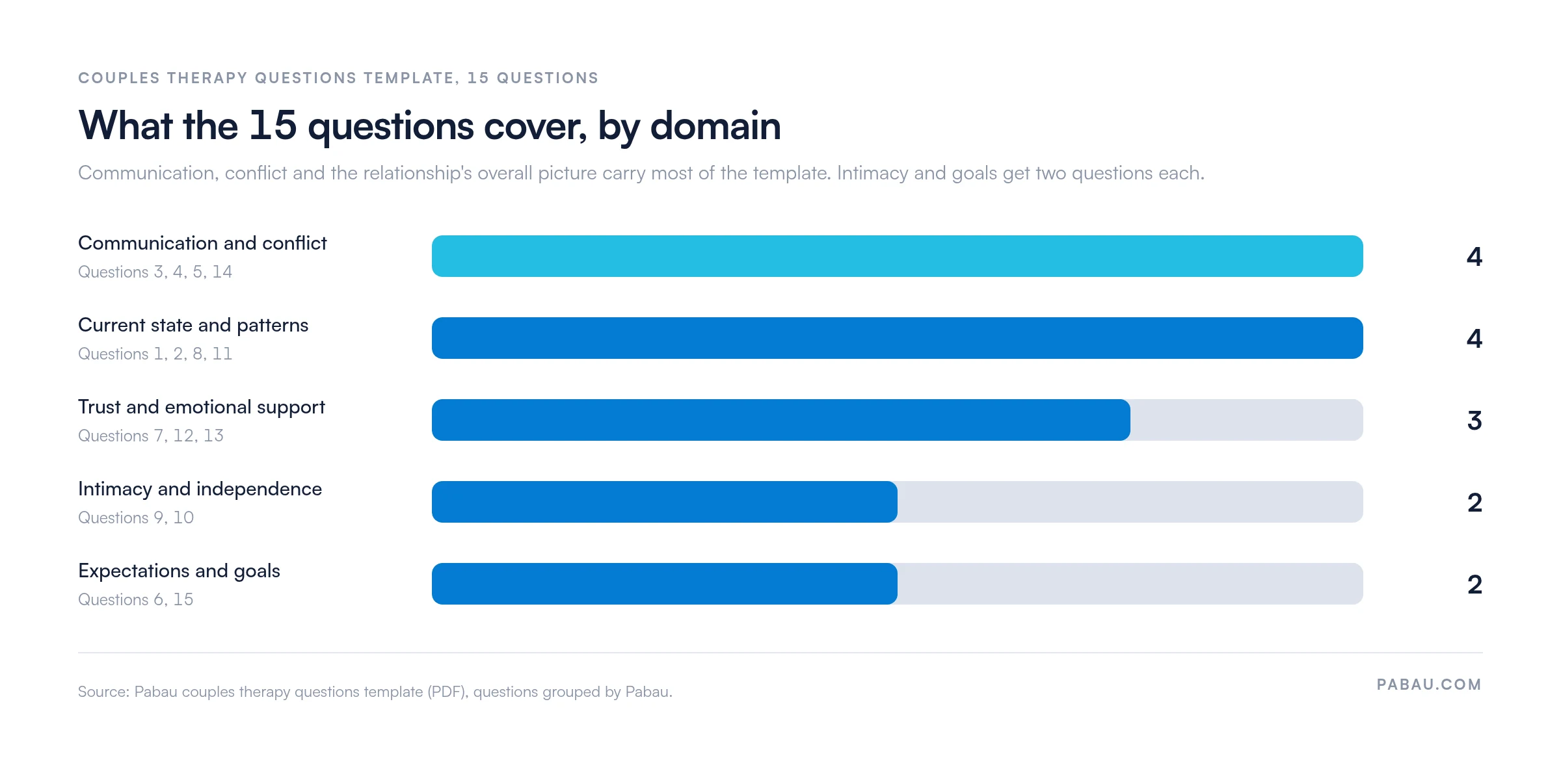
The 15 questions in this template fall into five domains, and communication, conflict, and the relationship’s overall picture account for eight of them.
Screen each partner privately for safety concerns such as intimate partner violence, because a partner may not disclose them in a joint session.
Intake, group, and teen sessions need their own question sets, and this article includes sample questions for each.
Practice management software like Pabau stores your questions as digital intake forms, and Pabau Scribe, its AI scribe, drafts the session note.
The template is an unscored question set with no cutoffs or totals, so you read each partner’s answers clinically. Its 15 questions fall into five domains:
The weighting below shows where the template goes deep and where you may want follow-up questions of your own.
Completed answers also work as a clinical record. They show that an assessment took place and capture each partner’s baseline view of the relationship. Record-keeping duties come from state licensing boards and professional codes, while HIPAA governs how those records are protected.
Five steps take the template from download to a documented first session:
Couples work still needs a standard intake. These questions establish the presenting concern, gather history, identify risk factors, and set treatment direction.
Intake questions follow an arc. Start broad and open-ended to invite the patient’s story, then move to structured questions on risk and history. Close with collaborative goal-setting, which builds rapport early and keeps safety screening thorough without feeling like an interrogation.
Each modality needs its own framing. The sets below add to the template rather than replace it.
Once the 15 template questions are answered, these follow-ups dig into the dynamics the answers raise. With software built for therapists, you can send them as a second form after the first session.
For homework between sessions, the couples therapy worksheet gives partners structured exercises that build on their answers. When partners agree on shared expectations, a relationship contract template records those commitments in writing.
Group therapy needs opening rounds that invite participation while respecting boundaries. Check-in questions create psychological safety and set the session’s tone.
Teen therapy questions meet adolescents where they are developmentally. Avoid jargon, use collaborative language, and normalize the teen experience to build rapport.
Each set can be adapted to your theoretical orientation and patient population.
Couples and family therapists use the template to structure a first session where two people tell different versions of the same story. Individual therapists use it when relationship strain is the presenting concern.
Marriage and family therapists, licensed professional counselors, psychologists, and clinical social workers all run couples work. Group practices and community agencies use a shared template to keep intake consistent across clinicians.
Clinical benefit: Every couple is assessed across the same domains, so a thinly covered area shows up early. A 2018 meta-analysis in Psychotherapy linked agreement on goals between therapist and patient with better outcomes.
Documentation benefit: Written answers give you a baseline to compare against at review sessions. They also show supervisors and auditors that a full assessment took place.
Efficiency benefit: Sending the questions before the first appointment frees session time for conversation. A saved template also means you never rebuild the question set for the next couple.
Keep one current version of each question set in a shared template library or your practice management system. Review the sets once a year as your approach and the evidence change, and retire old versions so clinicians don’t use them by mistake.
Many therapists start with a PDF like this one. They print it, hand it to each partner, then scan or retype the answers into two files.
Practice management software like Pabau replaces that step with digital intake forms. You build the 15 questions once, send them before the first appointment, and the answers land in each patient’s record.
During the session, Pabau Scribe, our AI scribe, turns the conversation into a draft note for you to review and sign. You finish documentation between sessions, and each couple’s goals stay attached to their records for review.

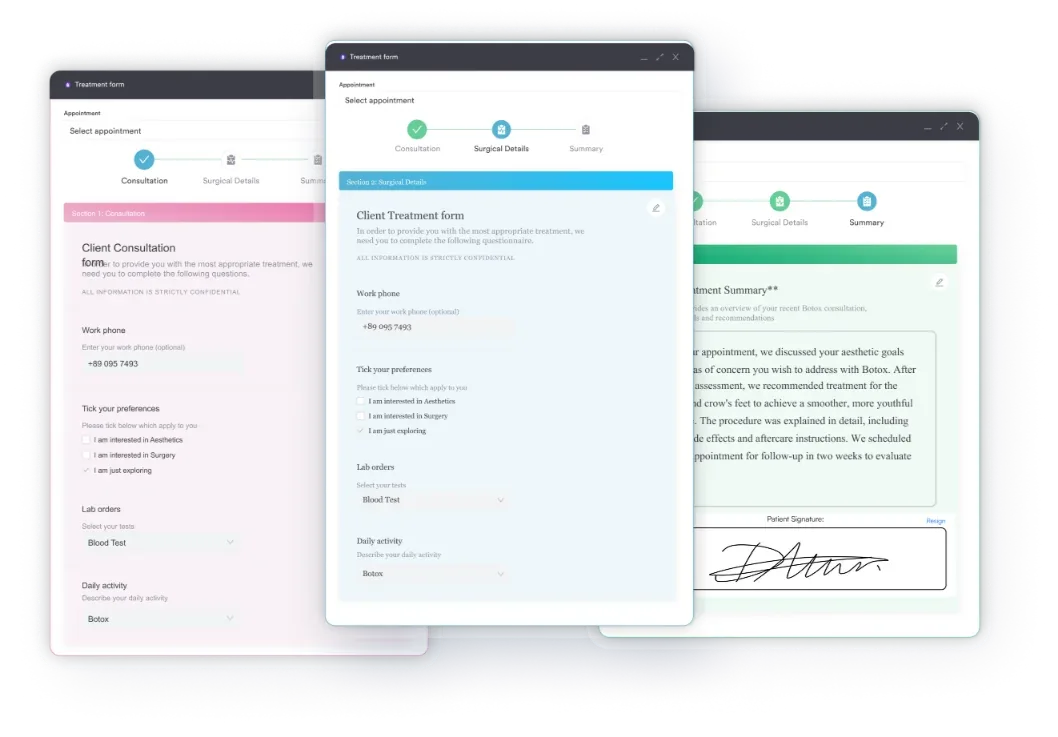
Pabau turns your couples therapy questions into digital forms that each partner completes before the first appointment. Answers land in the patient record, and Pabau Scribe drafts the session note.

Start with the 15 questions as written for your next couple, then note which answers leave you guessing. Those are the domains where your own follow-up questions belong.
The trade-off is time. A thorough first session runs longer, but it saves you from rebuilding the case formulation three sessions in when a trust breach finally surfaces.
Download the template above and adapt it to your approach. Book a demo to see how Pabau sends couples intake forms before the first session and files each partner’s answers automatically.

Need exercises for between sessions? Couples therapy workbook gives partners structured activities to work through at home.
Running a full psychiatric assessment? Psychiatric evaluation template walks through the sections and documentation of a complete evaluation.
Seeing adolescents as well as couples? Adolescent intake questionnaire for mental health covers the history and risk questions to ask teenage patients.
Setting up a standard intake? Mental health intake collects presenting concerns, history, and safety information from new patients.
Running group therapy? Group therapy informed consent: what to include covers the agreements group members sign before the first session.
Couples therapists usually ask each partner how they see the relationship, what brought them in, and how they handle conflict. They also ask about trust, intimacy, and recent stressors. Most close by asking what each partner hopes therapy will change.
Therapists move from assessment to goals with collaborative questions, such as what successful therapy would look like. The goals are written using SMART criteria so progress can be tracked. Regular reviews let the therapist adjust direction and mark progress with the patient.
Good questions for teens avoid jargon and cover school, friendships, family, sleep, mood, and activities that help. Open-ended prompts usually work better than yes-or-no questions. Build trust around sensitive topics like substance use and self-harm before asking about them directly.
Opening rounds often ask how members are feeling right now and what brought them in today. Asking about one accomplishment from the week normalizes small wins. Structured rounds give quieter members permission to pass, and a closing round asks for one takeaway.
Practice management software like Pabau lets you build the questions once as a digital intake form. Patients complete it online before their first appointment, and the answers save to their record automatically. The same form is then ready for every new couple.
Most therapists use both formats. Joint answers show how partners react to each other, and separate written answers let each person speak freely. Safety concerns such as intimate partner violence should always be screened in an individual conversation.