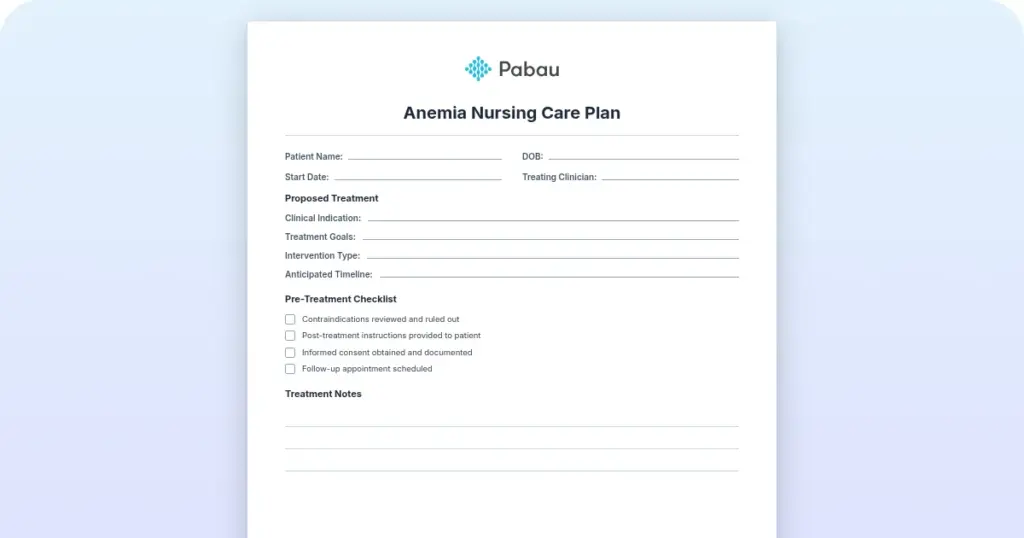
Anemia nursing care plan
An anemia nursing care plan is a structured document that guides a nurse from as...

Last Updated: Oct 9, 2026
A nursing diagnosis handbook is a clinical reference that helps registered nurses name a patient’s response to illness, using NANDA-I approved terminology. It gives you one framework for assessment, diagnosis, intervention, and outcome evaluation. That framework is the nursing process, and the handbook is how you apply it at the bedside.
NANDA-I is NANDA International, the body that publishes and maintains the approved diagnosis list. This guide covers the four diagnosis types, what each handbook entry holds, and how to write the statement itself. A free template sits below, ready to adapt for acute care, long-term care, mental health, or community nursing.
A blank clinical document template with eight numbered sections. They run from purpose, scope, and definitions through to procedure, records, training, and audit. Use it to set out how your team writes, stores, and reviews nursing diagnoses, then record the approval and review dates at the foot.
Download template
A nursing diagnosis handbook records how a patient responds to a health problem, in NANDA-I terms rather than medical ones.
Every NANDA-I entry carries a diagnostic label, a definition, defining characteristics, and related or risk factors.
The four diagnosis types are problem-focused, risk, health promotion, and syndrome, and each one is written differently.
A problem-focused statement runs to three parts, while a risk statement stops at two, because no signs have appeared yet.
Structured diagnosis documentation feeds automated care workflows, so interventions and review dates follow the diagnosis.
A medical diagnosis names the disease, such as type 2 diabetes. A nursing diagnosis names how the patient is responding to it, in terms nursing care can act on. The NANDA-I Nursing Diagnoses: Definitions and Classification is the official reference behind that language. Its current edition lists 267 approved diagnoses across 13 domains.
The handbooks nurses actually carry turn that classification into a working tool. Ackley and Ladwig’s Nursing Diagnosis Handbook and the LWW Nursing Diagnosis Reference Manual are the two most widely used. Each entry gives the definition, the signs you observe, the factors behind them, and interventions tied to measurable outcomes.
Nurses reach for them because they save time at the keyboard and keep wording consistent across the care team. They also supply the evidence base that surveyors expect to find in a patient record.
NANDA-I sorts every approved diagnosis into four types, and each one has a different clinical purpose. The distinction decides how you write the statement. It also shapes which clinical assessment templates you set up in your EMR.
Problem-focused diagnoses dominate acute settings. Risk diagnoses drive the prevention protocols on a ward. Health promotion diagnoses turn up in community and wellness nursing, and syndrome diagnoses apply to specific clinical events.
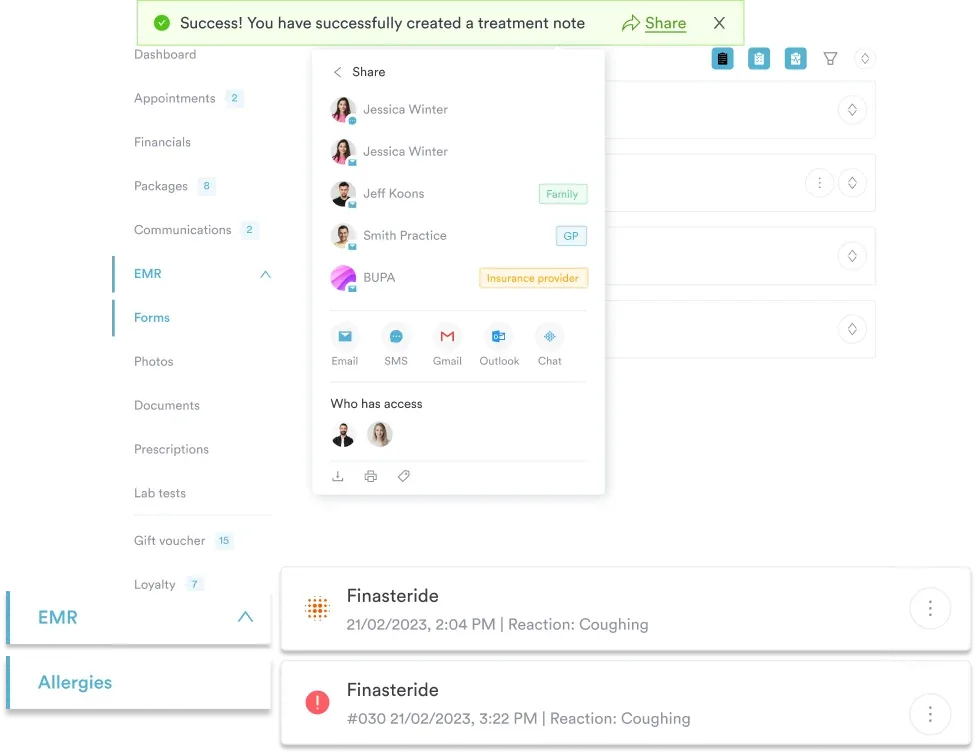
Every NANDA-I approved diagnosis follows the same structure, so you can apply it the same way on any unit. Knowing the parts also tells you why your handbook is laid out the way it is.
In digital charting, structured patient intake forms pre-populate these components, so nurses spend less time typing and more time with patients.
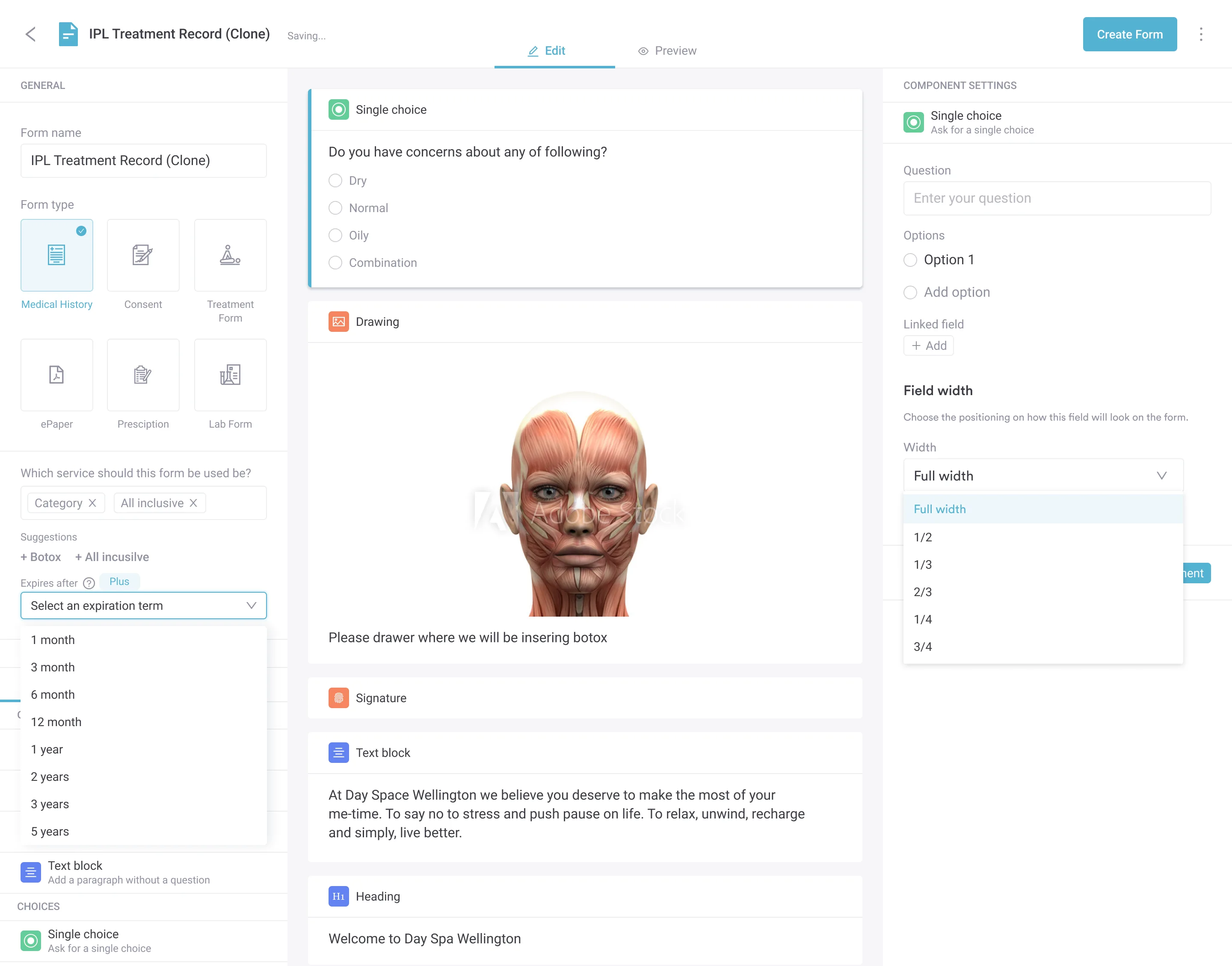
Writing the statement is the bridge between assessment and care planning. The handbook supplies the label. You supply the patient. Here is the process, step by step.
The finished statement has three parts, and each one comes from somewhere different. Only the first is lifted from the handbook.
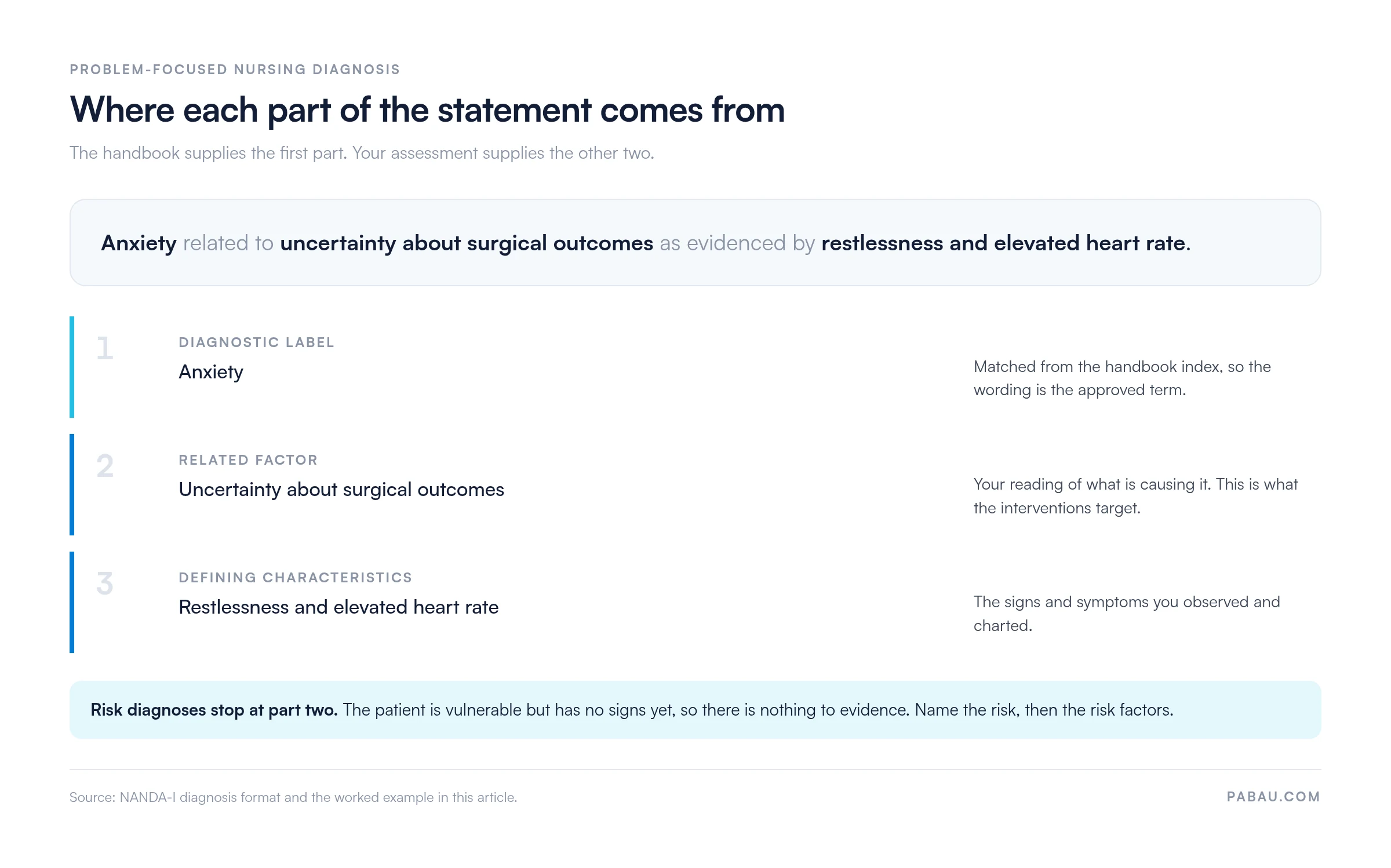
Risk diagnoses are the exception to that shape. No signs have appeared yet, so there is nothing to evidence. The statement names the risk, then the risk factors that leave the patient vulnerable.
Nurses working in clinical documentation software can attach the statement to a care protocol. The reminders and intervention templates then appear as soon as the diagnosis is saved.
NANDA-I refreshes its approved list every two to three years. New evidence goes in, and diagnoses that no longer match current nursing science come out. The 2024-2026 edition holds 267 approved diagnoses across 13 domains, which is the list your handbook is built on.
The 13 domains are Health Promotion, Nutrition, Elimination and Exchange, Activity/Rest, Perception/Cognition, Self-Perception, Role Relationships, Sexuality, Coping/Stress Tolerance, Life Principles, Safety/Protection, Comfort, and Growth/Development. Most handbooks group their entries the same way. Assessing a patient who cannot sleep, you would turn to Activity/Rest and find insomnia or sleep deprivation.
Hospitals and practices usually work from a subset of the full list. A mental health team leans on the coping and perception domains. A medical-surgical unit leans on activity, elimination, and safety, and your EMR’s diagnosis library can be trimmed to match.
The diagnosis is the pivot between assessment and action. Once the statement is written and the related factors are named, the care plan sets out which interventions address them and what outcome you expect.
Each handbook entry cross-references its suggested interventions to the NIC. For anxiety related to lack of knowledge about a procedure, it points you to anxiety reduction, teaching about the procedure, and the nurse’s supportive presence.
You pick the interventions that fit this patient, then set outcomes in NOC language. One example: patient anxiety falls from 8/10 to 4/10 within 24 hours. Our nursing interventions list is a quicker cross-check when a handbook entry runs long.
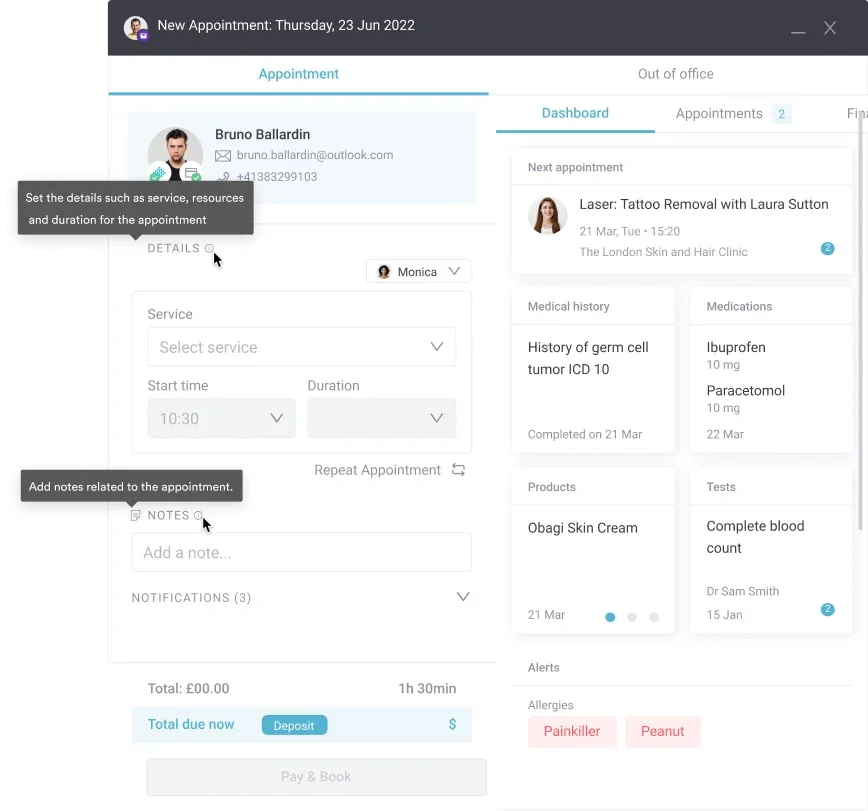
When a state board of nursing or an accreditation surveyor reads your records, they are checking two things. They want evidence that nursing decisions were sound, and that the reasoning was written down. NANDA-I terms carry that weight because they are published, peer-reviewed, and recognized internationally.
“Patient is unwell” will not survive that reading. “Impaired physical mobility related to post-operative pain as evidenced by inability to ambulate 10 feet without assistance” will. It shows the assessment, the reasoning, and a measure you can track over the next shift.
RNs in acute care, mental health nurses, and occupational therapists all work from the same framework. That is what keeps a patient’s record readable as they move along the care continuum.
Flipping through a paper handbook and then retyping the diagnosis into a chart is slow work, and the wording drifts between nurses. Practice management software like Pabau keeps the assessment, the diagnosis, and the care plan in the same patient record.
Pabau Scribe, our AI scribe, drafts the note from the consultation itself, so the assessment data is written up before you choose a label. Your diagnosis entries live in custom medical forms, so the characteristics and interventions are already on the page when a nurse opens one.
Connect that AI-assisted clinical documentation to your intake forms and the answers land in the same record as the note. The care plan, the review date, and the follow-up appointment then sit against one patient instead of three systems.
Plenty of teams print the template for quick reference at handover. Others rebuild its structure as a custom form, so the same headings come up every time a nurse starts a note.
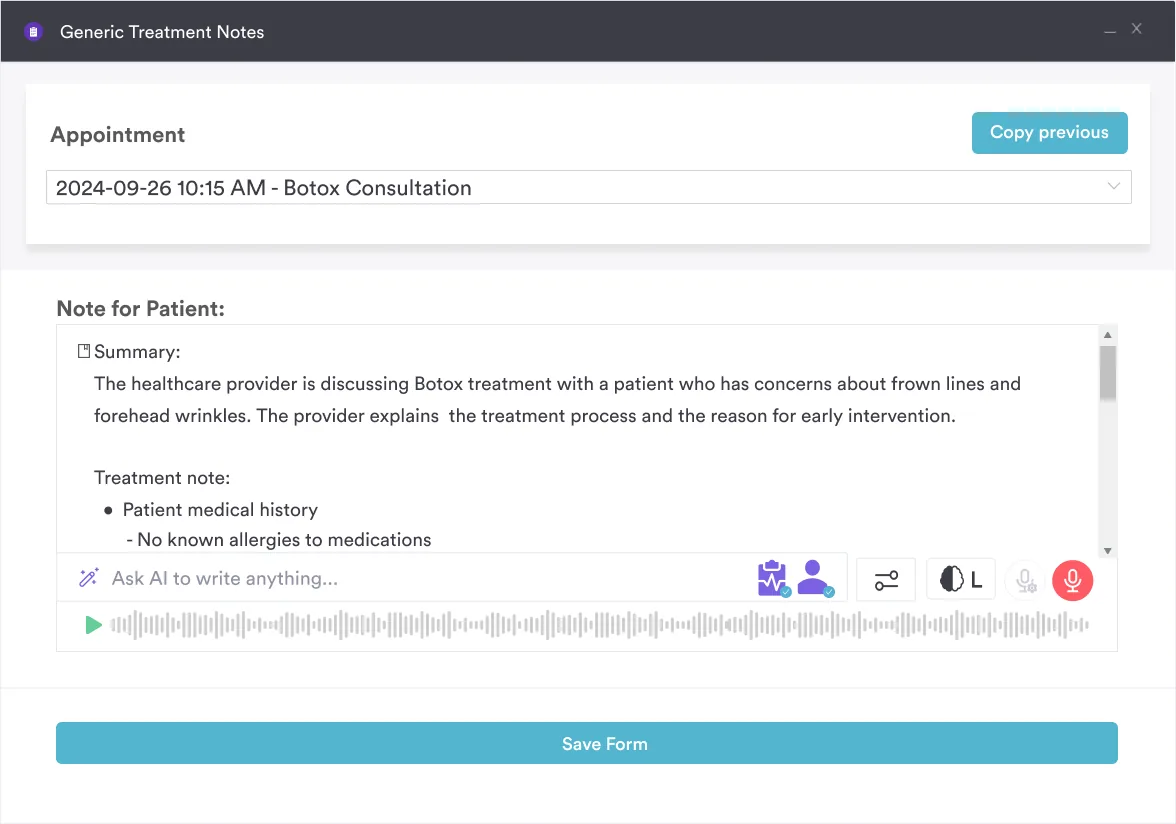

Pabau keeps the assessment, the diagnosis, the interventions, and the review date in one patient record. Your team writes the note once, and the care plan follows it.

A handbook earns its place by making your reasoning visible. The label, the cause, and the evidence sit in one line. The next nurse on shift can pick the patient up without a long handover.
Start with the free template above and shape it into your own documentation standard. Keep the handbook beside it for the approved wording, because the two do different jobs.
The format takes a shift or two to become automatic. After that it is quicker than writing prose, because the structure decides what belongs in the note. Book a demo to see how Pabau links a nursing diagnosis to its interventions, its outcomes, and its review date.

Writing the care plan next? Evaluation nursing care plan shows how to score the outcome once the interventions have run.
Need the interventions themselves? List of nursing interventions collects the actions nurses document most often, ready to drop into a plan.
Charting the whole shift? Nursing documentation covers what a complete record needs, from the admission note to discharge.
Mapping a patient’s problems visually? Nursing concept maps puts diagnoses, interventions, and outcomes on a single page.
Working on a nutrition diagnosis? Imbalanced nutrition nursing care plan is a worked example of the format this guide describes.
A medical diagnosis identifies a disease or condition, such as diabetes. A nursing diagnosis describes how the patient is responding to it, and what nursing care can do about that. Nurses document both, but only the nursing diagnosis drives nursing interventions and outcomes.
The 2024-2026 NANDA-I edition, the 13th, lists 267 approved diagnoses across 13 domains. The list is updated every two to three years as evidence emerges and older diagnoses are retired.
Yes. Publishers offer e-book and app versions of the Ackley and Ladwig and LWW handbooks. Your clinical software may also carry a built-in diagnosis library, searchable by symptom, patient population, or domain.
In most regulated settings, RNs are expected to formulate and document nursing diagnoses as part of the nursing process. LPNs and nursing students use handbooks to learn the framework. Some units run pre-printed care plans or templates to make it simpler for less experienced staff.
The Ackley and Ladwig handbook is the one most often recommended, because it walks through how to write a diagnosis rather than only defining them. Read the opening chapters on the nursing process first, then work into the alphabetical reference.