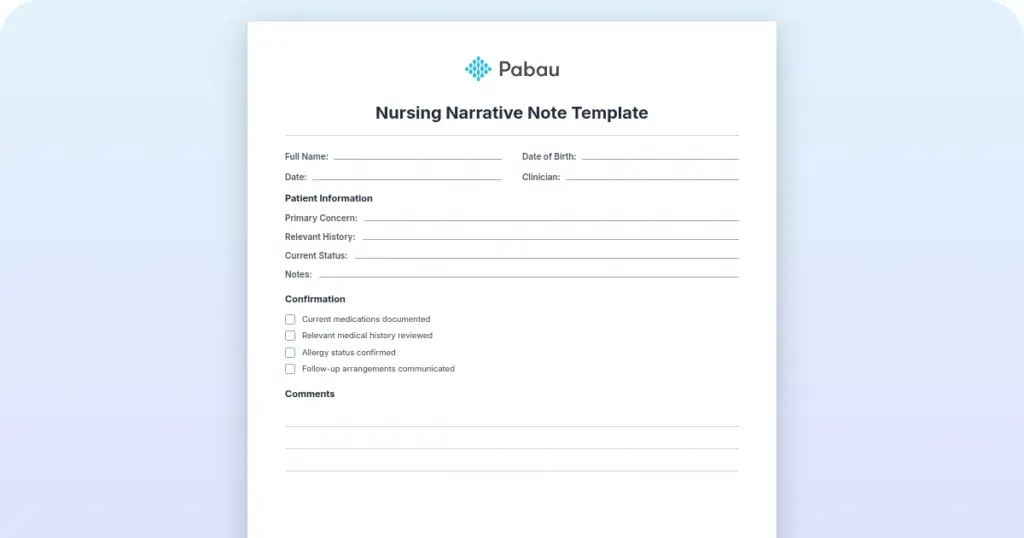
Nursing narrative note template
A nursing narrative note template is a structured PDF that guides you through re...

3
Last Updated: Oct 21, 2026
A nursing brain sheet is the one-page tool nurses use at the bedside to track vitals, medication times, lab results, tasks, and handoff notes. Hospital floors, clinics, and outpatient settings all generate the same flood of detail. The brain sheet keeps it organized in one place, instead of scattered across memory and the electronic health record (EHR). This guide covers what to include, how to customize a sheet for your specialty, and how to use one through a full shift.
This template gives you a ready-made layout for tracking vital signs, medications, labs, tasks, and handoff notes during a shift.
Download template
A nursing brain sheet is a personalized bedside tool nurses use to track patient information, vitals, medications, labs, tasks, and handoff notes each shift.
Effective brain sheets include an SBAR handoff layout (Situation, Background, Assessment, Recommendation), plus vitals, medications, labs, intake and output, tasks, and discharge planning.
Brain sheets vary by specialty: ICU tracks drips and ventilators, while med-surg covers multiple patients at once.
ER brain sheets prioritize rapid assessment, and labor and delivery (L&D) and pediatric sheets track specialty-specific parameters.
Practice management software like Pabau replaces manual transcription with digital patient records, task management, and automated workflows nurses can access without paper duplication.
A nursing brain sheet is a personal organizational tool, typically a sheet of paper or a few pages. A nurse fills it out at the start of a shift to centralize critical patient information. It is not an official medical record. The brain sheet serves as the nurse’s working reference during the shift, hand-written or printed. It’s discarded or shredded at shift end per HIPAA compliance requirements.
The purpose is simple: reduce cognitive load by externalizing patient details. That way, the nurse can focus on direct patient care instead of searching the EHR or medication cabinet. A brain sheet answers the bedside question, “What do I need to know about this patient right now?” in seconds, not minutes.
Across hospital units and specialty settings, the most effective brain sheets share a consistent structure. Here are the essential sections every nurse should include.
Patient intake software simplifies how clinicians capture this information, whether on paper or via tablet. It pre-populates section headings, so nurses don’t waste time designing their own layout.

The core components remain the same across settings, but each nursing specialty emphasizes different parameters. The templates below highlight what to prioritize in your unit.
ICU nurses manage critically ill patients with complex drips, mechanical ventilation, and continuous monitoring. An ICU brain sheet adds columns for ventilator settings, drip rates and drugs, central lines, chest tube output, and critical lab trending.
Med-surg floors often carry 5-8 patient assignments with mixed diagnosis types. A med-surg brain sheet balances task tracking with patient overview, allowing one nurse to manage multiple census efficiently.
Emergency department patients turn over rapidly. ER brain sheets prioritize fast assessment, triage level, chief complaint, and rapid diagnostic results for quick disposition.
Pediatric brain sheets track age-appropriate vitals, growth parameters, and play or developmental status. L&D sheets focus on maternal vitals, labor progress (cervical dilation, contractions), fetal status, and neonatal transition.
A one-size-fits-all brain sheet rarely works across all nurses and all shifts. The most effective brain sheets are personalized. Here’s how to build one that fits your workflow.
A brain sheet only works if you build it into your shift routine. Here’s how to use it from handoff to handoff.
At handoff, read your SBAR directly from your brain sheet aloud to the oncoming nurse rather than relying on memory. This protects continuity and creates a record of what was communicated. Taking two minutes to read from your sheet prevents hours of confusion later.
If you’re a nursing student or new graduate, a brain sheet is one of the highest-impact tools you can adopt. Many new nurses hesitate to use one, thinking they should rely on memory or the EHR alone. Instead, build the brain sheet habit from day one.
Effective patient care management depends on accurate, accessible information at the point of care. A structured brain sheet reduces cognitive overload: the mental strain of tracking 5-8 patients’ medications, labs, and tasks at once. Overload leads to missed steps, medication errors, and unsafe handoffs.
Joint Commission and the Institute for Healthcare Improvement (IHI) both endorse standardized handoff frameworks like SBAR to improve communication. A brain sheet that supports SBAR structure helps nurses comply with these safety standards and reduces the risk of harm from information loss.
Studies on nursing workflows consistently show that bedside organizational tools, whether paper or digital, improve task completion rates, reduce medication errors, and improve nurse confidence. The nursing brain sheet is one of the simplest, highest-impact safety interventions a nurse can adopt.
Paper brain sheets work well in fast-paced clinical settings, but they carry friction of their own. Handwriting takes time, updating the EHR means re-entering the same data, and the sheet disappears at shift end. Automated clinical workflows reduce this double-entry burden.

Practice management software like Pabau provides medical records management that structures vital sign tracking, medication timing, labs, and task lists in one location. Nurses see the same organized view without transcribing from the EHR to paper. Platforms that support patient portals and structured handoff communication let teams document handoff digitally. Notes get shared the moment they’re written, so paper notes never get lost.

For practices moving toward paperless workflows, a digital brain sheet built into the patient record offers the same cognitive benefit as paper. Role-based access keeps it available to nurses, without the waste or transcription risk of paper. Many practices start with paper brain sheets and move to digital as they grow.

Pabau’s centralized records, task management, and automated workflows cut the manual transcription burden from patient intake through shift handoff.

A nursing brain sheet earns its place the moment you stop rebuilding one from memory each shift and start trusting it to hold the details. Paper, laminated card, or a digital version built into the patient record, the format matters less than using it every single shift.
Download the free nursing brain sheet template above and customize it to your unit before your next shift. The habit pays off fastest in the first week. Handoffs get shorter, and the questions you used to chase down are already on the page. Book a demo to see how Pabau keeps that same structure available digitally, from patient intake through shift handoff.

Want to streamline patient data collection? Digital forms and structured templates simplify intake and handoff documentation for your entire team.
Scaling patient care across locations? Multi-location practice software keeps patient information, schedules, and handoffs consistent across all your sites.
Need to reduce documentation burden? Pabau Scribe, our AI scribe, transcribes and structures patient notes, so nurses spend less time writing and more time with patients.
A nursing brain sheet is a personal organizational tool, typically a sheet of paper. A nurse fills it out at the start of a shift to centralize vitals, medications, labs, tasks, and handoff notes. It is not an official medical record, and it’s discarded at shift end per HIPAA.
The terms are often used interchangeably. Both refer to a working bedside tool for organization. Some nurses distinguish a “brain sheet” as more personal and variable, while a “report sheet” is standardized unit-wide. In practice, they serve the same purpose.
Yes. Most nursing programs encourage students to use brain sheets during clinical practice. Your instructor or preceptor may require a specific format or template, so ask. Using a brain sheet as a student builds the habit early and improves organization and time management.
Per HIPAA, brain sheets contain identifiable patient information and must be disposed of securely. Shred the paper, burn it, or place it in a confidential waste bin. Never leave it in a break room, recycle bin, or trash can. Proper disposal protects patient privacy.
Update vital signs every 1-2 hours, medication administration as you go, and lab results as they return. The more frequently you update, the more accurate your sheet stays and the better your handoff will be.
Both work. Paper brain sheets are fast and work offline. Digital systems reduce transcription errors and make handoff data auditable. Many practices use paper during shifts and sync key information to digital records for continuity.