Sulcus Test: Shoulder Instability Assessment
The sulcus test is an orthopedic special test that checks for inferior glenohume...

1
Last Updated: Oct 22, 2026
A specialty medication list is a reference document your practice uses to track high-cost, complex or restricted drugs and the rules attached to each. Each row records the drug, its route and storage temperature, whether the payer needs prior authorization, its formulary tier, and any federal restrictions.
A drug usually counts as specialty if it costs more than $600 a month or needs cold-chain storage. Limited pharmacy distribution or an FDA Risk Evaluation and Mitigation Strategy (REMS) can qualify it too. Payer and specialty pharmacy lists show which drugs they treat as specialty. Your own list maps those drugs onto your patients, your payers and your drug fridge.
This guide covers what qualifies a drug, common specialty medications by condition, formulary tiers, prior authorization and storage. You can also download a free printable checklist below.
A printable checklist that opens with the patient’s name, date of birth and record number. Tick-off rows cover essentials, documents and optional items, each with space for quantity, who supplies it and confirmation, plus a notes page.
Download template
Specialty medications are high-cost drugs, often over $600 a month, that need special storage, handling, distribution or safety controls.
A specialty medication list records each drug’s condition, route, formulary tier, prior authorization flag and storage temperature, so staff check one source before prescribing.
Most specialty drugs need prior authorization from the payer, and some carry an FDA REMS that limits who can prescribe and dispense them.
Since the 2025 Part D redesign, Medicare caps a patient’s annual out-of-pocket drug costs, at $2,100 in 2026.
Practice software such as Pabau keeps the intake forms, patient records and AI scribe notes behind each prior authorization request in one place.
It is a structured table of the drugs your practice prescribes or administers that fall outside standard retail pharmacy distribution. For each drug, it captures:
The list gives prescribers and staff one place to settle three questions before a drug is ordered. Does the payer need to approve it first? What temperature must it be stored at? Do federal restrictions apply? The diagram below shows which columns answer which check.
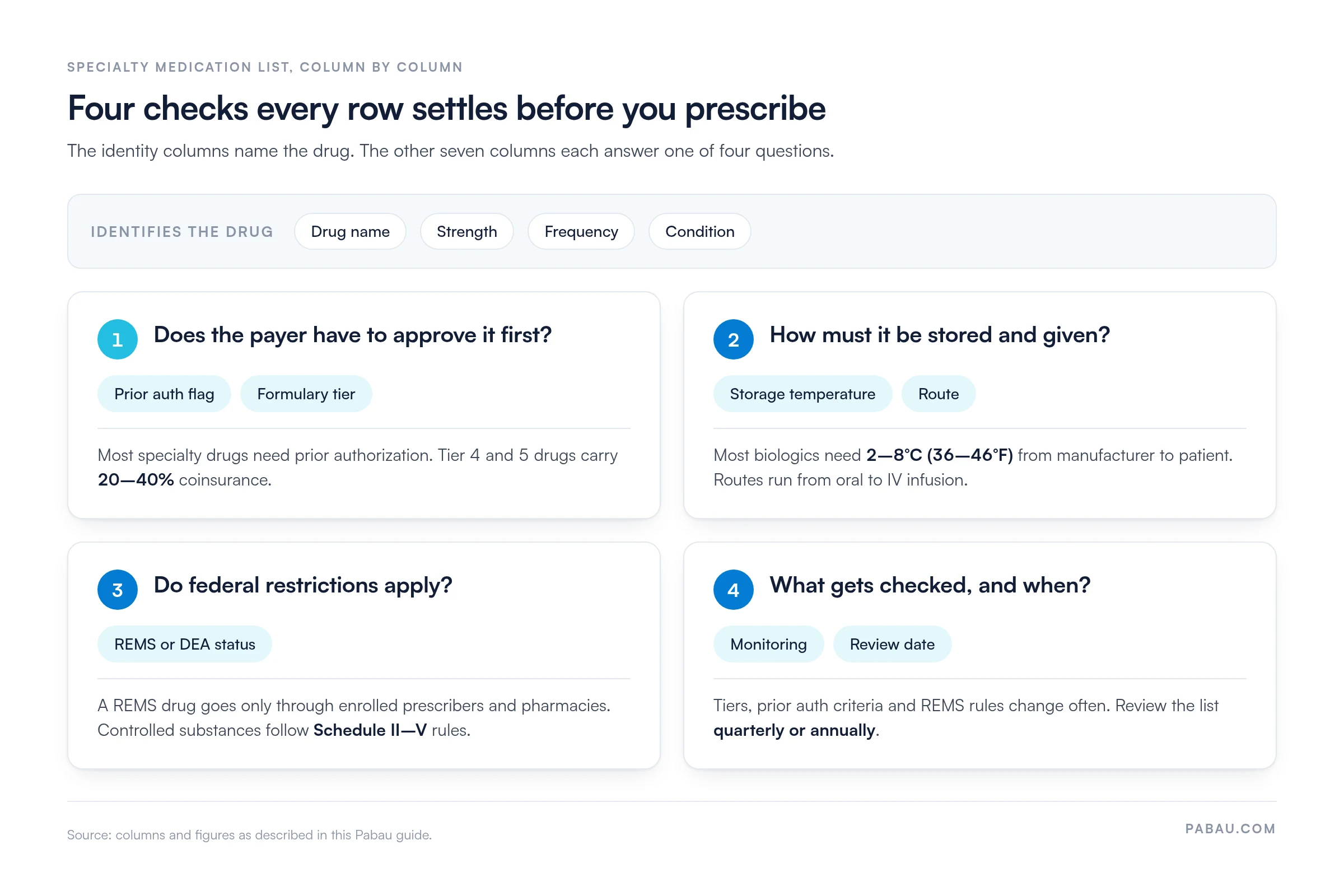
Recording those answers consistently, starting with your patient intake forms, cuts prescribing errors and avoidable prior authorization denials. It also keeps cold-chain and REMS protocols from depending on one person’s memory.
Payers, pharmacy benefit managers (PBMs) and the FDA use overlapping criteria to classify a drug as specialty. A drug doesn’t need to meet them all, and one is often enough.
The table below shows common specialty medications grouped by condition. It isn’t exhaustive, because your practice’s list will reflect your own patients and prescribing patterns.
In weight loss practices, GLP-1 agonists can make up most of the list, since they need refrigeration and often prior authorization. A separate GLP-1 medication list covers their brands, indications and dosing in more detail.
Lupus is another condition that relies on specialty drugs. Belimumab and anifrolumab are prior-authorization biologics, and an SLE medication list records them beside the steroids they are meant to spare.
Migraine prevention follows the same prior authorization pattern. Insurers usually approve a CGRP inhibitor only after a documented first-line trial, and a migraine prevention drug list keeps that history on file.
Most insurance formularies sort drugs into tiers that set the patient’s cost-sharing. Knowing a drug’s tier helps you anticipate what the patient will pay and set expectations early.
Medicare Part D places most specialty medications on Tier 4 or Tier 5, so beneficiaries may face $200–$500+ in monthly coinsurance per drug. Since the 2025 Part D redesign, that spending stops at an annual out-of-pocket cap, set at $2,100 for 2026. Always check the drug’s current tier with the patient’s payer before dispensing.
Most specialty medications need prior authorization from the patient’s insurer before dispensing. Prior authorization is the payer’s review of medical necessity and formulary compliance.
Your list should flag which drugs need prior authorization and which documents strengthen the request, such as previous treatment failures or genetic test results. Keep those flags in your prescription management software, where the prescriber sees them before the script goes out. That shortens approval delays and avoids gaps in treatment.

Specialty medications often need strict storage. Most biologics and many injectables need refrigeration at 2–8°C (36–46°F), and some need freezing or protection from light.
For each drug, note the storage temperature, the staff member responsible for monitoring and the escalation steps for a temperature excursion. Several specialty drugs, insulin included, also belong on a high-alert medication list, which flags drugs that cause serious harm when given in error.
Six steps take you from a blank template to a list your team checks at the point of prescribing.
Many practices build the list into their EHR or practice management system, so staff confirm prior authorization and storage needs at the point of prescribing.
Drug recall notices belong in the same review cadence. When one names a drug on your list, a medication recall checklist helps you match lot numbers and contact affected patients.
Without a central system, the evidence behind a specialty drug sits in several places. Intake answers live on paper, treatment history sits in a separate EHR, and justification letters get typed from scratch for each request.
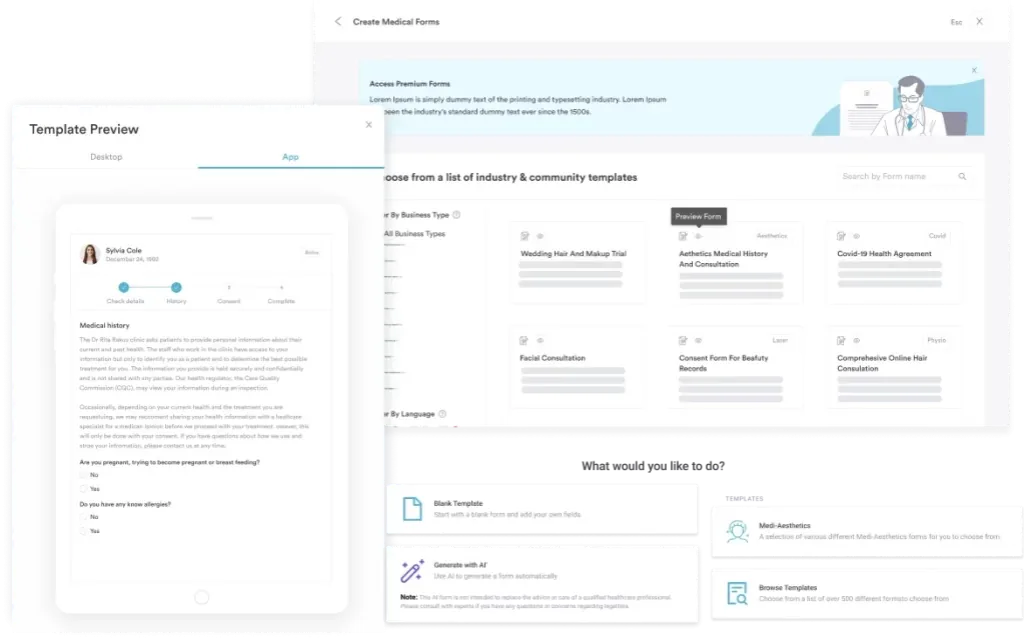
Pabau keeps that evidence on one patient record. Digital intake forms capture medication history, allergies and contraindications before the first appointment. Treatment notes and prior treatments sit on the same record, so the documents a payer asks for are already in one place.
Pabau Scribe, our AI medical scribe, drafts clinical notes from the consultation, including the treatment rationale a payer reviews. Formulary tiers and payer decisions still come from each payer, so your specialty medication list stays the reference for those.
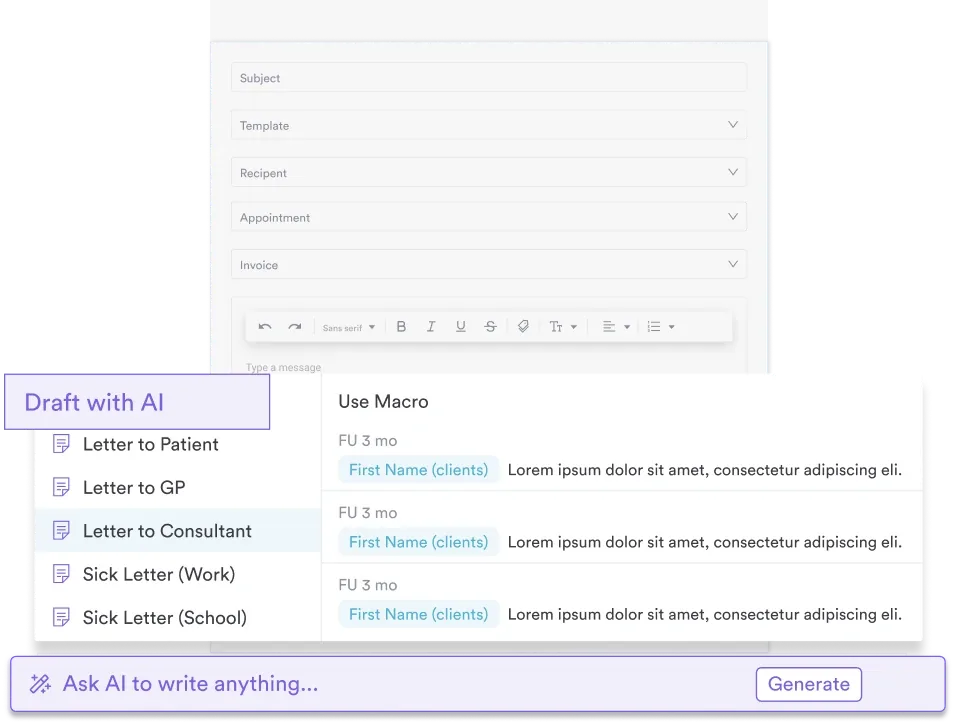

Pabau’s digital forms, patient records and AI scribe keep medication history and treatment rationale together. Your team has the evidence ready when a payer asks.

Start the list with the specialty drugs you already prescribe most, rather than a catalog of every specialty drug on the market. A short, accurate list your team checks at every script is worth more than a long one nobody trusts.
The trade-off is upkeep. Tiers, prior authorization criteria and REMS rules shift often, so the list needs a named owner and a review date. Check each new drug’s REMS status against the FDA’s REMS guidance before it goes on the list.
Kept current, the list means fewer denied requests, fewer spoiled doses and fewer patients waiting on treatment. Book a demo to see how Pabau keeps the forms, notes and records behind every specialty prescription in one place.

Prescribing GLP-1 agonists? GLP-1 medication list covers brands, indications and dosing in one reference.
Recording what patients take without a prescription? OTC medication list template keeps over-the-counter drugs on file next to prescriptions.
Giving oral drugs that must be swallowed whole? Medication do not crush list is a quick reference sheet for nursing staff.
Managing patients on several diabetes drugs? Diabetes medication list supports safe prescribing across diabetes drug classes.
A specialty medication list is a reference document cataloging the high-cost, complex or restricted drugs your practice prescribes or administers. It records drug name, strength, formulary tier, prior authorization requirement, storage temperature and REMS status, so prescribing stays safe and payer-approved.
Specialty medications typically cost more than $600 per month or need cold-chain storage. Many ship only through specialty pharmacies or need complex administration, such as infusions. Drugs with FDA REMS programs often qualify too. Examples include biologics such as adalimumab and pembrolizumab, and infused drugs such as bevacizumab.
Yes, most specialty medications need prior authorization from the payer before dispensing. The payer reviews the clinical justification and formulary compliance. Approval typically takes 24–48 hours. Denials often cite step therapy or off-formulary status, and you can appeal them with additional clinical evidence.
Most specialty medications, especially biologics and injectables, need refrigeration at 2–8°C (36–46°F). Some need freezing or protection from light. Document the cold chain from manufacturer to patient, because excursions above 8°C (46°F) can degrade the drug. Keep temperature monitors and backup power on every drug refrigerator.
Medication therapy management is a clinical service, often payer-sponsored. A pharmacist or other qualified provider reviews a patient’s medications for safety, effectiveness and cost. For specialty drugs, MTM often includes prior authorization support, patient education on administration and side effects, and adherence counseling.
Click the download button in the blue box near the top of this page. The PDF is a printable checklist with patient details, sections for essentials and documents, and rows for each item’s quantity and confirmation. Use its blank rows and notes page to add columns from this guide, such as prior authorization flag and storage temperature.