

CCSD code G5100: Bypass of duodenum billing guide
CCSD code G5100 bills a bypass that leaves the duodenum in place CCSD code G5100...

Last Updated: Oct 16, 2026
T4544 is the HCPCS Level II code for adult sized disposable incontinence product, protective underwear/pull-on, above extra large, each. In plain terms, it bills one bariatric pull-on garment per unit.
Style trips up more of these claims than size does. A tab-closure brief above extra large is T4543, and an XL pull-on is T4528. T4544 is a T-code, created for state Medicaid agencies, so Medicare won't pay it. Getting the code, payer, and paperwork right keeps the claim from bouncing back. The sections below cover the code ladder, payer rules, documentation, and a checklist to run before you submit.
Let Pabau's smart automation suggest the right codes, reduce claim denials, and keep your practice compliant—effortlessly.
Automate repetitive tasks and focus on what matters most—your patients.
Reduce coding errors and ensure compliance with the latest regulations.
Clean claims, fewer denials, and faster reimbursements.
Powerful insights and reporting to help your practice thrive.
HIPAA compliant SOC 2 certified GDPR-compliant Trusted by 4,000+ clinics worldwide

HCPCS code T4544 bills adult disposable pull-on protective underwear above extra large, one unit per garment.
A tab-closure brief in the same size is T4543, so read the style on the order before the size.
T-codes exist for state Medicaid agencies, and Medicare does not recognize them, so Medicaid is the usual payer.
Most programs want a dated order, a signed letter of medical necessity, a qualifying ICD-10 code, and often prior authorization.
Quantity limits and rates are set by each state or plan, so check the current manual before you dispense.
HCPCS code T4544 bills one adult disposable pull-on garment sized above extra large. The official descriptor from the Centers for Medicare and Medicaid Services (CMS) reads: Adult sized disposable incontinence product, protective underwear/pull-on, above extra large, each. It took effect on January 1, 2014.
The word “each” sets the unit of service. One garment equals one unit, so a full case is billed as the number of garments inside it.
Two facts in that descriptor decide whether T4544 fits. The garment pulls on, and it’s sized above extra large. Change either one and the code changes too. According to the CMS HCPCS code set, these T-codes split by product style first and size second.
T4544 and T4543 share a size but describe different products. T4543 is a tab-closure brief or diaper above extra large. T4544 is pull-on protective underwear in the same size. Each style has its own size ladder, as the grid below shows.
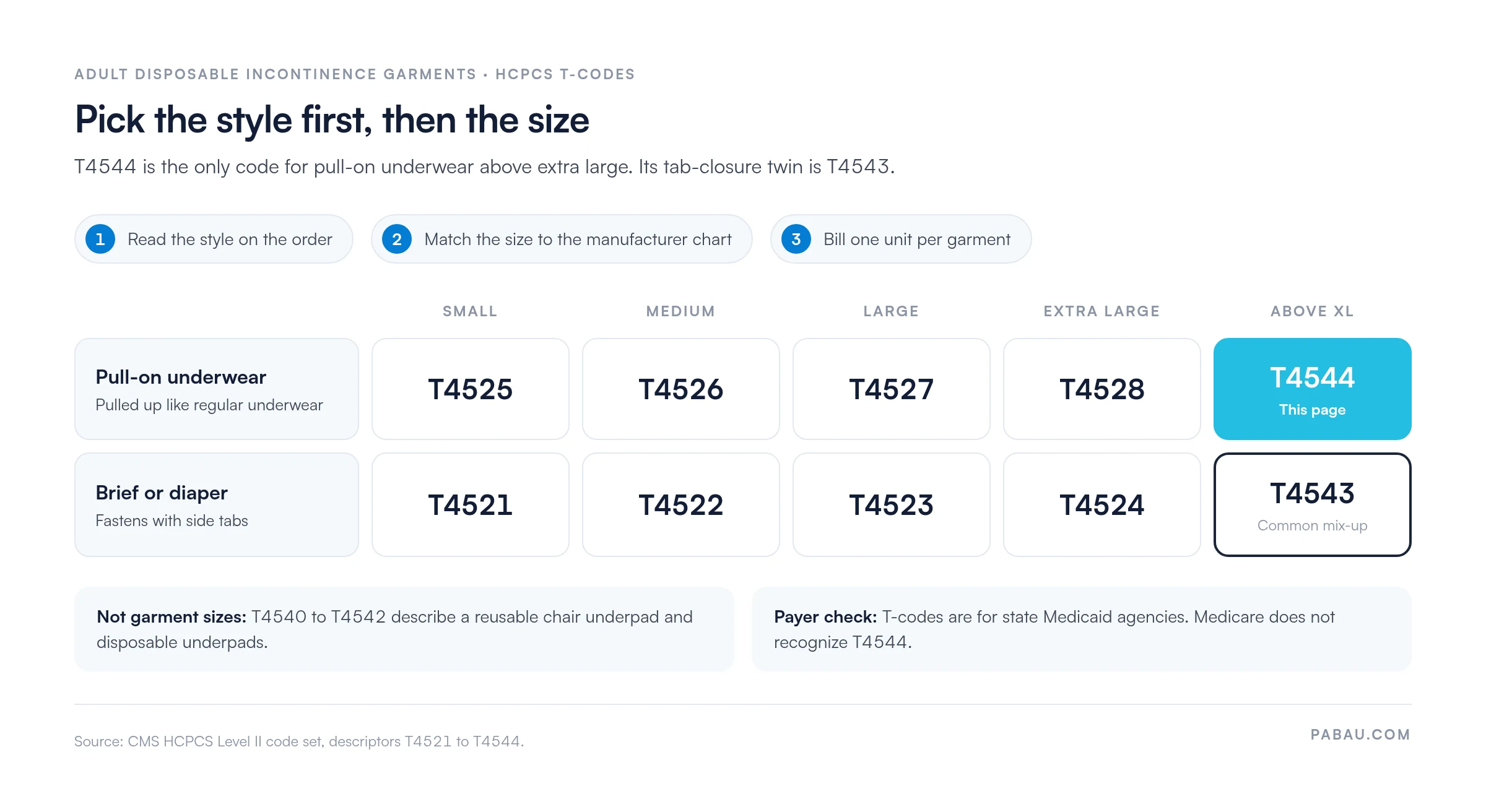
The two most common selection errors run in opposite directions. Some billers treat T4544 as “the biggest brief” and use it for a tab-closure product that belongs under T4543. Others reach for T4528, the XL pull-on, when the garment is above XL.
A tab-closure brief in standard XL is T4524. Codes T4540 to T4542 aren’t garment sizes at all. They describe a reusable chair underpad and disposable underpads, so they never stand in for T4544. T4545 isn’t a size either. It codes a disposable penile wrap, the one male-specific product in the range.
A patient’s order reads “pull-up, 3XL, four per day.” The style is pull-on and the size is above XL, so the code is T4544. Over 30 days, that comes to 120 units, as long as the plan’s monthly limit allows it.
Bill T4544 to Medicaid or a plan that covers incontinence garments, never to Medicare. CMS created T-codes for state Medicaid agencies, and Medicare doesn’t recognize them. Medicare also excludes adult incontinence garments from Part B, so no other code moves this product onto a Medicare claim.
Most state Medicaid programs cover these garments for enrolled patients with a qualifying diagnosis. The details depend on the program:
For a patient with both Medicare and Medicaid, check the state’s crossover rules. Some states bill Medicaid directly for items Medicare never covers. Others still ask for proof that Medicare won’t pay.
There’s no national quantity limit for T4544. Each state sets its own, and managed care contracts may differ from the fee-for-service limit in the same state. Limits can also change with the plan year.
Going over the limit without approved prior authorization usually triggers a quantity denial, often CO-119 (benefit maximum reached). To bill above it, request authorization first. Include the prescriber’s notes on incontinence frequency, functional status, and garments needed per day.
Verify the current quantity limit with the state Medicaid agency or MCO before dispensing above-standard quantities. Limits can change each benefit year. A retroactive authorization request after dispensing is hard to win on appeal.
T4544 documentation has one job, which is proving medical necessity before the garment ships. Payers usually want these six items in the patient file before you submit the claim:
Each state Medicaid program sets its own record retention period, and many require several years. Check your state’s rule, because incomplete records can lead to recoupment of paid claims.
The diagnosis on the claim must reflect a condition that causes incontinence. Medicaid programs commonly accept the codes below for incontinence garments. Payers typically want the same code on the prescribing order and the claim.
Neurogenic bladder diagnoses (N31.x) show a neurological cause for the incontinence, which strengthens a prior authorization request. Pair the incontinence code with the underlying condition where one applies.
Examples include multiple sclerosis (G35), dementia (F01-F03), or spinal cord injury coded by level (S14 cervical, S24 thoracic, S34 lumbar and sacral).
Whether T4544 needs prior authorization (PA) depends on the state Medicaid program or managed care plan. No single rule applies nationally. The table shows common patterns, but confirm current rules with the payer before dispensing.
If a request is denied, the supplier can appeal with the prescriber’s clinical notes, the LMN, and any functional assessment. Dispensing before the decision often leaves the claim unpaid, even when approval comes later. A clear prior authorization workflow gets the request in before the first delivery.
A T4544 claim follows the same five steps every month. Here’s the path from the order to the remittance:
T4544 claims go on the CMS-1500 form (paper) or its electronic equivalent, the 837P transaction. Getting these fields right is most of what it takes to submit a clean claim on the first pass.
For anything else, the state Medicaid billing manual or the MCO’s provider manual has the final word. Those documents set the modifier, unit, and authorization rules for T4544.
Medicare publishes no fee schedule amount for T4544, because it doesn’t recognize T-codes. State Medicaid programs set their own rates for incontinence garments, and those rates vary widely by state.
To look up current allowed amounts, use these resources:
Above-XL garments often carry a higher Medicaid rate than the XL codes, reflecting a higher unit cost. Don’t assume the T4528 or T4543 rate applies to T4544, so check the fee schedule for each code. For descriptor and status checks, the AAPC HCPCS code range lookup and the PGM Billing HCPCS tool give a quick reference.
Most T4544 denials come from a short list of errors, and you can catch nearly all of them before submission. The claim denial codes on the remittance tell you which one hit.
Appeals must reach the payer within its timely filing limits, which each Medicaid program and MCO sets. Include the original claim, the denial explanation, and all supporting documentation. Retroactive approval doesn’t guarantee payment, so confirm payer policy before you pursue it.
Most T4544 denials start before anyone builds the claim. The order names the wrong style, the LMN is unsigned, or the authorization number never reaches billing. Then your team chases the same patient file across email, paper, and the payer portal.
Pabau, the practice management platform we build, keeps the order, signed forms, and patient record together. Its practice claims management software pre-fills the claim from that record. It also holds the claim until required fields, like the authorization number, are complete.
In the US, claims go through Claim.MD, with eligibility checks and remittance posting built in. Your billers spend their time on exceptions instead of re-keying the same garment order every month.

Pabau pre-fills garment claims from the patient record and checks required fields, like the authorization number, before they go out. See how it fits your billing workflow.

Treat style, size, and payer as intake checks, not billing fixes. By the time a T4544 claim reaches billing, the order has already decided whether it gets paid.
The trade-off is a little more care at intake for far less rework later. A clean order, a signed LMN, and an authorization on file before delivery cover most of the risk.
Book a demo to see how Pabau helps your billing team send complete garment claims the first time.

Billing washable garments instead? HCPCS code T4536 covers reusable pull-on underwear in any size.
Coding for a child? HCPCS code T4531 explains the pediatric pull-on codes and how they differ from adult sizes.
Supplying underpads too? HCPCS code T4541 covers large disposable underpads and their billing rules.
Tired of chasing authorizations? Prior authorization software compares tools that track requests from submission to approval.
Want fewer claim errors at the source? Superbill documentation guide covers what a complete superbill needs before claim submission.
T4544 covers adult disposable pull-on protective underwear sized above extra large. You bill one unit per garment, and the claim usually goes to Medicaid.
Yes. Reusable protective underwear uses T4536, which covers any size. T4544 is for disposable garments only, so don’t use it for washable products.
Pediatric pull-ons have their own codes, T4531 for small or medium and T4532 for large. T4544 is adult sized, so it doesn’t apply to children’s garments.
The treating prescriber writes the order, usually a physician, nurse practitioner, or physician assistant. Which roles may sign depends on your state’s Medicaid rules.
Many Medicaid programs set a renewal interval for the order and the letter of medical necessity. Check your state’s DME manual and track the date. An expired order can sink every claim after it.



