HCPCS code T2043: Hospice continuous home care billing guide
HCPCS code T2043 pays for hospice crisis care by the hour HCPCS code T2043 is th...

Last Updated: Oct 7, 2026
HCPCS code T4536 is the Level II code for reusable protective underwear in a pull-on style, any size, billed per item. The official descriptor reads "Incontinence product, protective underwear/pull-on, reusable, any size, each." The code has been in effect since January 1, 2005.
Medicare does not cover incontinence supplies, so state Medicaid programs pay most T4536 claims. Each state sets its own fee, quantity limit and prior authorization rules. Many denials come from billing a near neighbor by mistake. The usual suspects are disposable pull-ons (T4525-T4528), reusable briefs (T4539) and reusable bed pads (T4537).
Let Pabau's smart automation suggest the right codes, reduce claim denials, and keep your practice compliant—effortlessly.
Automate repetitive tasks and focus on what matters most—your patients.
Reduce coding errors and ensure compliance with the latest regulations.
Clean claims, fewer denials, and faster reimbursements.
Powerful insights and reporting to help your practice thrive.
HIPAA compliant SOC 2 certified GDPR-compliant Trusted by 4,000+ clinics worldwide

T4536 bills reusable, washable protective underwear in a pull-on style, any size, one unit per item.
Disposable pull-ons use T4525-T4528, and reusable briefs or diapers use T4539, not T4536.
Medicare doesn’t cover incontinence supplies, so state Medicaid programs pay most T4536 claims.
Each state sets its own fee, quantity limit, prior authorization rule and modifier requirements in its provider manual.
A clean claim pairs a supported diagnosis, such as R32 or N39.46, with a signed order and proof of delivery.
HCPCS code T4536 covers reusable protective underwear in a pull-on style, in any size, billed per item. The garment is washable and pulls up like regular underwear, with built-in absorbency. It sits in the T4521-T4545 incontinence supply range of the CMS HCPCS Level II code set.
Two words in the descriptor do most of the work. “Reusable” rules out every disposable product, and “pull-on” rules out tab-closure briefs. Because the code covers any size, there is no separate small, large or bariatric version to choose. Sized versions exist only for disposables, and you can compare them in our HCPCS codes library.
Disposable pull-ons, reusable briefs and reusable underpads are the usual mix-ups. Each one shares a word with the T4536 descriptor, so a quick keyword search pulls up the wrong code. The grid below sorts the range by product shape and by whether the item goes in the wash.
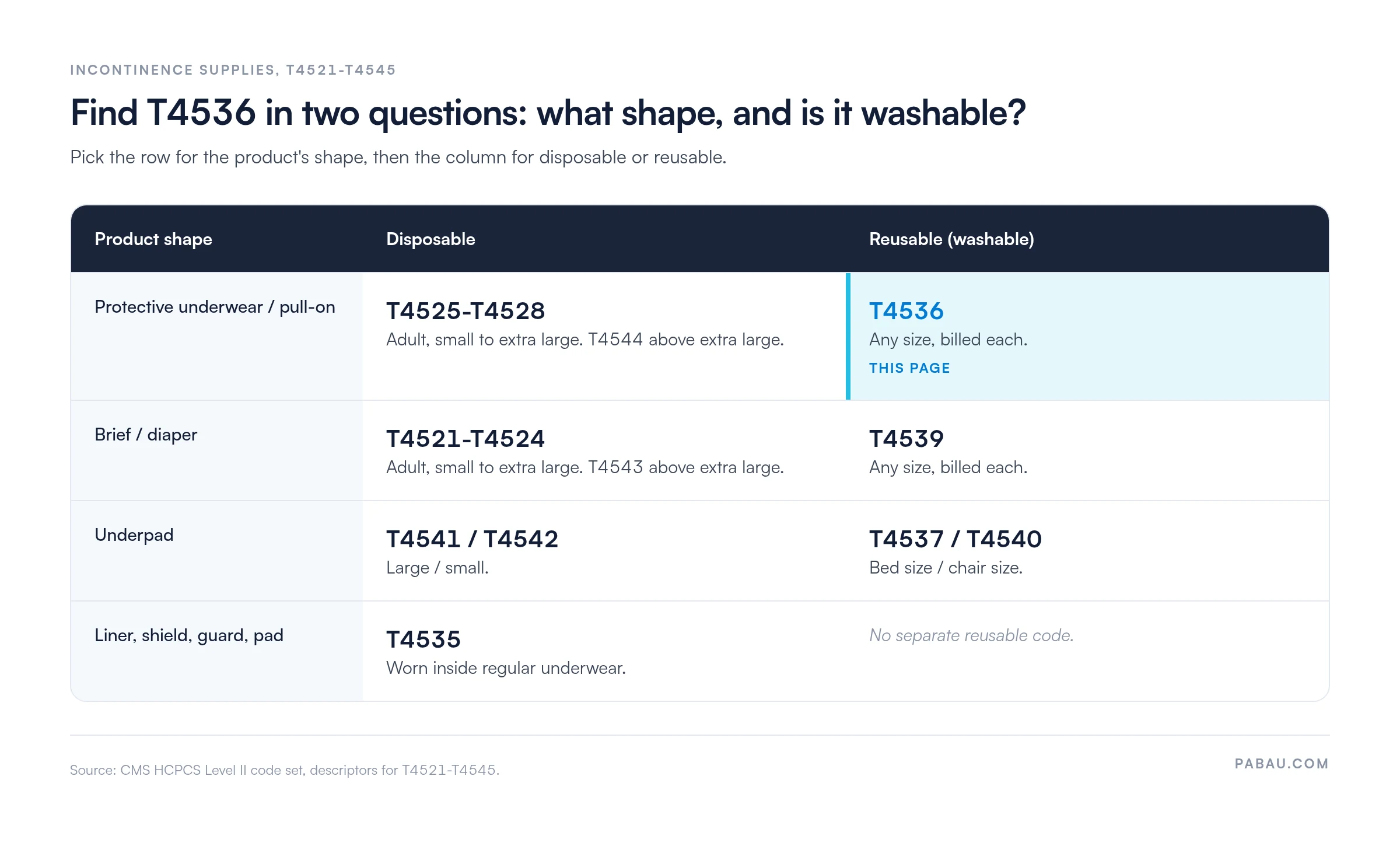
A quick test settles most cases. If the patient throws it away, T4536 is wrong. If it opens with side tabs, use T4539 instead. If it lies on a mattress, look at T4537. For pads worn inside underwear, see HCPCS code T4535.
State Medicaid programs pay for most T4536 claims. Medicare Part B does not cover incontinence supplies, regardless of how severe the condition is. So the payer you bill shapes the fee, the paperwork and the unit limit.
Reusable products change the quantity math. Washable garments last longer than disposables, so a state may count them over a longer period. Read how your state’s fee schedule counts units before you set up a repeat order.
A covered incontinence diagnosis supports medical necessity. The ICD-10-CM codes below are common, though each state publishes its own list. Confirm the code against your state Medicaid provider manual before you submit.
Use the specific N39.4- code the chart supports, such as N39.41 or N39.46. The parent code N39.4 is a category, not a billable code.
Most states want the same core file, even when the forms differ. Strong medical billing compliance means building it before delivery, not after a denial.
Write the order with the product words from the descriptor: reusable, protective underwear, pull-on. A reviewer matching the order to the claim then finds the same product on both.
A clean claim follows the same path in every state. Only the forms and limits change. Each step below removes one reason a clean claim could still bounce back.
Picture a Medicaid patient with mixed incontinence. The prescriber orders six reusable pull-on garments, and the chart records daily leakage. The supplier codes N39.46, confirms prior authorization, delivers the garments and collects a signed receipt. The claim then goes out as T4536 with six units.
Now change one detail. If the order had said “washable briefs with side tabs”, the right code would be T4539. The diagnosis and paperwork stay the same, but the product code changes.
No national rule requires a modifier on T4536. Instead, each state sets modifier rules for incontinence supplies in its DMEPOS or medical supply manual. Some states list a modifier for supplies, while others list none. Add only the modifiers your state manual names, and leave the rest off.
Most denials come from six sources, and each has a clear fix. A steady denial management routine catches repeat patterns early.
Run through these checks on every T4536 claim before it leaves your system.
These errors show up again and again on reusable pull-on claims.
Once a supply claim leaves the building, many teams track it in spreadsheets and payer portals. Pabau, the practice management software we build, keeps that follow-up in one place instead.
Its claims management feature shows each claim’s status and records any denial against it. So your team can see which T4536 claims are paid, which are pending and which need a fix.

Pabau’s claims management feature tracks claim status and records denials, so your team knows which incontinence supply claims still need attention.

T4536 is a narrow code, and that narrowness is the point. It fits one product: washable underwear that pulls on. When the product, the payer and the state rules line up, the claim is routine.
Start with the product, then read your state’s manual for limits and modifiers. Those two checks prevent most T4536 denials before they happen. Book a demo to see how Pabau keeps your supply claims visible from submission to payment.

Need to understand how billing denials are classified? Denial codes in medical billing breaks down the most common CARC and RARC codes and what each one means for your appeal.
Want to confirm Medicaid coverage before you deliver supplies? Insurance eligibility verification covers how to check a patient’s benefits up front.
Curious about the file behind your claim submission? 837 file explains the electronic claim format used to send HCPCS claims to Medicaid and other payers.
New to the billing side of a practice? What is medical billing walks through how a claim gets from service to payment.
Yes. The descriptor covers any size, so reusable pull-ons for a child can be billed as T4536. Children’s Medicaid or CHIP rules set the age limits and quantities.
There is no national limit. Each state Medicaid program sets its own allowance. Limits can run per month or over a longer period, so check your state’s fee schedule before setting up repeat orders.
Yes. T4536 has been in effect since January 1, 2005, and remains in the HCPCS Level II code set. Check the quarterly HCPCS update for any change.
Look in your state Medicaid fee schedule. Medicare does not cover T4536, so there is no federal Medicare rate to use.
Not as a standard medical benefit, because original Medicare excludes incontinence supplies. Some plans offer extra supply allowances, so check the patient’s plan documents.