

CCSD code G5100: Bypass of duodenum billing guide
CCSD code G5100 bills a bypass that leaves the duodenum in place CCSD code G5100...

Last Updated: Oct 16, 2026
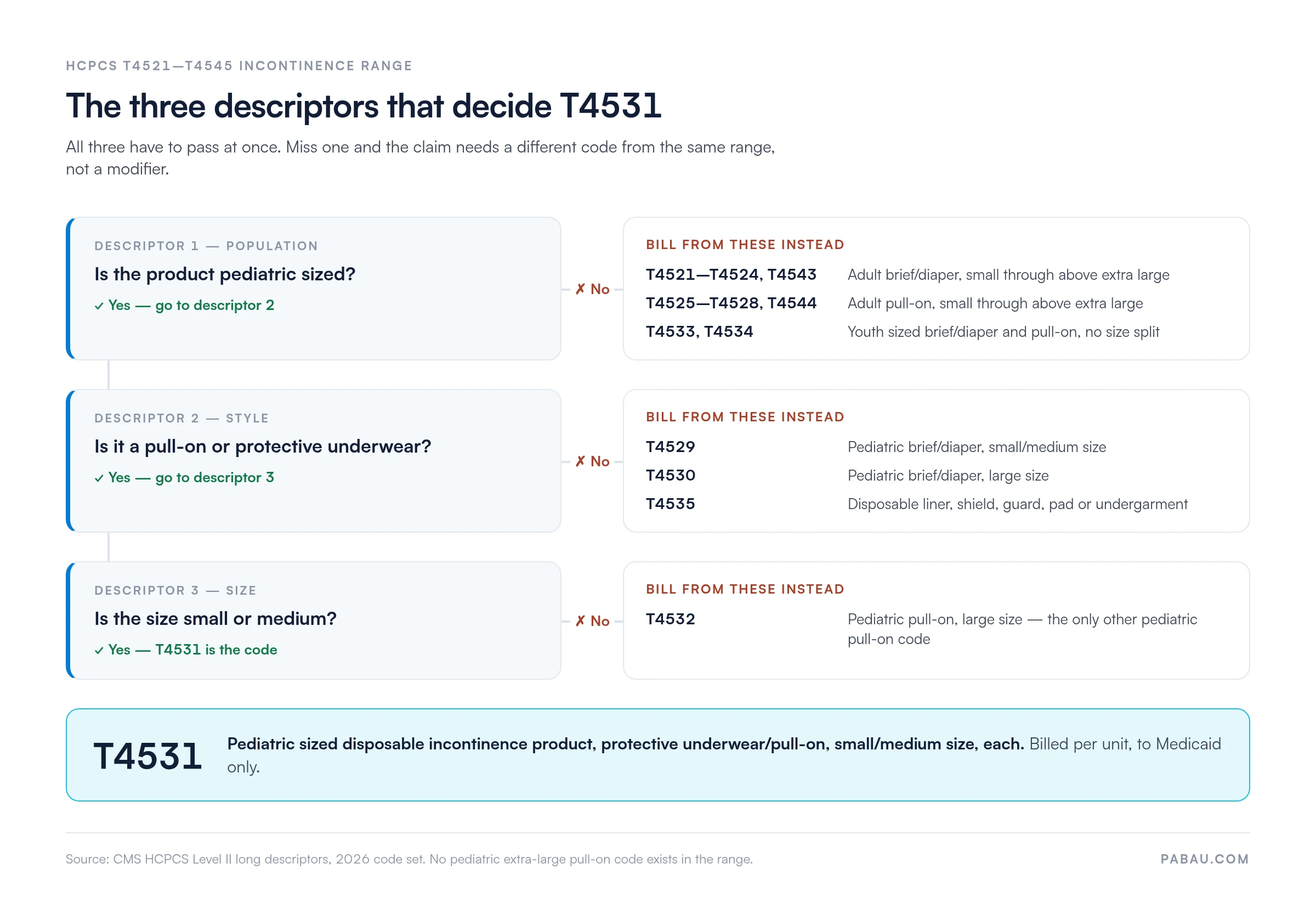
T4531 is the HCPCS Level II code for pediatric sized disposable incontinence product, protective underwear/pull-on, small/medium size, each.
Three descriptors define this code, and all three have to apply at once. The product must be pediatric sized rather than adult. The style must be a pull-on or protective underwear, not a flat brief or a pad. The size must be small or medium. The flow below shows which code takes over when one of the three fails.
Let Pabau's smart automation suggest the right codes, reduce claim denials, and keep your practice compliant—effortlessly.
Automate repetitive tasks and focus on what matters most—your patients.
Reduce coding errors and ensure compliance with the latest regulations.
Clean claims, fewer denials, and faster reimbursements.
Powerful insights and reporting to help your practice thrive.
HIPAA compliant SOC 2 certified GDPR-compliant Trusted by 4,000+ clinics worldwide

HCPCS code T4531 describes a pediatric-sized disposable incontinence product, protective underwear/pull-on, small/medium size, billed per each unit.
T4531 is a Medicaid-only code. Medicare Part B explicitly excludes incontinence supplies from its DME benefit, per Noridian MAC guidance.
Reimbursement rates vary by state Medicaid program. Never apply a single national rate. Verify the current fee schedule with your state Medicaid agency before billing.
Pabau’s claims management software supports HCPCS T-code billing workflows, helping providers submit clean Medicaid claims and track incontinence supply reimbursements.
Medicare Part B does not cover incontinence supplies, including pull-ons, diapers, and underpads. This exclusion is explicit in Noridian Medicare’s correct coding guidance for hygienic cleansers, diapers, and underpads. A reusable bed-size underpad billed as T4537 falls under the same exclusion. Billing T4531 to Medicare Part B produces a categorical denial rather than a request for more documentation.
The same exclusion applies to T4541, the large disposable underpad, so Part B denies that claim too.
T-codes, by design, are Medicaid-specific. State Medicaid programs are the intended and primary payers for the T4521-T4545 range, including T4531. Coverage eligibility, quantity limits, and prior authorization requirements all depend on the individual state’s Medicaid policy.
For dual-eligible beneficiaries, the claim routes to Medicaid for incontinence supplies. Medicare’s non-coverage is not a crossover opportunity. There is no secondary claim to file once Part B has denied the line.
No single national fee schedule rate governs T4531. Each state Medicaid program sets its own rate and updates it on its own schedule, which may not align with the federal fiscal year. According to CMS’s HCPCS overview, T-codes are maintained by CMS while reimbursement is administered at state level.
State Medicaid rates for pediatric incontinence pull-ons usually reflect the per-unit cost of the supply. Some states set a flat per-unit rate. Others use fee-for-service schedules tied to average wholesale price or to a contracted supplier rate.
Practices billing incontinence supplies under Medicaid should confirm enrollment status with the state program first. Not every provider type may bill T-codes directly in every state. Once enrollment is settled, the recurring work is rate tracking and quantity caps, which is what cleaner claims management takes off the biller’s desk.
Medicaid claims for T4531 fail most often on documentation, not on coding. State Medicaid programs require evidence of medical necessity before they approve an incontinence supply claim. The record has to establish that the child has a condition causing incontinence. It must also show that a pull-on product is clinically appropriate and that the quantity matches the clinical need.
Medical necessity for pediatric incontinence supplies is judged at the payer level. Per MAC guidance from Noridian, the documentation must support the specific product type billed. A general note about incontinence is not sufficient. The diagnosis code on the claim has to name a condition that causes functional incontinence.
Run T4531 claims through your state Medicaid fee schedule lookup before submitting. Rates vary by state, and submitting at an incorrect amount can delay payment or trigger a recoupment request.
Prior authorization (PA) requirements for T4531 vary by state. Some Medicaid programs require PA for every incontinence supply claim above a defined monthly quantity. Others require it only on initial authorization, with a simplified renewal process after that. A small number of states do not require PA at all for pediatric supplies.
A prior authorization request for T4531 needs three attachments. Include the treating clinician’s clinical notes and the product specification confirming size and style. Add the monthly quantity requested, with clinical justification for that number. PA denials on incontinence supplies are often overturned on first appeal once the documentation is complete.
Documentation checklists for T4531 are easy to find. The order those steps run in is what decides whether the claim clears on first pass. Work through this sequence front to back.
When a T4531 claim denies for ‘non-covered service,’ confirm the patient’s exact Medicaid benefit category. Some Medicaid managed care plans require T-code claims to route through the plan’s DME supplemental benefit rather than the state fee-for-service program.
The T4521-T4545 range covers disposable incontinence supplies across pediatric, youth, and adult sizes and two main product styles. Picking the wrong code from this range is the primary coding error on incontinence supply claims. Most published versions of this table merge sizes that CMS keeps separate, so the range is reproduced in full below.
T4545 is not a catch-all, despite how often it is described as one. Its official descriptor is a disposable penile wrap, billed per each unit. The miscellaneous incontinence supply code is A4335, which sits outside the T4521-T4545 range entirely. Use A4335 only when no specific code describes the product you dispensed. A small disposable underpad, for example, is coded T4542 rather than A4335.
Sizing also splits more finely on the adult side of the range than the pediatric side. Adult briefs and adult pull-ons each carry five size codes. Pediatric products carry two apiece, and there is no pediatric extra-large pull-on code at all. Check the HCPCS Level II codes index before assuming a neighboring size code exists.
Coders billing several incontinence products for the same patient in one period should confirm that each code maps to a distinct product type and size. Unbundling rules apply in some state programs. The clean claim checklist covers what to verify before electronic submission. You can also cross-check descriptors against the AAPC HCPCS Level II code lookup.
A few recurring patterns cause most T4531 denials. Knowing them in advance lets billers build pre-submission checks that catch the error before the claim leaves the practice.
Every one of these is catchable before submission. Build a short pre-submission check into the order that confirms population, style, size, diagnosis, PA number, and unit count. That turns most of these denials into edits rather than appeals.
Most practices bill these units out of three places at once. The state fee schedule sits in a spreadsheet. The prior authorization number sits in an email thread. The size descriptor gets checked by whoever happens to build the claim that month.
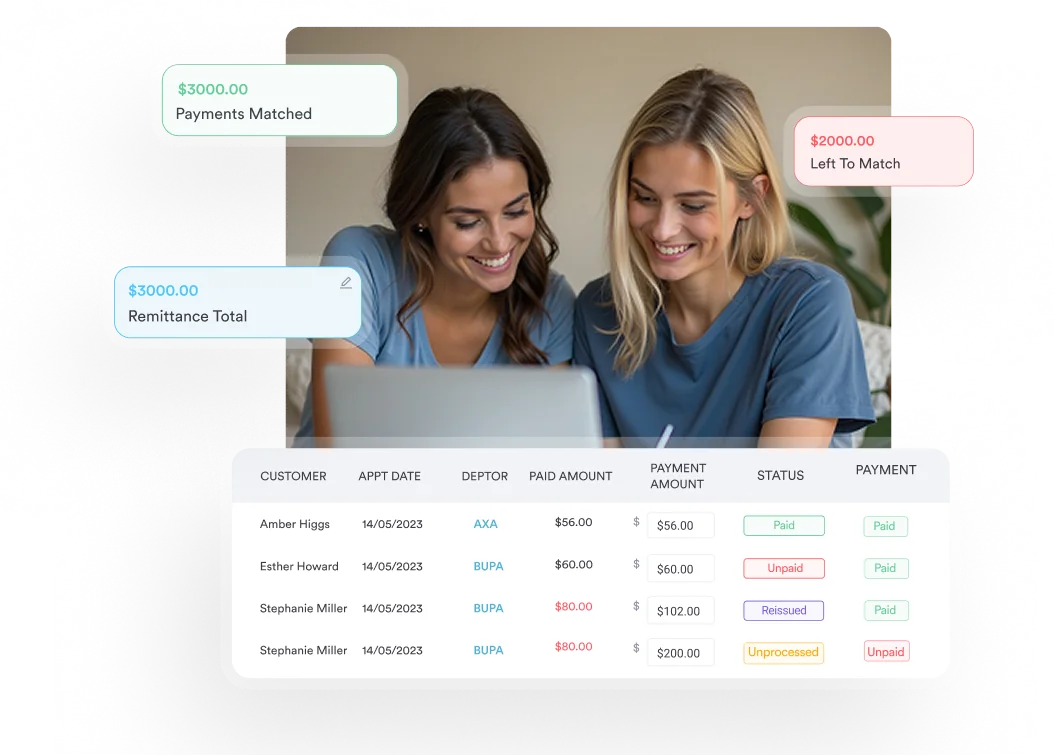
Practice management software like Pabau holds all three against the patient record. Claims leave as 837P files through our Claim.MD clearinghouse integration, which reaches thousands of US payers including state Medicaid programs. Electronic remittance advice comes back automatically and matches against the invoice it paid.
So a single T4531 claim’s history stays in one place. You can see the unit count billed, the PA number attached, the CARC code that came back, and the amount still unmatched. For a practice dispensing incontinence supplies every month, that retires the reconciliation spreadsheet.

Pabau’s claims management tools help pediatric and DME providers track HCPCS T-code submissions and manage prior authorization workflows. They also keep state Medicaid reimbursement schedules in view.

T4531 denials come from a short list: the wrong size code, a missing prior authorization number, or a diagnosis that does not support the product. A check against the three descriptors before submission catches nearly all of them.
The trade-off worth remembering is where you spend the effort. Confirming the size descriptor at the order stage costs a minute. Correcting it after a denial costs a resubmission and a place in the timely filing queue. T4532 is one keystroke from T4531, and no payer will fix that for you.
Put the population, style, and size check into the order form rather than into the appeal. Book a demo to see how Pabau tracks T-code claims and Medicaid remittances against one patient record.

Need a framework for managing Medicaid claim denials? Denial management in healthcare covers how to categorize, appeal, and prevent the most common payer denial patterns.
Submitting clean claims every time? Understanding the 837 file explains the electronic claim format used for Medicaid and commercial payer submissions.
Want to understand the full revenue cycle behind incontinence supply billing? Medical claims clearinghouse guide breaks down how clearinghouses validate and route HCPCS claims before they reach the payer.
Checking Medicaid eligibility before the visit? Insurance eligibility verification sets out what to confirm so a lapsed plan never reaches the claim.
Reading what the payer sends back? Electronic remittance advice explains how to match an ERA to the claim it paid and read its adjustment codes.
HCPCS code T4531 is used to bill a pediatric sized disposable incontinence product, specifically a protective underwear or pull-on style, in small/medium size. It is billed per each unit. T4531 is a Medicaid-specific Level II HCPCS code inside the T4521-T4545 incontinence supply range, and Medicare Part B does not cover it.
No. Medicare Part B explicitly excludes incontinence supplies, including pull-ons, diapers, and underpads, from its durable medical equipment benefit. Submitting T4531 to Medicare Part B produces a categorical denial. Claims should route to Medicaid for eligible patients.
T4531 covers a pediatric pull-on in small/medium size. T4532 covers the same product type in large size, and it is the largest pediatric pull-on code in the range. No pediatric extra-large pull-on code exists. Size is the only distinction between the two, and billing the wrong one is a common denial trigger.
You need a physician or nurse practitioner order specifying the product and the monthly quantity. You also need a diagnosis code establishing the medical cause of incontinence, plus a statement of medical necessity. Add the state Medicaid prior authorization number where one applies. Generic incontinence notes are not enough, because the record has to support both the product type and the clinical need.
Prior authorization requirements vary by state Medicaid program. Some states require PA for every incontinence supply claim, or for quantities above a monthly cap. Others require it only on initial authorization. Check your state Medicaid agency’s policy before billing T4531 to avoid automatic quantity denials.
Most state Medicaid programs cover incontinence supplies for pediatric beneficiaries with documented medical necessity. Coverage terms, quantity limits, and prior authorization requirements differ by state. Contact your state Medicaid agency, or review the state’s published HCPCS fee schedule, for the current rules and rates that apply to T4531.



