

CCSD code G5100: Bypass of duodenum billing guide
CCSD code G5100 bills a bypass that leaves the duodenum in place CCSD code G5100...

Last Updated: Oct 16, 2026
T4528 is the HCPCS Level II code for adult sized disposable incontinence product, protective underwear/pull-on, extra large size, each.
Original Medicare does not cover disposable incontinence supplies, so a T4528 claim sent to a Medicare Administrative Contractor will deny. State Medicaid is the paying program, with Medicaid managed care plans and some commercial insurers behind it.
Let Pabau's smart automation suggest the right codes, reduce claim denials, and keep your practice compliant—effortlessly.
Automate repetitive tasks and focus on what matters most—your patients.
Reduce coding errors and ensure compliance with the latest regulations.
Clean claims, fewer denials, and faster reimbursements.
Powerful insights and reporting to help your practice thrive.
HIPAA compliant SOC 2 certified GDPR-compliant Trusted by 4,000+ clinics worldwide

T4528 covers adult disposable protective underwear/pull-on style in extra large (XL) size only, billed per unit under HCPCS Level II.
Original Medicare does not cover disposable incontinence supplies. Beneficiaries pay 100% out of pocket, and no Medicare DMEPOS fee schedule amount exists for T4528.
State Medicaid programs are the primary payer. Rates, quantity limits, and prior authorization rules are set state by state. Medicaid managed care and commercial plans make up the rest.
Billing requires a prescriber order and a documented diagnosis of urinary incontinence (e.g. N39.3, N39.41, R32).
Practice management software like Pabau keeps the prescriber order, the diagnosis, and the claim record linked for audit.
HCPCS code T4528 describes a single adult sized disposable incontinence product in the protective underwear or pull-on style, extra large size. The “each” unit means every individual garment is billed as one unit of service. Unlike the brief-style codes in the same range, pull-on products are designed to look and fit like regular underwear. That makes them the usual choice for ambulatory patients who dress and undress independently.
The CMS HCPCS National Panel maintains the code and publishes annual updates to the Level II code set. T4528 has remained stable in recent code cycles, with no description changes for the 2026 code year.
The T prefix explains the payer picture. CMS created the T4521-T4545 block as National T Codes for state Medicaid agencies, giving those programs and other non-Medicare payers a shared descriptor set. They were never built as standard Medicare-payable DMEPOS items. That is why T4528 carries no allowable, no RVU, and no competitive bid rate.
There is no national fee schedule amount for T4528. Because the T4521-T4545 range was built for state Medicaid agencies, the rate depends on which payer you billed. It also depends on which state you are in. State Medicaid fee schedules do most of the work here, with managed care and commercial contracts covering the rest.
Original Medicare sits outside all of it. Part B treats disposable incontinence supplies as a non-covered benefit, so the beneficiary pays the full cost. Submitting T4528 to a Medicare Administrative Contractor produces a denial however complete the documentation is.
Because incontinence supply reimbursement is modest per unit, monthly volume rather than unit price drives the revenue line. A state rate change or a new quantity cap can move a supplier’s monthly total considerably. That makes the fee schedule worth checking on a calendar of your own.
To confirm what T4528 pays in your market, pull the current fee schedule directly from your state Medicaid agency. Then check the fee schedule attached to each managed care contract you hold. For the Medicare side, Medicare.gov’s incontinence supplies coverage page states the position plainly. It is a useful document to share with patients who expect Medicare to pay.
Build a one-page payer grid for incontinence supplies and refresh it every quarter. List each state Medicaid program and managed care plan you bill, along with its current T4528 rate. Add the monthly unit cap and whether prior authorization applies. State agencies update these schedules on their own timetable rather than a shared January cycle, so an annual check runs too late.
HCPCS code T4528 is billed by medical supply providers enrolled with the paying program. In practice that means a state Medicaid provider number, or a contract with the managed care or commercial plan. A physician, nurse practitioner, or other qualified prescriber must generate the initial order before the supplier can dispense or bill for the product.
Before submitting, confirm the claim meets the clean claim standard published by the paying program. Because state rules differ this widely, a short checklist per program catches more errors than one house standard applied across all of them.
State Medicaid programs, managed care plans, and commercial payers all require documentation supporting medical necessity before a T4528 claim will pay. Missing or incomplete documentation is the leading cause of incontinence supply claim denials.
Keep the order and the supporting clinical record together in the patient file rather than in a separate supply folder. State Medicaid integrity units and managed care auditors ask for the original order first, then the record carrying the diagnosis.
Every T4528 claim requires at least one ICD-10-CM diagnosis code that supports medical necessity for the incontinence product. The table below covers the urinary incontinence codes most commonly paired with T4528. The diagnosis should reflect the specific type of incontinence documented in the patient’s record. Reach for the unspecified code (R32) only where the record genuinely lacks that specificity.
Note what is missing from that table. N39.4 is a category header rather than a billable code, so a claim carrying it rejects on specificity before a coverage rule is ever applied. Bill one of its subcodes instead, such as N39.498, or fall back to R32 where the record supports nothing more precise.
These codes should be verified against the current AAPC HCPCS and ICD-10 code lookup and cross-referenced with your state Medicaid program’s incontinence supply policy. Several state Medicaid agencies publish a closed list of covered diagnoses for these codes. A diagnosis outside that list can trigger an automatic denial even when it is clinically appropriate.
The T4521-T4545 range covers the disposable and reusable incontinence supply codes. The adult disposable block runs on a simple grid. T4521 through T4524 are brief or diaper style in ascending size, and T4525 through T4528 are pull-on style in the same size order. Selecting the wrong code within this range is a common billing error, particularly after a patient’s size or product style changes. A patient who sizes down from extra large to large bills under T4527.
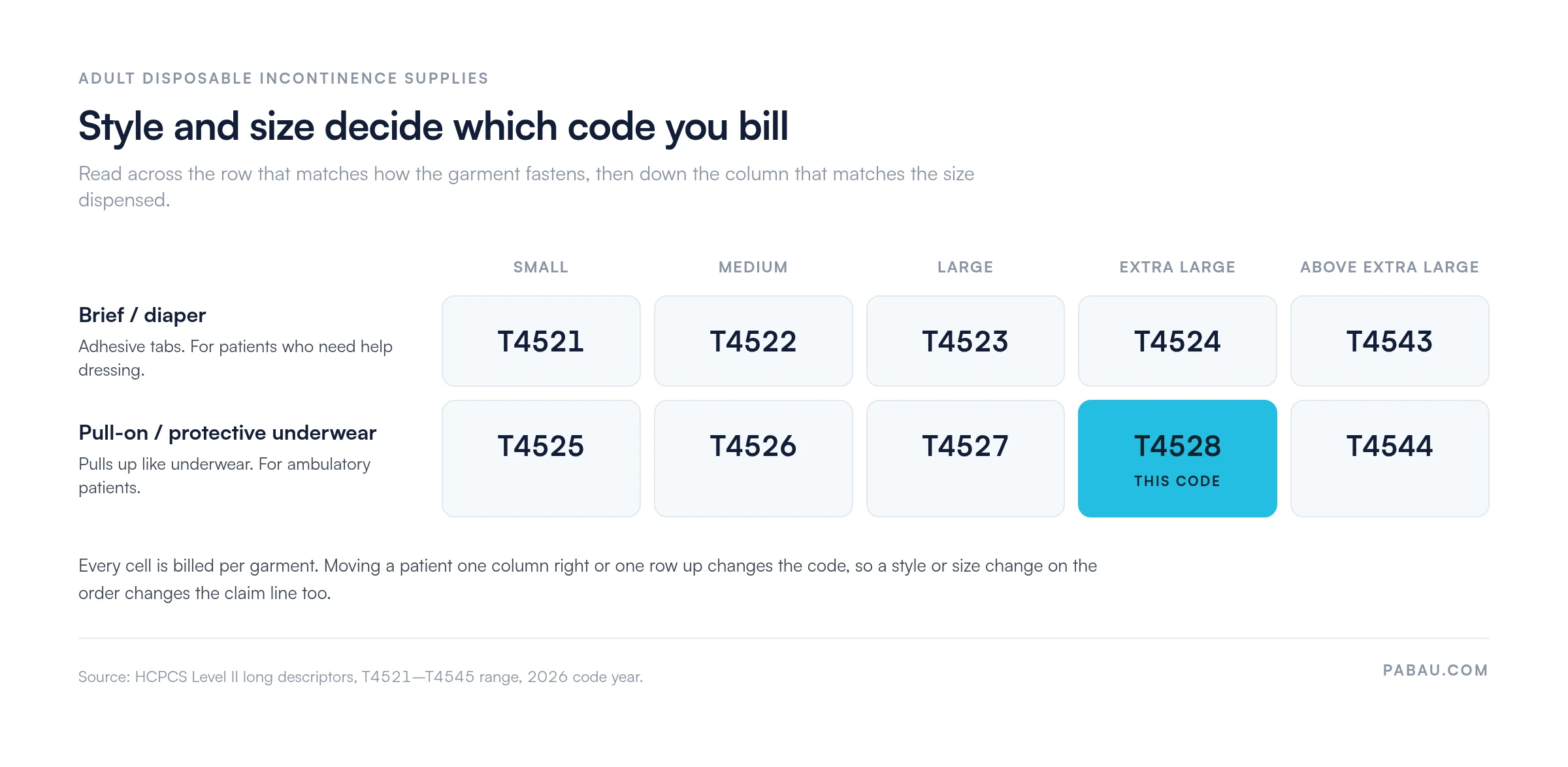
The most common coding confusion is between the brief/diaper codes (T4521-T4524) and the pull-on codes (T4525-T4528). Brief-style products fasten with adhesive tabs. They suit patients who cannot manage pull-on garments on their own, such as those who are bedridden or have significant dexterity limitations. Pull-on products look and fit like regular underwear, which makes them the usual choice for ambulatory patients who dress themselves.
Billing a pull-on code when the patient receives a tab-style brief is a product-descriptor mismatch, and so is the reverse. The size boundary matters just as much. If a patient moves up from extra large to an above-extra-large garment, the claim moves from T4528 to T4544. Always confirm the product dispensed against the code descriptor before submitting. You can cross-reference descriptors using the PGM Billing HCPCS lookup tool.
The rest of the range covers adjacent product types that carry their own codes. T4535 handles disposable liners, shields, and pads. T4541 and T4542 cover disposable underpads, and T4536 through T4540 cover reusable products and diaper services. None of these substitute for T4528, and bundling them onto a single line is a frequent source of partial denials.
Our wider HCPCS code library carries the descriptors for the neighboring supply ranges.
Coverage for T4528 is decided payer by payer. The differences between programs are wide enough that a workflow built for one state will not transfer cleanly to another. Medicaid is the anchor payer, Medicare sits outside the benefit, and commercial coverage is inconsistent.
Most state Medicaid programs cover adult disposable incontinence supplies for members with a qualifying diagnosis. Most also impose a consistent set of conditions before they will pay.
Original Medicare does not cover disposable incontinence supplies or adult diapers under any part of the fee-for-service benefit. Beneficiaries pay 100% of the cost themselves, and no Medicare DMEPOS fee schedule allowable exists for T4528. Incontinence supplies have also never been a product category in the DMEPOS Competitive Bidding Program. The competitive bid and non-bid rate distinction that applies to wheelchairs or CPAP devices does not exist for this code.
Medicare Advantage is the one place a Medicare-branded plan may help. A number of MA plans offer a supplemental over-the-counter or incontinence supply allowance as an extra benefit. These allowances are usually administered through a plan catalog. They are billed under separate HCPCS codes such as A4520 or A4554 rather than the T-code series. The amount is a plan design choice rather than a fee schedule rate. Verify the benefit in the plan’s evidence of coverage before you quote a patient a figure.
For dual-eligible patients, the routing decides the outcome. The claim should go to Medicaid or the Medicaid managed care plan as the paying program, not to the Medicare Administrative Contractor. Sending it to Medicare first only adds a denial and a delay to the cycle.
Medicaid coverage for T4528 varies significantly by state. Some states pay through a published fee-for-service schedule. Others route the benefit entirely through managed care organizations with their own authorization rules. A subset of states do not cover disposable incontinence products at all. Rates also differ by a wide margin between neighboring states for the same garment.
Verifying each state’s incontinence supply policy before the first dispense is the step that keeps these claims payable. For commercial plans, T4528 coverage depends on the individual plan benefit design. Many employer-sponsored plans exclude disposable incontinence supplies outright or apply a separate supply deductible. Confirm coverage through the plan’s eligibility and benefits verification process, and get the authorization reference in writing.
Verify Medicaid coverage before the first T4528 dispense, not after. State Medicaid programs change incontinence supply coverage more frequently than Medicare does. Subscribe to your state Medicaid agency’s provider bulletins to catch policy updates before they create a backlog of uncompensated claims.
Incontinence supply claims fail for a short list of repeatable reasons. Each one is preventable at the point of order entry, which costs far less than an appeal.
Work the resulting denials by reason code rather than one claim at a time. A single misrouted payer setting or an expired order template usually explains a whole batch. A structured approach to denial management surfaces that pattern faster than individual appeals do.
Billing incontinence supply codes like T4528 creates a specific documentation load. Every claim needs a matching prescriber order, a current diagnosis, and the correct product descriptor, all retained for potential audit. Across several state Medicaid programs and a handful of managed care plans, keeping those records straight takes more time than the coding does.
Pabau, our practice management software, keeps clinical documentation attached to the claim record. Its audit-ready claims management holds the order and the diagnosis behind a T4528 claim in the patient file rather than a separate paper folder.
For practices handling HCPCS Level II supply billing, the operational need is a reliable path from the prescriber order to a submitted claim. Pabau captures the required fields at the point of documentation, which removes the manual reconciliation step that delays incontinence supply batches. Remittance data then posts against the original claim, so adjustment reason codes surface while the claim is still young.

Pabau keeps prescriber orders, incontinence diagnoses, and claim documentation in one place so every T4528 submission is backed by a complete audit trail. See how practices use Pabau to manage HCPCS supply billing workflows.

Get the payer right first. T4528 is a Medicaid and commercial code, so routing it to Medicare costs a denial and restarts the aging clock. Every later correction is cheaper than that one.
After the payer, the descriptor does the work. Bill the pull-on style rather than the brief, and extra large rather than above extra large. Pair the code with a billable incontinence diagnosis and a current prescriber order, and the claim carries what a state integrity review asks for.
The rules governing all of it are set state by state, and they change on no shared calendar. A quarterly review of your payer grid costs an hour and catches a retired rate before it becomes a reconciliation problem. Book a demo to see how Pabau keeps the order, the diagnosis, and the claim record for each T4528 submission in one audit trail.

Dispensing tab-style briefs as well as pull-ons? HCPCS code T4524 covers the extra large brief/diaper product, the code most often billed in place of T4528.
Billing liners, shields, or pads alongside the garments? HCPCS code T4535 sets out the disposable liner code and why it cannot be bundled onto a T4528 line.
Want to reduce claim denials across your supply codes? Denial management in healthcare covers the most common denial reasons and the workflow fixes that prevent them.
Building a compliant billing process from scratch? Revenue cycle management fundamentals explains how to structure the end-to-end billing workflow for supply and clinical claims.
HCPCS code T4528 is a Level II supply code for an adult disposable incontinence product, protective underwear/pull-on style, extra large. Each garment is billed as one unit. It belongs to the T4521-T4545 National T Codes, which CMS established for state Medicaid agencies. Suppliers use it to bill Medicaid, Medicaid managed care, and commercial plans for XL pull-on garments dispensed to patients with documented urinary incontinence.
No. Original Medicare does not cover disposable incontinence supplies or adult diapers, so the beneficiary pays 100% of the cost. There is no Medicare DMEPOS fee schedule amount for T4528. Some Medicare Advantage plans offer a limited supplemental incontinence or over-the-counter allowance. Those are usually billed under separate codes such as A4520 or A4554 rather than the T-code series.
The most commonly paired ICD-10-CM codes are N39.3 (stress incontinence, female), N39.41 (urge incontinence), and N39.46 (mixed incontinence). N39.498 covers other specified urinary incontinence, and R32 covers the unspecified form. Note that N39.4 is a category header rather than a billable code, so a claim carrying it rejects on specificity. Use the most specific code the documentation supports, and treat R32 as a last resort.
Billing T4528 requires a signed prescriber order specifying the product type and size. The medical record also needs a current diagnosis of urinary incontinence and documentation of medical necessity. The supplier must retain all of this for potential post-payment audit by the state Medicaid agency or the paying plan.
Both codes cover an extra large adult garment, but the style differs. T4528 is the protective underwear/pull-on product, designed for ambulatory patients who can dress independently. T4524 is the brief/diaper product with adhesive tabs, designed for patients who need assistance. Billing the wrong style for the product dispensed is a descriptor mismatch and a common denial reason.
Medicaid is the primary payer for T4528, but coverage still varies by state. Some states reimburse incontinence supplies through a published fee-for-service schedule, and others require prior authorization through managed care organizations. A few exclude disposable incontinence products from the benefit entirely, so always verify coverage with the specific state program before dispensing.
Monthly unit limits for T4528 are set by each state Medicaid program, and managed care plans may apply a tighter cap. Limits of 150 to 300 units per month are common. The number is a state policy decision rather than a national standard, and units above the cap generally deny unless prior authorization is obtained first.



