CCSD Code M4780: Invasive urodynamic assessment
CCSD Code M4780: Definition and code overview CCSD Code M4780 is the code in the...

Last Updated: Nov 3, 2026
T4543 is the HCPCS Level II code for adult sized disposable incontinence product, protective brief/diaper, above extra large, each.
State Medicaid programs use this T-series code to pay for single-use protective briefs in the largest adult size, one unit per brief. Medicare Part B does not cover routine incontinence supplies, so T4543 claims go to Medicaid or a Medicaid managed care plan. Briefs from small to extra large use T4521 through T4524, and the above-extra-large pull-on version is T4544.
Let Pabau's smart automation suggest the right codes, reduce claim denials, and keep your practice compliant—effortlessly.
Automate repetitive tasks and focus on what matters most—your patients.
Reduce coding errors and ensure compliance with the latest regulations.
Clean claims, fewer denials, and faster reimbursements.
Powerful insights and reporting to help your practice thrive.
HIPAA compliant SOC 2 certified GDPR-compliant Trusted by 4,000+ clinics worldwide

HCPCS Code T4543 bills one adult disposable protective brief or diaper in the above-extra-large size, so smaller briefs and pull-ons need their own codes.
Medicare Part B does not cover routine incontinence supplies, so Medicaid is the primary payer for T4543 claims and coverage rules vary by state.
Most Medicaid plans require prior authorization before dispensing, and a missing authorization is the most common reason T4543 claims are denied.
Pabau’s claims management software stores each prior authorization as a case and validates every claim before it reaches the clearinghouse.
HCPCS Code T4543 is the Level II code for one adult sized disposable protective brief or diaper in the above-extra-large size. Briefs from small to extra large bill under T4521 through T4524, one code per size.
T4543 sits in the T45xx incontinence series, which the Centers for Medicare and Medicaid Services (CMS) reserves for state Medicaid agency use.
Medicare does not recognize T-series codes, unlike the A-series and E-series supply codes. CMS updates them in its annual HCPCS Level II file, so confirm T4543 is still active in the current year’s file before billing.
The T4543 billing code applies to above-extra-large disposable briefs that also meet the absorbency and product criteria of the patient’s state Medicaid program. Specifications vary by payer, but a claim generally needs these attributes to be in scope.
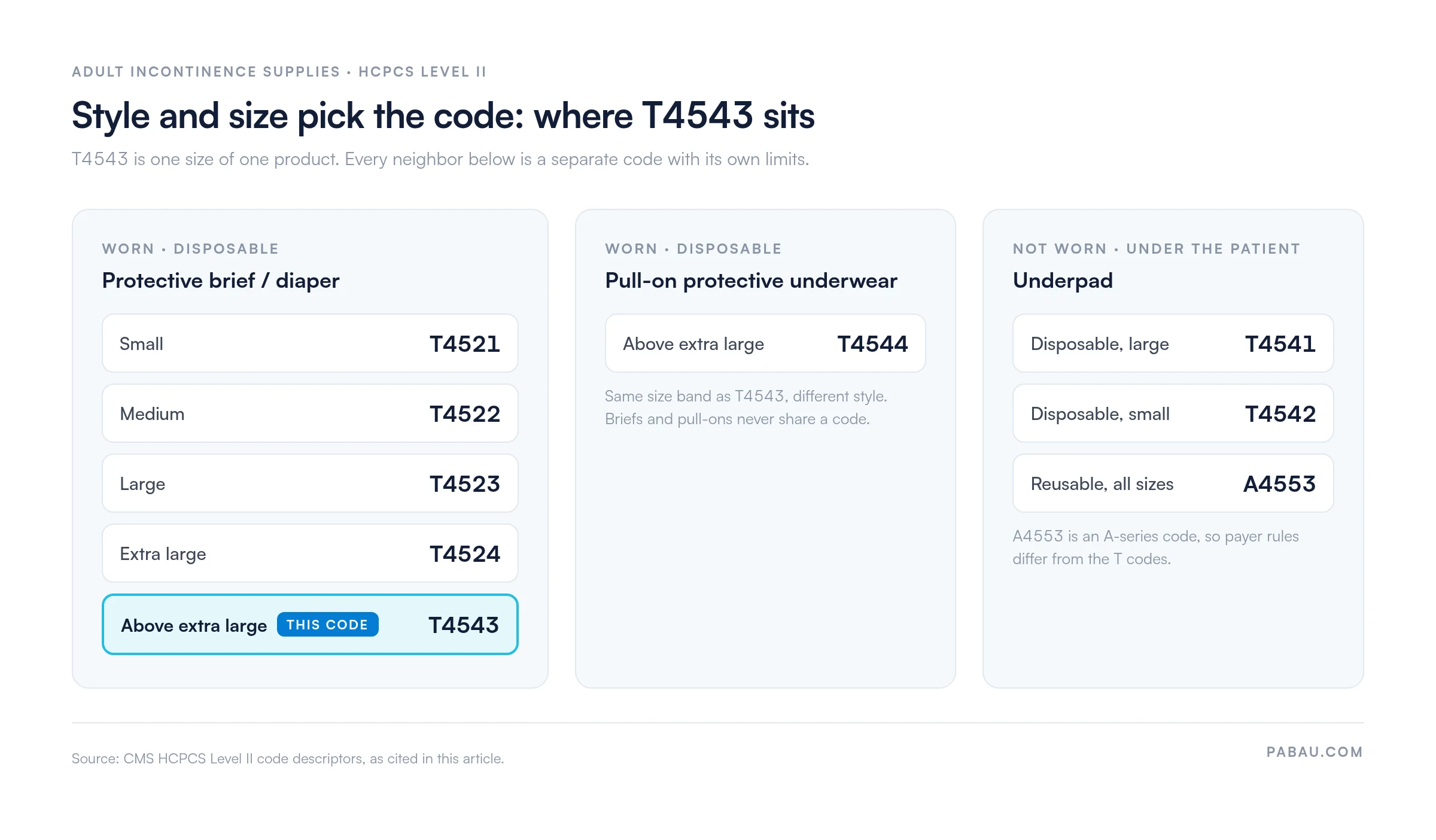
Style and size decide the code. Pull-on protective underwear in the same size bills under T4544, and an extra-large brief bills under T4524. Confirm which product your state program maps to T4543 before you dispense.
Billing HCPCS Code T4543 for excluded products is one of the fastest ways to generate a denial. The following product types and scenarios fall outside its scope.
The T45xx series covers multiple distinct incontinence product types. Selecting the wrong code is a common audit trigger because the products look similar but the billing rules differ. Use this comparison to confirm you have the right code before submitting.
The distinction payers check most often is T4543 versus T4541. T4543 is a worn brief, while T4541 is an underpad placed on a bed or chair. Payers flag claims where both codes appear on the same date of service without separate justification for each product in the physician order.
Among worn products, style and then size pick the code. The map below traces each neighboring product to its own code.
Medicare Part B does not cover routine incontinence supplies billed under T-codes, including HCPCS Code T4543. Medicare classes incontinence briefs, underpads and similar disposables as personal hygiene items, not durable medical equipment. The exclusion applies whatever the patient’s underlying diagnosis.
No Local Coverage Determination (LCD) opens Medicare Part B coverage for T4543, so verify the patient’s payer mix before submitting. A patient with Medicare as primary and Medicaid as secondary can still have the product covered by Medicaid.
Check whether the state program wants a Medicare denial on file for dual-eligible patients or accepts the claim directly. Billing Medicare for T4543 without that reason wastes an authorization cycle. Doing it knowingly also creates false claim risk.
Run a payer mix check before dispensing. If the patient has both Medicare and Medicaid, record the Medicaid plan name and policy number in the order file. Then bill Medicaid for T4543, following the state’s rule on whether a Medicare denial must be on file.
Medicaid is the primary payer for HCPCS Code T4543 claims across the United States. It is a state-federal partnership, so coverage rules, quantity limits, prior authorization thresholds and fee schedule rates differ by state.
A billing rule that applies in Texas may not apply in Ohio. Pull the current coverage bulletin or provider manual for the patient’s state Medicaid plan before billing.
Key variables to verify per state program include the following:
Most state Medicaid programs and MCOs require prior authorization (PA) before dispensing products billed under HCPCS Code T4543.
A claim without a current, approved PA number attached is the most common reason T4543 claims are denied. Understanding insurance eligibility verification and PA status before each dispensing cycle prevents the bulk of these denials.
Follow these steps to obtain authorization before dispensing:
A complete documentation package for HCPCS Code T4543 must be on file before the claim is submitted. Payers audit incontinence supply claims regularly, and a missing document can trigger recoupment of money already paid. Medical billing compliance for DMEPOS claims depends on maintaining this file consistently for every dispensing cycle.
The ICD-10-CM diagnosis code attached to a T4543 claim must support the medical necessity of the incontinence product. The codes below are commonly paired with T4543, and each one has a full entry in our ICD-10-CM codes library. Check the payer’s coverage policy for its approved diagnosis list before billing.
HCPCS Code T4543 is billed per unit, where one unit equals one disposable incontinence product. The payer’s monthly quantity limit caps how many units you can bill in a calendar month without extra medical necessity documentation. Billing over the standard limit without an approved quantity override triggers an automatic denial.
Typical Medicaid quantity allowances by incontinence severity level are outlined below. These are general industry ranges; verify the applicable state program’s current fee schedule before billing.
When a patient’s clinical need exceeds the standard limit, submit a quantity override request with the PA. Include a voiding diary, nursing assessment, or specialist note that quantifies the daily product usage. Payers rarely approve override quantities without specific clinical evidence in the record.
Denials for HCPCS Code T4543 follow a predictable pattern, and the same six reasons recur across billing cycles. A pre-submission checklist that covers each one prevents more denials than rebilling after the fact. Good denial management starts before the claim is submitted.
A denied HCPCS Code T4543 claim can be appealed if the denial rests on missing documentation or a correctable error. Most Medicaid programs allow an initial appeal within 30 to 90 days of the denial date. The payer’s explanation of benefits (EOB) states the exact deadline.
Audit your T4543 claim file quarterly. Pull every denied claim from the past 90 days and group them by denial reason code. If more than 20% share one root cause, fix the step in your process that produces it.
Incontinence supply billing runs on its own clock. Authorizations expire on their own dates, quantity limits reset monthly, and each payer and state sets its own documentation rules. Pabau’s claims management software keeps those claims in one dashboard, from Pending to Paid.
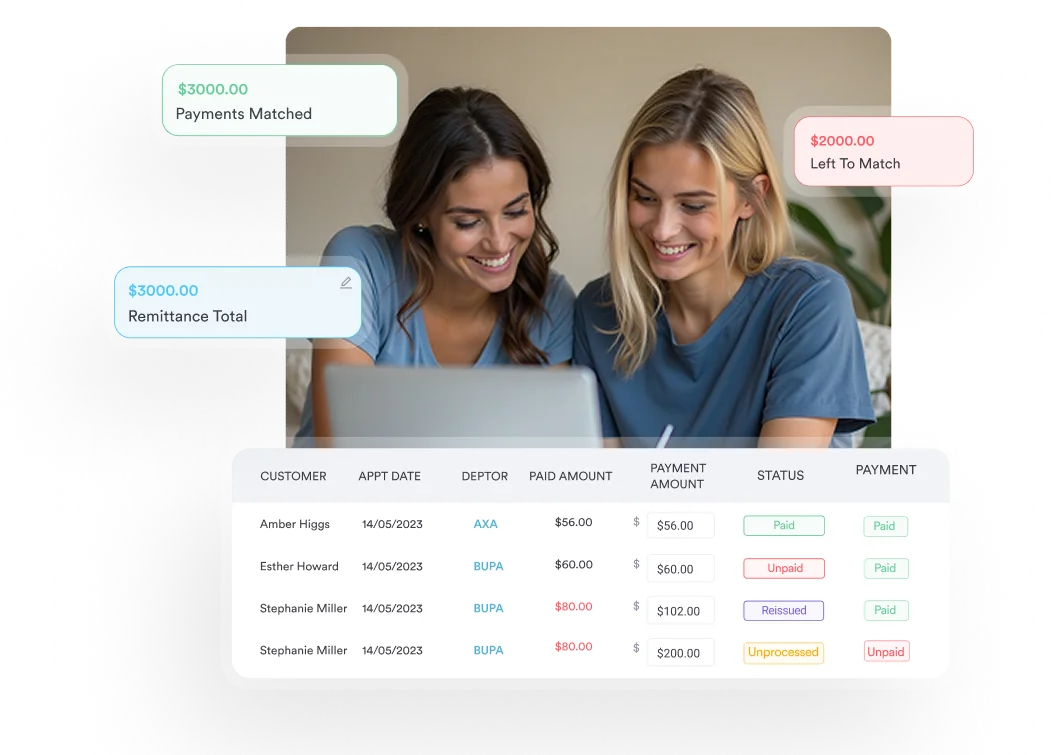
For T4543 and other T-code supply claims, Pabau takes on these steps:
The outcome is one place to see every incontinence supply claim’s status, even with several patients on overlapping authorization renewals. Your team stops reconciling spreadsheets and spends that time on the denials that need a person.

Store each prior authorization as a case and validate HCPCS claims before they reach the clearinghouse. Rejected claims show exactly which field to fix.

Treat every T4543 claim as a Medicaid claim from the first day. Before you dispense, confirm three facts: the brief is above extra large, the authorization is active, and the diagnosis supports the quantity.
Those checks take minutes per dispensing cycle, while an appeal can hold up payment for weeks. The size check matters most, because it is the one error a perfect authorization file cannot rescue.
Book a demo to see how Pabau tracks authorizations and validates incontinence supply claims before they reach the payer.

Is the patient one size down? HCPCS Code T4524 covers the extra-large adult brief and its billing rules.
Adding underpads to the order? HCPCS Code T4541 walks through large disposable underpad claims.
Billing a payer that uses A-series codes? HCPCS Code A4520 covers the incontinence garment code some payers use instead.
Want a clean claim checklist for supply submissions? Clean claim standards breaks down the elements every HCPCS claim needs before transmission.
HCPCS Code T4543 is the billing code for adult disposable protective briefs or diapers in the above-extra-large size. An enrolled DMEPOS supplier dispenses them to eligible patients under a physician order. Smaller briefs, pull-ons, underpads and reusable products use separate codes.
No. Medicare Part B does not cover routine incontinence supplies billed under HCPCS Code T4543 or any other T-series code. Medicare classes incontinence briefs as personal hygiene items outside the DMEPOS benefit. Medicaid is the primary coverage source for these products.
T4543 covers a worn disposable brief in the above-extra-large size, while T4541 covers a large disposable underpad placed under the patient. They are different product types with separate quantity limits and documentation requirements. Billing the underpad code when a brief was dispensed results in a denial and can trigger an audit.
A T4543 claim requires a signed physician order and an active prior authorization with its PA number documented. It also needs a supporting ICD-10-CM diagnosis code, proof of delivery and, where the payer requires one, a certificate of medical necessity. Missing any single element is sufficient grounds for denial or post-payment recoupment.
Monthly quantity limits for HCPCS Code T4543 vary by state Medicaid program and typically range from 60 to 200 units, depending on documented incontinence severity. Light incontinence generally allows 60 to 90 units. Heavy or overnight cases may qualify for 150 to 200 units with an approved quantity override and supporting clinical evidence.
Common companion codes include T4544 (above-extra-large pull-on underwear), T4524 (extra-large brief) and T4521 (small brief). Underpads use T4541 (large) or T4542 (small), and reusable underpads use A4553. Each has its own quantity limit and prior authorization path.