CPT code 63081: Vertebral corpectomy, cervical spine
CPT code 63081: official descriptor and procedure overview CPT code 63081 descri...

Last Updated: Oct 6, 2026
T4541 is the HCPCS Level II code for incontinence product, disposable underpad, large, each. It bills one large, single-use pad laid on a bed or chair under the patient, not a garment the patient wears.
Medicare does not pay T4541. CMS lists it as not payable, and its coverage rules treat incontinence pads as a hygienic supply. State Medicaid programs and Medicaid managed care plans pay it at their own rates, often only alongside worn incontinence products.
Let Pabau's smart automation suggest the right codes, reduce claim denials, and keep your practice compliant—effortlessly.
Automate repetitive tasks and focus on what matters most—your patients.
Reduce coding errors and ensure compliance with the latest regulations.
Clean claims, fewer denials, and faster reimbursements.
Powerful insights and reporting to help your practice thrive.
HIPAA compliant SOC 2 certified GDPR-compliant Trusted by 4,000+ clinics worldwide

HCPCS Code T4541 bills one large, single-use underpad placed on a bed or chair, not a garment the patient wears.
CMS lists T4541 as not payable by Medicare, and NCD 280.1 denies incontinent pads as a nonreusable hygienic supply.
State Medicaid programs and Medicaid managed care plans pay T4541 at their own rates, with their own monthly unit caps.
Some Medicaid plans pay underpads only when the patient also receives worn products such as briefs or pull-ons.
Claims hold up best with two diagnosis codes, one for the incontinence and one for the condition that causes it.
HCPCS Code T4541 is the Level II code for a large disposable incontinence underpad, billed per pad. The pad is a flat absorbent sheet laid on a bed, chair, or wheelchair seat under the patient. It protects the skin and the surface beneath from leakage, and it is thrown away after one use.
The code is easy to confuse with worn products, because the same T-code family also bills briefs and pull-on underwear. T4541 never describes a garment. If the patient wears the product, the claim needs a brief or pull-on code instead, or T4535 for a liner.
Medicare does not pay T4541. Most claims go to state Medicaid programs or Medicaid managed care plans, which set their own rates, unit caps, and documentation rules. Payers compare the claim with the supplier’s invoice, so the product shipped decides the code.
The table below lists the reference data for T4541 as published in the CMS HCPCS Level II file for October 2026. Our HCPCS billing guides cover many of the neighboring incontinence codes compared in the next section.
Three choices decide the code for an incontinence product. Is it worn or laid flat? Is it disposable or washable? And for underpads, is it the large or the small size billed under T4542? The decision tree below runs through all three in order. The table after it then compares T4541 with the codes it is most often swapped for.
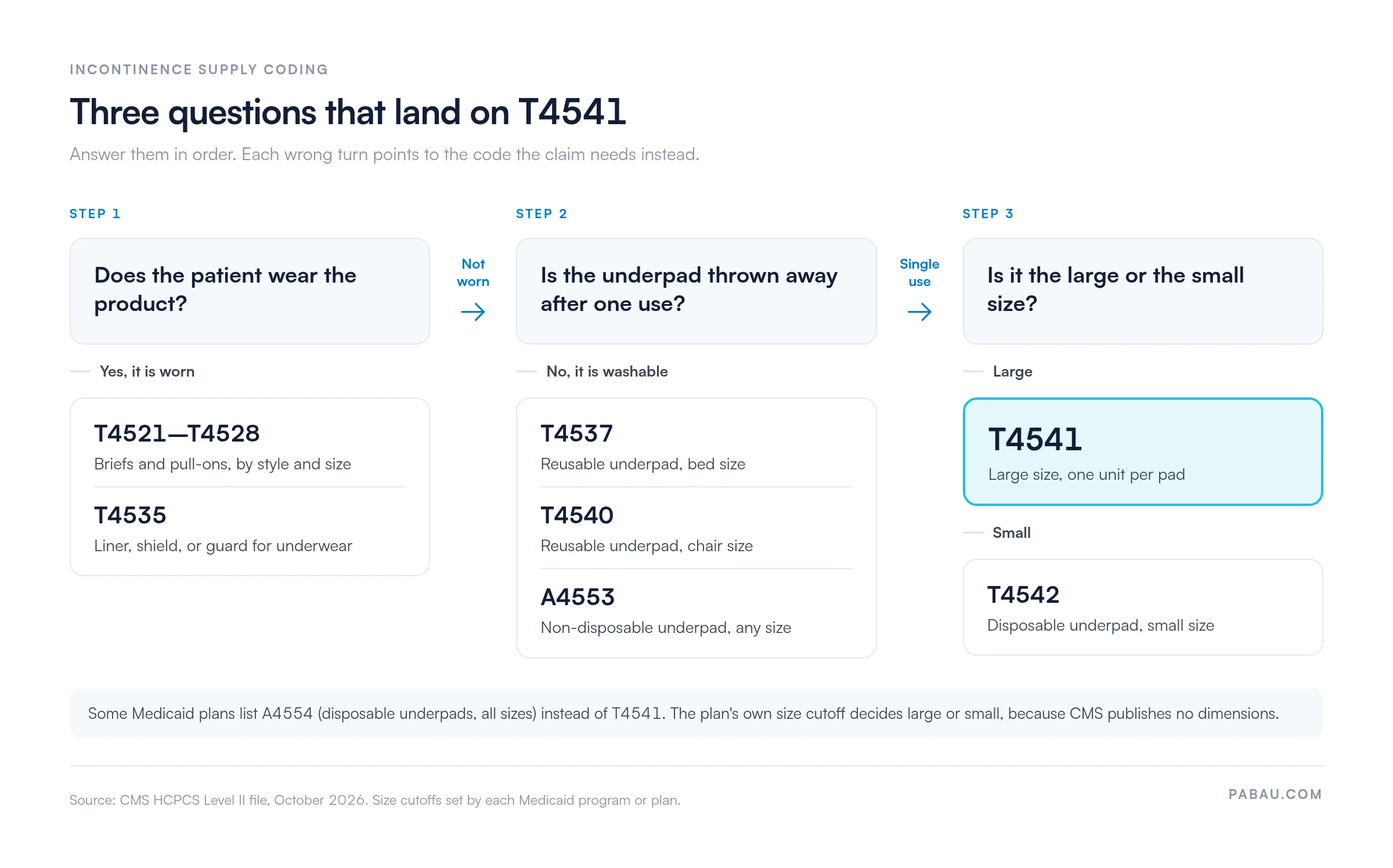
CMS does not publish dimensions for large or small underpads. Each Medicaid program or plan sets the cutoff in its product list or provider manual. Check that the pad size on the invoice matches the size your payer assigns to T4541 before you bill it.
Traditional Medicare does not pay for T4541 under any circumstances. The CMS HCPCS file gives the code coverage code I, which means it is not payable by Medicare. Extra documentation cannot change that outcome.
The coverage rule behind it is NCD 280.1, the durable medical equipment reference list. It denies incontinent pads as a nonreusable supply and a hygienic item under section 1861(n) of the Social Security Act. Underpads therefore fail the definition of durable medical equipment, whichever code is used.
Some Medicare Advantage plans offer incontinence supplies as a supplemental benefit. Those plans set their own codes, vendors, and limits. Confirm the plan’s benefit and preferred code before you ship, rather than assuming T4541 will be accepted.
State Medicaid programs are the main payers for T4541, and each one writes its own rules. Medicaid managed care plans can layer stricter limits on top of the state program. Treat every state and every plan as a separate payer.
One rule trips up many suppliers. UnitedHealthcare Community Plan’s incontinence supplies policy 2026R7111B puts T4541 in its Group 2 with T4542, A4553, and A4554. It pays Group 2 underpads only when the member also receives Group 1 worn products such as briefs, pull-ons, or liners.
The policy’s reasoning is that underpads support the member’s hygiene alongside worn products, rather than protecting furniture or bedding. A patient who receives underpads alone will see those claims deny under this policy, unless the state is exempt from that rule.
The same policy shows how far monthly caps vary. Its default is 300 Group 2 units per member per month, but several states set their own figures.
These figures belong to one managed care policy, published May 29, 2026. Your state’s fee-for-service program or another plan may set different limits. Check the current policy for the patient’s plan before each new order.
There is no national payment rate for T4541. Medicare’s pricing indicator of 00 means Part B sets no fee for it. The code carries no payment amount on the Medicare DMEPOS fee schedule.
Each state Medicaid agency publishes its own rate in its fee schedule, and managed care plans pay under their contracts with suppliers. Rates are set per pad and change on each state’s own update cycle.
Pull the rate from the state Medicaid fee schedule or the plan’s provider manual for the date of service. Third-party price lists lag behind state updates, so they work as a cross-check only.
Payers want the claim to show both the incontinence and the reason for it. UnitedHealthcare Community Plan denies incontinence supply claims when the only diagnoses come from its incontinence list. A second code must name the condition causing the incontinence, such as dementia, multiple sclerosis, or a spinal cord injury.
The incontinence codes below all appear on that policy’s accepted list. Pair one with the cause documented in the patient’s record.
Some states narrow the list further. Under the same policy, Kansas requires one of seven specific codes for members aged 21 and older. Massachusetts accepts a single diagnosis code. Read the state section of the plan’s policy before you finalize the claim.
Most Medicaid programs require a signed order and proof of need before they pay for incontinence supplies. Many also require prior authorization above a set quantity. Keep these items on file for every T4541 order, and review them against your medical billing compliance process.
The refill contact matters more than it looks. The UnitedHealthcare policy bans automatic shipments and stockpiling. It also limits each order to 30 days of supplies, and delivery should not happen before the member is down to 15 days of stock.
Work through these steps in order for each delivery. They fit inside the wider medical billing process that runs from eligibility to payment.
Most T4541 denials come from payer setup rather than clinical need. The table maps each common cause to its fix. Track these causes over time as part of your denial management work.
Underpad claims fail when the order, the diagnosis, and the delivery receipt sit in different places. A biller then submits before the record is complete, and the denial arrives weeks later.
Pabau, the practice management platform we build, keeps the signed order, clinical notes, consent forms, and delivery records on one patient record. Its claims management software pulls the data already on that record into a pre-filled claim. It then submits and tracks the claim through Claim.MD, so your team sees each status without logging into a separate portal.
Remittances post back against the original claim, so a T4541 denial shows its reason code next to the record that caused it. Your team fixes the record once, and the next month’s claim goes out complete.

Pabau keeps orders, notes, and delivery records on one patient record, then submits and tracks claims through Claim.MD. Your team spends less time reworking T4541 denials.

T4541 is a narrow code, and most of its denials come from treating it like a broader one. It bills a large disposable pad that lies under the patient, and only Medicaid-side payers pay for it.
Before the first shipment, settle three questions for each patient’s plan. Does it use T4541 or A4554? Does it pay underpads without worn products? And what is its monthly cap? Answer those once, and the monthly claims become routine.
Book a demo to see how Pabau keeps the order, diagnosis, and delivery record attached to every T4541 claim.

Billing the small underpad as well? HCPCS Code T4542 covers the small-size disposable underpad and how payers separate the two sizes.
Need a framework for tracking claim denials by root cause? Denial management in healthcare covers how to categorize, track, and reduce denials across your billing operation.
Want to understand how clean claims are built? What is medical billing explains the revenue cycle from eligibility checks through payment posting.
Looking for documentation standards for supply billing? Medical billing compliance outlines the record-keeping that keeps suppliers audit-ready.
HCPCS Code T4541 is the Level II code for a large disposable incontinence underpad, billed per pad. The pad lies flat on a bed or chair under the patient and is thrown away after one use.
No. CMS lists T4541 as not payable by Medicare, and NCD 280.1 denies incontinent pads as a nonreusable hygienic supply. Some Medicare Advantage plans cover incontinence supplies as a supplemental benefit, under their own codes and limits.
Both codes bill a disposable underpad. T4541 is the large size and T4542 is the small size. CMS sets no dimensions, so each Medicaid program or plan defines the size cutoff in its product list.
A4554 bills disposable underpads of any size under one code, while T4541 is limited to the large size. Some Medicaid plans list A4554 instead of T4541, so check the plan’s code list first.
It depends on the plan. UnitedHealthcare Community Plan pays underpads only when the member also receives worn products, though several states are exempt. Check the plan’s policy before shipping underpads on their own.
Use an incontinence code such as N39.41, N39.46, R39.81, or R15.9, plus a code for the condition causing the incontinence. Some plans deny claims that carry the incontinence code alone.