CPT code 36468: Injection sclerotherapy of telangiectasia billing guide
CPT code 36468: Official descriptor and code family CPT code 36468 is defined by...

Last Updated: Nov 13, 2026
J7631 is the HCPCS Level II code for cromolyn sodium, inhalation solution, FDA-approved final product, non-compounded, administered through DME, unit dose form, per 10 milligrams.
One unit equals 10 mg, so a standard 20 mg/2 mL ampule bills as two units. Its look-alike is J7632, the compounded version, which the Medicare nebulizer LCD denies as not reasonable and necessary.
Let Pabau's smart automation suggest the right codes, reduce claim denials, and keep your practice compliant—effortlessly.
Automate repetitive tasks and focus on what matters most—your patients.
Reduce coding errors and ensure compliance with the latest regulations.
Clean claims, fewer denials, and faster reimbursements.
Powerful insights and reporting to help your practice thrive.
HIPAA compliant SOC 2 certified GDPR-compliant Trusted by 4,000+ clinics worldwide

HCPCS code J7631 bills FDA-approved, non-compounded cromolyn sodium inhalation solution given through a DME nebulizer, in unit dose form.
One unit equals 10 mg, so a standard 20 mg/2 mL ampule is two units.
The compounded version is J7632, and the Medicare nebulizer LCD denies it as not reasonable and necessary.
Medicare covers cromolyn under LCD L33370 for obstructive pulmonary disease, using the Group 8 diagnosis codes in policy article A52466.
Albuterol is not J7631, so bill albuterol unit dose solution with J7613 instead.
HCPCS code J7631 is the Level II code for FDA-approved, non-compounded cromolyn sodium inhalation solution, given through DME in unit dose form, per 10 mg.
In plain terms, it’s the cromolyn ampule a patient puts in a home nebulizer. Medicare’s nebulizer LCD L33370 lists cromolyn (J7631) among the inhalation drugs it can cover for obstructive pulmonary disease.
The code catches people out for one reason. Its neighbors in the J7600 range look almost identical, and it is easy to mix up with the albuterol codes. Albuterol unit dose solution has its own code, and cromolyn has this one.
The current non-compounded wording dates from 1 January 2008, when CMS split cromolyn into J7631 and the compounded J7632. The code itself is older, so you may see an earlier date in some lookup tools.
Unit math is where most J7631 lines go wrong, so work it out first. Divide the total milligrams dispensed by 10. A cromolyn ampule holds 20 mg in 2 mL, so each one counts as two units.
Here’s a worked example for a 30-day supply at four 20 mg treatments a day:
L33370 sets a maximum for cromolyn of 2,480 mg a month, which is 248 units. That’s the same regimen over a 31-day month. Claims above that are denied as not reasonable and necessary. Check the exact wording in the current LCD.
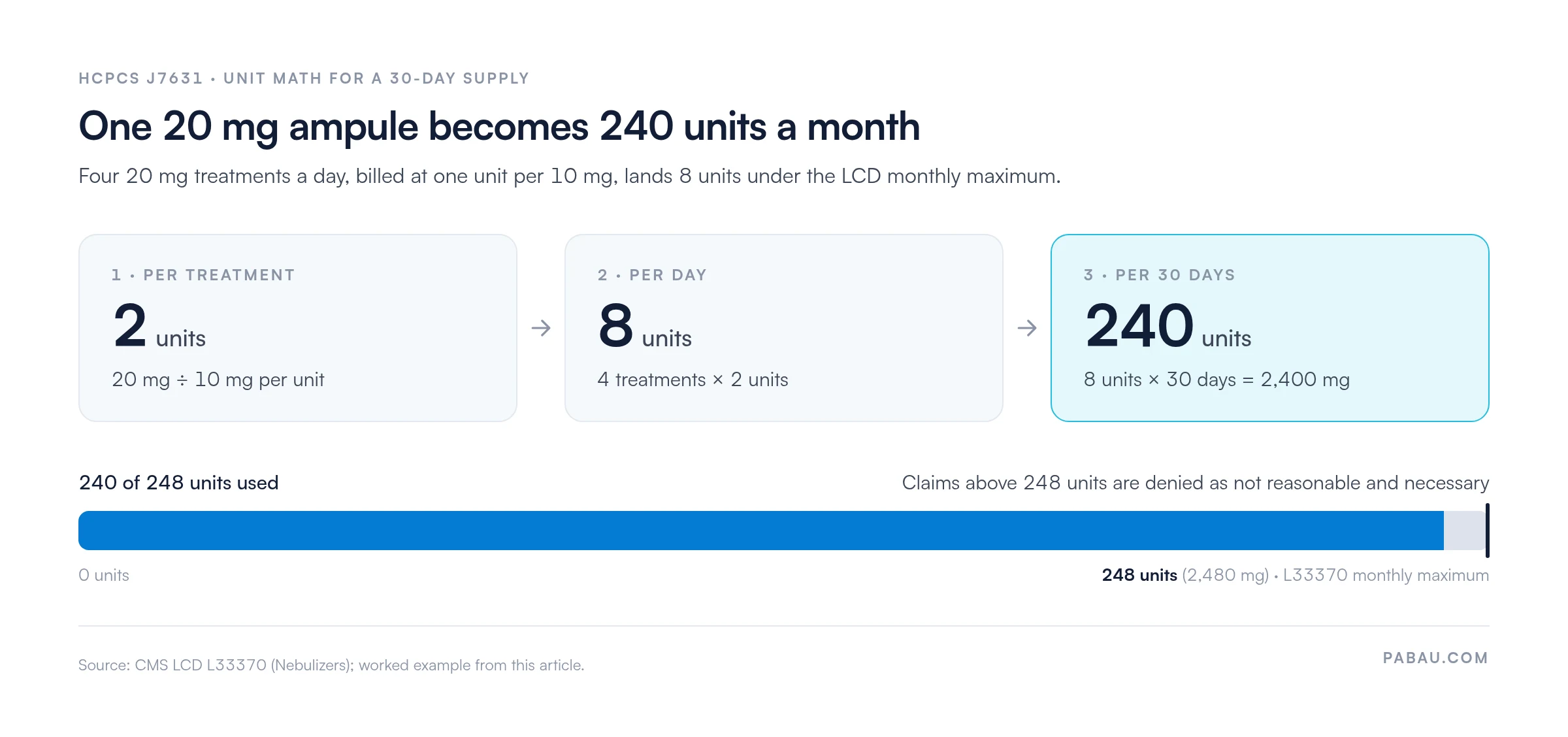
The most common slip is billing the ampule count as the unit count. Sixty ampules is 120 units, not 60.
Once the units are right, check the code itself. These are the codes most often confused with J7631, and each one bills something different.
If the dispensing record says albuterol, stop and recode. A cromolyn code on an albuterol claim fails on both the drug and the unit, because albuterol bills per 1 mg.
Medicare doesn’t cover cromolyn on its own terms. It covers it as a nebulizer drug, so the claim stands or falls on the nebulizer policy. L33370 says cromolyn (J7631) is reasonable and necessary for managing obstructive pulmonary disease. The matching diagnoses are the Group 8 codes in policy article A52466.
Group 8 includes J41–J47 (asthma, COPD, chronic bronchitis, emphysema), J60–J70.9 and two COVID-19 codes. Common examples are J45.909 for unspecified asthma and J44.9 for COPD. Check the exact code on the list.
The drug and the equipment are tied together, too. The LCD says that if none of the nebulizer drugs are covered, the nebulizer compressor and its accessories are denied as well. A J7631 denial can therefore pull an E0570 nebulizer claim down with it.
Commercial and Medicaid plans write their own policies. Many follow the Medicare logic, but confirm prior authorization and quantity rules with each payer.
For a home nebulizer patient, the DME supplier bills the DME MAC, not the prescriber’s practice. Here’s the path a clean claim takes.
Medicare pays one dispensing fee per covered drug period. That’s G0333 for the initial fee, Q0513 for 30 days or Q0514 for 90 days. Q0513 and Q0514 can’t go on the same date of service.
Billers ask the same few modifier questions about this code. Here are the short answers from policy article A52466.
Your DME MAC’s own pages carry the details for your jurisdiction, so follow them where they add to the policy article.
When a denial does land, read the remittance codes first. Our guide to denial codes in medical billing explains what each one means.
When nebulizer orders live in a chart, a spreadsheet and a payer portal, details drift between them. A 20 mg dose becomes 20 units on the claim, and nobody notices until the denial arrives.
Pabau’s practice software keeps the clinical record and the billing in one system. Pabau supports insurance billing through claims management, and US claims run through Claim.MD. The order, the diagnosis and the claim sit on the same patient record, so your team checks them in one place.
The coding judgment stays with your billers. Pabau gives them the record to check it against, which makes the pre-submission checklist faster to run.

Pabau keeps the patient record, the diagnosis and the insurance claim in one system, with US claims sent through Claim.MD. Your billers check each line against the chart before it goes out.

Treat J7631 as a cromolyn code first and a units problem second. Confirm the drug is FDA-approved cromolyn, then divide the milligrams by 10, and most of the risk is gone.
The rest is policy hygiene. Match the diagnosis to Group 8, use KO and KX as A52466 describes, and recheck L33370 whenever it’s revised. Book a demo to see how Pabau keeps the record and the claim side by side for your billing team.

Billing the nebulizer itself? HCPCS code E0570 covers the compressor nebulizer that J7631 depends on.
Was the drug albuterol, not cromolyn? HCPCS code J7613 is the albuterol unit dose code, billed per 1 mg.
Billing a second nebulizer drug? HCPCS code J7644 explains ipratropium bromide unit dose billing.
No specific code for the inhalation drug? HCPCS code J7699 covers the not-otherwise-classified inhalation drug code.
Working a denied claim? Denial codes in medical billing decodes the remittance codes behind a rejection.
No. Cromolyn is a preventive controller for asthma. It’s labeled as a prophylactic agent and has no role in treating an acute attack, so patients still need a separate rescue inhaler.
No. J7631 describes an inhalation solution given through a DME nebulizer only. Nasal sprays and oral cromolyn are different products and don’t bill on this code.
When it’s given through a home nebulizer, the DME MAC processes it as a Part B claim. Inhalation drugs not given through DME aren’t billed to the DME MAC. Policy article A52466 notes they may fall under Part D instead.
Not automatically. LCDs bind Medicare contractors only. Commercial and Medicaid plans set their own rules, so check each payer’s drug policy and prior authorization list.
No. The descriptor requires administration through DME, which means a nebulizer. A metered-dose inhaler isn’t DME, so it doesn’t bill on J7631.