CPT code 63081: Vertebral corpectomy, cervical spine
CPT code 63081: official descriptor and procedure overview CPT code 63081 descri...

Last Updated: Oct 6, 2026
T4545 is the HCPCS Level II code for incontinence product, disposable, penile wrap, each. One wrap equals one billable unit, and the code is billed mainly to state Medicaid programs and commercial payers.
T4545 closes the T4521–T4545 incontinence supply range. Its neighbors T4543 and T4544 are above-extra-large briefs and pull-ons for any adult, while T4545 is built for male anatomy. A claim needs a physician order, an incontinence diagnosis, and documentation naming the disposable penile wrap.
Let Pabau's smart automation suggest the right codes, reduce claim denials, and keep your practice compliant—effortlessly.
Automate repetitive tasks and focus on what matters most—your patients.
Reduce coding errors and ensure compliance with the latest regulations.
Clean claims, fewer denials, and faster reimbursements.
Powerful insights and reporting to help your practice thrive.
HIPAA compliant SOC 2 certified GDPR-compliant Trusted by 4,000+ clinics worldwide

T4545 covers a disposable incontinence penile wrap, billed per unit, with one wrap equal to one unit.
Traditional Medicare doesn’t cover routine incontinence supplies, so T4545 is billed mainly to state Medicaid programs and commercial payers.
T4543 and T4544 are above-extra-large sizing codes for adult briefs and pull-ons, so they’re neighbors in the range, not alternative penile products.
A clean T4545 claim needs a physician order, an incontinence diagnosis, medical necessity notes, and a quantity within the payer’s limit.
Pabau, the practice management platform we build, runs validation checks on every claim before it’s sent to the payer.
HCPCS code T4545 is the Level II HCPCS code for “incontinence product, disposable, penile wrap, each.” It belongs to the T-code series, which the Centers for Medicare and Medicaid Services (CMS) maintains. T-codes serve state Medicaid programs and other payers outside the standard Medicare DME benefit.
T4545 is the terminal code in the T4521-T4545 incontinence supply range, and its neighbors are listed in our HCPCS procedure codes index.
The “each” unit descriptor means one penile wrap equals one billable unit. Quantity limits vary by payer and state Medicaid program, but most follow CMS guidelines capping monthly incontinence supply quantities based on documented clinical need.
T4545 covers only one product type: a disposable penile wrap used for male urinary incontinence. Reusable products, female incontinence products, and alternative male incontinence formats all fall under different codes.
Covered under T4545:
Not covered under T4545:
Medical necessity documentation must confirm the patient has urinary incontinence and that the penile wrap format is the appropriate product. Billing T4545 for a patient who received an above-extra-large brief (T4543) is a coding error that will trigger a denial or audit.
The T4521-T4545 range covers the HCPCS incontinence supply codes, and selecting the wrong code within it is a frequent billing error for incontinence suppliers. The table below shows the two codes that sit directly before T4545 and are most likely to be confused with it.
T4543 is an above-extra-large disposable brief or diaper, and T4544 is an above-extra-large disposable protective underwear or pull-on. Both are sizing codes for any adult, not shape or gender codes. T4545 is the only code in this set built for male anatomy, as a sleeve-style wrap applied directly to the penis.
Supplying one product and billing another is upcoding or downcoding, and both carry audit risk under NCCI edits.
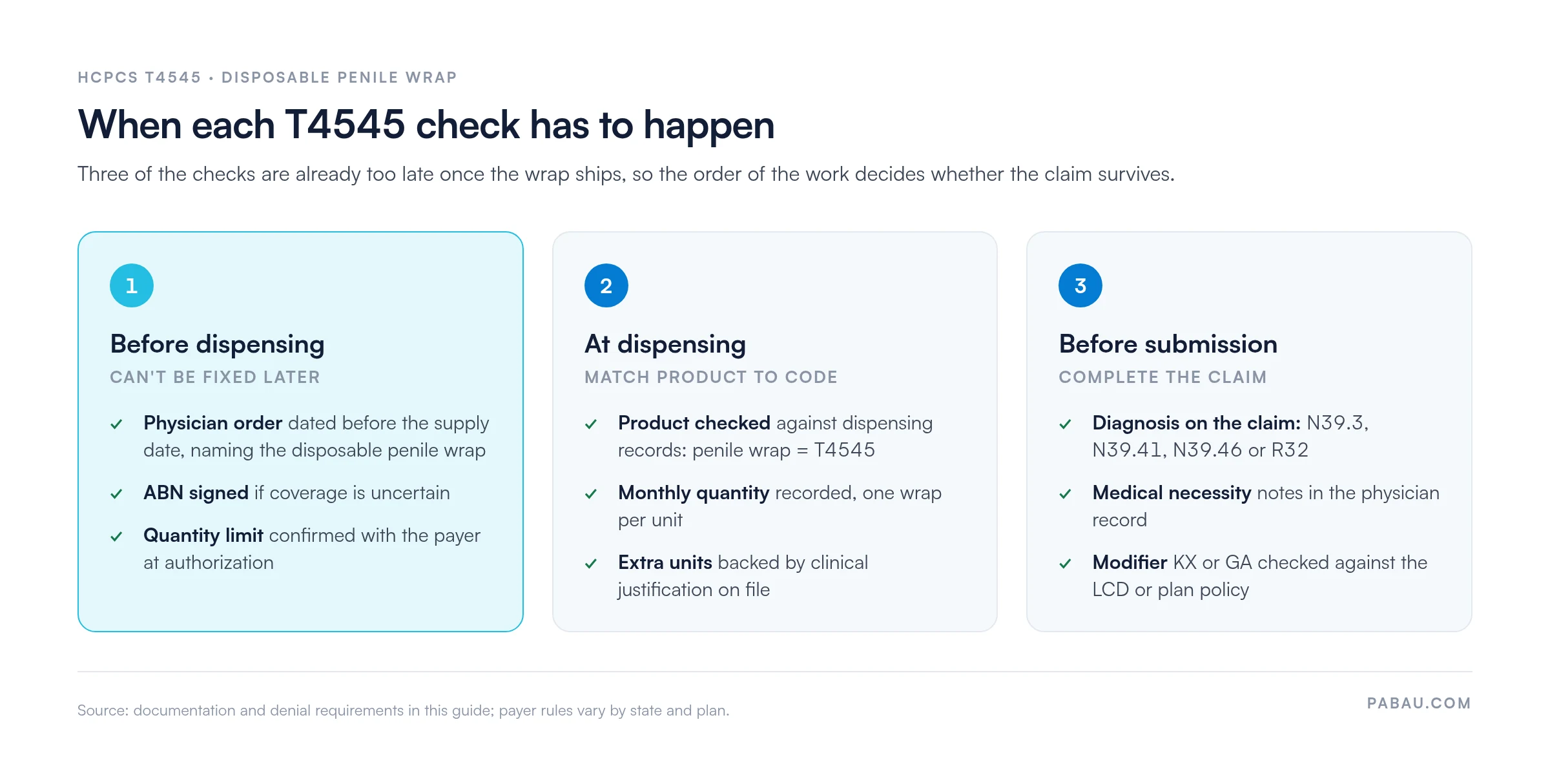
Clean medical billing documentation for T4545 rests on four requirements, plus an ABN wherever coverage is uncertain. Missing any one of them is sufficient grounds for denial.
When the physician’s notes confirm incontinence but don’t name the type, R32 is the diagnosis to report. A specific code such as N39.41 gives the claim stronger support whenever the record allows it.
Timing matters as much as the paperwork, because three of these checks can’t be fixed once the wrap has shipped.
Billing compliance requirements for DMEPOS suppliers also include valid supplier accreditation and a current NSC number. A lapse in either one triggers automatic claim rejection at the MAC level.
Medicare does not cover routine incontinence supplies as standard DME under the traditional Medicare benefit. This is a common misconception that leads billers to submit T4545 claims to Medicare Part B and receive systematic denials. The T-code series itself signals Medicaid and state agency use, not Medicare DME benefit coverage.
Reimbursement for T4545 comes from these payer categories:
Fee schedule rates for T4545 change annually. They also vary by geographic region, Medicaid competitive bidding area, and individual state fee schedule.
Check current rates against the CMS DMEPOS fee schedule and the relevant state Medicaid portal. The Physician Fee Schedule look-up tool leaves out MAC-priced supply codes such as T4545, so it returns no rate. Do this before you set billing expectations with suppliers or patients.
Before billing T4545 to any payer, run an eligibility check that specifically identifies incontinence supply benefits. Many commercial plans and Medicare Advantage plans list incontinence supplies under a supplemental benefit section, not under standard DME. A general eligibility confirmation that shows ‘DME covered’ does not guarantee T4545 will pay.
Most T4545 denials fall into six patterns. Knowing each one in advance lets billers catch the issue before submission rather than after a denial notice arrives. Sound denial management workflows cut rework time on DMEPOS claims.
Submitting a clean claim for T4545 means verifying all six conditions above before the claim leaves the billing queue. A review cycle that catches even one of these per claim batch still cuts denial volume over time.
Run a monthly T4545 claim denial report filtered by denial reason code. If CO-4 (incorrect code) or CO-50 (not medically necessary) appear repeatedly, trace them back to your documentation or dispensing workflow. Fixing that source process stops the same error reaching the next batch of claims.
Modifier selection for T4545 depends on the payer, the LCD criteria status, and whether an ABN is in place. Using the wrong modifier, or omitting one entirely, can cause a denial just as easily as a wrong code. The table below lists the modifiers most relevant to T4545 DMEPOS claims.
Verify modifier requirements against the specific MAC LCD or Medicaid plan policy in the patient’s jurisdiction. Modifier rules are not universal across payers, and applying a modifier incorrectly can trigger a post-payment audit even when the underlying claim was correct.
DMEPOS billing for incontinence T-codes carries a heavy admin load. Product-to-code mapping, quantity tracking, modifier selection, LCD documentation, and ABN workflows all run in parallel for each patient’s supply cycle. Manual handoffs between those steps are where errors pile up.
Pabau’s claims management software runs validation checks every time you go to send a claim. A claim missing a membership number or an authorization code is stopped before it reaches the payer. For US practices, the Claim.MD integration adds real-time eligibility checks, so you can confirm coverage before the wrap ships.
Each claim then shows its status on one dashboard, from pending and submitted through processing, paid, or error. ERA remittances post against the claim, so your revenue cycle management no longer depends on a monthly spreadsheet review.

Pabau checks each claim for missing details before it’s sent, confirms eligibility in real time, and tracks every claim to payment. See how it fits your T-code billing.

T4545 billing turns on one question. Does the record prove a disposable penile wrap was ordered, dispensed, and medically needed? If it does, most of the denial patterns above never come into play.
So start with the dispensing workflow, not the claim form. Date the order before the supply, match the product to the code at the shelf, and confirm the payer’s quantity limit at authorization. That’s a little more work up front for far fewer appeals later.
Book a demo to see how Pabau checks each T4545 claim for missing details before it goes to the payer.

Billing the briefs at the other end of the range? HCPCS code T4521 covers the small adult disposable brief, the first code in the T4521-T4545 series.
Is the patient using a liner or guard instead of a wrap? HCPCS code T4535 explains how disposable liners, shields, guards and pads are billed.
Did the order call for an external catheter, not a wrap? HCPCS code A4349 walks through billing for disposable male external catheters.
Facing a Medicaid MCO that wants approval first? The prior authorization process sets out a step-by-step workflow for getting supply orders approved before you bill.
HCPCS code T4545 is the billing code for an incontinence product, disposable, penile wrap, each. It’s a single-use, sleeve-style male incontinence product billed per unit under Medicaid and commercial payer programs. It’s the terminal code in the T4521-T4545 HCPCS incontinence supply range.
No, traditional Medicare Part B does not cover routine incontinence supplies, including T4545, as a standard DME benefit. Some Medicare Advantage (Part C) plans include incontinence supplies as a supplemental benefit. Verify coverage with the individual plan before billing.
Fee schedule rates for T4545 vary by state Medicaid program and are updated annually. There is no single national Medicare fee schedule rate because Medicare does not cover this code as a standard benefit. Check the current rate in the applicable state Medicaid fee schedule. For CMS reference pricing on supply codes, use the CMS DMEPOS fee schedule page rather than the Physician Fee Schedule tool.
Prior authorization requirements for T4545 depend entirely on the payer and, for Medicaid, the state. Most fee-for-service Medicaid programs require a physician order and medical necessity documentation but not a formal prior authorization. Managed Medicaid MCOs and commercial plans often require explicit prior authorization before supply delivery. Verify with each payer before billing.
T4543 and T4544 are sizing codes for any adult, not male-specific products. T4543 covers an above-extra-large disposable brief or diaper, and T4544 an above-extra-large disposable protective underwear or pull-on. T4545 alone is male-specific, as a disposable penile wrap applied directly to the penis. All three are billed per unit, and billing the wrong code for the product dispensed is a coding error.
The most common denial reasons are a wrong code within the T4543-T4545 range and a missing or post-dated physician order. Quantities over payer limits without justification and missing medical necessity notes also trigger denials. So do a missing ABN when coverage was uncertain and a missing or incorrect KX or GA modifier. A pre-submission documentation checklist prevents most of them.