HCPCS Code T2042: Hospice routine home care billing guide
HCPCS Code T2042: Official descriptor and coverage definition HCPCS Code T2042 i...

Last Updated: Nov 2, 2026
T4532 is the HCPCS Level II code for pediatric sized disposable incontinence product, protective underwear/pull-on, large size, each. One pull-on dispensed is one billing unit.
State Medicaid programs are the payer, because Medicare Part B excludes incontinence supplies. The same pull-on in small or medium size is T4531, and a pediatric large tab-closure brief is T4530.
Let Pabau's smart automation suggest the right codes, reduce claim denials, and keep your practice compliant—effortlessly.
Automate repetitive tasks and focus on what matters most—your patients.
Reduce coding errors and ensure compliance with the latest regulations.
Clean claims, fewer denials, and faster reimbursements.
Powerful insights and reporting to help your practice thrive.
HIPAA compliant SOC 2 certified GDPR-compliant Trusted by 4,000+ clinics worldwide

HCPCS code T4532 covers one pediatric-sized disposable pull-on, sold as protective underwear, in large size, billed per unit.
It is the largest pediatric pull-on code. Above it sit T4534 for youth-sized pull-ons and T4525 to T4528 for adult pull-ons.
T4532 is a Medicaid code. Medicare Part B excludes incontinence supplies, so a Part B claim denies outright.
Each state sets its own age floor and monthly cap. Minnesota Medicaid does not cover pull-ons for children under 4.
Pabau’s claims management software keeps the order, authorization number and unit count on the patient record. Size and quantity errors then surface before submission.
HCPCS code T4532 is the Level II code for one pediatric-sized disposable pull-on, also called protective underwear, in large size. Each pull-on dispensed is one billing unit. CMS maintains the code in the T4521-T4545 incontinence supply range, while state Medicaid programs set coverage and rates.
Three descriptors have to match the product on the order. It must be pediatric sized, a pull-on rather than a tab-closure brief, and large. When one of them fails, the claim moves to a different code. Adding a modifier to T4532 does not fix the mismatch.
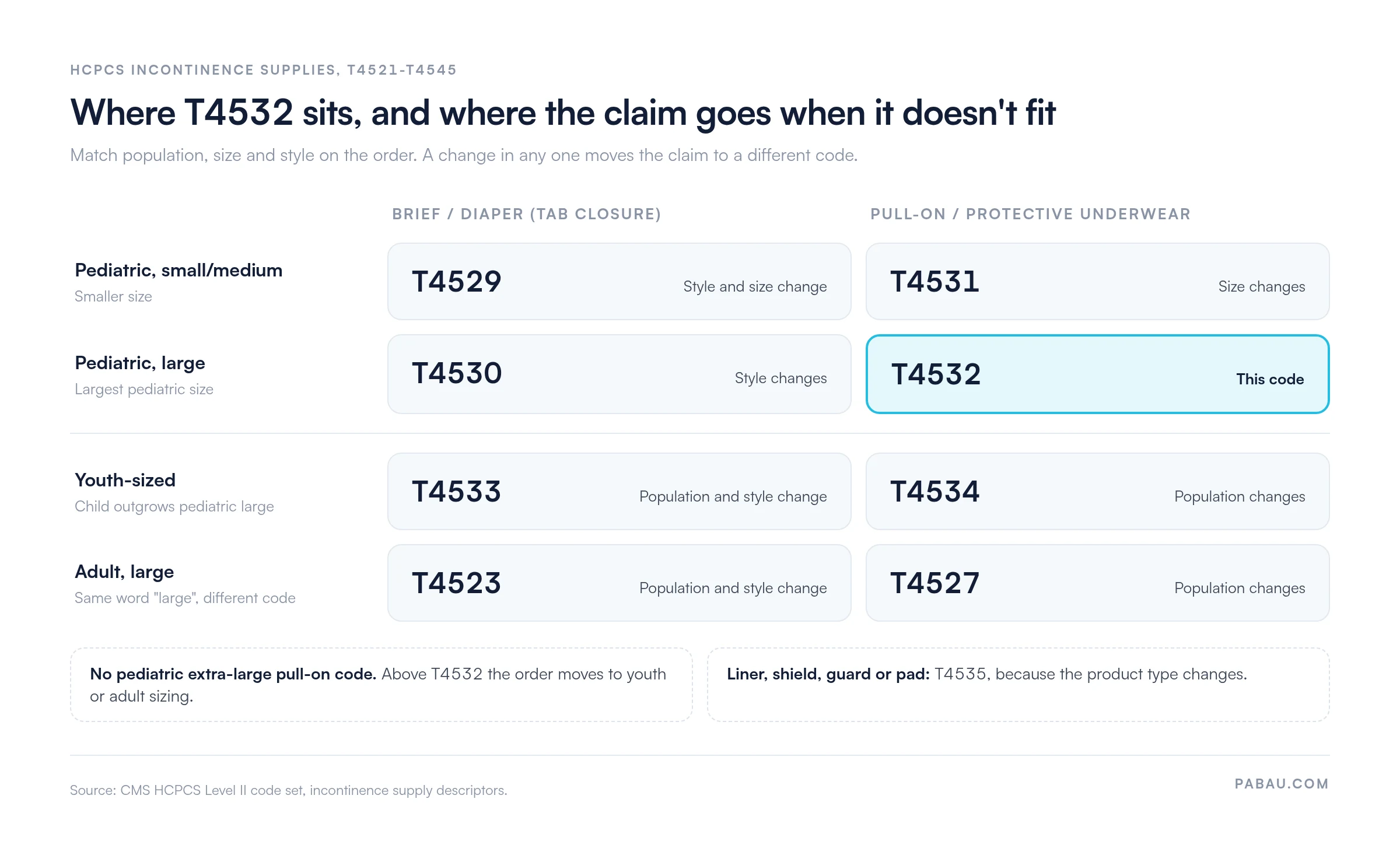
Most coding errors on this page start with the word “large.” T4532 is a pediatric large pull-on. An adult large brief is T4523, and an adult large pull-on is T4527.
Every neighboring code differs from T4532 on exactly one or two of its three descriptors. Match the dispensed product against this table before the order is signed.
T4532 is the top rung of the pediatric pull-on ladder. No pediatric extra-large pull-on code exists. When a child outgrows the large size, the order moves to T4534 for a youth-sized pull-on or to an adult pull-on code.
The size of the dispensed product decides the code, whatever the child’s age. The grid below maps each move away from T4532.
When a child’s order moves from T4532 to a youth or adult code, write a new order. Then check whether the authorization names the old code. An approval issued for T4532 may not cover T4534, and the first claim on the new code can deny.
Medicare Part B does not cover incontinence supplies, including pull-ons, diapers and underpads. Noridian Medicare’s correct coding guidance for diapers and underpads states the exclusion directly. A T4532 claim sent to Part B denies as a non-covered item, and extra documentation cannot change that outcome.
T-codes exist for state Medicaid programs, so Medicaid is the payer for T4532. For enrollees under 21, the Early and Periodic Screening, Diagnostic and Treatment (EPSDT) benefit requires states to cover medically necessary care. Pediatric incontinence supplies are usually reviewed against that standard.
Rates follow the same split. No national fee schedule rate exists for T4532, and each state publishes its own per-unit amount. Managed care plans pay their contracted supplier rate instead, so check the plan contract rather than the state schedule.
Two state rules decide most pediatric pull-on claims: the age floor and the monthly cap. The two programs below show how far they vary, so treat neither as a national standard.
The age floor exists because bladder and bowel control is still developmentally normal in toddlers. Superior’s policy says so directly for children aged three and under. A T4532 order for a young child therefore needs a diagnosis explaining why pull-ons are medically necessary at that age.
Count units by the piece. A pack of 18 pull-ons is 18 units, and billing the pack as one unit underpays the claim. Units above the monthly cap need an approved exception before the claim goes out.
The diagnosis on the claim has to explain why a child needs pull-ons past the age when toilet training is expected. A neurological or congenital cause supports the claim more clearly than unspecified incontinence. Covered diagnosis lists vary by payer, so check the plan’s list first.
Superior’s Texas policy shows how the nocturnal enuresis limit works in practice. For members aged five and older with that diagnosis, it limits supplies to 30 underpads a month.
Medicaid claims for T4532 fail more often on documentation than on coding. The record has to show a condition causing incontinence and a clinical reason for the pull-on style. It also has to support the monthly quantity ordered.
Pull-ons generally suit a child who can stand and take part in toileting. A child who spends most of the day in bed or a wheelchair may be better served by a tab-closure brief, coded T4530. The order should record which style the clinician chose and why.
Prior authorization (PA) rules for T4532 vary by state and by plan. Some programs require PA for every incontinence supply order. Others require it only above a monthly quantity or below an age floor. Approvals usually run for a fixed period, and a claim dated after expiry denies even when the rest of the file is complete.
Run a monthly report of T4532 authorizations that expire within the next 30 days. Renewing before expiry keeps shipments going and avoids a retroactive authorization request.
Each step below depends on the one before it, so work through them in order.
A short list of patterns causes most T4532 denials. Each one can be caught on the order form before the claim leaves the practice.
Start with the claim adjustment reason code on the remittance advice, because each code needs a different response.
Most of these denials never need an appeal when the order is checked first. The clean claim checklist sets out what to confirm before electronic submission. Denial management in healthcare covers how to fix a repeating pattern at the source.
For the rest of the range, the HCPCS Level II codes index lists each incontinence code with its own billing page.
Pediatric pull-on billing usually runs out of several places at once. The order sits in the chart, the authorization in an email thread and the state rate in a spreadsheet. The size check falls to whoever builds the claim that month.
Pabau holds the order, the authorization number and the unit count against the patient record. Claims go out as 837P files through our Claim.MD clearinghouse integration, which reaches state Medicaid programs. Pabau’s claims management software then matches each remittance against the invoice it paid.
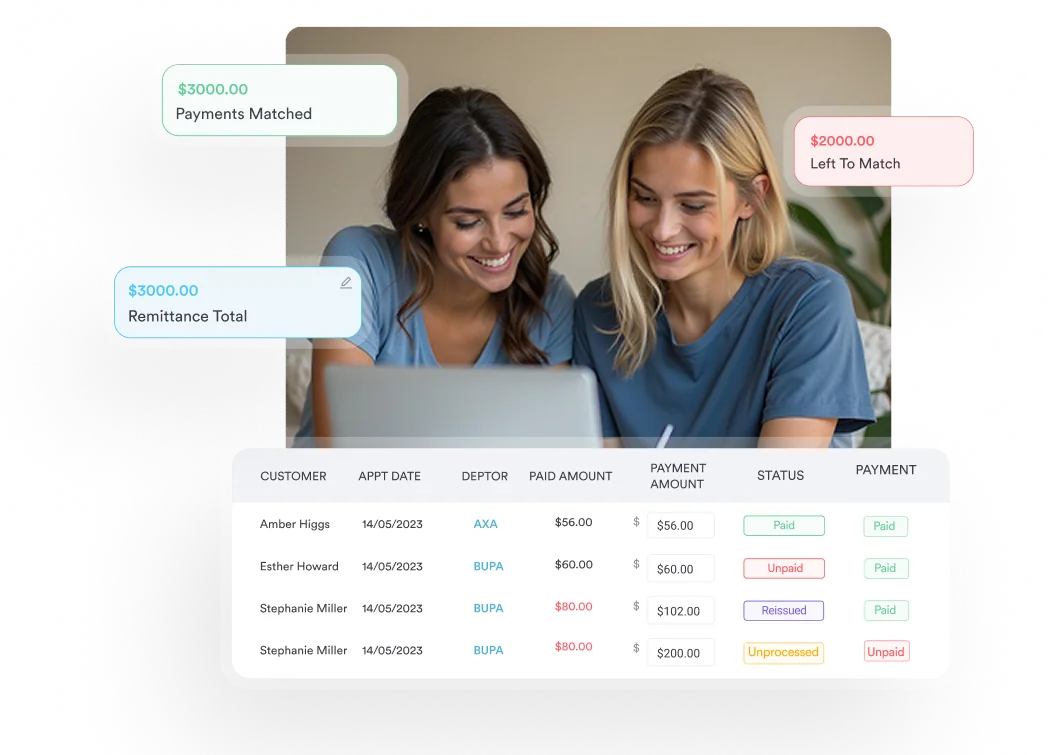
When a child moves from T4532 to a youth code, the history stays on one record. You can see which code each month was billed under, which authorization covered it and what came back.

Pabau keeps HCPCS T-code orders, prior authorization numbers and Medicaid remittances on one patient record. Size and quantity errors surface before the claim goes out.

T4532 is a narrow code with a misleading word in it. “Large” here means the largest pediatric pull-on, while the adult large products sit on T4523 and T4527.
The decision that matters most comes when a child outgrows this size. Moving the order to T4534 or an adult code early, with the authorization updated, keeps supplies arriving without a denied month.
Put the population, style and size check on the order form, where it costs a minute. Book a demo to see how Pabau keeps T-code orders, authorizations and Medicaid remittances on one patient record.

Need to understand how claims clearinghouses process HCPCS codes? Medical claims clearinghouse guide explains how claims route from submission to payer adjudication.
Want to understand the superbill workflow behind HCPCS submissions? Superbill documentation guide covers how superbills support DME and procedure code billing.
HCPCS code T4532 covers one pediatric-sized disposable pull-on, also called protective underwear, in large size. It is billed per unit to state Medicaid programs. The product must be pediatric sized, pull-on style and large for the code to apply.
No. T4532 is a pediatric pull-on code. An adult large brief is billed as T4523, and an adult large pull-on as T4527. Billing T4532 for an adult product is a coding error that leads to a denial.
No. Medicare Part B excludes incontinence supplies, including pull-ons, diapers and underpads, from its DME benefit. A T4532 claim sent to Part B denies categorically, so route it to Medicaid.
Size is the only difference. T4531 covers a pediatric pull-on in small or medium, and T4532 covers the same product in large. T4532 is the largest pediatric pull-on code in the range.
Use T4534 for a youth-sized pull-on, or an adult pull-on code from T4525 to T4528 for adult sizing. No pediatric extra-large pull-on code exists. Check whether the prior authorization needs updating to the new code.
You need a signed order naming the pull-on style, large size and monthly quantity, plus a diagnosis that explains the incontinence. Add a statement of medical necessity and the patient’s age. Include a prior authorization number where the state or plan requires one.