

HCPCS code E0198: Water pressure pad billing guide
HCPCS code E0198 is a water pad for a standard mattress HCPCS code E0198 is the ...

Last Updated: Oct 13, 2026
Q4186 is the HCPCS Level II code for Epifix, per square centimeter (add-on, list separately in addition to primary procedure).
EpiFix is a dehydrated human amnion/chorion membrane (dHACM) allograft used on chronic wounds. You bill it per square centimeter of product applied, on its own line next to the CPT application code. From January 1, 2026, Medicare pays it as an incident-to supply at one flat national rate of about $127 per sq cm.
Let Pabau's smart automation suggest the right codes, reduce claim denials, and keep your practice compliant—effortlessly.
Automate repetitive tasks and focus on what matters most—your patients.
Reduce coding errors and ensure compliance with the latest regulations.
Clean claims, fewer denials, and faster reimbursements.
Powerful insights and reporting to help your practice thrive.
HIPAA compliant SOC 2 certified GDPR-compliant Trusted by 4,000+ clinics worldwide

HCPCS Code Q4186 reports EpiFix, a dehydrated human amnion/chorion membrane (dHACM) allograft, billed per square centimeter of product applied.
Since January 1, 2026, Medicare pays Q4186 as an incident-to supply at one flat rate of about $127 per sq cm in any setting.
LCD L35041 is a Novitas Solutions policy for its JH and JL states, so check your own MAC’s current skin substitute policy.
Bill Q4186 on its own line next to the matching CPT application code from 15271-15278, or the claim is likely to be denied.
No KX modifier requirement applies to Q4186, and Medicare does not pay for discarded product, so bill only the square centimeters you applied.
HCPCS Code Q4186 is the Level II code that the Centers for Medicare and Medicaid Services (CMS) assigns to EpiFix, per square centimeter. The official long descriptor adds that it is an add-on code, listed separately in addition to the primary procedure. Q4186 captures the product itself, while a CPT application code captures the work of placing it.
Each code in the Q4100 series maps to one named product or product line. Q4186 cannot be billed for a different skin substitute, even one from the same manufacturer. MiMedx’s EpiCord, for example, has its own code, Q4187. Check the product name on the package against the code before you submit.
EpiFix is a dehydrated human amnion/chorion membrane allograft placed over a prepared wound bed. It is processed human placental tissue, not a bioengineered dermal matrix and not a traditional surgical skin graft. Practices managing medical billing workflows for wound care should plan for three linked claim elements per encounter.
Keep this structure on every Q4186 encounter. A claim that merges the product and the application, or leaves out the diagnosis, is likely to be denied.
LCD L35041 is a local coverage determination from Novitas Solutions for skin substitutes on lower-extremity chronic wounds. It covers diabetic foot ulcers and venous stasis ulcers, plus full-thickness trauma or abscess ulcers.
L35041 applies only in the Novitas JH and JL jurisdictions. Those cover Colorado, New Mexico, Oklahoma, Texas, Arkansas, Louisiana, Mississippi, Delaware, the District of Columbia, Maryland, New Jersey and Pennsylvania.
The current version has been in effect since the September 26, 2019 revision. It is a local policy, not a national one. First Coast and CGS keep their own active LCDs, so check your own MAC’s current policy before you bill.
L35041 lists diabetic foot ulcers and venous stasis ulcers, plus full-thickness trauma or abscess ulcers. Pressure ulcers are not a listed indication. Novitas’s criteria are a useful benchmark, but they bind claims only in its states. If your MAC is First Coast or CGS, follow that contractor’s LCD, and check any other MAC’s website for a current policy.
Billing Q4186 outside L35041’s covered indications is likely to be denied and, when repeated, creates compliance exposure. In Novitas states, the scenarios below fall outside the policy. Check commercial payer policies separately, because each plan sets its own rules.
Reviewing adherence to medical billing compliance standards before each application helps you catch non-covered cases at the point of care, not after a denial.
HCPCS Code Q4186 covers the skin substitute product only. The work of applying it is billed with a CPT application code on a separate line. A CPT code that does not match the wound’s location or size can trigger a technical denial.
CPT 15273, 15274, 15277 and 15278 are not pediatric codes. They cover wounds of 100 sq cm or more, and the body-area measure applies to children. For a diabetic foot ulcer, CPT 15275 is the base code. Using 15271 for a foot wound is a site mismatch payer edits can flag.
Each Q4100-series code describes one product. Using the wrong Q code for the product applied is a coding error with compliance implications. You cannot fix it by changing the unit count.
Confirm the code by checking the product name and manufacturer against the current CMS HCPCS quarterly file or the AAPC HCPCS code lookup. When in doubt, contact the manufacturer’s reimbursement support line for the current assigned code.
Q4186 units are square centimeters of product applied to the wound, not wound surface area and not package size. Wound area still matters, because it sets the CPT application code.
Worked example: A diabetic foot ulcer measures 5 cm x 4 cm, or 20 sq cm. You open a 25 sq cm sheet, apply 20 sq cm and discard 5 sq cm. Bill Q4186 x 20 units and CPT 15275, with the DFU diagnosis codes. Record the 5 sq cm discarded in the chart, but do not bill it to Medicare. If the wound measured 30 sq cm, you would add one unit of CPT 15276 for the extra 5 sq cm.
Prior authorization (PA) rules for Q4186 vary by payer and change often. Traditional Medicare has no routine PA requirement for Q4186, but many Medicare Advantage, commercial and Medicaid managed care plans do. Confirm requirements before the application date using insurance eligibility verification tools to avoid post-service denials.
Capture documentation in the chart before the claim goes out. For L35041, that means the covered diagnosis, 30 or more days of conservative care, the application count for the episode, and product applied and discarded. The four checks below follow the order a claim meets them.
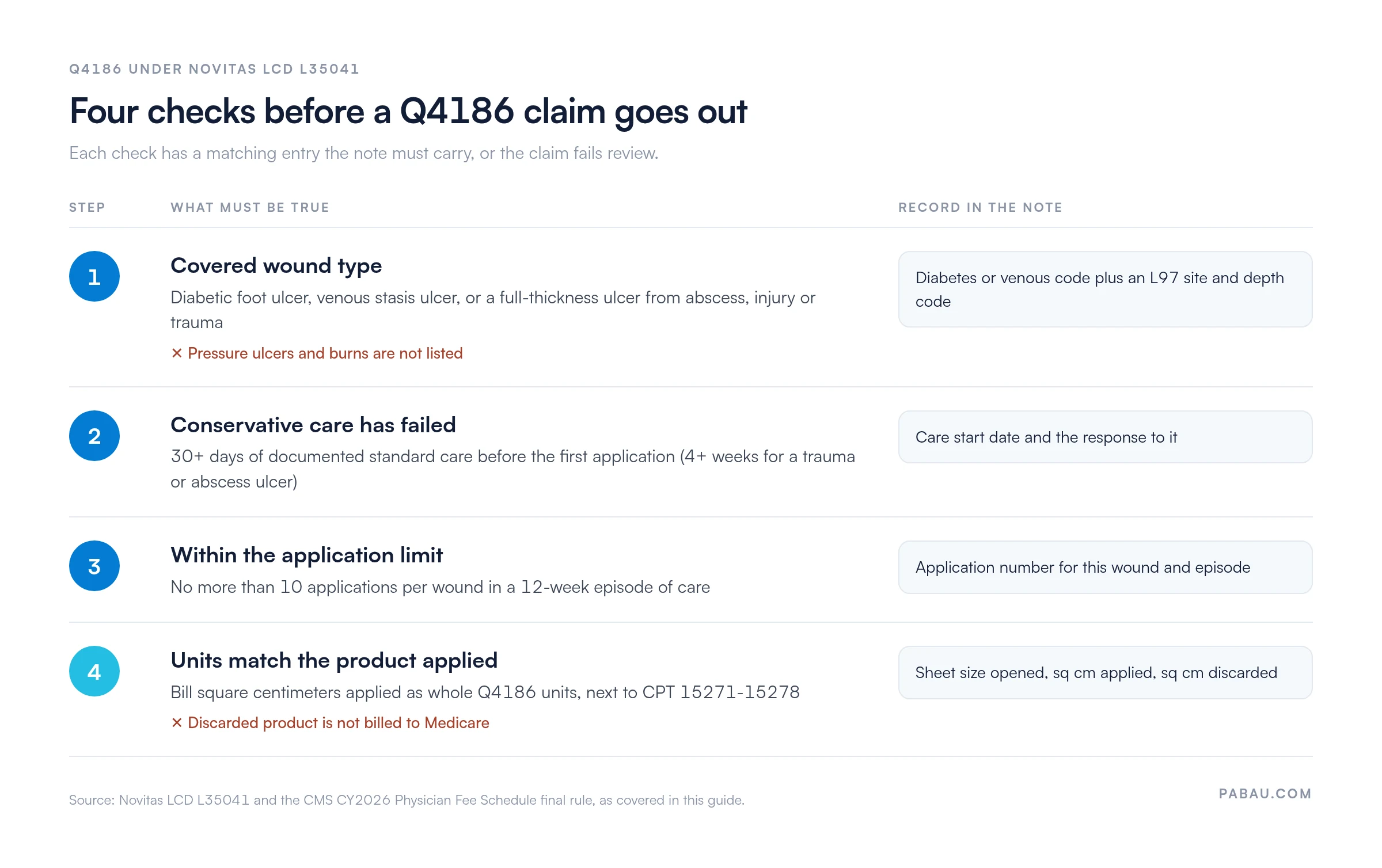
Add wound measurements and photographs at each visit, the product name and lot number, and the treating clinician’s note. Keeping superbill requirements consistent for wound care encounters helps your team capture each field every time.
Audit your wound care note template before the first Q4186 claim. Add structured fields for wound length, width and depth, photographs, the conservative care start date, the application number, and product applied versus discarded. If a reviewer cannot find one of these fields in the note, the claim can fail an L35041 review.
Modifiers on Q4186 claims tell the payer about coverage status and service context. A wrong modifier, or one added out of habit, can hold up an otherwise clean claim.
Place of service (POS) decides who bills the product. In the office (POS 11), the treating provider bills Q4186 and the application CPT.
Hospital outpatient departments (HOPDs) use POS 22 on campus or POS 19 off campus. There, the facility bills the product and the physician bills only the application CPT. Medicare now pays the same flat per-sq-cm rate in both settings. Confirm the billing-entity split with your compliance lead before the first encounter.
Q4186 is no longer paid on an average sales price basis. EpiFix is a 361 HCT/P, not a BLA-licensed product. Under the CY2026 Physician Fee Schedule final rule (CMS-1832-F), CMS pays it as an incident-to supply from January 1, 2026.
The result is one flat national rate of about $127 per sq cm, the same in the office and the HOPD. CMS’s correction notice puts it at $127.14.
The CY2026 PFS relative value file lists Q4186 at 3.81 non-facility RVUs. At the $33.4009 non-QP conversion factor, that gives $127.26 before geographic adjustment. Check your local rate in the CMS Physician Fee Schedule lookup tool.
Common Q4186 denials and fixes:
Read medical billing denial codes alongside your remittance advice to categorize each rejection. Electronic remittance advice shows the CARC and RARC codes behind each denial.
Every Q4186 claim needs an ICD-10-CM diagnosis that supports a covered wound. Under L35041, that means a diabetic foot ulcer or a venous stasis ulcer. Full-thickness trauma or abscess ulcers also qualify once they have failed 4 weeks of care. Verify each code against the current year’s CMS ICD-10-CM coding updates, because codes change each October.
Code to the highest level of specificity the medical record supports. For diabetic foot ulcers, pair the diabetes code, such as E11.621, with an L97 code for the ulcer’s site and depth. That pairing gives the payer what it needs to check coverage.
Many wound care practices keep wound measurements in the chart, product logs on paper and the claim in a separate billing tool. When those records drift apart, units stop matching the note and L35041 documentation goes missing.
Pabau, our practice management and EHR platform, keeps wound notes, photographs and custom forms in one patient record. Your team can build a wound care note with fields for measurements, conservative care dates, and product applied versus discarded.
Pabau’s claims management software then submits the claims your team builds and tracks their status. Code selection, modifiers and unit counts stay with your billers, working from a complete note.
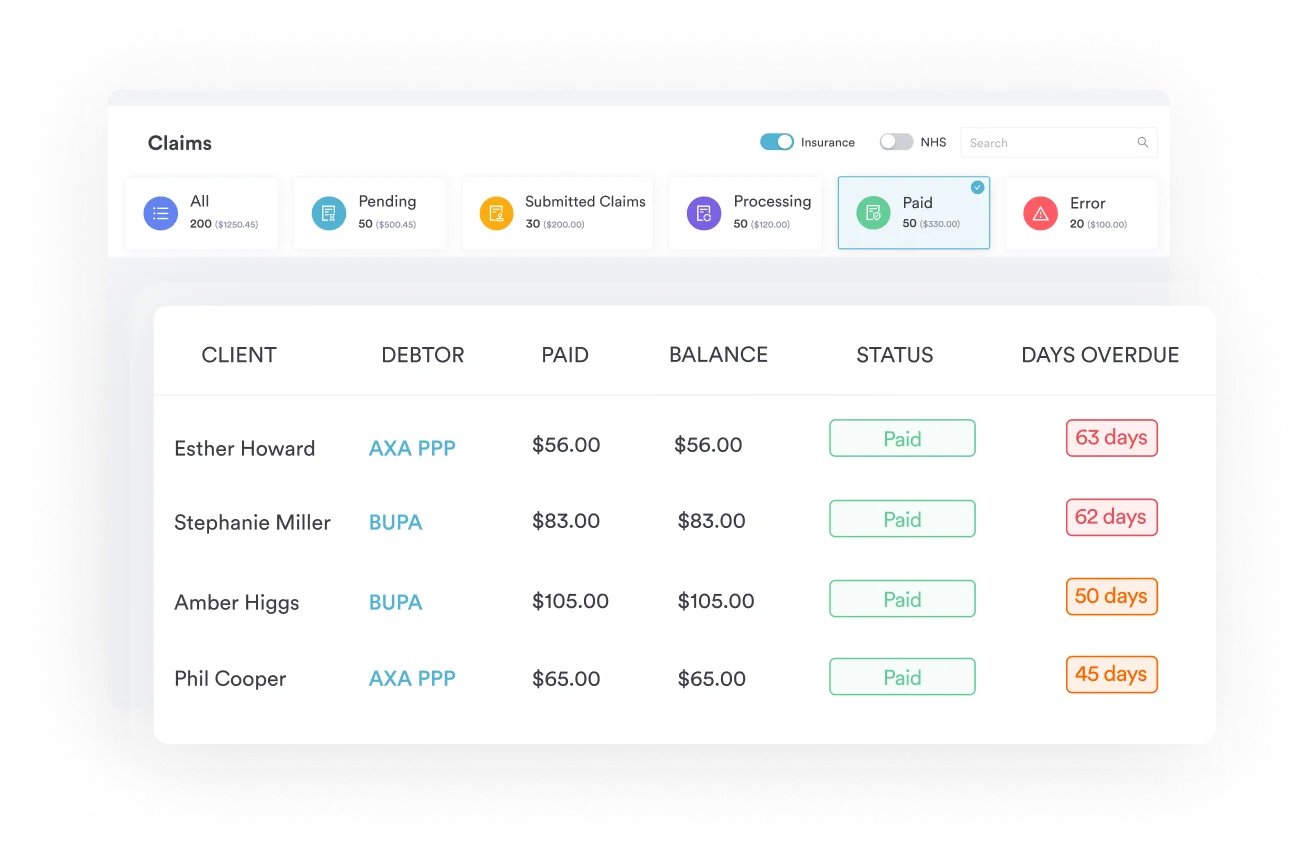

Pabau keeps wound notes, photos and forms in one patient record, then submits and tracks the claims your team builds. See how it fits your wound care workflow.

Three facts now shape Q4186 billing. EpiFix is a supply paid at one flat rate, L35041 binds only Novitas states, and Medicare does not pay for discarded product. Practices still working from ASP rates or a KX rule are billing against a policy that no longer applies.
Start with your MAC’s current policy, then rebuild the wound care note so it records product applied, product discarded and the application count. That single change protects both the unit count and the medical necessity record.
Book a demo to see how Pabau keeps wound care documentation and claim submission in one place for your practice.

Need a structured approach to medical billing? What is medical billing explains the end-to-end revenue cycle process for healthcare practices new to claim workflows.
Want to understand how denials are categorized? Denial codes in medical billing covers CARC and RARC code interpretation for faster appeal responses.
Building a compliance-ready billing process? Medical billing compliance standards outlines the documentation and audit trail requirements that protect practices during payer reviews.
Billing the injectable form of EpiFix? HCPCS Code Q4145 covers the per-mg injectable version and how its units differ from the sheet product.
Applying umbilical cord tissue instead? HCPCS Code Q4187 walks through Epicord billing, units and 2026 payment.
HCPCS Code Q4186 reports EpiFix, a dehydrated human amnion/chorion membrane (dHACM) allograft, billed per square centimeter of product applied. It is used on chronic wounds such as diabetic foot ulcers and venous leg ulcers. It covers the product only, and the application is billed separately with CPT 15271-15278.
Bill one unit per square centimeter of product applied, as recorded in the note. Medicare does not pay for discarded product, and the JW and JZ modifiers do not apply to Q4186. Under Novitas LCD L35041, coverage is limited to 10 applications per wound per 12-week episode.
Common settings are the office (POS 11) and the ambulatory surgical center (POS 24). Hospital outpatient departments use POS 22 on campus or POS 19 off campus. In an HOPD, the facility bills the product and the physician bills only the application CPT code.
Each Q4100-series code maps to one named product. Q4187 is Epicord, a different product made from umbilical cord tissue, and Q4145 is injectable EpiFix billed per mg. Using the wrong code for the product applied is a coding error. Confirm the code against the current CMS HCPCS file or with the manufacturer’s reimbursement team.



