HCPCS Code Q4185: Cellesta flowable amnion billing guide
HCPCS Code Q4185: definition and official descriptor HCPCS Code Q4185 is the Lev...

Last Updated: Nov 20, 2026
Q4142 is the HCPCS Level II code for XCM Biologic Tissue Matrix, billed per square centimeter of matrix applied. The product is a porcine-derived, non-cross-linked collagen matrix, not an amniotic membrane.
From January 1, 2026, Medicare pays Q4142 as an incident-to supply at a flat national rate of $127.14 per square centimeter. Coverage is left to each MAC's judgment. The chart must show why this surgical-mesh product suited the wound.
Let Pabau's smart automation suggest the right codes, reduce claim denials, and keep your practice compliant—effortlessly.
Automate repetitive tasks and focus on what matters most—your patients.
Reduce coding errors and ensure compliance with the latest regulations.
Clean claims, fewer denials, and faster reimbursements.
Powerful insights and reporting to help your practice thrive.
HIPAA compliant SOC 2 certified GDPR-compliant Trusted by 4,000+ clinics worldwide

Q4142 is XCM Biologic Tissue Matrix, a porcine-derived, non-cross-linked collagen matrix billed per square centimeter. It is not an amniotic membrane product.
Units equal the square centimeters of matrix applied, while the application CPT code follows the wound surface area.
Q4142 is an add-on code, so it always rides with a primary application code from CPT 15271-15278.
From January 1, 2026, Medicare pays Q4142 as an incident-to supply at a flat $127.14 per square centimeter.
Medicare coverage is carrier judgment, so the chart has to justify a surgical-mesh product on the wound you treated.
HCPCS Code Q4142 reports XCM Biologic Tissue Matrix, billed per square centimeter as an add-on to the primary application procedure. The CMS quarterly HCPCS file gives the long descriptor as “Xcm biologic tissue matrix, per square centimeter (add-on, list separately in addition to primary procedure).” The code names one branded product, not a tissue category.
XCM is a porcine-derived, non-cross-linked extracellular collagen matrix. Older billing guides group Q4142 with amniotic membrane grafts, which is wrong. The table below holds the reference facts to check before a claim goes out.
XCM Biologic Tissue Matrix is an animal-derived collagen sheet made from pig tissue. Its collagen is left non-cross-linked, so the body can remodel the matrix as the repair heals. It contains no human or placental tissue. Architect is another animal-derived collagen matrix, made from horse pericardium and billed under Q4147.
The product reached the market as a surgical mesh. FDA’s device record lists it under surgical mesh product codes, including collagen mesh for plastic and reconstructive surgery. The product listing on WoundReference names these uses:
That labeling matters on a wound care claim. A reviewer who sees Q4142 on a diabetic foot ulcer will ask why a soft-tissue reinforcement mesh was the right choice. The procedure note should answer that question before anyone asks it.
Before you stock XCM for chronic wound care, ask your MAC and your main commercial payers whether they accept it for that use. Its FDA labeling describes surgical soft-tissue reinforcement, so coverage for an ulcer is not a given.
Medicare has no national coverage determination for Q4142. The HCPCS file assigns coverage code C, which leaves the decision to the Medicare Administrative Contractor (MAC). Each claim is judged on whether the product was reasonable and necessary for that wound.
The MACs had finalized new skin substitute LCDs for diabetic foot ulcers and venous leg ulcers, due to start on January 1, 2026. CMS announced their withdrawal on December 24, 2025. Novitas, CGS, and First Coast still apply their existing skin substitute policies. Elsewhere, claims are reviewed case by case.
If your MAC has an active policy, read its covered product list and its billing article before you bill Q4142. If it has none, the record still has to show a chronic wound, failed standard care, and a clinical reason for this product.
Traditional Medicare does not require prior authorization for Q4142 in most states. CMS’s WISeR model adds review for skin substitutes in six states, but only where an active LCD applies. Medicare Advantage and commercial plans often set their own authorization rules.
Check the requirement with each payer before every application, not only at the start of a treatment episode. A missing authorization usually comes back as CO-197.
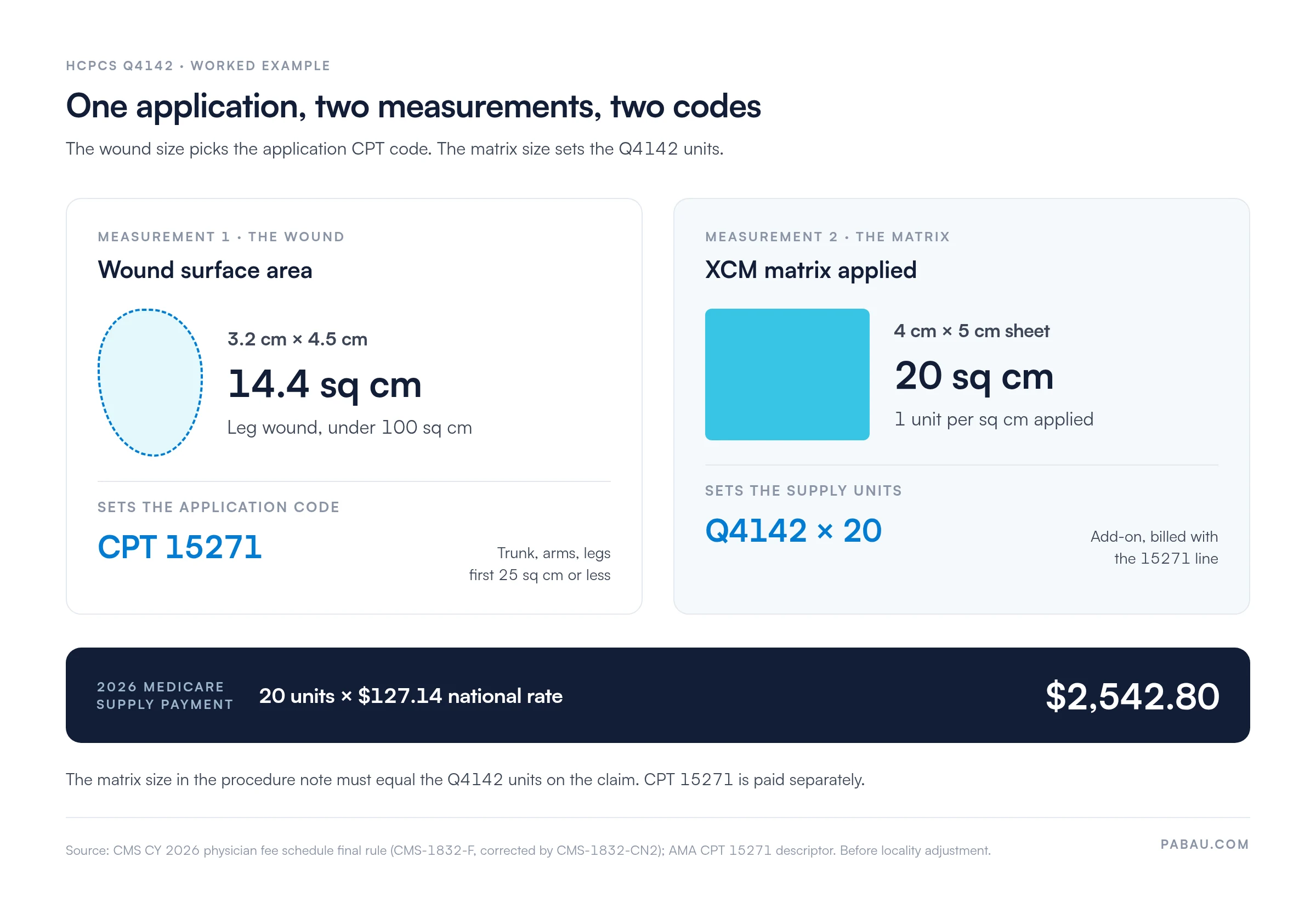
Each unit of Q4142 is one square centimeter of XCM matrix applied to the wound. The application CPT code works differently, because it follows the wound surface area. Record both numbers in the procedure note, since the claim depends on each one.
Example: A leg wound measures 3.2 cm by 4.5 cm, or 14.4 sq cm. That wound surface area points to CPT 15271. If a 4 cm by 5 cm sheet of XCM covers it, the claim carries 20 units of Q4142.
Since 2026, Medicare pays skin substitutes as supplies rather than as drugs or biologicals. The JW and JZ waste modifiers no longer apply, and trimmed or discarded matrix is not billed.
Q4142 is a supply add-on code and cannot be billed alone. Every claim needs a primary application code from CPT 15271-15278, chosen by wound site and by whether total wound surface area is under or over 100 sq cm.
The 1% of body area option applies to infants and children only.
Same-day debridement and E/M services: NCCI edits decide whether debridement can be reported with the application code on the same date; check the current table first. Use 59 or XS only for a distinct service, such as a separate wound.
Report an E/M visit with modifier 25 only when the note documents a significant, separately identifiable service. Edit pairs change quarterly, so confirm them first. A superbill template with modifier fields keeps same-day codes consistent.
Documentation decides most Q4142 claim outcomes. MAC medical reviewers look for the same records on every skin substitute claim. Building them into the application visit supports clean claim submission instead of a scramble after a denial.
Keep the clinical record and the billing record consistent. The matrix size in the note must equal the Q4142 units on the claim. Medical billing compliance reviews start with that match.
Keep the purchase invoice and packaging label for every Q4142 application. Pricing no longer depends on the invoice in 2026, but auditors can still ask you to prove which product you applied and how much.
Each skin substitute Q-code names a specific product, so the code follows the product on the invoice. XCM is easy to confuse with other collagen matrices and with the amniotic grafts that sit beside it in the code range. Particulate AmnioBand, for instance, is an amniotic product billed per 1 mg under code Q4168.
Confirm product-to-code assignments in the CMS quarterly HCPCS update or the AAPC HCPCS code lookup. CMS adds and retires skin substitute codes each quarter, so check the mapping whenever you change suppliers.
From January 1, 2026, Medicare pays Q4142 as an incident-to supply at a flat national rate of $127.14 per square centimeter. The CY 2026 physician fee schedule final rule (CMS-1832-F) moved skin substitutes to this supply payment. The rate is set for the full year, not updated quarterly.
CMS first published the rate as $127.28 per square centimeter. Its correction notice, CMS-1832-CN2, lowered it to $127.14. The rule groups products by FDA category: PMA, 510(k), and 361 HCT/P. All three share the same rate in 2026.
XCM was cleared as a 510(k) surgical mesh, which places it in the 510(k) group. CMS has said the category rates may diverge in later years. Check each new fee schedule rule for a 510(k)-specific figure.
Because every qualifying product now earns the same rate, the margin on Q4142 depends on what the practice pays for XCM. Compare the purchase price with your allowed amount before you reorder. For revenue cycle management, add that check to the start-of-year billing review.
Commercial payers set Q4142 rates in their own contracts. Some benchmark to Medicare and others set product-specific fees. Confirm the rate and any authorization rule in each payer contract.
OIG has flagged skin substitute spending as a high-risk billing area. Most denials on Q4142 come from the same few causes. Tracking denial management by reason code shows which ones your team repeats. The denial codes in medical billing guide explains each code in more detail.
Q4142 claims fail when the wound note, the matrix size, and the claim disagree. Pabau, the practice management platform we build, keeps the procedure note, photos, and invoice on one patient record.
Your clinicians record the wound measurements and the matrix applied in the visit note. The billing team then works from that record, so the units on the claim match the size documented. Pabau’s claims management software submits the claim and tracks what comes back.

Pabau keeps the wound note, photos, and invoice on one patient record, so the Q4142 units you bill match the matrix you documented. Claims management then submits the claim and tracks the response.

Q4142 is a porcine collagen matrix code, and billing it as an amniotic graft starts the claim on the wrong facts. In 2026 the payment side is simple: a flat supply rate per square centimeter applied.
The harder part is coverage. With no national policy and few active LCDs, each claim stands on its own record. A note that justifies a surgical-mesh product for this wound is what gets Q4142 paid.
To see how Pabau keeps wound notes and claims in step, book a demo.

Need a framework for managing claim denials at scale? Denial management in healthcare covers root-cause analysis and appeals workflows for high-volume billing teams.
Want to understand how the billing system connects end to end? Medical billing fundamentals explains how HCPCS supply codes fit into the broader claims cycle from patient encounter to payment posting.
Looking to tighten your compliance posture for wound care billing? Medical billing compliance outlines the documentation and audit-readiness standards that apply to high-risk code categories like skin substitutes.
HCPCS Code Q4142 covers XCM Biologic Tissue Matrix, billed per square centimeter as an add-on to a skin substitute application code. XCM is a porcine-derived, non-cross-linked collagen matrix, not an amniotic product. Medicare coverage is left to each MAC under coverage code C.
Bill one unit per square centimeter of XCM matrix applied. A 4 cm by 4 cm piece is 16 units. The wound surface area is measured separately, because it sets the application CPT code. The units billed must match the matrix size recorded in the procedure note.
Q4142 is an add-on code, so it is always billed with a primary application code from CPT 15271-15278. The code depends on the wound site and on whether the total wound surface area is under or over 100 sq cm. A claim with Q4142 alone will fail the payer add-on edit.
Usually not under traditional Medicare. CMS’s WISeR model adds skin substitute review in six states, but only where an active LCD applies. Medicare Advantage and commercial plans often require authorization, so check with each payer before every application.
Q4142 is XCM Biologic Tissue Matrix, a porcine collagen matrix. Q4143 is Repriza, a human acellular dermal matrix. Both are billed per square centimeter, and the right code follows the product on the invoice.
Keep wound assessment notes, length and width measurements, the matrix size applied, and the standard care tried before. Add the product name, lot number, and your reason for choosing XCM. Include dated photographs where your MAC or payer asks for them.