

HCPCS code E0198: Water pressure pad billing guide
HCPCS code E0198 is a water pad for a standard mattress HCPCS code E0198 is the ...

Last Updated: Oct 13, 2026
Q4187 is the HCPCS Level II code for Epicord, per square centimeter (add-on, list separately in addition to primary procedure). Epicord is a dehydrated human umbilical cord (dHUC) allograft made by MiMedx, and Q4187 pays for the graft alone.
The fact to hold onto is that Q4187 never travels by itself. It rides on the same claim as a 15271-15278 application code, with units counted in square centimeters. Medicare's CY2026 rate is a flat $127.14 per square centimeter, so every miscounted unit changes the payment. The sections below follow one claim from wound measurement to payment.
Let Pabau's smart automation suggest the right codes, reduce claim denials, and keep your practice compliant—effortlessly.
Automate repetitive tasks and focus on what matters most—your patients.
Reduce coding errors and ensure compliance with the latest regulations.
Clean claims, fewer denials, and faster reimbursements.
Powerful insights and reporting to help your practice thrive.
HIPAA compliant SOC 2 certified GDPR-compliant Trusted by 4,000+ clinics worldwide

HCPCS code Q4187 covers Epicord (MiMedx), a dehydrated human umbilical cord allograft billed per square centimeter.
Units equal wound length times width in centimeters, rounded to the nearest whole number and never above the graft size applied.
Q4187 is an add-on supply code, so it must share a claim with a 15271-15278 application code or it denies.
Medicare pays a flat CY2026 rate of $127.14 per square centimeter, with no locality or GPCI adjustment.
Medicare coverage depends on documented wound type, wound duration, failed conservative care, and same-day measurements.
Pabau’s claims management software pre-fills Q4187 claims from the patient record and checks required claim fields before submission.
HCPCS code Q4187 is the Level II supply code for Epicord umbilical cord allograft, per square centimeter. The Centers for Medicare and Medicaid Services maintains it. It pays for the graft itself. Placing that graft on the wound is a separate service, billed through a companion CPT application code.
Epicord is a dehydrated human umbilical cord (dHUC) allograft, derived from umbilical cord tissue. MiMedx processes it with its PURION PLUS technology. That tissue source is what separates it from Epifix (Q4186), a dehydrated amnion/chorion membrane, and it is why the two products carry separate codes.
Before Q4186 and Q4187 existed, Epifix and Epicord were both billed under Q4131. CMS later gave each product its own code in the HCPCS Level II file, so every claim now names the graft by descriptor.
Claims for dates of service after the transition belong under the product-specific code. Confirm the effective date in the CMS annual HCPCS file, because contractors can handle transition claims differently.
With the history settled, the next call is which of the two MiMedx codes the invoice supports. Q4187 covers Epicord and Q4186 covers Epifix. Both come from MiMedx, but Epicord is an umbilical cord allograft and Epifix is an amnion/chorion membrane.
Picking the wrong code is a documentation error, and it can trigger a medical necessity review on a claim that would otherwise pay.
Product choice belongs to the treating clinician, based on the wound and on what is in stock. Code choice is simpler: match the HCPCS code to the product label on the invoice. If a supply shortage forces a swap, recheck that the payer’s LCD covers the graft that went on the wound.
A swap moves the supply line to the substitute’s own code. Truskin, for example, bills under Q4167 and carries its own coverage and prior authorization rules.
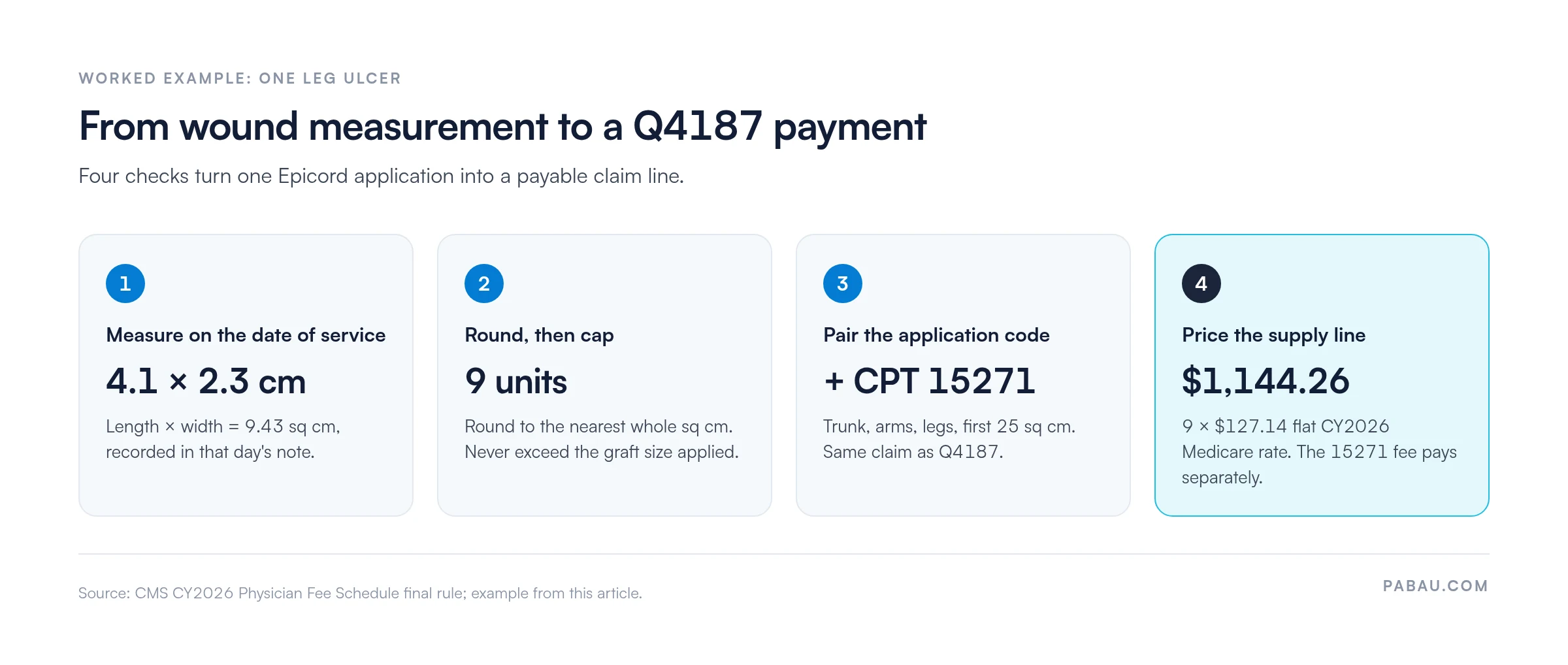
Units for Q4187 equal the wound area in square centimeters on the date of service. Overbilled units rank among the most common audit triggers for skin substitute codes, yet the math itself is short. Here is the sequence, using a leg ulcer that measures 4.1 by 2.3 cm.
Common error: billing the wound area instead of the graft that went on. Say the note records a 12 sq cm wound, but only a 4 sq cm piece went on. Billing 12 units is overbilling, whatever the wound size.
Carried through to payment, the same 4.1 by 2.3 cm wound produces one supply line and one procedure line.
HCPCS code Q4187 pays for the product only. Placing the graft is a separate procedure, reported with a CPT application code from the 15271-15278 series. Send Q4187 without one and the line denies for missing procedure reporting.
Pick the application code by anatomical site first, then by wound size. A plantar diabetic foot ulcer takes 15275, plus 15276 for each extra 25 sq cm. A venous leg ulcer takes 15271, plus 15272 beyond the first 25 sq cm. Both codes go on the same claim, never on separate claims.
The application side has its own traps, from site grouping to add-on sequencing. Our billing guide for CPT code 15271 covers that half of the claim in more depth.
Medicare coverage for Q4187 is governed by CMS article 54117 and the MAC’s Local Coverage Determination (LCD). Coverage is never automatic. The treating provider has to show the patient meets the LCD’s medical necessity criteria before Epicord goes on, and before the claim goes out.
Across most MACs, the LCD checks follow a familiar pattern:
LCD criteria are contractor-specific, so Novitas Solutions may cover what CGS, WPS, or NGS does not. Pull the active LCD from your MAC’s website before billing Q4187 for a new patient population under that contract.
Does traditional Medicare need prior authorization? Not under most MACs today. Parts A and B generally let the first application go ahead without it.
What about Medicare Advantage and commercial plans? UnitedHealthcare, Medicare Advantage plans, and most commercial payers require it before the first application. Send wound measurements, wound duration, ICD-10 codes, and proof of failed conservative care with the request. Recheck each payer every plan year, because these policies change often.
Once coverage is confirmed, the setting decides who gets paid for what. Place of service (POS) determines which entity bills Q4187 and which fee schedule applies to the application code.
In the physician office (POS 11), the practice captures both the supply payment and the application fee, which usually makes it the highest combined reimbursement. In a facility, the supply revenue goes to the facility instead of the individual provider.
For CY2026, CMS finalized a flat national payment of $127.14 per square centimeter for skin substitute grafts billed as incident-to supplies. That rate does not vary by MAC jurisdiction, locality, or geographic practice cost index (GPCI). You can confirm it in the CMS Medicare Physician Fee Schedule lookup tool.
That makes the supply math simple. The 9-unit wound from the unit section pays 9 x $127.14, or $1,144.26, for the graft. The 15271 application fee is paid on top, at its own fee schedule rate.
Q4187 claims rarely fail for exotic reasons. They fail when a step gets skipped, so the same eight steps, run in the same order every time, catch most problems before submission.
Missing or thin documentation is the leading reason Q4187 claims are denied on reopening or audit. Tick each item below before the claim leaves the practice:
Audit your Q4187 documentation template against your MAC’s active LCD before treating the first patient in a new wound care program. LCDs are updated periodically, so a template built against a 2022 LCD may miss a requirement added in 2024 or 2025. Download the current LCD from your MAC’s website and map each criterion to a chart element.
With the claim built, the diagnosis is the last place a Q4187 line can fall short. Pairing it with an unspecified or wrong ICD-10-CM code is a top LCD non-coverage trigger. Code to the highest specificity available, including laterality, site, and severity or stage.
Use the ICD-10-CM code set for the current fiscal year. It updates every October 1, so a code valid in FY2025 can be revised or deleted in FY2026. The CMS ICD-10 codes page publishes the annual update files.
Nearly every Q4187 denial traces back to a skipped step from the sections above. The table maps each common denial to its root cause and fix. Match the CARC and RARC codes your payer returns against our guide to medical billing denial codes to see which row applies.
Log every Q4187 denial by root cause, and review the tally weekly during the first 90 days of a new wound care program. Patterns show up fast, and one corrected template often clears a whole row of the table.
Medicare pays most wound care Q4187 claims, but commercial and Medicaid coverage keeps expanding. Each of these payers sets its own criteria, so the Medicare checklist above is a starting point rather than a guarantee.
If you bill several payers, keep a payer-by-payer coverage matrix for Q4187. It stops claims from going to plans that will deny on coverage before anyone reads the records. The AAPC HCPCS code lookup helps when a payer policy describes the product in different terms.
Request a coverage determination letter from each commercial payer before billing Q4187 for the first time under that plan. A written confirmation protects against retroactive denials and gives your billing team a reference for appeals. File the letter with the patient’s chart for the wound episode.
Many wound care teams still build a Q4187 claim by hand. Someone copies codes from the chart, rechecks the member ID, and lines up the diagnosis pointers one by one.
Pabau, the practice management and billing platform we build, starts the claim from the patient record instead. The application CPT attached to the service lands on the charge line, and ICD-10 slots are seeded from the recorded problem list. Built-in HCPCS and ICD-10 lookup libraries let coders confirm Q4187 and its diagnoses without leaving the claim.
Before sending, Pabau’s claims software for practices checks that required fields, such as membership numbers and authorization codes, are complete. Claims then go out through its clearinghouse connections, which include Claim.MD for US practices.
Fewer claims bounce back for missing data, so your team spends its time on coverage questions instead of rework.

Pabau pre-fills skin substitute claims from the patient record, gives coders HCPCS and ICD-10 lookup, and checks required claim fields before submission.

Q4187 rewards practices that treat it as two lines on one claim. The supply line is priced by the square centimeter, and the procedure line is priced by site. With a flat 2026 rate, the supply side is now the predictable half.
The judgment call sits upstream, in the chart. An umbilical cord allograft documented against the LCD, measured on the day, and capped at the graft size will pay. The same graft with a missing measurement will not, however clean the codes look.
So spend your audit time on the wound note first and the claim form second. If claim prep still eats hours, book a demo to see how Pabau pre-fills and field-checks skin substitute claims before they reach the payer.

Still holding Epicord claims under the old shared code? HCPCS code Q4131 explains how the shared Epifix and Epicord code split into Q4186 and Q4187.
Billing a different skin substitute on the same 2026 rate? HCPCS code Q4127 applies the same unit math and flat payment to Talymed.
Need a framework for managing billing denials across your practice? Denial management in healthcare covers the full denial lifecycle from root cause analysis to appeal strategy.
Want every billable element captured before the claim leaves? Superbill preparation walks through what a complete superbill records for each visit.
Looking to cut resubmissions? Clean claim submission lists the fields and checks that get a claim paid on first pass.
Yes. Its descriptor reads “add-on, list separately in addition to primary procedure,” so Q4187 is never billed alone. It always follows a 15271-15278 application code on the same claim.
Medicare pays $1,271.40 for the graft, at the flat CY2026 rate of $127.14 per square centimeter. The application CPT code is paid separately on top of that amount.
No. The entity that buys the graft bills the supply. Incident-to billing requires the practice to bear the product cost, so a hospital-supplied graft is billed by the hospital.
Compare the billed units with the graft size on the invoice and the measurement in that day’s note. If both support the units, appeal with those documents. If not, correct the units and resubmit.
Epicord is a dehydrated human umbilical cord (dHUC) allograft made by MiMedx. Epifix (Q4186) is a dehydrated human amnion/chorion membrane (dHACM) allograft, so the two come from different tissue sources.



