

CCSD code G5100: Bypass of duodenum billing guide
CCSD code G5100 bills a bypass that leaves the duodenum in place CCSD code G5100...

Last Updated: Oct 16, 2026
Q4145 is the HCPCS Level II code for EpiFix, injectable, 1 mg.
From January 1, 2026, Medicare pays this product as an incident-to supply rather than as a Part B biological. Payment is a flat national rate per square centimeter of documented wound surface area, not average sales price plus 6% and not per milligram. Since April 1, 2026, the application is reported with a non-sheet G-code, G0681 through G0684, on the same claim and date of service.
Let Pabau's smart automation suggest the right codes, reduce claim denials, and keep your practice compliant—effortlessly.
Automate repetitive tasks and focus on what matters most—your patients.
Reduce coding errors and ensure compliance with the latest regulations.
Clean claims, fewer denials, and faster reimbursements.
Powerful insights and reporting to help your practice thrive.
HIPAA compliant SOC 2 certified GDPR-compliant Trusted by 4,000+ clinics worldwide

HCPCS Code Q4145 covers EpiFix injectable amniotic allograft, made by MiMedx and used on chronic non-healing wounds
From January 1, 2026, Medicare pays Q4145 as an incident-to supply rather than as a separately payable Part B biological
Payment is a flat national rate of about $127 per square centimeter of wound surface area, not ASP plus 6% and not per milligram
Since April 1, 2026, pair Q4145 with a non-sheet application G-code, G0681 through G0684. CPT 15271-15278 now cover sheet-form products only
Discarded product is not payable in 2026, and the JW and JZ modifiers do not apply to incident-to supplies
Texas Medicaid removed Q4145 as a covered benefit on March 1, 2023, with Q4159 as the covered replacement code
Practice management software like Pabau tracks the status of each Q4145 claim and checks required fields before submission
HCPCS Code Q4145 describes “EpiFix, injectable, 1 mg”. It is a Level II HCPCS Q-code assigned to a single amniotic allograft product manufactured by MiMedx. Wound care programs reach for it on chronic ulcers that have already failed conservative treatment.
EpiFix is derived from dehydrated human amnion/chorion membrane (dHACM). It contains growth factors, cytokines, and extracellular matrix proteins that support wound healing. In fact, the injectable formulation is distinct from the sheet form, which carries a separate code, Q4186.
Q-codes are temporary HCPCS Level II codes maintained by CMS for items and services not yet captured by permanent codes. Specifically, Q4145 sits within the skin substitute and cellular and tissue-based product (CTP) family.
From January 1, 2026 Medicare pays it as an incident-to supply at a flat rate per square centimeter of wound surface area. Accordingly, the rest of this guide reflects that model.
The CY2026 Medicare Physician Fee Schedule final rule (CMS-1832-F) rebuilt the way Medicare pays for skin substitutes. CMS reclassified every skin substitute that is not licensed as a biological under section 351 of the Public Health Service Act. Those products are now incident-to supplies furnished with the application procedure, rather than Part B biologicals with their own average sales price. MiMedx does not hold an approved BLA for EpiFix, so Q4145 falls squarely inside the reclassified group.
Three practical consequences follow, and each one breaks a habit that was correct in 2025:
Only skin substitutes licensed as biologics under section 351 keep the older average sales price methodology. Q4145 is not one of them, so any 2026 claim built on ASP pricing or per-milligram units is built on a superseded rule.
HCPCS Code Q4145 covers the supply cost of EpiFix injectable when used to treat chronic, non-healing wounds. Medicare coverage for this family of products has historically been set out in local coverage policy, including Article ID 56696 in the Medicare Coverage Database. Most MACs retired or reworked their skin substitute policies for 2026. Therefore, confirm what is currently active in your jurisdiction before relying on last year’s criteria.
Covered indications include:
Excluded uses include:
Q4145 covers only the product supply. The application itself is billed separately with the matching non-sheet G-code. Otherwise, submitting the product code without its application code, or with a sheet-form CPT code instead, triggers a claim edit or an outright rejection.
Under the 2026 model, the number that matters is the wound surface area you measured and documented. Record length and width at each visit, then calculate the treated area in square centimeters. That figure drives both the application code and the units reported. Measurement is the audited element now, where unit conversion used to be.
Report only the amount actually applied to the wound. Discarded or unused product is not payable in 2026, so it never appears on the claim. The chart below shows which application code follows from the product form and the measured area.
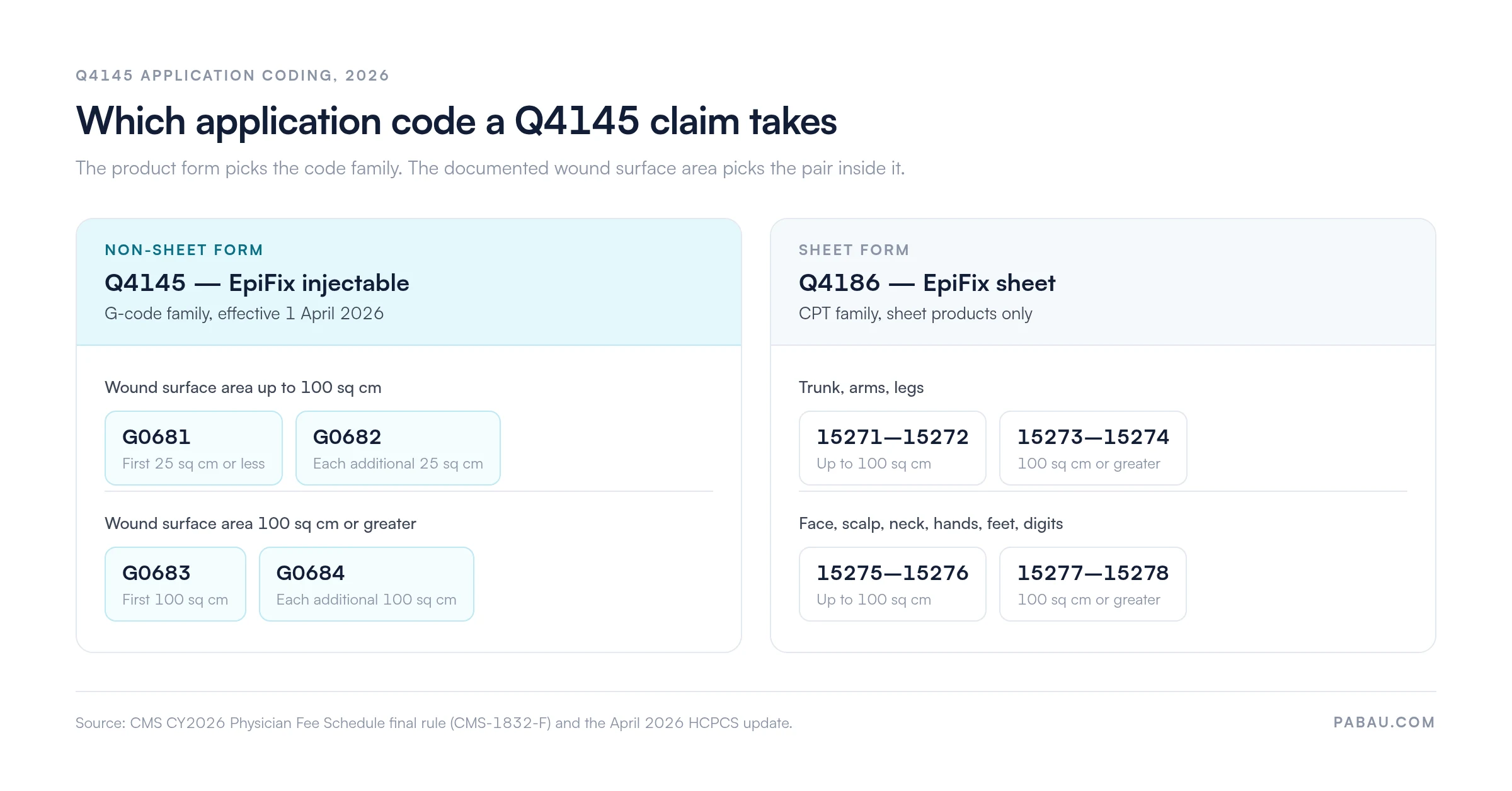
Injectable and micronized EpiFix is a non-sheet product, so it pairs with the G-code series. The application code and the product code must appear on the same claim for the same date of service.
First Coast Service Options and other MACs reject claims in both directions. An application code without its product code is rejected, and so is a product code without its application code. Therefore, check the pairing before submission rather than after the rejection.
The CPT application series is now limited to sheet-form skin substitutes, so it is the correct family for Q4186 rather than Q4145. It is listed here because the two EpiFix forms are frequently confused. A sheet CPT code on a Q4145 claim is a rejection.
AlloSkin AC is another product that still takes this CPT series. Its supply code, Q4141, is billed per square centimeter alongside the application line.
The JW and JZ modifiers do not belong on a Q4145 claim. CMS and its contractors treat sheet and non-sheet skin substitutes as supplies for payment purposes, and the drug wastage modifiers do not apply to supplies. Discarded skin substitute product is not payable in 2026, so no wastage remains to report. In short, bill only the amount applied to the wound.
Modifier KX has historically attested that the coverage criteria in an applicable LCD were met and that the documentation is on file. With most skin substitute LCDs retired or rewritten for 2026, append KX only where the payer’s current policy still calls for it. Coverage now turns largely on what the medical record shows about wound history, conservative care, and response to treatment. Check the plan’s policy before defaulting to any modifier set.
The 2026 flat rate is paid in two settings. The physician office (POS 11) receives the fee schedule’s non-facility amount, and the hospital outpatient department (POS 19 or 22) receives the matching OPPS amount. However, the inpatient setting bundles the product into the facility payment, so it is not separately billable. Ambulatory surgical center billing needs payer-specific verification.
For 2026 dates of service, Medicare pays Q4145 at a single national rate per square centimeter of wound surface area treated. CMS finalized that amount at approximately $127.28 in CMS-1832-F, and a subsequent technical correction put the figure at about $127.14. The same rate applies in the physician office under the fee schedule and in the hospital outpatient department under OPPS. Your actual allowance is that national amount adjusted for your locality, so verify it in the CMS Physician Fee Schedule lookup tool before you bill.
This replaces quarterly ASP pricing for Q4145 entirely. Average sales price plus 6% survives only for skin substitutes licensed as biologics under section 351 of the Public Health Service Act. EpiFix has no approved BLA. Thus, a 2026 claim priced off an ASP file is priced off the wrong methodology.
The 2026 HCPCS annual update kept Q4145 as an active code. Payer-specific rates for Medicare Advantage, Medicaid, and commercial plans still differ from the Medicare baseline. Some payers do not cover the code at all. Texas Medicaid, for example, ended coverage of Q4145 in March 2023, so no rate applies there.
Every Q4145 claim must include a covered ICD-10-CM diagnosis code. An unsupported diagnosis remains among the top three reasons these claims are denied on first submission. The ICD-10-CM codes most commonly accepted for HCPCS Code Q4145 fall across three wound categories:
Submitting a truncated code, such as L97 without its full character specification, is a common clean-claim failure. Cross-reference the diagnosis against whatever coverage policy is currently active for your MAC in the Medicare Coverage Database before filing. Our ICD-10-CM code reference carries the full character detail behind each of the wound categories above.
Prior authorization requirements for Q4145 vary significantly by payer. Original Medicare does not require it, but eligibility still needs checking at the front desk. That check catches a plan-level coverage exclusion before the vial is opened.
Whether or not authorization is required, the medical record has to support the claim. Part B medical review is done by your Part B MAC, such as Noridian JE or First Coast Service Options. Reviewers look for all of the following in Q4145 records:
Each missing element on that list maps to a denial reason in the next section. A record carrying all of them survives post-payment review, and one that stops at the physician order does not.
Before every Q4145 claim goes out, run two checks. First, confirm a non-sheet application code (G0681-G0684) sits on the claim with the product code. Second, confirm the wound surface area in the note matches the area billed. Those two checks catch most 2026 rejections, and both cost seconds at the desk rather than weeks in appeal.
Q4145 has a higher-than-average denial rate compared with standard HCPCS supply codes. It sits at the intersection of product billing, application coding, and documented medical necessity. The 2026 rule change added a fresh set of failure modes. Instead, work each one back to its root cause rather than resubmitting blind.
Map the CARC code on the remittance back to one of these causes before you appeal. A cause that shows up twice in a month points at the charge template rather than at one claim, so fix it upstream.
EpiFix has two HCPCS codes. Q4145 covers the injectable form and Q4186 covers the sheet form. Billing one when the other was used is a misrepresentation that post-payment audits can identify from the product’s lot documentation. Since April 2026 the two forms also take different application codes, so the error now surfaces at the front end.
Two other codes come up on these claims. The sheet form was billed under Q4131 until CMS split that code into Q4186 and Q4187 on January 1, 2019. Q4159 matters to Texas practices, because it replaced Q4145 on the Texas Medicaid covered list in March 2023.
Annual changes to the skin substitute Q-codes come from the CMS HCPCS Level II coding process, not from a DMEPOS contractor. Palmetto GBA’s PDAC classifies DMEPOS items, which is a separate scope. Part B medical review of these claims belongs to your Part B MAC.
Check the quarterly HCPCS Level II update files on the CMS website. They confirm whether the Q4145 and Q4186 descriptors are unchanged, and whether a newer code better describes the product administered.
Keep a one-page Q4145 reference at the point of care. Four rules changed in 2026. Payment is per sq cm of wound surface area, and the application codes are G0681-G0684. Wastage is not billable, and JW and JZ never appear on the claim. As a result, clinicians completing encounter forms against that card make far fewer errors than those working from memory.
A practice that carried its 2025 charge template into 2026 found out on the remittance. Per-milligram units and sheet CPT codes stayed on the superbill, and the mismatch surfaced weeks after treatment. As a result, rebuilding those templates by hand across every provider and every payer is slow, and the rules are still moving.
Practice management software like Pabau keeps that logic in one place. Charge codes, wound measurements, and payer rules live alongside the clinical note. The wound surface area a clinician records becomes the figure the claim is built from.
Pabau then runs a pre-submission check for cleaner claims management, confirming that required fields such as membership and authorization numbers are present. A five-stage status view shows where each Q4145 claim sits, from submitted through to paid.
The result is fewer rejections from mismatched code pairings, faster rework when a payer does push back, and a documented trail behind every application. For a practice running several wound care providers across multiple plans, that consistency is the difference between a clean month and a backlog of appeals.

Track every Q4145 claim through a five-stage status view. Pabau checks that required fields, such as membership and authorization numbers, are present before submission.

HCPCS Code Q4145 is a different code to bill in 2026 than it was in 2025. Payment follows documented wound surface area at a flat national rate, and application is reported with G0681-G0684. In short, discarded product is not payable, and the drug wastage modifiers have no place on the claim.
The practices that get paid first rebuilt the charge template and the encounter form. They did it before the first claim of the quarter went out, and everyone else is repricing after the remittance.
Pabau tracks each Q4145 claim through a five-stage status view, so a rejection surfaces the week it lands rather than at month-end reconciliation. Book a demo to see how wound care teams run skin substitute billing in Pabau.

Need to understand denial code responses? Denial codes in medical billing covers how to read CARC and RARC codes on remittance advice and structure your appeal.
Building a cleaner billing workflow? Submitting a clean claim explains the pre-submission validation steps that reduce first-pass denials across all HCPCS codes.
Managing multiple payer requirements? Revenue cycle management essentials outlines how wound care practices can structure their RCM process to handle payer variation at scale.
HCPCS Code Q4145 covers EpiFix injectable, an amniotic allograft made by MiMedx. It treats chronic non-healing wounds such as diabetic foot ulcers and venous leg ulcers. The code covers the product supply only. Since April 1, 2026 the application is reported separately with a non-sheet G-code, G0681 through G0684, on the same claim and date of service.
Injectable EpiFix is a non-sheet product, so it pairs with the G-code series. Use G0681 and its add-on G0682 for wounds up to 100 sq cm. Use G0683 and its add-on G0684 for wounds of 100 sq cm or more. CPT 15271 through 15278 now apply to sheet-form products only. Otherwise, MACs reject claims where the product code and the application code family do not match.
No on both counts. Skin substitute wastage is not payable for 2026 dates of service, so only the amount actually applied to the wound goes on the claim. The JW and JZ modifiers report drug and biological wastage, and CMS guidance states they do not apply to incident-to supplies. Document the amount applied and the amount discarded in the record, but bill only what was applied.
Original Medicare does not require prior authorization for Q4145, while most Medicare Advantage plans and many commercial plans do. Texas Medicaid is a different situation entirely. The TMHP bulletin of January 13, 2023 removed Q4145 as a covered Texas Medicaid and CSHCN benefit, effective March 1, 2023. Q4159 became the covered replacement, so no authorization makes Q4145 payable there.



