

HCPCS Code L0472: Hyperextension TLSO billing guide
HCPCS code L0472: Official descriptor and device definition HCPCS code L0472 des...

Last Updated: Nov 5, 2026
P9037 is the HCPCS Level II code for platelets, pheresis, leukocytes reduced, irradiated, each unit. It covers single-donor platelets that were both leukocyte-reduced and irradiated, reported once for each unit transfused.
Two common causes of P9037 denials are choosing an adjacent code, usually P9036 or P9053, and billing without the blood bank's leukoreduction and irradiation records.
Let Pabau's smart automation suggest the right codes, reduce claim denials, and keep your practice compliant—effortlessly.
Automate repetitive tasks and focus on what matters most—your patients.
Reduce coding errors and ensure compliance with the latest regulations.
Clean claims, fewer denials, and faster reimbursements.
Powerful insights and reporting to help your practice thrive.
HIPAA compliant SOC 2 certified GDPR-compliant Trusted by 4,000+ clinics worldwide

P9037 covers pheresis platelets that are both leukocyte-reduced and irradiated. Irradiated-only units are P9036, and leukoreduced-only units are P9035.
P9053 adds CMV-negative status to the same product, so a unit labeled CMV-negative moves off P9037 and onto P9053.
Bill one unit of P9037 per pheresis platelet unit transfused. Multiple units in one encounter go on a single claim line with a matching quantity.
The blood bank’s leukoreduction and irradiation records both support a P9037 claim. Without either one, the code is unsupported on audit.
Pabau, the practice management platform we build, submits and tracks insurance claims and keeps each patient’s claim history in one place.
HCPCS Code P9037 is the billing code for platelets collected by pheresis (apheresis) that are both leukocyte-reduced and irradiated, reported per unit. The official descriptor reads: Platelets, pheresis, leukocytes reduced, irradiated, each unit. The code sits in the P9010-P9100 blood and blood products range of HCPCS Level II, maintained by the Centers for Medicare & Medicaid Services.
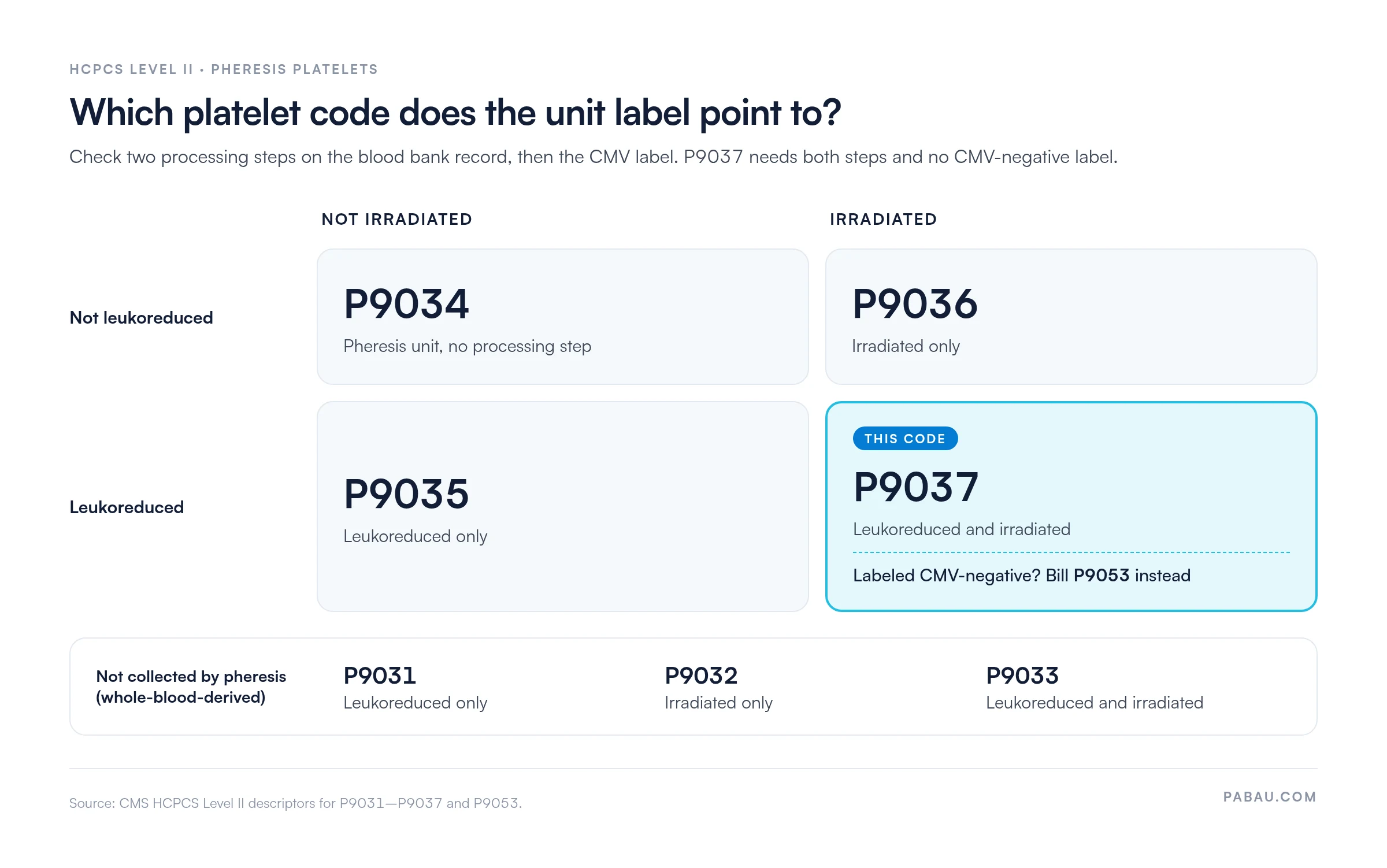
Three features define the product. It is collected by pheresis from a single donor, it is leukocyte-reduced, and it is irradiated. Remove either processing step, or add cytomegalovirus-negative (CMV-negative) status, and a different code applies. The grid below maps each combination to its code.
Pheresis (apheresis) platelet collection uses an automated machine to draw blood from a single donor, separate the platelets, and return the remaining components. The result is a single-donor platelet unit rather than a pool of whole-blood-derived platelets. Because the unit comes from one donor, the recipient is exposed to fewer donor antigens, which lowers alloimmunization risk.
Leukoreduction removes most white blood cells from the unit, either by filtration or during the pheresis collection itself. Under FDA and AABB standards, a leukoreduced pheresis platelet unit carries fewer than 5 × 10⁶ residual white cells. Fewer donor leukocytes lower the risk of febrile reactions, human leukocyte antigen (HLA) alloimmunization and CMV transmission.
Irradiation exposes the unit to gamma or X-ray radiation before transfusion. It damages the DNA of donor T-lymphocytes without meaningfully affecting platelet function. That stops those lymphocytes from multiplying in a susceptible recipient and causing transfusion-associated graft-versus-host disease (TA-GvHD). Leukoreduction alone does not prevent TA-GvHD, which is why some patients need both steps.
As the AAPC HCPCS code reference shows, the combination of processing steps sets the code. P9035 is leukoreduced only, P9036 is irradiated only, and P9037 carries both.
For billing, what matters is documentation: the blood bank must record that the unit was leukoreduced and irradiated, with the irradiation date and dose. Those records are the primary support for P9037 on audit or appeal.
Irradiated blood products are clinically indicated for patients at risk of TA-GvHD. The physician order must reflect the clinical reason for requesting an irradiated product. That reason must link to a supporting ICD-10-CM diagnosis code on the claim.
The physician’s transfusion order should state that an irradiated product is required, with the clinical rationale. Blood bank records should confirm that the unit dispensed was both leukoreduced and irradiated. If either piece is missing, the payer can deny the line even when the code is right.
The P-series platelet codes differ by collection method and by processing steps. Picking the wrong one leads to denials or post-payment recoupment. Match every processing step on the blood bank label against this table before submitting.
Common coding errors: One is billing P9037 for a unit whose blood bank record shows only one processing step. An irradiated-only unit is P9036, and a leukoreduced-only unit is P9035. Another is billing P9037 for a unit labeled CMV-negative, which belongs on P9053. Either way, the claim no longer matches the transfusion record, and payers flag that on audit.
P9037 is billed per unit, where one unit equals one leukoreduced, irradiated pheresis platelet unit as released by the blood bank. If a patient receives two units during a single transfusion encounter, report P9037 with a quantity of 2 on one claim line. Do not split them into two lines with a quantity of 1 each.
On facility claims using the UB-04, report P9037 with revenue code 0384 (platelets). Some hospitals charge only for processing a donated unit. They report the product under revenue code 0390 instead, per CMS and Medicare Administrative Contractor (MAC) guidance. Revenue code 0391 covers blood administration, so it belongs on the transfusion line, not the product line.
Confirm the revenue code against your MAC’s current billing guidance.
For outpatient hospital claims under the Outpatient Prospective Payment System (OPPS), blood products carry status indicator R and have their own Ambulatory Payment Classification (APC). They are paid separately from the transfusion procedure. Check the current rate in the latest OPPS Addendum B. Keep the blood bank release record with the claim file to support the units reported.
Medicare’s blood deductible applies only to whole blood and packed red cells, so it does not reduce payment on P9037. The transfusion administration service is billed separately with a CPT code. P9037 covers the blood product itself, not the act of infusing it. Billing both on the same claim is correct, because they are two distinct billable items.
Most P9037 claims need no modifier. JW and JZ are drug-wastage modifiers for single-dose drug containers, and Medicare does not require them on blood product P-codes. Leave them off the P9037 line.
Some payers require modifier BL (special acquisition of blood and blood products) on blood product lines. Add it only where that payer’s billing instructions call for it. Check your MAC’s current transmittals and your commercial contracts before billing, because an unexpected modifier can trigger a CO-4 denial.
The blood bank generates most of the records a P9037 claim needs, but coders should check the chart before the claim goes out. A clean claim submission for P9037 includes all of the following:
AABB (the Association for the Advancement of Blood & Biotherapies) sets the standards for blood bank documentation. Accredited facilities keep leukoreduction and irradiation records as a standard part of the transfusion service record. That makes pulling supporting documents for claims or appeals more straightforward.
Before the claim goes out, pull the transfusion order, leukoreduction record, irradiation record and administration record for each P9037 unit. Confirm the unit ID on each processing record matches the unit ID on the release record. A mismatch between unit identifiers can trigger a CO-16 denial (missing or invalid information) on an otherwise correct claim.
Medicare covers P9037 under OPPS for outpatient hospital claims when the transfusion is medically necessary. The documentation must also support the need for an irradiated product. Coverage follows CMS HCPCS guidance and any Local or National Coverage Determinations (LCDs or NCDs) that apply.
No blanket NCD covers all irradiated blood products, so check your MAC’s LCD database for jurisdiction-specific rules. To meet billing compliance requirements, verify the current LCD before submitting the first claim for a new patient population.
Commercial payers handle prior authorization for blood products inconsistently. Inpatient transfusions are typically covered under the DRG or case-rate payment without a separate authorization. Outpatient transfusions may need prior authorization from some commercial plans, particularly for repeat transfusions in high-cost groups like bone marrow transplant recipients.
Verify the plan’s requirements before the transfusion when possible, or at minimum before the claim is submitted.
Medicaid coverage for irradiated blood products varies by state program and managed care organization. Some states bundle blood product costs into the facility per-diem, while others reimburse them separately. Do not apply one state’s rules to another. Contact the state Medicaid program or managed care plan for its current coverage policy.
The table below pairs each common P9037 denial with its denial code and the pre-submission check that prevents it. Tracing each denial to its root cause is the first step in denial management workflows.
On appeal, send the leukoreduction and irradiation records, the physician order and the transfusion administration record as a single package. A complete package leaves the payer no open question about which product was transfused. Our guide to decoding denial codes explains each claim adjustment reason code (CARC) and what it means for an appeal.
The ICD-10-CM diagnosis code on a P9037 claim must reflect a condition for which irradiated blood products are clinically appropriate. Payers cross-reference the diagnosis against the product billed. A thrombocytopenia code alone (without a condition indicating immunosuppression or elevated TA-GvHD risk) is insufficient to justify an irradiated product over a standard pheresis platelet.
Use the NLM HCPCS code lookup to cross-reference code details, then pair with the appropriate diagnosis below.
These codes establish the patient’s risk category. Use them as primary or secondary diagnoses depending on the clinical context, and confirm that the attending or ordering physician’s documentation supports the coded condition. Coders should not select a diagnosis code for the sole purpose of justifying the blood product without an underlying clinical record to support it.
Blood product claims are often keyed by hand from blood bank paperwork into a separate billing system. Each P9037 line then needs a unit count, two processing flags and a diagnosis. A slip in any of them surfaces weeks later as a denial.
Pabau offers simpler claims management by submitting your insurance claims and tracking each one from a single screen. Your team can see which P9037 lines were paid, denied or returned for correction without logging in to separate payer portals.
Each patient’s claim history stays in one place. When an appeal is due, the original submission and its status are already on file. The coder starts from that record rather than rebuilding it.

Pabau submits and tracks your insurance claims and keeps each patient’s claim history in one place. Your team can follow every P9037 line from submission to payment.

P9037 is the right code only when the blood bank record shows a pheresis unit that was both leukoreduced and irradiated, with no CMV-negative label. If either processing step is missing, or CMV-negative status is added, a neighboring code applies. The label on the unit decides the code, so read it before you code the claim.
Make that check part of every claim. Compare the unit label, the leukoreduction record and the irradiation record against the code, and take units from the release record. It adds a minute per claim and keeps the claim aligned with the transfusion record if a payer audits it. For the wider billing picture, see Pabau’s overview of revenue cycle management.
Book a demo to see how Pabau submits and tracks blood product claims from submission to payment.

Need to understand denial codes in more depth? Denial codes in medical billing covers CARC reason codes and how to structure effective appeals.
Want to reduce claim rejections at submission? Clean claim submission explains the documentation and formatting standards that prevent CO-16 and CO-4 denials before they happen.
Looking for a medical billing fundamentals reference? Medical billing fundamentals covers the end-to-end billing workflow from charge capture through remittance posting.
Billing an irradiated unit that was not leukoreduced? HCPCS code P9036 covers irradiated pheresis platelets and the records that support them.
Were the platelets whole-blood-derived rather than pheresis? HCPCS code P9033 covers leukoreduced, irradiated platelets collected without pheresis.
HCPCS Code P9037 covers platelets collected by pheresis (apheresis) that are both leukocyte-reduced and irradiated, reported per unit. It covers the blood product only. The transfusion itself is billed separately with the applicable CPT administration code. Irradiated-only pheresis units are P9036, and leukoreduced-only pheresis units are P9035.
Both codes cover pheresis platelets that are leukocyte-reduced and irradiated. P9053 adds one more attribute: the unit is CMV-negative. If the blood bank label shows CMV-negative status, P9053 is the correct code. Billing P9037 for a P9053 unit creates a mismatch between the claim and the transfusion record that payers flag on audit.
There is no fixed per-encounter cap. Bill the number of leukoreduced, irradiated pheresis platelet units released and administered during the encounter, as documented by the blood bank release record. Report that quantity on a single claim line rather than stacking separate claim lines. The quantity must match the blood bank release record exactly.
Common pairings include Z94.81 (bone marrow transplant status), C81.90 (Hodgkin lymphoma), and C91.00 and C92.00 (acute leukemias). Others are D81.9 (combined immunodeficiency), D82.1 (DiGeorge syndrome) and P61.0 (neonatal thrombocytopenia in exchange transfusion contexts). The diagnosis code must reflect a condition for which irradiated products are clinically appropriate, not just a general thrombocytopenia code.



