HCPCS code P9058: Red blood cells, leukocytes reduced, CMV-negative, irradiated
HCPCS code P9058: Official descriptor and key attributes HCPCS code P9058 report...

Last Updated: Oct 26, 2026
P9036 is the HCPCS Level II code for platelets, pheresis, irradiated, each unit. It covers one bag of single-donor apheresis platelets that was irradiated before transfusion, with no leukoreduction step.
It belongs to the P9034-P9037 pheresis platelet family. P9035 covers leukoreduced units, and P9037 covers units that are both leukoreduced and irradiated. Payers treat each processing combination as a separate product, so the code has to match the blood bank record.
Let Pabau's smart automation suggest the right codes, reduce claim denials, and keep your practice compliant—effortlessly.
Automate repetitive tasks and focus on what matters most—your patients.
Reduce coding errors and ensure compliance with the latest regulations.
Clean claims, fewer denials, and faster reimbursements.
Powerful insights and reporting to help your practice thrive.
HIPAA compliant SOC 2 certified GDPR-compliant Trusted by 4,000+ clinics worldwide

P9036 covers irradiated apheresis (pheresis) platelets only, not pooled platelets and not units that were also leukoreduced.
Billing is per unit: one unit equals one apheresis platelet bag, so each bag transfused on a date of service is counted separately.
P9037 is the correct code when the product is both irradiated and leukoreduced, and billing P9036 for that unit causes a coding mismatch denial.
Every claim needs three documentation anchors: a physician order for irradiated platelets, the blood bank record, and a supporting ICD-10-CM diagnosis.
Pabau, the practice management platform we build, validates each claim before submission and shows the reason when a payer rejects one.
HCPCS code P9036 is a Level II code maintained by the Centers for Medicare & Medicaid Services. Its official descriptor is Platelets, pheresis, irradiated, each unit. It covers one bag of single-donor platelets that was irradiated before transfusion, with no leukoreduction step.
The code sits in the P9010-P9100 range, Blood and Blood Products, with Associated Procedures. Within that range, P9034 to P9037 form the pheresis platelet family that hospitals, transfusion centers, and blood suppliers bill from.
P9036 covers a single-donor platelet product collected by apheresis (also called pheresis or plateletpheresis) that has been irradiated before transfusion. Both parts matter for billing, because each one is a distinct processing step that maps to a specific code.
Apheresis collection: Pooled platelets combine donations from several whole-blood units. An apheresis platelet comes from a single donor, through a machine that separates the platelets and returns the remaining blood components. One apheresis collection typically yields the equivalent of four to six pooled platelet units.
Irradiation purpose: Gamma or X-ray irradiation prevents transfusion-associated graft-versus-host disease (TA-GvHD). This rare but frequently fatal complication happens when donor T-lymphocytes attack the recipient’s tissue. Irradiation inactivates those lymphocytes without affecting platelet function.
Irradiated platelets are indicated for patients at risk of TA-GvHD, including those who are:
The decision to irradiate rests on a physician order that specifies the irradiated product. That order is also the documentation anchor for the claim.
The most common coding error on apheresis platelet claims is billing P9036 for a unit that was also leukoreduced, or the reverse. Two questions about the blood bank record settle the code: was the unit irradiated, and was it leukoreduced?
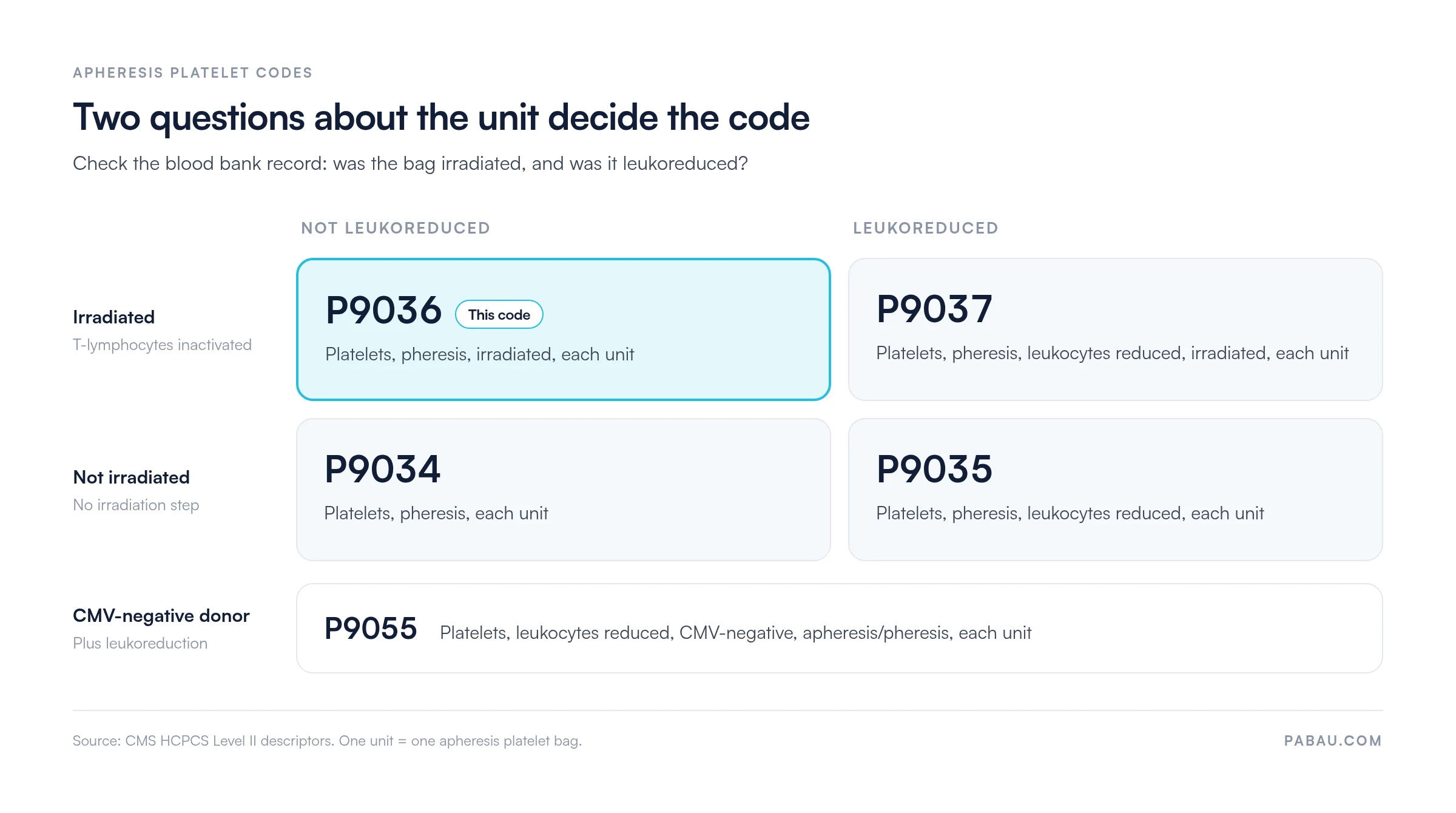
CMV-negative status adds a third variable. The table below sets P9036 beside the rest of the pheresis platelet family and P9055, the code for CMV-negative units.
The P9036 vs. P9037 decision is the highest-stakes selection point. If the blood bank record shows both irradiation and leukoreduction, P9037 is correct. Billing P9036 for a dual-processed unit undercodes the product, and a post-payment audit may flag it.
A unit that was leukoreduced but not irradiated takes P9035, and a CMV-negative leukoreduced unit takes P9055. Check descriptors in the AAPC HCPCS code range lookup before you submit a claim for any P90xx blood product.
HCPCS code P9036 is billed per unit, where one unit equals one apheresis platelet bag. If a patient receives three bags in one session, report P9036 with three units on the claim line.
P9036 is used in hospital outpatient (POS 22), inpatient (POS 21), and hospital-based transfusion center settings. Freestanding transfusion centers billing on a CMS-1500 use POS 11 or 49, depending on their classification. A POS that doesn’t match the claim type (837I vs. 837P) is a leading technical denial for blood product codes.
The hospital or facility that administers the transfusion typically bills P9036 on the UB-04 (837I) as part of the outpatient claim. When a blood supplier provides the product to a separate facility, billing arrangements vary by contract. CMS sets blood product payment each year under the hospital outpatient prospective payment system (OPPS).
Under Medicare OPPS, blood products including P9036 are grouped into an Ambulatory Payment Classification (APC). Payment rates are updated annually in the CMS OPPS final rule.
Verify the rate in that year’s OPPS Addendum B, because third-party guides can lag behind the latest update. Billing teams that run claims through medical billing software should review the P9036 charge whenever a new addendum publishes.
Before submitting P9036 on an OPPS claim, check your chargemaster against Addendum B for the current year. A stale chargemaster entry is one of the quietest revenue leaks in blood bank billing. The claim still pays, but at last year’s rate.
CMS assigns a Medically Unlikely Edit (MUE) to P9036, which sets the maximum units payable per date of service without additional documentation. MUE values for P-series blood codes are published in the CMS MUE tables, which are updated quarterly. Confirm the current value in the live file rather than a static reference.
An MUE denial does not mean the transfusion was clinically inappropriate. High-volume platelet support is common in oncology, transplant, and trauma settings. When a transfusion legitimately exceeds the MUE, the corrective path is:
MUE appeals are more likely to succeed when the documentation ties each unit to a specific clinical event. A platelet count below a defined threshold at a set time is one example, and a general diagnosis on its own is weaker evidence.
Modifier use with P9036 is narrower than with CPT procedure codes, but several modifiers apply in specific billing scenarios.
Modifier applicability varies by Medicare Administrative Contractor (MAC) and by commercial payer policy. Confirm the rules in your MAC’s local coverage policy before appending any modifier. Checking modifier requirements in advance is a core part of medical billing compliance for blood bank departments.
Medicare does not typically require prior authorization for blood product transfusions under OPPS. It treats them as covered services when medical necessity is documented in the patient record. Commercial payers and Medicaid programs take a different approach.
Commercial payers: Many commercial plans require prior authorization for irradiated blood products, particularly when the product is ordered on an outpatient basis. The diagnosis is often the trigger. A plan may cover irradiated platelets automatically for confirmed bone marrow transplant recipients but review less common immunodeficiency diagnoses separately.
Medicaid: Prior authorization requirements for P9036 vary significantly by state Medicaid program. Some states include blood products in a blanket covered-service category, while others require authorization per transfusion episode. Check the state Medicaid fee schedule or managed care organization before assuming coverage.
Clinical indicators payers require: Whatever the payer, the clinical record must document three elements:
Plans that request medical records on audit can deny a claim that lacks any of the three, even when the transfusion was clinically appropriate.
Strong documentation is what separates a payable P9036 claim from a denial. Blood product claims are audit-sensitive because they carry high per-unit costs and are frequently reviewed in post-payment audits.
When any of these elements is missing, the claim is technically incomplete, even if the transfusion was clinically necessary. The most effective prevention is a documentation checklist built into the blood bank release workflow, rather than chasing records at billing time. Submitting a clean claim starts at the point of care.
Flag the irradiation indication in the physician order at the time the transfusion is ordered, not retrospectively. Retrospective orders created to support billing are an audit red flag and may be excluded from review. Document the clinical reason for irradiation in the progress note on the same date of service.
Denials on P9036 claims cluster around a predictable set of errors. Fixing each root cause cuts denial volume without claim-by-claim review.
Denial management strategies for blood product codes work best when you track each root cause by claim adjustment reason code (CARC). A spike in one CARC across P9036 claims usually points to a workflow change or a payer policy update. Review the remittance advice denial codes to spot those patterns quickly.
Pairing P9036 with the correct ICD-10-CM diagnosis code completes the medical necessity argument for the claim. The codes below cover the main clinical scenarios for irradiated apheresis platelets, based on AABB standards and transfusion medicine practice. Verify them against the current ICD-10-CM tabular list, because codes are updated every fiscal year.
The more specific the ICD-10-CM code on the claim, the stronger the medical necessity argument. D84.9 (immunodeficiency, unspecified) will support the claim but is more likely to attract an audit request than Z94.81 or a specific lymphoma code. When the clinical record supports a more specific diagnosis, use it.
Many P9036 denials start with a claim that left the office incomplete. The platelet code may be wrong, a prior authorization number may be missing, or the unit count may not match the order. Billing teams usually find out weeks later, from a remittance advice.
Pabau, the practice management platform we build, raises each insurance claim from the patient’s invoice, so the units charged are the units billed. Claim validation catches missing or invalid details before submission. Prior authorization codes follow the appointment, so the number is already on the claim when it reaches your clearinghouse.
When a payer does reject a claim, Pabau shows the reason, so your team can correct it and resubmit. Every claim is tracked from Pending to Paid in one dashboard, which keeps your revenue cycle management out of spreadsheets.

Pabau validates each claim before it reaches your clearinghouse. When a payer rejects one, the reason sits on the claim, so your team can fix and resubmit it quickly.

Accurate P9036 billing comes down to one match: the code has to describe what the blood bank did to the unit. Irradiation alone is P9036, irradiation plus leukoreduction is P9037, and leukoreduction alone is P9035.
So start at the blood bank release, not at the billing desk. Capture the physician order, transfusion record, and diagnosis when the bag is issued. The claim then answers the payer’s medical necessity questions before they’re asked. A short checklist at release costs far less than weeks of appeal work later.
Book a demo to see how Pabau checks each blood product claim before it reaches the payer.

Want to see how electronic claims work? 837 file billing explains how HCPCS codes travel from your system to the payer through the 837P and 837I transaction formats.
HCPCS code P9036 covers platelets collected by apheresis from a single donor and irradiated to prevent transfusion-associated graft-versus-host disease. It is billed per unit. It does not cover pooled platelets, leukoreduced-only products (P9035), or units that received both irradiation and leukoreduction (P9037).
P9036 covers irradiation only, P9035 covers leukoreduction only, and P9037 covers both steps applied to the same product. Billing P9036 when the product is also leukoreduced undercodes the claim and may be flagged in a post-payment audit.
CMS assigns an MUE to P9036 that limits payable units per date of service. Confirm the current value in the live CMS MUE table, because it can change with each quarterly update. When a clinically justified transfusion exceeds the MUE, appeal with modifier 59 on the excess units. Include documentation that ties each unit to a distinct clinical event.
Medicare does not typically require prior authorization for P9036 under OPPS when medical necessity is documented. Commercial payers and some state Medicaid programs do, particularly for outpatient transfusions. Confirm the requirements with the payer before the transfusion is given.
Modifier JW applies when a unit is ordered but discarded before administration. Modifier 59, or an X-modifier, marks additional units over the MUE as distinct clinical events. Modifier GY may be used when the plan doesn’t cover the service and the patient needs a denial notice. Rules vary by MAC and payer, so confirm local policies before appending.
Yes. P9036 is billed in hospital outpatient settings (POS 22) under Medicare OPPS, as well as in inpatient and hospital-based transfusion center settings. The claim type (837I vs. 837P) must match the facility classification and place-of-service code to avoid a technical denial.