HCPCS Code T5999: Billing, Medicaid coverage, and documentation guide
HCPCS Code T5999 is the Level II code for a supply, not otherwise specified, bil...

Last Updated: Nov 24, 2026
HCPCS code P9050 is the Level II code for granulocytes, pheresis, each unit. It reports one bag of white cells, collected by apheresis, transfused to a neutropenic patient whose infection won't clear.
The code trips teams up for two reasons. Its neighbors are platelet and red cell codes, so a quick dropdown pick can land on the wrong product. Medicare's October 2026 OPPS file also lists P9050 with status indicator E2, meaning no OPPS payment rate. Getting the product, units and diagnosis right still protects the charge. Below, you'll see how the claim moves, what trips it up and what to check before you submit.
Let Pabau's smart automation suggest the right codes, reduce claim denials, and keep your practice compliant—effortlessly.
Automate repetitive tasks and focus on what matters most—your patients.
Reduce coding errors and ensure compliance with the latest regulations.
Clean claims, fewer denials, and faster reimbursements.
Powerful insights and reporting to help your practice thrive.
HIPAA compliant SOC 2 certified GDPR-compliant Trusted by 4,000+ clinics worldwide

HCPCS code P9050 reports one unit of granulocytes collected by pheresis, billed once for each unit transfused.
No code describes irradiated granulocytes, so CMS has hospitals report P9050 plus CPT 86945 when the unit is irradiated.
The October 2026 OPPS Addendum B gives P9050 status indicator E2, so it has no APC or OPPS payment rate.
A billing platform such as Pabau keeps blood product claims, supporting documents and denial follow-up together, so fixes happen before resubmission.
HCPCS code P9050 bills one unit of granulocytes collected by pheresis. The CMS HCPCS Level II code set describes it as “Granulocytes, pheresis, each unit,” in the P9010-P9100 blood and blood products range. It has been active since January 1, 2002, and each word in the descriptor changes how you bill it.
That irradiation rule comes from the Medicare Claims Processing Manual, chapter 4, section 231.5. When a specific code for the irradiated product exists, you use it. For granulocytes there isn’t one, so the irradiation goes on its own line.
Which patients get a P9050 unit? Usually a patient with severe neutropenia and a bacterial or fungal infection that hasn’t responded to antimicrobials. Think of a patient on chemotherapy for leukemia, or a stem cell transplant recipient waiting for counts to recover.
The product itself is unusual. A unit must be transfused quickly and expires within 24 hours of collection. Because it carries red cells, it also needs ABO compatibility and a crossmatch. Most blood banks order it from a supplier for a named patient, rather than keeping it on the shelf.
The evidence is mixed, too. The RING trial, published in Blood in 2015, found no overall benefit on its primary outcome. Payers know this, so the record has to show why this patient needed it.
P9050 covers the product only. Giving it is a separate service, reported with CPT 36430 for a standard transfusion. For a push transfusion in a child aged 2 or younger, use CPT 36440 instead.
P9050 describes one product. Its exclusions are the neighbors that look alike in a dropdown of HCPCS Level II codes.
Here’s the stretch of the range coders scroll through most. Descriptors come from the CMS October 2026 HCPCS file, and status indicators from the October 2026 OPPS Addendum B.
Notice the pattern. Every neighbor carries status R, the blood product indicator, with its own APC. P9050 stands alone with E2, which shapes how Medicare handles the line.
Status indicator E2 means CMS has no pricing information or claims data for the code. In practice, Medicare doesn’t pay an E2 line on an outpatient claim. CMS still lists P9050 among the codes it recognizes as blood products, though.
You still report the product. CMS requires a blood product HCPCS code whenever you bill a transfusion service code, and the transfusion pays once per day. The revenue codes follow the blood billing rules in chapter 4, section 231.
One quieter rule helps here. The Medicare blood deductible applies only to whole blood and packed red cells, so it doesn’t touch a granulocyte unit. Before your first P9050 claim of the year, ask your MAC how it wants the E2 line reported.
Hospital outpatient rates live in the OPPS Addendum B, which CMS refreshes each quarter, in January, April, July and October. The CMS Addendum A and B updates page is the place to check. The physician fee schedule lookup won’t help, because it covers professional services, not hospital blood products.
For P9050, the current file shows no rate at all. That makes three other figures matter more:
Pull the new Addendum B each quarter and compare the P9050 row. A status change from E2 would alter how you bill it.
Granulocytes treat infection in a patient without working neutrophils. So the claim needs a diagnosis for the neutropenia, plus a code for the infection itself. Codes below are from the FY2027 ICD-10-CM tabular list.
Then add the infection, such as a sepsis code from A41.- or a fungal code from B44.-. Check your MAC’s transfusion LCD for listed diagnoses, too, and review those lists each year.
A granulocyte claim gets read closely, partly because the product is rare. These are the records a reviewer will ask for:
Charge capture starts at the blood bank, so the billing office works from its records. Follow the same six steps on every claim and the lines stay consistent.
Put together, those steps produce the lines below. The supplier’s charge decides the P9050 lines, and the rest never change.
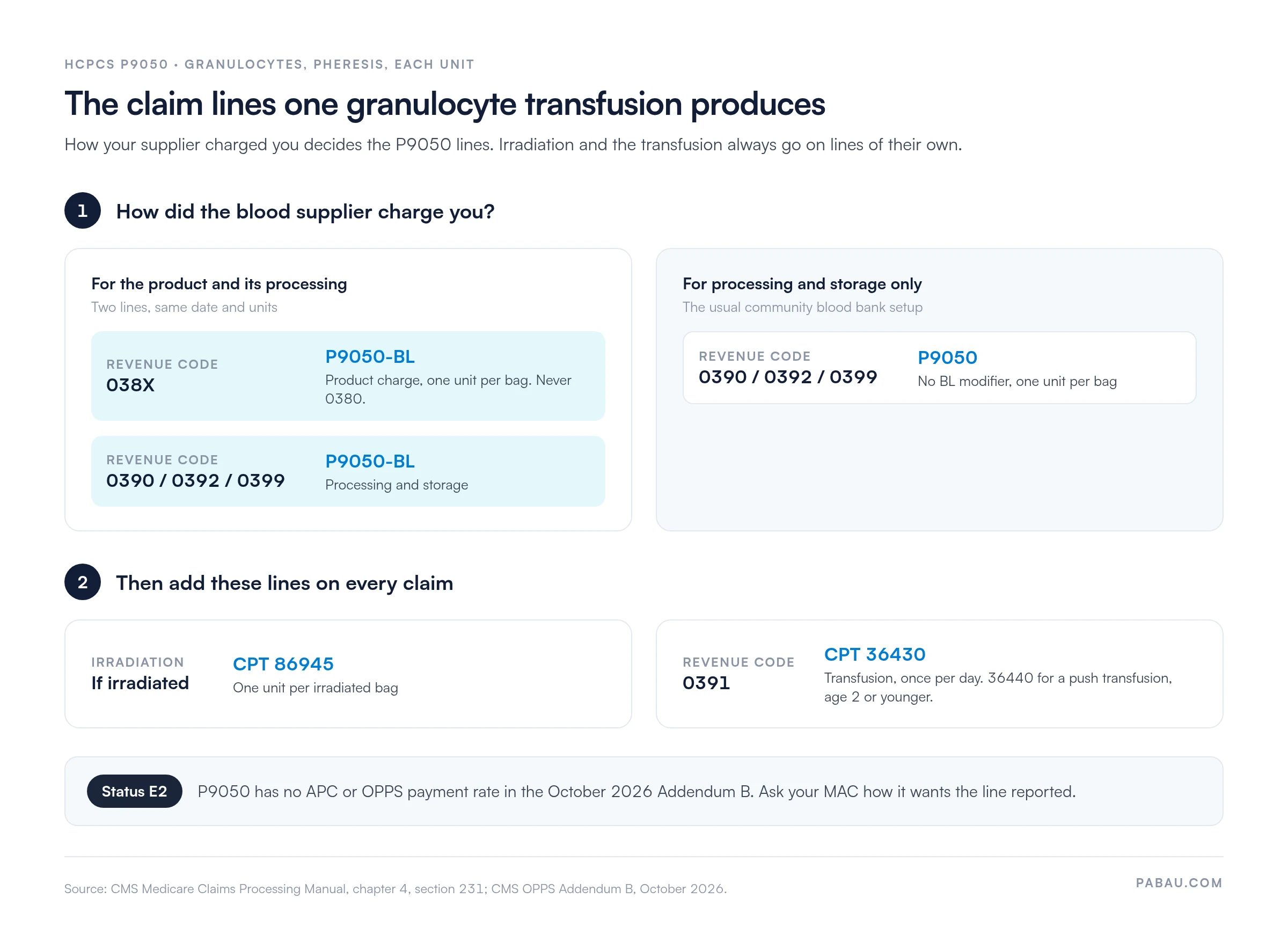
Worked example. A patient with acute myeloid leukemia is neutropenic after induction chemotherapy and has a fungal infection. She receives one irradiated granulocyte unit in the outpatient infusion unit. The supplier charged for the product and its processing.
The claim carries P9050-BL on a 038X line and again on a 0392 line, one unit each. It adds CPT 86945 for the irradiation and CPT 36430 on revenue code 0391. The diagnoses read D70.1, T45.1X5A, then the fungal infection code.
Run the claim through your clearinghouse edits last. A clean claim on the first pass saves a week of rework.
Most problems show up as a returned claim before any denial. The table pairs each cause with its usual signal and fix.
For Medicare, a redetermination must be filed within 120 days of receiving the initial determination. Attach the order, ANC, issue record and transfusion record together. Good denial management then logs the root cause, so the same mistake doesn’t repeat.
Do commercial plans follow the E2 status? No, they aren’t bound by OPPS status indicators. Many pay the unit under the contract, so check yours.
Is prior authorization needed? Rarely in time, since granulocytes are ordered for urgent infections. Notify the plan as soon as you can and keep the reference number.
Will they want the irradiation line? Some do, while others expect irradiation inside the product charge. Read the payer’s blood product policy before the first claim.
What if they deny on coverage? Ask for the medical policy they applied. Then answer its criteria point by point with the ANC, cultures and failed antimicrobials.
Blood product claims go wrong when the issue record, the order and the claim live in different places. Billers end up chasing paperwork after a claim has already come back.
Pabau, a practice management platform, brings the patient record, documents and claims together through its claims management software. Your team submits electronically, sees each claim’s status and works denials from one list. The supporting records are already attached when an appeal is due.

Pabau’s claims management links each claim to the patient record and its documents, then tracks status and denials in one place. Your team fixes problems before resubmitting.

P9050 is a small code with a short shelf life behind it. Treat it as its own product, never a variant of the platelet codes, and the hardest part is done.
The E2 status is the piece to watch. Confirm with your MAC how it wants the line reported, and recheck the Addendum B every quarter. Meanwhile, keep irradiation, transfusion and wastage on their own lines, backed by a record that shows why antimicrobials weren’t enough.
Book a demo to see how Pabau keeps transfusion claims, records and denial follow-up in one place.

Billing pheresis platelets instead? HCPCS code P9035 covers billing for leukocyte-reduced pheresis platelets.
Need the irradiated platelet code? HCPCS code P9037 explains billing for pheresis platelets that are both leukocyte reduced and irradiated.
Coding HLA-matched platelets for a refractory patient? HCPCS code P9052 walks through the HLA-matched apheresis platelet code.
Pairing the product with its administration code? CPT code 36430 covers the transfusion service billed alongside every blood product.
Working through CARC codes on a remittance? Denial codes in medical billing maps common denial codes to the fix each one needs.
It gives white cells to a patient with severe neutropenia and a bacterial or fungal infection that isn’t responding to treatment. It’s a bridge until the patient’s own counts recover.
They must be transfused within 24 hours of collection, and sooner is better. That’s why blood banks order them for a named patient instead of keeping stock.
Not under OPPS. The October 2026 Addendum B lists P9050 with status indicator E2, so it has no APC or payment rate. Report it anyway with the transfusion, and confirm the reporting with your MAC.
No. Medicare applies the blood deductible only to whole blood and packed red cells, so granulocyte units are outside it.
No national coverage determination addresses them. P9050 carries coverage code C in the HCPCS file, so each MAC decides coverage. Check your MAC’s transfusion LCD.