

CCSD code G5100: Bypass of duodenum billing guide
CCSD code G5100 bills a bypass that leaves the duodenum in place CCSD code G5100...

Last Updated: Oct 16, 2026
P9035 is the HCPCS Level II code for platelets, pheresis, leukocytes reduced, each unit.
Choosing P9035 turns on how the platelets were collected and processed. Leukoreduced pheresis platelets that are also irradiated take P9037, and leukoreduced red blood cells are a separate product billed under P9016. The transfusion itself is billed separately, usually with CPT 36430.
Let Pabau's smart automation suggest the right codes, reduce claim denials, and keep your practice compliant—effortlessly.
Automate repetitive tasks and focus on what matters most—your patients.
Reduce coding errors and ensure compliance with the latest regulations.
Clean claims, fewer denials, and faster reimbursements.
Powerful insights and reporting to help your practice thrive.
HIPAA compliant SOC 2 certified GDPR-compliant Trusted by 4,000+ clinics worldwide

HCPCS code P9035 bills one unit of apheresis platelets that have been leukocyte reduced, and each apheresis bag counts as one claim unit.
P9035 is a platelet code, not a red cell code. Leukoreduced red blood cells are billed under P9016.
Leukoreduced pheresis platelets that are also irradiated take P9037, and CMV-negative, HLA-matched, and pathogen-reduced units each have their own code.
In the July 2026 OPPS Addendum B, P9035 carries status indicator R and APC 9501, with a national unadjusted rate of $511.59 per unit.
Pabau, the practice management platform we build, submits and tracks claims and posts remittances, while your coders keep ownership of code selection.
HCPCS code P9035 is the Level II code for platelets, pheresis, leukocytes reduced, each unit. The Centers for Medicare and Medicaid Services (CMS) maintains it among the HCPCS Level II codes for blood and blood products (P9010-P9100). In practice, it bills the platelet product itself, one apheresis unit at a time.
“Pheresis” means an apheresis machine collected the platelets from a single donor, instead of pooling them from several whole blood donations. “Leukocytes reduced” means most of the donor white cells were removed, usually by filtration during or after collection. In other words, each apheresis bag the patient receives is one unit on the claim.
P9035 never covers the transfusion service. The hospital reports that on its own line, usually with CPT 36430. However, readers who came here for leukoreduced red blood cells need a different code, HCPCS code P9016.
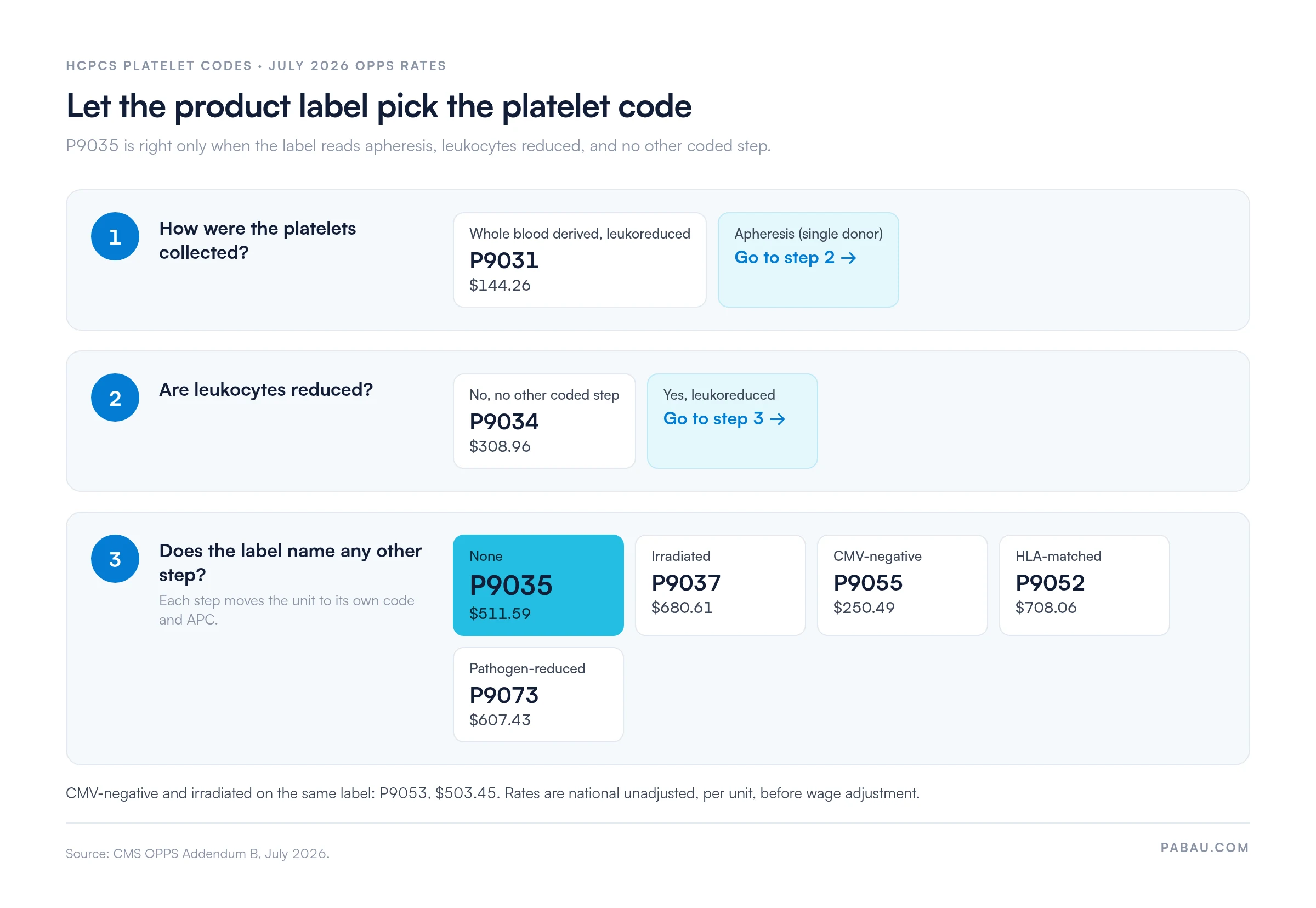
P9035 covers single-donor apheresis platelets that are leukoreduced and have no other coded processing step. In contrast, once a unit is also irradiated, tested CMV-negative, HLA-matched, or pathogen-reduced, it moves to a more specific code. In short, three questions about the product label settle which one applies.
Ordering physicians choose leukoreduced platelets to lower three transfusion risks. As a result, billers should expect to see one of them in the chart when a payer asks why the product was needed.
The most expensive P9035 error is billing it for a unit that went through another processing step. Each step has its own code and its own APC, so the payment moves with the code. The table below shows the platelet family with each code’s July 2026 OPPS national unadjusted rate.
Rates come from the CMS OPPS Addendum B for July 2026 and are wage-adjusted on the claim. The table shows why the product label matters. In fact, a mistaken code can pay hundreds of dollars more or less than the unit the patient received.
Irradiation causes the most confusion. When a specific code for the irradiated product exists, the Medicare Claims Processing Manual, Chapter 4, section 231.5 says to bill that code. An irradiated leukoreduced pheresis unit is therefore P9037 alone, never P9035 plus CPT 86945.
Likewise, a rapid bacterial test on a platelet unit is a separate service. It is reported with P9100 (pathogen test for platelets), which has its own APC and does not change the product code.
Payers judge medical necessity from the chart, and for platelets the chart usually centers on the platelet count. The 2025 AABB and ICTMG platelet transfusion guidelines set restrictive thresholds for common scenarios:
These thresholds guide clinical decisions, and they are not payer coverage rules. Even so, they shape what an auditor expects to find. For example, a transfusion given above the relevant threshold needs a written reason, such as active bleeding or a planned procedure.
In hospital outpatient departments, Medicare pays P9035 under the Outpatient Prospective Payment System (OPPS). Status indicator R marks it as a blood product paid through its own APC, 9501. The July 2026 national unadjusted rate is $511.59 per unit, with a minimum unadjusted copayment of $102.32.
P9035 is not on the Medicare Physician Fee Schedule, so an MPFS lookup returns no rate for it. Also, OPPS rates change each January, with quarterly addenda in between. For that reason, check the current Addendum B before you update the chargemaster.
During an inpatient stay, the cost of platelets is bundled into the MS-DRG payment under the inpatient prospective payment system. However, the separate APC payment for P9035 applies only to outpatient transfusions.
The Medicare blood deductible covers only whole blood and packed red cells. Platelets fall outside it, so a P9035 unit never counts toward the patient’s annual three-pint deductible.
Medicaid programs and commercial plans set their own blood product rates and rules. Some follow the OPPS structure, while others pay from a negotiated fee schedule. Pull each payer’s outpatient blood products policy before the first P9035 claim, and confirm whether it asks for prior authorization.
A clean P9035 claim links four pieces: the product line, the transfusion line, the unit count, and a diagnosis that supports the transfusion. Chapter 4, section 231 of the Medicare Claims Processing Manual sets the rules for each one.
The revenue code depends on what the hospital paid for. In most cases, hospitals get platelets from a community blood bank that charges only for processing and storage.
The outpatient code editor returns a claim that carries a 038X blood line without the matching processing line. Also, revenue code 0380 is not valid for Medicare billing.
Bill the transfusion under revenue code 0391 with CPT 36430 (transfusion, blood or blood components). A push transfusion for a patient two years or younger uses CPT 36440. Both map to APC 5241 at $450.73 in July 2026. In addition, Medicare pays the transfusion APC once per day, however many units or products were given.
A transfusion code needs a blood product code on the claim to be paid. Therefore, report P9035 and the transfusion CPT code on the same claim, with the same date of service.
Each apheresis bag is one unit. If the blood bank splits a unit and part goes to this patient, bill P9011 (blood split unit) instead of P9035. Add CPT 86985 for each split prepared for that patient, and report split platelets under revenue code 0384.
Modifier BL is the one Medicare requires, and only on purchased blood lines. By contrast, the JW and JZ modifiers are drug-waste modifiers for single-dose drug containers. They are not used on blood product lines.
The ICD-10-CM codes should explain why the patient needed platelets. Common choices include:
Pick the most specific code the chart supports, because a payer that questions the leukoreduced product will look for the clinical reason in the order or the transfusion note.
The blood bank issue record is the source of truth for the product code. Before a P9035 claim goes out, the record set should show:
Cross-check the label against the claim line at the point of billing. For example, a label that also reads “irradiated”, “CMV negative”, or “pathogen reduced” points to a different code.
P9035 denials follow common patterns. In fact, most trace back to a mismatch between the label, the chargemaster, and the claim line. The table maps each trigger to its fix, and denial management in healthcare covers the wider workflow.
A clean claim for P9035 has the label, the code, and the unit count in agreement. Also, filter your remittances by adjustment reason code each month. If the same denial keeps hitting blood product lines, the fix usually belongs in the chargemaster.
Blood product denials usually start upstream of billing. The order, the issue record, and the claim line each describe the unit, and a payer rejects the claim when they disagree. As a result, chasing those denials by hand costs a billing team hours each month.
Pabau builds each claim from details already saved in the patient record, so fewer fields get retyped. In addition, its claims management software submits and tracks claims through Claim.MD in the US and posts remittances back against each claim.
However, your coders still choose the code and confirm coverage with the payer. When a denial lands, the team sees which claims it hit and resubmits from the same record, so a repeated error gets fixed once.

Pabau submits and tracks claims, posts remittances, and shows which claims a denial hit, so your team can correct and resubmit from the same record.

Above all, let the product label choose the code. If it reads apheresis platelets, leukocytes reduced, and nothing more, P9035 is right. Irradiation, CMV-negative testing, HLA matching, or pathogen reduction each move the unit to its own code, and the payment moves with it.
The work sits in the chargemaster more than on each claim. Map every label your blood supplier ships to its P-code once, and review the map when a new product arrives. In this way, that single step heads off most wrong-code denials.
Book a demo to see how Pabau keeps blood product claims tracked from submission to remittance.

Billing whole-blood-derived platelets instead? HCPCS code P9031 covers leukoreduced platelets made from whole blood donations.
Looking for the leukoreduced red cell code? HCPCS code P9016 explains how to bill red blood cells, leukocytes reduced.
Need a framework for working denials? Denial management in healthcare covers root-cause analysis and resubmission workflows.
Want to read remittances faster? Electronic remittance advice explains how to read 835 files and spot denial patterns.
Building a compliance checklist for your coders? Medical billing compliance outlines the documentation standards that reduce audit exposure.
HCPCS code P9035 is the Level II code for platelets, pheresis, leukocytes reduced, each unit. It bills one bag of leukoreduced apheresis platelets. The transfusion itself is billed separately, usually with CPT 36430.
No. P9035 describes apheresis platelets. Leukoreduced red blood cells are billed with P9016, and plain red blood cells with P9021.
Both describe leukoreduced apheresis platelets, but P9037 units are also irradiated. Bill an irradiated unit as P9037 alone, without adding CPT 86945 for the irradiation.
In the July 2026 OPPS Addendum B, P9035 has status indicator R and APC 9501. The national unadjusted rate is $511.59 per unit before wage adjustment. Check the current addendum, since rates change.
When the hospital pays only for processing and storage, use revenue code 0390, 0392, or 0399. When it also buys the product, add a 0384 line, with modifier BL on both lines.
No. JW and JZ are drug-waste modifiers for single-dose drug containers. Blood products such as P9035 do not use them, though purchased blood lines carry modifier BL.



